
Discover 25 easy coloring ideas for school students, including animals, flowers, school objects, landscapes, patterns, and fun classroom activities.
Easy Coloring Ideas for School Students: Simple Pictures to Color
Coloring is a fun and creative activity that helps school students explore colors, practise careful hand movements, and express their ideas through art. From simple flowers and cute animals to school objects and nature scenes, there are many easy pictures that students can color at home or in the classroom.
You do not need expensive art supplies or advanced drawing skills to get started. A simple outline, a few coloring pencils or crayons, and some imagination are enough to create an attractive picture.
In this guide, you will discover easy coloring ideas for school students, beginner-friendly themes, classroom coloring activities, and practical tips for making every coloring project more enjoyable.
Why Is Coloring Good for School Students?
Coloring is more than filling a picture with different shades. It gives students an opportunity to practise useful creative skills.
- Color recognition: Students learn to identify colors and notice how different shades look together.
- Hand control: Staying within an outline helps students practise controlled pencil and crayon movements.
- Creativity: Students can experiment with their own color combinations instead of copying every detail.
- Observation: Coloring familiar objects encourages students to notice shapes, patterns, and details.
- Patience and focus: Completing a picture encourages students to work carefully and pay attention to a task.
- Art confidence: Simple projects give beginners a comfortable way to explore art without worrying about perfection.
The experience should remain enjoyable. Students can use their imagination and choose different colors rather than feeling that every picture must look exactly the same.
25 Easy Coloring Ideas for School Students
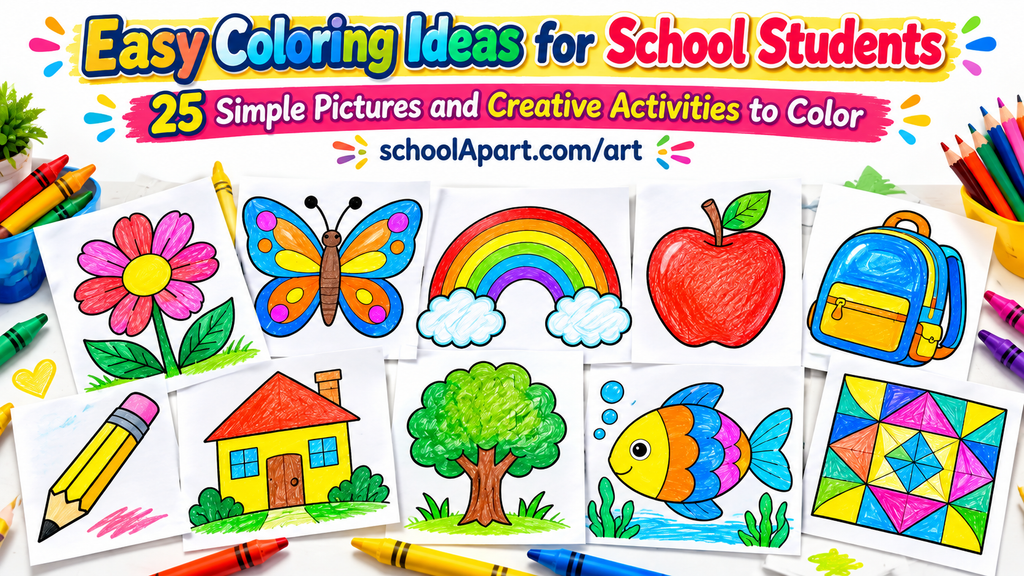
Here are 25 beginner-friendly ideas that work well for home practice, school art periods, and creative activities. Choose a subject based on the student’s age, drawing ability, and available time.
1. Flower Coloring
Draw a simple flower with five or six large petals, a circular center, a stem, and two leaves.
Coloring idea: Use yellow for the center, pink or purple for the petals, and green for the stem and leaves. Students can also experiment with different colors for each petal.
Skill to practise: Coloring curved shapes and combining colors.
2. Butterfly Coloring
A butterfly is a good subject for practising patterns and color combinations. Begin with a simple outline and two large wings.
Coloring idea: Use two or three colors and repeat similar patterns on both wings. Students can choose bright colors or create a soft pastel effect.
Skill to practise: Symmetry, pattern recognition, and color balance.
3. Tree Coloring
Draw a simple tree with a trunk, branches, and a rounded leafy top.
Coloring idea: Use brown for the trunk and different shades of green for the leaves. Add a little yellow or orange to show sunlight or changing leaf colors.
Skill to practise: Coloring larger areas and adding simple color variations.
4. Fruit Basket Coloring
Draw a basket containing simple fruits such as apples, bananas, grapes, and oranges.
Coloring idea: Use red or green for apples, yellow for bananas, purple or green for grapes, and orange for oranges.
Skill to practise: Recognizing objects and choosing suitable colors.
5. Cute Animal Coloring
Start with easy animal shapes, such as a cat, rabbit, turtle, fish, or bird.
Coloring idea: Use natural-looking colors or invent a playful color scheme. For a turtle, students can color the shell with alternating patterns.
Skill to practise: Coloring small shapes and adding simple details.
6. Rainbow Coloring
Draw a large rainbow with broad, evenly spaced bands.
Coloring idea: Use the familiar rainbow sequence of red, orange, yellow, green, blue, indigo, and violet. Younger students can use fewer broad bands if that is easier.
Skill to practise: Following an order and coloring parallel curved sections.
7. Sun and Cloud Coloring
Create a simple picture with a sun, a few clouds, and a horizon line.
Coloring idea: Use yellow or orange for the sun and light blue for the sky. Keep the clouds white or add very light blue shading.
Skill to practise: Working with large shapes and contrasting colors.
8. Mountain Landscape Coloring
Draw two or three overlapping mountains, a sky, and a small area of land.
Coloring idea: Use blue, green, violet, or brown for the mountains. Different shades can help separate the distant mountains from the foreground.
Skill to practise: Coloring overlapping shapes and creating a sense of distance.
9. Fish and Underwater Scene
Draw a large fish with a few bubbles, seaweed, and small stones.
Coloring idea: Use contrasting colors for the fish and simple repeating patterns on its body. Color the water light blue or turquoise.
Skill to practise: Combining curved lines, small details, and patterns.
10. Bird on a Branch
Draw a simple bird sitting on a branch with a few leaves.
Coloring idea: Choose one main color for the bird and a second color for small details. Use brown for the branch and green for the leaves.
Skill to practise: Coloring a small subject without making the picture too crowded.
11. School Bag Coloring
Draw a school bag with pockets, straps, and a simple design.
Coloring idea: Choose a main color for the bag and a contrasting color for the pockets or straps. Add simple shapes such as circles or stars for decoration.
Skill to practise: Coloring geometric shapes and keeping edges neat.
12. Books and Pencils
Draw a small stack of books beside a pencil, ruler, and eraser.
Coloring idea: Give each book a different cover color. Use a natural wood color for the pencil and a contrasting shade for the eraser.
Skill to practise: Coloring straight-edged objects and small details.
13. Classroom Coloring Scene
Create a simple classroom picture with a board, desk, books, and a clock.
Coloring idea: Use different colors for classroom objects while keeping the background relatively simple.
Skill to practise: Working with several objects in one composition.
14. House and Garden Coloring
Draw a small house with a roof, windows, a door, and a garden.
Coloring idea: Choose a roof color, a contrasting wall color, and green for the garden. Add flowers or a pathway if there is enough space.
Skill to practise: Coloring a complete scene with several related objects.
15. Bicycle Coloring
Draw a bicycle using two circles, a frame, a seat, and handlebars.
Coloring idea: Use one main color for the frame and darker shades for the tyres. Keep the background simple so the bicycle remains the focus.
Skill to practise: Coloring outlines, circles, and narrow spaces.
16. Boat on a Lake
Draw a simple boat floating on calm water, with hills or clouds in the background.
Coloring idea: Use brown or another color for the boat, blue for the water, and soft shades for the sky.
Skill to practise: Coloring horizontal areas and separating foreground from background.
17. Butterfly Garden
Combine flowers, leaves, butterflies, and a few small stones in one picture.
Coloring idea: Use a limited palette of three or four main colors to make the picture look coordinated.
Skill to practise: Repeating colors across several objects.
18. Garden Vegetables
Draw simple vegetables such as carrots, tomatoes, eggplants, and leafy greens.
Coloring idea: Use orange for carrots, red for tomatoes, purple for eggplants, and green for leaves.
Skill to practise: Connecting familiar objects with their usual colors while exploring alternatives.
19. Cup and Plate Coloring
Draw a cup, a plate, and a spoon on a table.
Coloring idea: Decorate the cup with stripes, dots, or simple geometric patterns. Use a light background to make the objects stand out.
Skill to practise: Coloring everyday objects and adding decorative details.
20. Rocket in Space
Draw a simple rocket with large fins, circular windows, stars, and planets.
Coloring idea: Use two main colors for the rocket and contrasting colors for the planets. A dark blue or purple background can represent space.
Skill to practise: Coloring enclosed shapes and balancing bright colors against a dark background.
21. Hot Air Balloon
Draw a large balloon with several curved sections and a small basket underneath.
Coloring idea: Alternate two or three colors between the sections. Keep the basket a different color from the balloon.
Skill to practise: Repeating patterns and maintaining color consistency.
22. Simple Robot Coloring
Draw a friendly robot using rectangles, circles, and squares.
Coloring idea: Use a few coordinated colors for the body, eyes, buttons, and arms. Students can invent their own robot design.
Skill to practise: Coloring geometric shapes and creating a personal design.
23. Geometric Pattern Coloring
Create a page filled with circles, triangles, squares, zigzags, and repeating lines.
Coloring idea: Repeat the same color every few shapes, or create a pattern that moves from light colors to dark colors.
Skill to practise: Pattern recognition, neat coloring, and color repetition.
24. Leaf and Nature Pattern
Draw different leaves, small branches, and simple natural shapes across the page.
Coloring idea: Use several shades of green, with small touches of yellow, orange, or brown.
Skill to practise: Observing natural shapes and experimenting with shades.
25. Mandala-Inspired Geometric Design
Create a simple symmetrical design using circles, petals, dots, and repeated geometric shapes.
Coloring idea: Choose a small palette and repeat the same color pattern around the design.
Skill to practise: Symmetry, repetition, and careful coloring.
For younger students, keep the design large and simple. More detailed patterns are better suited to students who already enjoy working with small spaces.
Easy Coloring Ideas by Class Level
Students develop different levels of hand control and artistic confidence as they grow. The following suggestions can help you choose suitable activities.
For Nursery, LKG, and UKG
Choose pictures with large outlines and only a few sections.
Suitable ideas include:
- Large flowers
- Simple fruits
- Sun and clouds
- Basic shapes
- Large fish
- Balloons
- Simple animals
Encourage students to recognize colors and explore the movement of crayons or pencils. Staying perfectly inside every outline should not be the main goal.
For Classes 1–3
Students can try pictures with more objects and slightly smaller sections.
Suitable ideas include:
- Butterflies with wing patterns
- Fruit baskets
- Trees and gardens
- School bags and books
- Houses with gardens
- Simple vehicles
- Rainbow landscapes
Introduce simple color combinations and encourage students to finish one section at a time.
For Classes 4–5
Students can experiment with more detailed pictures and planned color schemes.
Suitable ideas include:
- Mountain landscapes
- Underwater scenes
- Space pictures
- Geometric patterns
- Nature compositions
- Still-life arrangements
- Detailed school scenes
Encourage students to think about contrast, foreground and background, and the way colors work together.
These are flexible suggestions, not strict age limits. Choose activities according to individual ability and interest.
Coloring Activities for School and Classroom
Coloring can also become a group learning activity instead of an individual exercise.
1. One Picture, Different Colors
Give students the same simple outline and ask each student to choose a different color scheme.
Compare the results and discuss how color choices change the appearance of a picture.
2. Complete the Pattern
Provide a row of shapes or a repeating design. Students choose a color pattern and continue it consistently.
This activity combines coloring with basic pattern recognition.
3. Nature Color Hunt
Ask students to observe safe, familiar natural objects, such as leaves, flowers, and stones. They can then create a picture using colors they noticed.
Remind students not to pick plants or touch unfamiliar objects without permission.
4. Classroom Art Display
Invite students to color the same theme, such as trees, houses, or underwater scenes. Display the completed pictures together to show different approaches to the same subject.
5. Design Your Own Picture
Ask students to draw a simple object or scene, then color it using their own choices.
This activity encourages creativity rather than relying entirely on a ready-made outline.
How to Choose Colors for a Coloring Picture
Choosing colors becomes easier when students follow a few simple principles.
Start with the Main Subject
Identify the main object first. Decide which color will make it stand out from the background.
For example, a yellow flower can stand out against green leaves, while a brightly colored fish can stand out against a lighter blue background.
Use a Small Color Palette
Three to five main colors are often enough for a simple picture. Using fewer colors can help the finished work look coordinated.
Try Light and Dark Shades
Use a lighter shade for some areas and a darker shade for others. Even a simple change in shade can make a flat shape look more interesting.
Experiment with Contrasting Colors
Some colors look more noticeable when placed beside contrasting colors. Students can experiment with blue and orange, or purple and yellow, to see how the relationship changes the picture.
Remember That Creativity Matters
Objects do not always need to be colored realistically. A purple tree or a blue flower can be part of an imaginative artwork. The aim is to explore colors thoughtfully and enjoy the process.
For more guidance, read SchoolApart’s Colour Theory Explained and Color Mixing for Beginners.
Simple Tips for Neat and Beautiful Coloring
- Start with clean hands and a suitable drawing surface.
- Choose coloring pencils or crayons that are comfortable to hold.
- Begin with larger areas before moving to small details.
- Use gentle, even strokes rather than pressing too hard immediately.
- Follow the outline where possible, but do not worry about every small mistake.
- Keep similar colors together if you are using several pencils or crayons.
- Avoid adding too many colors to a small picture.
- Take short breaks when your hand feels tired.
- Keep the finished picture somewhere safe so it does not become creased or damaged.
Different tools create different effects. Crayons are convenient for broad areas, while colored pencils are useful for smaller sections and more controlled shading.
If you are choosing materials, see Colored Pencils vs Crayons vs Markers: Which Is Best for Beginners?.
How to Make Your Own Coloring Practice Routine
A short, regular coloring session can help students develop confidence.
Try this simple routine:
- Choose a picture: Select a subject that matches your current skill level.
- Plan your colors: Pick a few colors before starting.
- Color the large areas: Work on the main parts of the picture first.
- Add small details: Finish with patterns, outlines, or small sections.
- Review your work: Notice one thing you like and one thing you want to practise next time.
Students can repeat the same picture using a different color scheme. This makes it easier to compare ideas and learn how different colors affect the final result.
Easy coloring activities give school students a practical way to explore art, practise hand control, and develop their own creative ideas. Simple subjects such as flowers, animals, school objects, landscapes, and geometric patterns provide plenty of opportunities to learn.
Start with pictures that have clear outlines and large spaces. As confidence grows, move on to more detailed scenes and patterns.
Most importantly, let students make their own choices. Coloring is not only about producing a neat picture; it is also about experimenting, observing, and enjoying the process of creating art.
FAQs
1. Frequently Asked Questions
1. What are some easy coloring ideas for school students?
Flowers, butterflies, fruits, animals, rainbows, school bags, books, houses, landscapes, and geometric patterns are all easy subjects for school students.
2. Which coloring activities are suitable for Nursery, LKG, and UKG?
Large flowers, simple fruits, basic shapes, balloons, clouds, and easy animal pictures are good starting points because they have large spaces and simple outlines.
3. What can students color for a school art activity?
Students can color nature scenes, school objects, animals, landscapes, geometric patterns, or classroom-themed pictures. The choice can depend on the lesson and the student’s skill level.
4. Which coloring tools are best for school students?
Crayons are convenient for broad areas, while colored pencils offer more control for small details. Washable markers may also be suitable when used according to their instructions.
5. How can students make their coloring look neat?
Start with larger areas, use gentle strokes, work carefully near outlines, and add small details at the end. Practice matters more than perfect results.
6. How many colors should beginners use?
Three to five main colors are often enough for a simple picture. Students can gradually experiment with more colors as they gain confidence.
7. Are coloring activities useful for classroom learning?
Yes. Teachers can use coloring activities to encourage creativity, color recognition, pattern practice, and observation. Activities should be adapted to the students’ needs and abilities.
8. What are some easy nature coloring ideas?
Flowers, trees, leaves, butterflies, birds, mountains, gardens, and underwater scenes are useful nature-inspired subjects.
9. How can students practise color combinations?
Students can color the same outline several times using different color schemes. They can also practise complementary colors, light and dark shades, and repeating color patterns.
10. How can teachers make coloring activities more creative?
Give students the same outline but let them choose their own colors. Another option is to ask them to design their own picture or create a repeating pattern.
11. Do students always need to use realistic colors?
No. Realistic colors help with observation, but imaginative colors encourage creative expression. A student can choose unusual colors when the activity allows it.
12. How often should students practise coloring?
Students can practise whenever it fits their schedule. Short, enjoyable sessions are often easier to maintain than long activities that cause fatigue.
Leave a Reply