
Compare colored pencils, crayons, and markers to find the best coloring tool for beginners, school students, detailed drawings, and art projects.
Colored Pencils vs Crayons vs Markers: Which Is Best for Beginners?
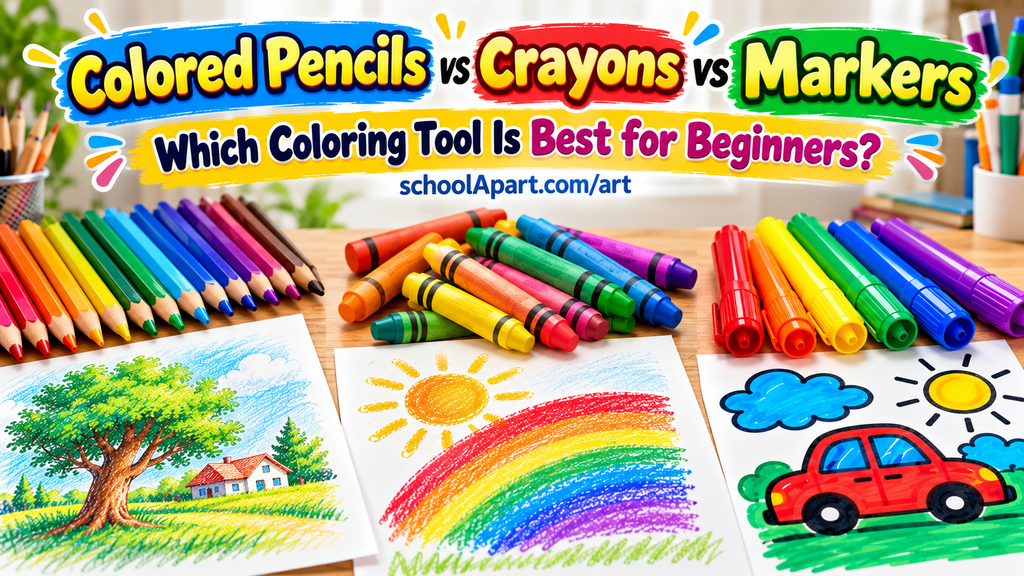
Colored pencils, crayons, and markers are three popular coloring tools for school students and beginner artists. All three can make drawings colorful, but they produce different results and work better for different purposes.
Colored pencils are useful for detailed coloring and controlled shading. Crayons are easy to hold and suitable for broad, playful coloring. Markers produce bold, vibrant colors and can cover areas quickly.
So, which one should you choose? The best option depends on your age, drawing style, the type of paper you use, and the results you want.
Colour Theory Explained: A Complete Beginner’s Guide to Understanding Colors
In this guide, you will learn the differences between colored pencils, crayons, and markers, their advantages and disadvantages, and how to choose the right coloring tool for your needs.
What Are Colored Pencils?
Colored pencils are drawing and coloring tools that contain colored pigment inside a pencil-shaped casing. They allow you to apply color with a pointed tip, making them useful for both detailed work and larger areas.
Colored pencils are available in different formulations, including wax-based and oil-based varieties.
Advantages of Colored Pencils
- Good for details: Their pointed tips help you color small shapes, patterns, and outlines.
- Controlled application: You can gradually build color by changing pencil pressure.
- Useful for shading: Layering different colors can create depth and tonal variation.
- Easy to carry: They are compact and convenient for school bags.
- Less messy: They generally do not spill or leak like liquid coloring materials.
Disadvantages of Colored Pencils
- Coloring large areas can take time.
- Heavy pressure may leave visible marks or damage the paper surface.
- Some pencils need frequent sharpening.
- Smooth, intense coverage may require several layers or higher-quality pencils.
Best Uses for Colored Pencils
Colored pencils are particularly useful for:
- Detailed drawings
- Nature illustrations
- Small patterns and designs
- Shading and color blending
- School art assignments that need precision
What Are Crayons?
Crayons are solid coloring tools commonly made from wax or other suitable coloring materials. They are easy to grip and allow children to fill shapes with broad, colorful strokes.
Traditional wax crayons are especially common in early childhood classrooms, while other types of crayons may have different textures and properties.
Advantages of Crayons
- Easy to hold: Their thicker shape can be comfortable for young children.
- Simple to use: They do not require sharpening in the same way as colored pencils.
- Good for broad coloring: Crayons can cover large shapes with repeated strokes.
- Durable for classroom use: They have no liquid ink that can spill.
- Useful for creative exploration: Children can experiment with pressure, overlapping colors, and simple textures.
Disadvantages of Crayons
- Small details can be difficult because the tips are usually thicker.
- Wax buildup can create an uneven surface.
- Colors may look less precise than marker colors or carefully layered pencil colors.
- Some crayons can break under excessive pressure.
- Wax crayons may not be suitable for every type of paper or art technique.
Best Uses for Crayons
Crayons are useful for:
- Preschool and early school activities
- Large coloring shapes
- Simple drawings
- Classroom art projects
- Creative activities that emphasize exploration over fine detail
What Are Markers?
Markers are coloring tools that deliver ink or another coloring medium through a porous tip. They are available in different tip shapes, sizes, and ink formulations.
Some markers are water-based, while others are alcohol-based or use different specialized inks. Their performance depends on the product type.
Advantages of Markers
- Bright colors: Many markers produce bold, visually striking results.
- Fast coverage: Broad tips can color large areas quickly.
- Clear lines: Fine-tip markers can create outlines and small details.
- Different tip options: Brush, bullet, chisel, and fine tips support different techniques.
- Useful for lettering: Some markers are designed for decorative writing and illustration.
Disadvantages of Markers
- Some markers bleed through thin paper.
- Ink can dry out if the cap is left off.
- Certain inks may be difficult to remove from clothes or surfaces.
- Some marker types can be expensive to replace.
- Blending results vary considerably by ink type and paper.
Best Uses for Markers
Markers are useful for:
- Bold illustrations
- Posters and school projects
- Decorative lettering
- Clear outlines
- Quick coloring of larger areas
Colored Pencils vs Crayons vs Markers: Main Differences
| Feature | Colored Pencils | Crayons | Markers |
|---|---|---|---|
| Color application | Gradual and controlled | Broad and waxy or solid | Usually bold and ink-based |
| Fine details | Excellent | Limited | Good with fine tips |
| Large-area coloring | Can take time | Good | Often fast |
| Shading | Very good | Possible, but less precise | Depends on marker type |
| Color blending | Good with suitable pencils | Limited or technique-dependent | Depends on ink and paper |
| Mess and cleanup | Usually low | Usually low | Can stain or leak |
| Paper concerns | Heavy pressure can mark paper | Wax can build up | Some inks bleed through |
| Portability | Excellent | Excellent | Excellent, with caps secured |
| Common use | Detailed drawings | Children’s coloring | Bold coloring and illustration |
These comparisons describe common product types. Individual products can perform differently depending on their materials, quality, and intended use.
Which Is Best for Beginners?
There is no single winner for every beginner. Each tool has strengths.
Choose Colored Pencils If You Want Detailed Coloring
Colored pencils are a strong choice if you enjoy drawing carefully, filling small spaces, layering colors, or adding shadows. They are especially useful when you want to control how much color appears on the paper.
Choose Crayons If You Want Simple, Easy Coloring
Crayons are a practical option for young children and beginners who prefer a comfortable grip and broad coloring strokes. They work well for basic shapes, playful drawings, and many classroom activities.
Choose Markers If You Want Bold, Bright Colors
Markers are useful when you want strong colors, clean lines, or quick coverage. They can be a good choice for posters, lettering, and illustrations, provided you use suitable paper.
Which Coloring Tool Is Best for School Students?
The right tool depends on the student’s activity and skill level.
- Preschool activities: Thick crayons are often convenient because they are easy to grip and use.
- Basic school coloring: Crayons or colored pencils can work well, depending on the drawing and the student’s preference.
- Detailed art assignments: Colored pencils offer greater control for small shapes and gradual shading.
- Posters and bold designs: Markers can provide strong colors and clear visual impact.
- Art practice involving shading: Colored pencils are often a useful starting point.
- Paper-sensitive projects: Test the tool on spare paper before starting the final work, especially when using markers.
Always follow school instructions about permitted materials and choose age-appropriate products.
Can You Use Colored Pencils, Crayons, and Markers Together?
Yes. You can combine coloring tools in one artwork if the paper and materials are suitable.
For example:
- Draw the main shapes with a light pencil sketch.
- Color larger areas with crayons or colored pencils.
- Add selected bold details with markers.
- Use colored pencils to add fine patterns or small areas of shading.
Test your materials first. Some markers may smear other media, and wax from crayons can affect how additional materials sit on the paper. Layering results vary by product.
How to Choose the Right Coloring Tool
Before buying, consider these five factors.
1. Your Purpose
Choose the tool according to what you want to create. Detailed drawings, broad children’s coloring, and bold poster designs may need different materials.
2. Your Skill Level
Beginners do not need a large collection. Start with one suitable set and learn how to control it before buying more supplies.
3. Paper Quality
Thin paper may buckle or allow marker ink to bleed through. Colored pencils and crayons can also leave marks or build up on certain surfaces. Test the paper before beginning a major project.
4. Comfort and Grip
Choose a tool that feels comfortable to hold. Younger children may find thicker crayons easier to manage, while older students may prefer pencils or different marker tips.
5. Budget and Replacement Cost
Compare the number of colors, durability, and replacement needs. A basic set that suits your activities is often more useful than an expensive set with features you rarely use.
Common Mistakes to Avoid
- Buying too many tools at once: Start with a small set and expand when you understand your needs.
- Using markers on unsuitable paper: Test for bleeding before coloring the final page.
- Pressing too hard with colored pencils: Build color in layers instead of applying maximum pressure immediately.
- Using crayons for tiny details: Choose a sharper tool when the artwork requires precision.
- Leaving marker caps off: Secure the caps after use to reduce drying.
- Choosing only by color count: Paper compatibility, ease of use, and control matter just as much as the number of colors.
Final Verdict: Colored Pencils vs Crayons vs Markers
Colored pencils, crayons, and markers are all useful coloring tools, but they serve different needs.
- Best for detailed coloring and shading: Colored pencils
- Best for simple coloring and young beginners: Crayons
- Best for bold colors and quick coverage: Markers
If you are unsure which one to buy, begin with the tool that matches your most common activity. You can add other types later as your skills and interests develop.
The goal is not to own every coloring tool. It is to choose the right one for the artwork you want to create and practice using it confidently.
FAQ
1. Which is better for beginners: colored pencils, crayons, or markers?
It depends on the activity. Colored pencils are useful for details and shading, crayons are convenient for simple coloring, and markers are useful for bold colors and quick coverage.
2. Are colored pencils better than crayons?
Colored pencils usually provide more control for fine details and gradual shading. Crayons can be easier for broad coloring and may be more comfortable for young children to grip.
3. Are markers better than colored pencils?
Markers can cover areas quickly and produce bold colors. Colored pencils generally offer more gradual control for layering and shading.
4. Which coloring tool is best for preschool children?
Thick, age-appropriate crayons are often a convenient choice for preschool activities because they are easy to grip and use.
5. Which is best for detailed drawings?
Colored pencils are generally a good choice for detailed drawings because their pointed tips allow controlled application in small areas.
6. Which is best for school projects?
The best option depends on the project. Colored pencils work well for detailed diagrams, crayons for simple coloring, and markers for bold posters and outlines.
7. Do markers bleed through paper?
Some markers can bleed through thin paper, depending on the ink and paper quality. Test them on a spare sheet before using them on the final artwork.
8. Can I use colored pencils and markers together?
Yes. You can combine them when the paper and materials are compatible. Test a small area first because some inks may smear or behave differently over other media.
9. Can crayons be used for detailed coloring?
Crayons can color smaller areas, but their thicker tips usually make precise details more difficult than with colored pencils or fine-tip markers.
10. Which coloring tool is easiest to carry to school?
Colored pencils, crayons, and markers are all portable. Keep markers capped securely and store each tool in a suitable pencil case.
11. Which coloring tool is best for shading?
Colored pencils are often the most versatile of these three for gradual shading because you can build color in layers and control pressure.
12. Are markers suitable for beginners?
Yes. Markers can be easy to use, particularly for bold coloring and simple illustrations. Beginners should choose suitable paper and replace the caps after use.
13. Which coloring tool is the least messy?
Colored pencils and crayons generally avoid the liquid ink spills associated with markers. However, all three can leave marks on hands, clothing, or surfaces depending on how they are used.
14. Should students buy a large set of coloring tools?
Not necessarily. A small, suitable set is enough to begin. Students can expand their collection as their skills and project requirements develop.
15. How do I choose the right coloring tool?
Consider your age, activity, desired level of detail, paper type, comfort, budget, and the specific results you want to achieve.

Leave a Reply