

Help kids improve handwriting with alphabet, word, and sentence practice worksheets. Explore easy tracing exercises and daily writing activities for school students.
Handwriting Practice Worksheets for Kids: Free Exercises for Better Writing
Handwriting practice worksheets for kids can help children learn to form letters correctly, write words neatly, leave spaces between words, and develop better writing habits.
For school students, regular handwriting practice is useful for completing classwork, homework, worksheets, and written assignments. However, children do not need to fill many pages every day to improve their handwriting. Short, focused exercises can help them practise specific writing skills without becoming overwhelmed.
In this guide, you will find simple handwriting practice activities for letters, numbers, words, and sentences. You will also learn how parents and teachers can use these exercises to help children develop clearer and more consistent handwriting.
Why Are Handwriting Practice Worksheets Useful?
Handwriting worksheets give children a structured way to practise writing. They can see a letter or word, follow a model, and then try writing it independently.
Regular practice can help children work on:
- Letter formation
- Pencil control
- Letter size
- Spacing between letters and words
- Writing on ruled lines
- Consistency in handwriting
- Confidence with everyday writing tasks
Worksheets are particularly useful when each exercise has a clear purpose. For example, a letter-tracing worksheet focuses on letter formation, while a sentence-copying worksheet allows children to practise spacing, punctuation, and line alignment together.
1. Alphabet Handwriting Practice Worksheets
Alphabet practice is a useful starting point for children who are learning to write English letters.
Begin with a few letters at a time instead of asking children to practise the entire alphabet in one sitting.
Capital Letter Practice
Practise these capital letters:
A A A A A
B B B B B
C C C C C
D D D D D
E E E E E
F F F F F
Children can copy each row into a notebook or onto ruled handwriting paper.
Small Letter Practice
Once children are comfortable with capital letters, practise lowercase letters.
a a a a a
b b b b b
c c c c c
d d d d d
e e e e e
f f f f f
Encourage children to maintain consistent letter shapes and sizes.
Practice tip: Ask children to write each letter slowly first. Gradually reduce the amount of guidance as they become more confident.
2. Letter Tracing Worksheets for Kids
Letter tracing allows children to follow an existing letter shape before writing independently.
Use this simple progression:
Trace → Copy → Write Independently
For example, when practising the letter A:
- Show the child a clearly written capital A.
- Ask the child to trace the letter on a worksheet.
- Ask the child to copy A beside the model.
- Ask the child to write A without looking at the model.
Repeat the process with other letters.
Simple Letter Practice
| Letter | Copy the letter | Write independently |
|---|---|---|
| A | A A A | ___ ___ ___ |
| B | B B B | ___ ___ ___ |
| C | C C C | ___ ___ ___ |
| D | D D D | ___ ___ ___ |
| E | E E E | ___ ___ ___ |
This table is a practice template, not a dotted tracing worksheet. For younger children, teachers can prepare dotted letters on paper or use a printable tracing sheet.
3. Number Writing Practice Worksheets
Handwriting practice can also include numbers.
Children use numbers in mathematics, dates, counting activities, and everyday schoolwork.
Start with numbers 1–10.
1 1 1 1 1
2 2 2 2 2
3 3 3 3 3
4 4 4 4 4
5 5 5 5 5
Continue with 6, 7, 8, 9, and 10.
Number Copying Practice
| Number | Copy the number | Write independently |
|---|---|---|
| 1 | 1 1 1 | ___ ___ ___ |
| 2 | 2 2 2 | ___ ___ ___ |
| 3 | 3 3 3 | ___ ___ ___ |
| 4 | 4 4 4 | ___ ___ ___ |
| 5 | 5 5 5 | ___ ___ ___ |
Ask children to keep the numbers a similar size and write them clearly on the line.
4. Word Handwriting Practice Worksheets
After practising individual letters, children can move on to simple words.
Choose familiar words that children understand and can read.
Easy Word Practice
Copy each word three times.
| Word | Writing practice |
|---|---|
| cat | ___ ___ ___ |
| dog | ___ ___ ___ |
| sun | ___ ___ ___ |
| pen | ___ ___ ___ |
| book | ___ ___ ___ |
| tree | ___ ___ ___ |
| ball | ___ ___ ___ |
| fish | ___ ___ ___ |
| apple | ___ ___ ___ |
| school | ___ ___ ___ |
Encourage children to focus on letter formation and spacing instead of rushing to complete every word.
For younger learners, begin with short words and gradually introduce longer ones.
5. Three-Letter Word Writing Practice
Three-letter words are useful for beginners because they provide a simple way to practise connecting letters into complete words.
Try these examples:
- cat
- bat
- mat
- dog
- log
- sun
- cup
- pen
- hat
- map
Copy and Practise
cat → ___ ___ ___
dog → ___ ___ ___
sun → ___ ___ ___
pen → ___ ___ ___
cup → ___ ___ ___
Ask children to copy each word carefully. Then cover the model and ask them to write the word again from memory if appropriate for their learning level.
6. Sentence Handwriting Practice Worksheets
Sentence practice helps children use letters and words together.
It also provides an opportunity to practise capital letters, punctuation, word spacing, and writing on the line.
Easy Sentences for Kids
Copy each sentence neatly.
- I have a pen.
- This is my book.
- I like apples.
- The sun is hot.
- My bag is blue.
- I go to school.
- The cat is small.
- I love to read.
- My friend is kind.
- We play together.
Sentence Copying Template
Sentence: I have a pen.
Write here: __________________________________
Sentence: I like apples.
Write here: __________________________________
Sentence: I go to school.
Write here: __________________________________
Children should leave a clear space between words and use capital letters and full stops correctly.
7. Daily Handwriting Practice Worksheets
Daily practice does not have to involve a different worksheet every day.
You can use a simple routine and change the letters, words, and sentences as children improve.
A 10-Minute Practice Routine
2 minutes — Letter warm-up
Practise a few familiar letters.
3 minutes — Word practice
Copy three to five simple words.
3 minutes — Sentence practice
Copy one or two short sentences.
2 minutes — Review
Check letter size, spacing, and line alignment.
Younger children may need shorter sessions. Adjust the duration to suit the child’s age, attention, and comfort.
8. Four-Line Handwriting Practice
Four-line handwriting paper can help some children understand letter height and placement.
The exact layout depends on the paper and handwriting style being taught.
For example, children may use the guide lines to practise:
- Lowercase letters that stay within the main writing area
- Tall letters such as b, d, h, and l
- Letters with descending parts such as g, j, p, and y
- Consistent letter size
- Proper word spacing
Teachers should demonstrate where letters belong on the particular paper being used.
Practice activity: Write a short row of letters, then copy two or three words underneath. Ask children to check whether their letters sit consistently on the guide lines.
9. Cursive Handwriting Practice
Children who are ready to learn cursive writing can practise it separately from regular print handwriting.
Start with the letter shapes and connecting strokes taught in their school curriculum.
Then move through these stages:
- Practise individual cursive letters.
- Repeat familiar letters.
- Join simple letter combinations.
- Copy short words.
- Write simple sentences.
Do not ask beginners to write long cursive passages immediately.
The goal is to develop comfortable, consistent letter formation before increasing writing length or speed.
Handwriting Practice for Different Learning Stages
Children have different handwriting needs depending on their age and experience.
Preschool and Early Learners
Focus on:
- Straight lines and curves
- Simple shapes
- Pencil control
- Basic letter recognition
- Large letter movements
Beginning School Writers
Focus on:
- Capital and lowercase letters
- Letter formation
- Numbers
- Short words
- Simple sentences
Primary School Students
Focus on:
- Consistent letter size
- Word spacing
- Line alignment
- Longer sentences
- Copying short paragraphs
- Comfortable writing speed
These are general suggestions, not strict age requirements. Follow the child’s current ability and school curriculum.
How Parents Can Use Handwriting Worksheets at Home
Parents can make handwriting practice easier by creating a simple and comfortable routine.
Choose One Skill at a Time
If the child struggles with spacing, focus on spacing first. Do not correct every mistake in every line.
Demonstrate Before Asking the Child to Write
Show how to form a letter or word. Let the child observe before practising independently.
Keep Worksheets Manageable
A small number of carefully completed exercises can be more useful than many rushed pages.
Give Helpful Feedback
Instead of saying only that the handwriting is messy, explain what to improve.
For example:
“Your letters are clear. Now try leaving a little more space between the words.”
Compare Progress Over Time
Keep a few samples of the child’s writing. Compare them after several practice sessions to identify improvements and areas that still need support.
Common Mistakes to Avoid During Handwriting Practice
Writing Too Quickly
Rushing can make letters uneven and difficult to read.
Better approach: Begin slowly and increase speed gradually when writing becomes more consistent.
Copying Too Many Lines
Long repetitive exercises can become tiring.
Better approach: Use short, focused practice sessions.
Ignoring Letter Formation
Repeatedly copying an incorrectly formed letter may reinforce the same mistake.
Better approach: Demonstrate the correct formation and practise it carefully.
Forgetting Word Spacing
Children may write words too close together.
Better approach: Show examples of clear word spacing and let children practise short sentences.
Correcting Everything at Once
Too many corrections can overwhelm children.
Better approach: Choose one or two skills to focus on during each session.
A Simple Seven-Day Handwriting Worksheet Plan
Use this weekly plan as a starting point.
| Day | Practice activity |
|---|---|
| Monday | Capital letter practice |
| Tuesday | Lowercase letter practice |
| Wednesday | Number writing |
| Thursday | Short word copying |
| Friday | Sentence copying |
| Saturday | Review difficult letters and words |
| Sunday | Free writing or a favourite sentence |
Repeat the plan with new letters and words as needed.
There is no need to follow the schedule rigidly. Adjust it if the child needs more time with a particular skill.
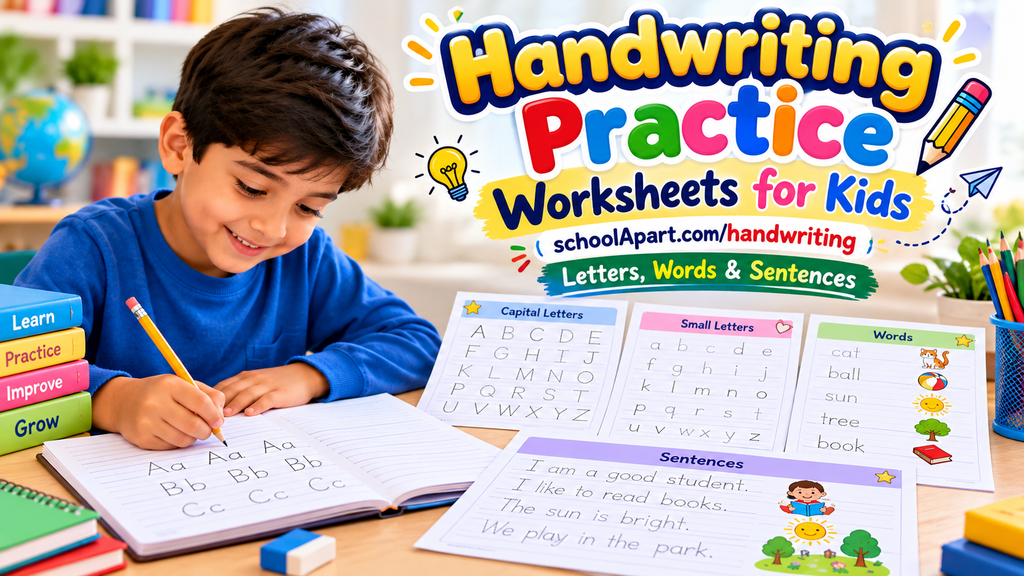
Handwriting practice worksheets can help children develop their writing skills through structured and manageable exercises.
Start with letters and numbers, move on to words, and gradually introduce sentences. Use tracing when helpful, but also give children opportunities to copy examples and write independently.
Most importantly, keep practice comfortable, consistent, and encouraging.
With regular practice and suitable guidance, children can work towards handwriting that is clearer, more consistent, and easier to read.
Frequently Asked Questions
1. What are handwriting practice worksheets for kids?
Handwriting practice worksheets are learning materials that help children practise letters, numbers, words, and sentences. They may include tracing, copying, ruled lines, or spaces for independent writing.
2. How can I improve my child’s handwriting at home?
Begin with comfortable pencil control and correct letter formation. Use short exercises for letters, words, and sentences. Practise regularly and focus on one or two improvements at a time.
3. Which handwriting worksheets should beginners use?
Beginners can start with lines, curves, simple shapes, and individual letters. Once they are comfortable, introduce words and short sentences.
4. How long should children practise handwriting each day?
Around 5–10 minutes can be a practical starting point for many children. Younger learners may need shorter sessions, while older students can adjust the duration to their comfort and schoolwork.
5. Are tracing worksheets useful for handwriting?
Tracing worksheets can help children become familiar with letter shapes and stroke direction. Children should also practise copying and writing independently rather than relying on tracing alone.
6. How can children improve spacing between words?
Use short sentences and demonstrate a clear gap between words. Ruled paper and simple visual spacing cues can help children practise consistent spacing.
7. Should children practise capital and lowercase letters separately?
Practising them separately can help beginners learn their shapes. Later, children should practise using both types of letters correctly in words and sentences.
8. Are cursive handwriting worksheets suitable for every child?
Cursive practice is useful when it matches the child’s learning stage and school curriculum. Children should first develop the writing control and letter knowledge needed for the chosen style.
9. Can handwriting worksheets improve writing speed?
Worksheets can help children practise consistency and control. Writing speed may improve over time, but the first priority should be comfortable, readable handwriting rather than rushing.
10. Can I use a notebook instead of printable worksheets?
Yes. A ruled notebook can be used for most letter, word, and sentence exercises in this guide. Printable worksheets are an additional option, not a requirement.



Leave a Reply