

Discover 30 fun tongue twisters for kids, from easy to challenging, with pronunciation tips, practice activities, and speaking games.
Tongue Twisters for Kids: Fun Examples to Improve Speaking Skills
Tongue twisters for kids are a fun way to practice English pronunciation, speaking rhythm, and clear speech. These short, playful sentences often repeat similar sounds, making them entertaining to say and challenging to master.
- Spoken English for Kids: Complete Beginner’s Guide — Start with the basics of spoken English.
Children can practice tongue twisters at home, in the classroom, or with friends. They do not need special equipment or advanced English skills. Even beginners can start with a few simple words and gradually move to longer sentences.
- How to Learn Spoken English at Home — Build a simple home learning routine.
- How to Improve English Speaking Skills for Kids — Explore practical ways to practise speaking.
In this guide, you will find 30 tongue twisters for kids, organised from easy to challenging. You will also discover sound-based exercises, speaking games, and practical tips to help children practise confidently.
What Are Tongue Twisters?
A tongue twister is a word, phrase, or sentence that is difficult to say quickly because it contains similar or repeated sounds.
For example:
She sells seashells by the seashore.
The repeated “s” and “sh” sounds make this sentence challenging to say clearly.
Tongue twisters are often used as language games. Children can say them slowly at first, repeat them several times, and gradually increase their speed while keeping the words clear.
Benefits of Tongue Twisters for Kids
Tongue twisters can make English speaking practice more enjoyable. When children practise them regularly, they can develop several useful language skills.
1. Practise Clear Pronunciation
Repeated sounds encourage children to pay attention to how words are spoken. This can help them notice differences between similar sounds.
2. Develop Speaking Confidence
Children often enjoy practising funny sentences. A playful activity can make speaking English feel less intimidating.
3. Improve Listening Skills
Listening carefully to a tongue twister helps children notice individual sounds, word patterns, and the rhythm of a sentence.
4. Build Speaking Fluency
Repeating short sentences gives children opportunities to practise connecting words naturally. Speed should come after clarity.
5. Learn New Vocabulary
Tongue twisters introduce children to words such as sheep, shells, wood, cheese, and chocolate. Parents and teachers can explain unfamiliar words before beginning practice.
Important: Tongue twisters are practice activities, not a treatment for speech or language difficulties. Children should never be pressured to speak faster than they can comfortably manage.
30 Tongue Twisters for Kids
The following examples progress from short, simple phrases to longer and more challenging sentences. An adult can read each one aloud before the child tries it.
Level 1: Easy Tongue Twisters for Beginners
These short examples are suitable for children who are just starting to practise English tongue twisters.
1. Red Lorry, Yellow Lorry
Tongue twister: Red lorry, yellow lorry.
Practice focus: Repeated “r” and “l” sounds.
Try this: Say each colour slowly, then repeat the whole phrase three times.
2. Big Black Bear
Tongue twister: Big black bear.
Practice focus: The “b” sound.
Try this: Say the three words clearly without rushing.
3. Blue Balloon
Tongue twister: Blue balloon.
Practice focus: The “b” and “l” sounds.
Try this: Repeat the phrase five times, keeping both words clear.
4. Four Fine Fish
Tongue twister: Four fine fish.
Practice focus: The “f” sound.
Try this: Listen for the same starting sound in every word.
5. Six Silly Snakes
Tongue twister: Six silly snakes.
Practice focus: The “s” sound.
Try this: Say the phrase slowly and notice the repeated sound.
6. Green Grapes
Tongue twister: Green grapes grow.
Practice focus: The “gr” sound.
Try this: Practise saying “green grapes” before adding “grow.”
7. Tiny Tigers
Tongue twister: Two tiny tigers take turns.
Practice focus: The “t” sound.
Try this: Tap the table gently once for each word as you speak.
8. Happy Hippos
Tongue twister: Happy hippos hop.
Practice focus: The “h” sound.
Try this: Say each word clearly and keep a steady rhythm.
9. Funny Frogs
Tongue twister: Five funny frogs find flies.
Practice focus: The “f” sound.
Try this: Clap once after each word to slow down the sentence.
10. Clever Cats
Tongue twister: Clever cats climb.
Practice focus: The “cl” sound.
Try this: Repeat “clever cats” first, then add “climb.”
Level 2: Medium Tongue Twisters for Kids
These examples contain more words and repeated sound patterns. They are suitable for children who are comfortable with short phrases.
11. Peter Piper
Tongue twister: Peter Piper picked a peck of pickled peppers.
Practice focus: The “p” sound.
Try this: Break the sentence into three parts: “Peter Piper,” “picked a peck,” and “of pickled peppers.”
12. She Sells Seashells
Tongue twister: She sells seashells by the seashore.
Practice focus: The difference between “s” and “sh.”
Try this: Listen to an adult say the sentence. Repeat it slowly, paying attention to the two different sounds.
13. A Proper Copper Coffee Pot
Tongue twister: A proper copper coffee pot.
Practice focus: Repeated “p” and “k” sounds.
Try this: Say “proper copper” separately before practising the whole phrase.
14. Betty Botter
Tongue twister: Betty Botter bought some butter.
Practice focus: The “b” sound.
Try this: Emphasise each word gently without shouting.
15. Which Witch?
Tongue twister: Which witch wished which wish?
Practice focus: The “w” sound and repeated question words.
Try this: Say the sentence slowly enough to keep every word distinct.
16. Toy Boat
Tongue twister: Toy boat, toy boat, toy boat.
Practice focus: The “oy” and “oa” vowel combinations.
Try this: Repeat the phrase three times, taking a short pause between repetitions.
17. Six Sticky Skeletons
Tongue twister: Six sticky skeletons.
Practice focus: The “s” sound and consonant combinations.
Try this: Start with “sticky skeletons,” then add “six.”
18. Fresh Fried Fish
Tongue twister: Fresh fried fish.
Practice focus: The “fr” sound.
Try this: Practise “fresh” and “fried” separately before joining them.
19. Black Bug
Tongue twister: A big black bug bit a big black bear.
Practice focus: The “b” sound and short words.
Try this: Divide the sentence into two parts and practise each one.
20. Chocolate Chips
Tongue twister: Charlie chose chocolate chips.
Practice focus: The “ch” sound.
Try this: Say “Charlie chose” first, then complete the sentence.
Level 3: Challenging Tongue Twisters for Kids
These longer examples are ideal for children who enjoy a challenge. They may need several attempts to say each sentence clearly.
21. Woodchuck
Tongue twister: How much wood would a woodchuck chuck if a woodchuck could chuck wood?
Practice focus: Repeated “w” and “ch” sounds.
Try this: Practise the first half of the question before attempting the entire sentence.
22. Fuzzy Wuzzy
Tongue twister: Fuzzy Wuzzy was a bear. Fuzzy Wuzzy had no hair.
Practice focus: The “z” and “w” sounds.
Try this: Practise one sentence at a time, then join them together.
23. Three Free Throws
Tongue twister: Three free throws.
Practice focus: The “th” and “f” sounds.
Try this: Say “three” slowly, then practise “free throws.” Do not rush the first sound.
24. The Thirty-Three Thieves
Tongue twister: The thirty-three thieves thought that they thrilled the throne throughout Thursday.
Practice focus: The “th” sound.
Try this: Practise the words “thirty-three thieves” before attempting the full sentence.
25. Which Wristwatch?
Tongue twister: Which wristwatches are Swiss wristwatches?
Practice focus: The “w” and “r” sounds.
Try this: Break the sentence into small word groups and repeat each group clearly.
26. Six Slippery Snails
Tongue twister: Six slippery snails slid slowly seaward.
Practice focus: The “s” and “sl” sounds.
Try this: Say the sentence slowly while keeping the beginning of each word clear.
27. A Big Black Bear
Tongue twister: A big black bear sat on a big black rug.
Practice focus: The “b” sound and repeated word patterns.
Try this: Practise “big black bear” before saying the full sentence.
28. The Blue Bluebird
Tongue twister: The blue bluebird blinks.
Practice focus: The “bl” sound.
Try this: Say “blue bluebird” slowly, then add “blinks.”
29. The Shy Sheep
Tongue twister: Six sheep should sleep in a shed.
Practice focus: The “sh” and “s” sounds.
Try this: Listen carefully to the beginning of “sheep,” “should,” and “shed.”
30. The Busy Baker
Tongue twister: The busy baker baked a batch of buttery biscuits.
Practice focus: The “b” sound and repeated syllables.
Try this: Practise “busy baker” and “buttery biscuits” separately before joining the sentence.
How to Practise Tongue Twisters Step by Step
Children do not need to say a tongue twister quickly to benefit from it. Follow this simple routine.
Step 1: Listen First
Ask a parent, teacher, or another confident speaker to read the sentence aloud. Children should listen to the sounds before trying to repeat them.
Step 2: Understand the Words
Explain any unfamiliar vocabulary. For example, a seashore is the land along the edge of the sea.
Understanding the sentence makes it easier to remember.
Step 3: Start Slowly
Say each word clearly. If a child gets stuck, return to the difficult word or phrase instead of repeating the entire sentence immediately.
Step 4: Break It into Small Parts
Long tongue twisters become easier when divided into short groups.
For example:
- Peter Piper
- Picked a peck
- Of pickled peppers
Practise each group before combining them.
Step 5: Repeat with a Steady Rhythm
Repeat the sentence two or three times at a comfortable speed. Focus on clear sounds rather than speed.
Step 6: Increase Speed Gradually
Once the child can say the sentence clearly, try speaking a little faster. If the words become unclear, slow down again.
Step 7: Celebrate Progress
Praise effort, careful listening, and improvement. Children should feel comfortable making mistakes while learning.
Fun Tongue Twister Activities for Kids
Turn pronunciation practice into a game to keep children interested.
1. Tongue Twister Challenge
Choose one short tongue twister. Each child gets three attempts to say it clearly. The goal is improvement, not simply speed.
2. Repeat After Me
An adult says a phrase slowly, and the child repeats it. Gradually increase the length of the phrase as the child becomes more comfortable.
3. Sound Detective
Choose a tongue twister that repeats one sound. Ask the child to identify the sound and find the words that contain it.
For example, in “Five funny frogs find flies,” the repeated starting sound is “f.”
4. Tongue Twister Cards
Write a different tongue twister on each card. Let the child pick a card, read it, and practise it aloud.
Use shorter cards for beginners and longer ones for confident speakers.
5. Family Practice Time
Parents and children can take turns saying the same tongue twister. Everyone can laugh at their mistakes and try again.
6. Record and Listen
With a parent’s permission, record a child saying a tongue twister. Listen together and identify one thing the child did well and one sound to practise.
Avoid criticising the child’s accent. The focus should be clear, comfortable communication.
A Simple 7-Day Tongue Twister Practice Plan
A few minutes of enjoyable practice can be easier to maintain than a long session.
| Day | Practice | Goal |
|---|---|---|
| Day 1 | Red lorry, yellow lorry | Practise short phrases |
| Day 2 | Five funny frogs find flies | Notice repeated sounds |
| Day 3 | Betty Botter bought some butter | Practise the “b” sound |
| Day 4 | She sells seashells by the seashore | Listen for “s” and “sh” |
| Day 5 | Peter Piper picked a peck of pickled peppers | Break a long sentence into parts |
| Day 6 | Six slippery snails slid slowly seaward | Practise a steady rhythm |
| Day 7 | Choose a favourite tongue twister | Review and celebrate progress |
Children can repeat this plan with different examples from the list. Younger children may prefer practising only one short phrase each day.
Tips for Parents and Teachers
- Choose age-appropriate examples: Start with three or four words for younger learners.
- Model the sounds: Demonstrate the phrase before asking a child to repeat it.
- Keep sessions short: Five minutes of focused practice may be enough for a young learner.
- Avoid pressure: Never make a child feel embarrassed for getting a word wrong.
- Focus on clarity: Fast speech is not the main goal.
- Use visual support: Pictures of bears, frogs, boats, or sheep can help children understand unfamiliar words.
- Encourage regular practice: A little practice on several days can be more manageable than one long session.
- Respect different accents: English has many accepted accents. The aim is understandable speech, not copying one particular accent.
If a child consistently struggles to produce certain sounds or is difficult to understand, consider speaking with a qualified speech-language professional for individual guidance.
Related English Learning Guides
Help children build a stronger foundation in English with these related guides from SchoolApart.com.
- English Pronunciation for Kids: Easy Tips and Practice — Practise English sounds and clearer speech.
- 100 Basic English Words for Kids — Build everyday vocabulary.
- Daily Use English Words for Kids — Learn common words and expressions.
- Action Words for Kids — Learn useful verbs through examples.
- School Vocabulary for Kids — Learn words used in the classroom.
- Opposite Words for Kids — Practise common pairs of opposite words.
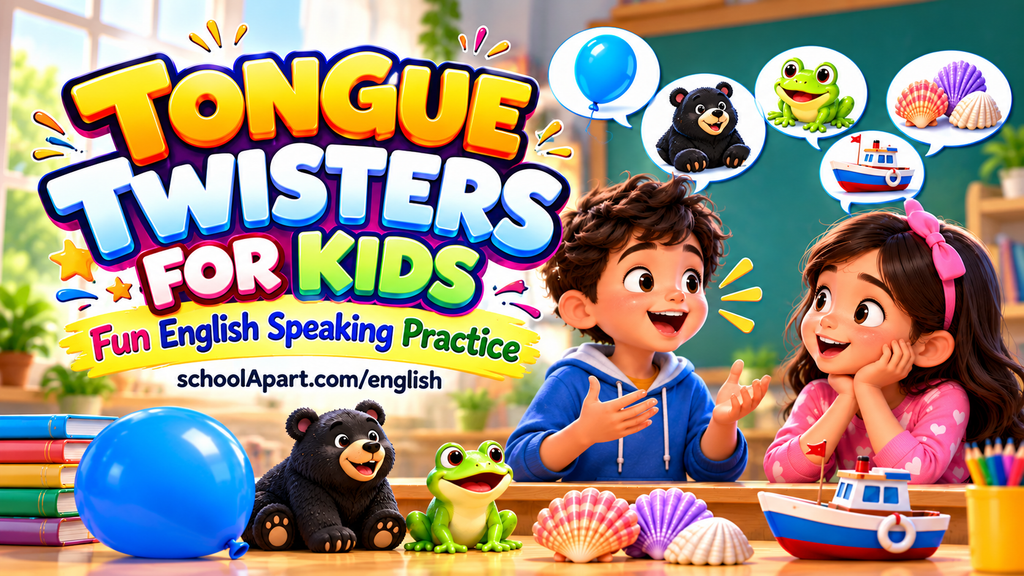
Tongue twisters for kids make English speaking practice fun, interactive, and memorable. From simple phrases such as “Big black bear” to longer challenges such as the Peter Piper tongue twister, children can explore repeated sounds while practising clear speech.
Start with easy examples, listen carefully, and repeat each phrase at a comfortable speed. Use tongue twister cards, family challenges, or a short daily routine to keep children engaged.
The most important goal is not to speak the fastest. It is to enjoy learning, practise patiently, and become more confident using English.
Explore more English learning resources at SchoolApart.com to help children develop vocabulary, pronunciation, and everyday speaking skills.
Frequently Asked Questions
1. What are tongue twisters for kids?
Tongue twisters for kids are playful words or sentences that are difficult to say because they contain repeated or similar sounds. They can help children practise pronunciation, listening, and speaking rhythm.
2. What is an easy tongue twister for kids?
“Big black bear” is a simple tongue twister for beginners. Children can practise it slowly before trying longer sentences.
3. What is the most famous tongue twister for children?
“Peter Piper picked a peck of pickled peppers” is one of the best-known English tongue twisters. Its repeated “p” sound makes it a popular speaking challenge.
4. How do tongue twisters help children learn English?
Tongue twisters encourage children to listen carefully, repeat sound patterns, and practise speaking clearly. They can also introduce new vocabulary in a playful way.
5. At what age can children start practising tongue twisters?
Children can begin with very short, simple phrases when they are comfortable repeating spoken words. Parents should choose examples that match each child’s language level rather than following a strict age limit.
6. How long should kids practise tongue twisters?
Start with a few minutes per session. Stop or take a break if the child becomes tired, frustrated, or loses interest.
7. Should children say tongue twisters quickly?
No. Children should first learn to say the words clearly and comfortably. They can gradually increase speed once they can pronounce the sentence accurately.
8. Can tongue twisters improve English pronunciation?
Tongue twisters provide opportunities to practise repeated sounds and clear speech. They can support pronunciation practice, although they do not replace broader listening, speaking, and language-learning activities.
9. Which tongue twisters help practise the “s” and “sh” sounds?
“She sells seashells by the seashore” is a useful example for listening to the “s” and “sh” sounds. Children can practise each word slowly before saying the full sentence.
10. Are tongue twisters suitable for English beginners?
Yes. Beginners can start with phrases such as “Blue balloon” or “Four fine fish.” They can move to longer sentences as their confidence grows.
11. Can parents practise tongue twisters at home?
Yes. Parents can read a phrase aloud, explain unfamiliar words, and let children repeat it. Family games and short practice sessions can make learning enjoyable.
12. Do tongue twisters help with speaking confidence?
They can provide a playful opportunity to practise speaking without the pressure of a formal conversation. Positive feedback and a relaxed atmosphere help children participate confidently.
13. Should children copy a particular English accent?
No. Children can learn from different English accents. The main goal is to speak clearly enough to be understood, while developing comfortable and consistent pronunciation.
14. What should children do when they cannot say a tongue twister?
They should slow down, divide the sentence into smaller parts, and practise the difficult words separately. It is perfectly normal to need several attempts.
15. Can teachers use tongue twisters in the classroom?
Yes. Teachers can use them for warm-up activities, sound recognition, pair practice, and short speaking games. Choose examples appropriate for the students’ ages and abilities.


Leave a Reply