
Teach action words for kids with 60 common verbs, simple meanings, example sentences, and fun activities to build vocabulary and speaking skills.
Action Words for Kids: Verbs with Examples
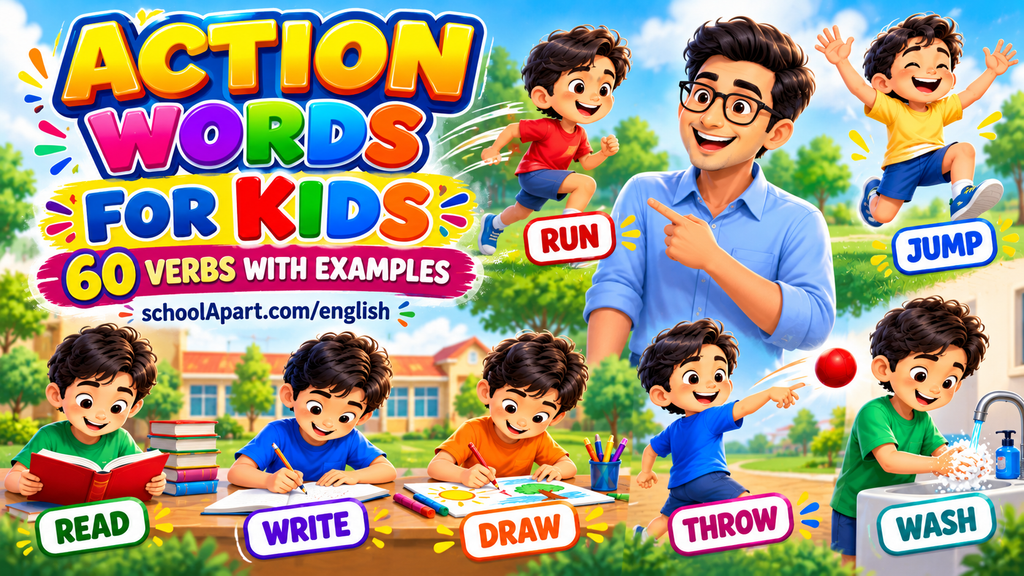
Action words help children describe what people, animals and things do. Words such as run, jump, eat, read, write and play are some of the first verbs children can learn in English.
In grammar, action words are commonly called verbs. They help children build meaningful sentences, describe everyday activities and communicate more clearly.
In this guide, children will learn common action words with simple English meanings and example sentences. Parents and teachers can also use the activities to make learning more enjoyable.
What Are Action Words?
Action words are words that tell us what someone or something does. They describe activities and actions.
Look at these examples:
- The boy runs.
- The girl reads.
- The baby sleeps.
- The children play.
The bold words describe actions. They tell us what the people are doing.
Action words are useful when children begin speaking English because they help them explain what they do, what they see and what is happening around them.
Action Words for Kids with Meanings and Examples
1. Everyday Action Words
These common verbs describe activities children may do at home, at school or while playing.
| No. | Action Word | Simple Meaning | Example Sentence |
|---|---|---|---|
| 1 | Eat | To take food into the body | I eat an apple. |
| 2 | Drink | To swallow a liquid | I drink water. |
| 3 | Sleep | To rest in a natural state of sleep | I sleep at night. |
| 4 | Wake | To stop sleeping | I wake up early. |
| 5 | Sit | To rest with your body supported by a seat | Please sit here. |
| 6 | Stand | To be upright on your feet | Please stand up. |
| 7 | Walk | To move at a regular pace using your feet | I walk to school. |
| 8 | Run | To move quickly on foot | I run in the park. |
| 9 | Play | To do something for fun | I play with my friends. |
| 10 | Rest | To relax after activity | I rest after school. |
2. Learning and School Action Words
Children use these verbs when talking about learning, reading, writing and classroom activities.
| No. | Action Word | Simple Meaning | Example Sentence |
|---|---|---|---|
| 11 | Read | To look at and understand written words | I read a story. |
| 12 | Write | To form letters or words | I write my name. |
| 13 | Learn | To gain knowledge or a skill | I learn English. |
| 14 | Study | To spend time learning a subject | I study every day. |
| 15 | Draw | To make a picture using lines | I draw a flower. |
| 16 | Colour | To add colour to a picture | I colour the picture. |
| 17 | Count | To say numbers in order | I count to ten. |
| 18 | Ask | To say a question or request information | I ask a question. |
| 19 | Answer | To reply to a question | I answer the teacher. |
| 20 | Listen | To pay attention to a sound or speaker | I listen to my teacher. |
3. Movement and Playing Action Words
These verbs are easy to practise through movement games. Children can perform the actions as they say the words.
| No. | Action Word | Simple Meaning | Example Sentence |
|---|---|---|---|
| 21 | Jump | To push yourself off the ground | I jump high. |
| 22 | Hop | To move by jumping on one foot or with short jumps | I hop on one foot. |
| 23 | Skip | To move with light, springing steps | I skip along the path. |
| 24 | Dance | To move your body to music | I dance to music. |
| 25 | Swim | To move through water | I swim in the pool. |
| 26 | Climb | To move up something using your hands and feet | I climb the stairs. |
| 27 | Crawl | To move close to the ground on your hands and knees | The baby can crawl. |
| 28 | Kick | To hit or move something with your foot | I kick the ball. |
| 29 | Throw | To send something through the air with your hand | I throw the ball. |
| 30 | Catch | To stop and hold something moving through the air | I catch the ball. |
4. Speaking and Communication Action Words
These verbs help children talk about conversations and communication.
| No. | Action Word | Simple Meaning | Example Sentence |
|---|---|---|---|
| 31 | Speak | To say words aloud | I speak English. |
| 32 | Talk | To communicate using words | I talk to my friend. |
| 33 | Say | To express something in words | I say hello. |
| 34 | Tell | To give information or a story to someone | I tell a story. |
| 35 | Ask | To request information or make a request | I ask for help. |
| 36 | Reply | To answer someone | I reply to the message. |
| 37 | Call | To speak to someone or attract attention | I call my mother. |
| 38 | Shout | To speak very loudly | Do not shout in class. |
| 39 | Whisper | To speak very softly | I whisper to my friend. |
| 40 | Explain | To make something clear | I explain my answer. |
5. Creative and Helpful Action Words
These verbs help children describe making things, helping others and taking care of their surroundings.
| No. | Action Word | Simple Meaning | Example Sentence |
|---|---|---|---|
| 41 | Make | To create or produce something | I make a paper boat. |
| 42 | Build | To put parts together to create something | We build a tower with blocks. |
| 43 | Paint | To create a picture or add colour using paint | I paint a tree. |
| 44 | Cut | To divide something using a sharp tool | I cut the paper with scissors. |
| 45 | Fold | To bend something over itself | I fold my paper. |
| 46 | Fix | To repair something | I fix my toy. |
| 47 | Help | To make something easier for someone | I help my friend. |
| 48 | Share | To give part of something to another person | I share my toys. |
| 49 | Clean | To remove dirt or make something tidy | I clean my room. |
| 50 | Wash | To clean with water, often using soap | I wash my hands. |
6. Other Useful Action Words
These verbs describe everyday activities, feelings and actions children may observe around them.
| No. | Action Word | Simple Meaning | Example Sentence |
|---|---|---|---|
| 51 | Smile | To make your face show happiness | I smile at my friend. |
| 52 | Laugh | To make sounds or movements that show amusement | We laugh at the funny story. |
| 53 | Cry | To shed tears, often when sad or hurt | The baby begins to cry. |
| 54 | Think | To use your mind to consider something | I think about the answer. |
| 55 | Remember | To keep or bring something back to mind | I remember your name. |
| 56 | Find | To discover something you are looking for | I find my pencil. |
| 57 | Carry | To hold and take something from one place to another | I carry my school bag. |
| 58 | Open | To make something no longer closed | I open the door. |
| 59 | Close | To shut something | I close the window. |
| 60 | Give | To hand something to someone | I give a book to my friend. |
Learning tip: Some words can be used in different ways. For example, run can describe moving quickly, but it can also be used in sentences such as “I run a small shop.” Young beginners should start with the most familiar meaning and learn other uses gradually.
How to Use Action Words in Simple English Sentences
Knowing a verb is useful, but children also need to learn how to use it in a sentence.
1. Use “I + Action Word”
This is a simple sentence pattern for beginners.
- I eat.
- I read.
- I write.
- I play.
- I dance.
Encourage children to add more information when they are ready.
- I read a book.
- I play football.
- I write my name.
2. Use “He/She + Action Word”
When talking about one person, the verb often changes in the simple present tense.
- He runs fast.
- She reads a book.
- He plays football.
- She sings a song.
Explain the pattern through examples rather than asking young children to memorise grammar rules immediately.
3. Use “I Am + Action Verb-ing”
Use this pattern to describe something happening now.
- I am reading.
- I am writing.
- I am eating.
- I am playing.
- I am drawing.
Children can perform an action and say what they are doing.
4. Ask and Answer Questions
Practise short questions with children.
Question: What are you doing?
Answer: I am reading.
Question: What is he doing?
Answer: He is running.
Question: What is she doing?
Answer: She is drawing.
These examples help children connect action words with everyday speaking.
Fun Activities to Teach Action Words to Kids
1. Act and Guess
One child performs an action without saying the word. The other child guesses it.
For example, a child pretends to sleep, and the partner says, “Sleep!”
After guessing, encourage the child to use the word in a sentence: “The baby is sleeping.”
2. Simon Says
Give simple instructions such as:
- Simon says, “Jump!”
- Simon says, “Clap!”
- Simon says, “Stand up!”
- Simon says, “Sit down!”
Children listen carefully and perform the correct action. This game combines vocabulary practice with listening skills.
3. Picture and Word Matching
Prepare picture cards showing actions such as running, reading, eating and dancing. Prepare separate word cards with the corresponding verbs.
Ask children to match each picture with the correct word and then say a short sentence.
4. Action Word Hunt
Ask children to observe what people are doing in a picture, storybook or safe everyday setting.
They might see someone walking, reading, cooking, writing or cleaning. Ask them to identify the action and describe it in English.
5. Draw and Describe
Ask children to draw a simple scene, such as a playground or classroom. They can describe the actions in their picture.
Examples:
- The boy is running.
- The girl is reading.
- The children are playing.
- The teacher is writing.
6. Daily Action Diary
At the end of the day, ask children to describe three things they did.
For example:
- I played with my friends.
- I read a story.
- I helped my family.
This activity encourages children to connect English with their daily experiences.
A Simple Seven-Day Action Words Practice Plan
| Day | Words to Practise | Activity |
|---|---|---|
| Day 1 | Eat, drink, sleep, wake, sit, stand, walk, run, play, rest | Act out each word. |
| Day 2 | Read, write, learn, study, draw, colour, count, ask, answer, listen | Practise school-related sentences. |
| Day 3 | Jump, hop, skip, dance, swim, climb, crawl, kick, throw, catch | Play a safe movement game. |
| Day 4 | Speak, talk, say, tell, ask, reply, call, shout, whisper, explain | Practise speaking and listening. |
| Day 5 | Make, build, paint, cut, fold, fix, help, share, clean, wash | Describe everyday tasks. |
| Day 6 | Smile, laugh, cry, think, remember, find, carry, open, close, give | Use picture cards and examples. |
| Day 7 | Revise all 60 words | Play Act and Guess and make simple sentences. |
This is a suggested schedule. Younger children may need more time, and revision can be repeated over several weeks.
Tips for Parents and Teachers
- Introduce a few words at a time rather than teaching all 60 at once.
- Use pictures, real objects, actions and short sentences.
- Encourage children to say the words aloud.
- Ask simple questions and give them time to respond.
- Correct mistakes gently by modelling the correct sentence.
- Praise effort and participation instead of expecting perfect English immediately.
- Revisit familiar verbs in different contexts so children understand how they are used.
The aim is to help children understand and use action words naturally, not simply memorise a list.
Action words are an important part of children’s English vocabulary. They help children describe movement, learning, communication, creativity and everyday activities.
Start with familiar verbs, practise them through games and help children use them in short sentences. With regular, enjoyable practice, children can gradually become more confident in understanding and speaking English.
Frequently Asked Questions
1. What are action words for kids?
Action words are words that describe what someone or something does. Examples include run, jump, eat, read, write, play and sleep. In grammar, action words are commonly called verbs.
2. What is the difference between an action word and a verb?
An action word is a common way of describing a verb that expresses an action. However, not all verbs describe physical actions. Some verbs, such as know, believe and seem, describe states or conditions.
3. How many action words should kids learn at a time?
There is no fixed number for every child. Beginners can start with five to ten familiar verbs and practise them in simple sentences before learning more.
4. How can I teach action words to young children?
Use movement games, picture cards, demonstrations and simple instructions. Ask children to perform an action, say its name and use it in a short sentence.
5. How do action words help children speak English?
Action words help children describe activities and form sentences such as “I play,” “She reads” and “They are running.” They make everyday communication more meaningful.
6. What is an example of an action word in a sentence?
In the sentence “The boy kicks the ball,” the word kicks is the action word because it tells us what the boy does.
7. What should children learn after action words?
Children can practise daily-use English words, school vocabulary, opposite words, daily English sentences and simple conversations. These topics help them use their growing vocabulary in different situations.

Leave a Reply