
Learn coloring for beginners with simple techniques, color tips, materials, blending, shading, practice exercises, and easy ideas for school students.
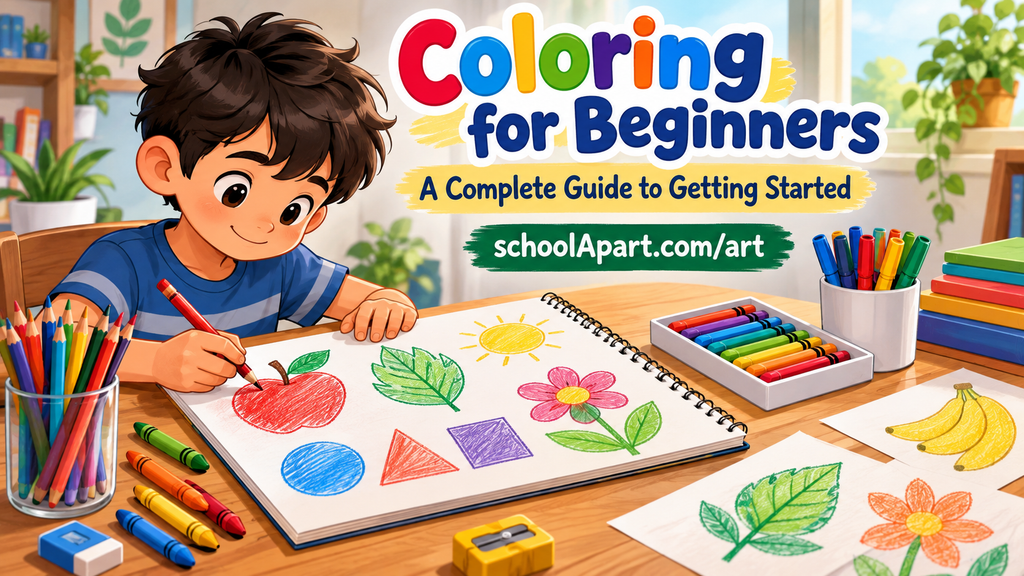
Coloring for Beginners: A Complete Guide to Getting Started
Coloring is one of the easiest and most enjoyable ways to begin learning art. You do not need advanced drawing skills to start coloring. With a few basic materials and some simple techniques, beginners can create colorful and attractive artwork while developing important artistic skills.
For school students, coloring is more than simply filling spaces with different colors. It helps develop color awareness, hand control, observation, creativity, patience, and attention to detail.
If you are completely new to coloring, this guide will help you understand the basic materials, color choices, techniques, and practice methods you can use to build your skills step by step.
What Is Coloring?
Coloring is the process of adding color to a drawing, illustration, pattern, or artwork using materials such as colored pencils, crayons, markers, or paints.
A simple black-and-white drawing can look completely different after color is added. By choosing different colors, shades, and combinations, you can create mood, depth, contrast, and visual interest.
Coloring can be done as:
- Coloring simple drawings
- Coloring books and worksheets
- Nature illustrations
- Cartoon characters
- School project artwork
- Pattern designs
- Decorative artwork
- Creative illustrations
For beginners, simple drawings are usually the best place to start.
Why Should Beginners Learn Coloring?
Coloring offers several benefits for students and beginner artists.
1. It develops creativity
Coloring allows you to experiment with different colors and combinations.
2. It improves hand control
Holding and moving a pencil, crayon, or marker carefully helps develop better hand coordination.
3. It teaches color awareness
Regular practice helps you understand how different colors look together.
4. It improves concentration
Careful coloring requires attention, especially when working on small areas.
5. It builds confidence
Completing a colorful artwork can encourage beginners to try more advanced art techniques.
6. It supports drawing practice
Coloring teaches beginners to pay attention to shapes, boundaries, light, and visual details.
Basic Coloring Materials for Beginners
You do not need a large collection of expensive art supplies when starting.
Art Supplies for Beginners: Essential Drawing & Painting Materials You Need
Essential materials
| Material | Best for beginners |
|---|---|
| Colored pencils | Detailed coloring and shading |
| Crayons | Simple and easy coloring |
| Markers | Bright, bold colors |
| Drawing paper | General coloring practice |
| Eraser | Cleaning unwanted pencil marks |
| Pencil | Outlining and light sketching |
| Sharpener | Keeping colored pencils sharp |
If you are just starting, a basic colored pencil set is often a practical choice because it allows you to practice both coloring and simple shading.
For a broader overview of beginner art materials, see Art Supplies for Beginners.
Colored Pencils, Crayons or Markers?
Beginners often wonder which coloring tool they should use.
Colored Pencils
Colored pencils are useful for:
- Detailed artwork
- Small areas
- Layering colors
- Light and dark effects
- Simple shading
They give you good control and are especially useful for students.
Crayons
Crayons are easy to use and work well for:
- Simple drawings
- Large areas
- School activities
- Younger beginners
They usually create a softer and more solid-looking color.
Markers
Markers produce bright and strong colors.
They are useful for:
- Posters
- Bold illustrations
- Lettering
- Simple artwork
However, some markers can bleed through thin paper, so using suitable drawing paper is important.
How to Choose Colors
Choosing colors is one of the most important parts of coloring.
Colour Theory Explained: A Complete Beginner’s Guide to Understanding Colors
Beginners do not need to memorize complicated color theory. Start by observing how colors work together.
Primary Colors
The traditional primary colors are:
- Red
- Yellow
- Blue
These colors are commonly used as a starting point for understanding color relationships.
Secondary Colors
Secondary colors can be created by combining primary colors:
- Red + Yellow → Orange
- Yellow + Blue → Green
- Blue + Red → Purple
Understanding these relationships can make color selection easier.
For a deeper explanation, read Colour Theory Explained.
Warm and Cool Colors
Colors can also be broadly described as warm or cool.
Warm colors
Examples include:
- Red
- Orange
- Yellow
They often create a feeling of warmth and energy.
Cool colors
Examples include:
- Blue
- Green
- Purple
They often create a cooler or calmer visual effect.
Beginners can experiment with both groups to see how they change the appearance of an artwork.
Basic Coloring Techniques for Beginners
You can create much better coloring results by learning a few simple techniques.
1. Even Coloring
Try to fill an area with an even layer of color.
Keep your pencil pressure consistent and avoid leaving large white gaps.
Practice:
Draw five simple circles and color each one evenly.
2. Light-to-Dark Coloring
Start with a light layer and gradually increase the pressure.
This creates a smooth transition from light to dark.
This technique is particularly useful with colored pencils.
3. Layering Colors
Instead of pressing very hard immediately, build the color gradually using several light layers.
For example:
Light yellow → darker yellow → orange
Layering can produce richer colors without making the artwork look too harsh.
4. Blending
Blending means creating a smoother transition between colors.
You can practice by placing two similar colors next to each other and gradually overlapping them.
For example:
Light blue → blue → dark blue
5. Directional Coloring
The direction of your coloring strokes can affect the appearance of the artwork.
Try:
- Horizontal strokes
- Vertical strokes
- Diagonal strokes
- Circular strokes
For many beginner drawings, small controlled strokes can help create a cleaner result.
6. Pressure Control
Do not use the same pressure everywhere.
Try:
Light pressure → medium pressure → strong pressure
You will notice that the same pencil can produce different shades depending on pressure.
How to Color Inside the Lines
Staying inside the lines is a basic skill that improves with practice.
Try these steps:
- Start from the edge of the shape.
- Use small controlled strokes.
- Move gradually toward the center.
- Avoid pressing too hard.
- Slow down around corners and narrow areas.
Do not worry if your first attempts are not perfect. Control improves naturally with practice.
How to Add Light and Dark Areas
Flat coloring can make an object look simple. Adding light and dark areas can make it appear more three-dimensional.
First decide where your imaginary light source is coming from.
Shading Techniques for Beginners: A Complete Step-by-Step Guide
For example:
Light source → top left
Then:
- Top-left areas can remain lighter.
- Opposite areas can become darker.
- The transition between light and dark should be gradual.
This connects coloring with the drawing skill of Light and Shadow.
You can also practice this using the techniques explained in Shading Techniques for Beginners.
A Simple Step-by-Step Coloring Exercise
Here is an easy exercise for beginners.
Step 1: Draw a simple apple
Use a pencil to draw a basic apple shape.
Step 2: Choose your colors
Try:
- Light red
- Red
- Dark red
- Green
Step 3: Add the lightest layer
Apply a light red layer across most of the apple.
Step 4: Add darker areas
Add more red near the lower or side portion of the apple.
Step 5: Create a shadow
Use a darker red or a related darker tone.
Step 6: Color the leaf
Use light and dark green to create variation.
Step 7: Add a highlight
Leave a small area lighter to suggest reflected or direct light.
This simple exercise teaches base color, layering, pressure control, light and dark values, and basic shading.
Coloring Simple Shapes
Before coloring complicated pictures, practice with simple shapes.
Try coloring:
- Circles
- Squares
- Triangles
- Ovals
- Stars
- Leaves
- Simple flowers
For each shape, try three versions:
Version 1: One flat color
Version 2: Light-to-dark shading
Version 3: Two-color blending
This is an excellent beginner exercise because it lets you focus on coloring rather than drawing complicated objects.
Coloring Practice Exercise for Beginners
Try this 7-day practice routine.
| Day | Practice |
|---|---|
| Day 1 | Even coloring |
| Day 2 | Light and dark pressure |
| Day 3 | Two-color blending |
| Day 4 | Coloring simple shapes |
| Day 5 | Leaves and flowers |
| Day 6 | Simple fruit |
| Day 7 | A complete colored drawing |
You can repeat the cycle with different subjects.
Common Coloring Mistakes Beginners Make
1. Pressing too hard
Strong pressure can make blending difficult and may damage the paper.
Better approach: Start lightly and build the color gradually.
2. Using too many colors
Adding many unrelated colors can make an artwork look visually confusing.
Better approach: Start with a small, planned color palette.
3. Ignoring light direction
Randomly placing dark areas can make objects look flat.
Better approach: Decide where the light is coming from before adding shading.
4. Coloring too quickly
Fast coloring often creates uneven areas.
Better approach: Work slowly and use controlled strokes.
5. Ignoring the paper
Some markers and wet materials do not work well on ordinary thin paper.
Better approach: Choose paper according to the coloring medium.
6. Trying complicated pictures too early
Very detailed illustrations can be frustrating for beginners.
Better approach: Start with simple shapes and gradually increase difficulty.
How to Improve Your Coloring Skills
The best way to improve is regular, focused practice.
Practice small areas
Instead of trying to complete a large artwork every day, practice one technique at a time.
Compare different pressures
Use the same colored pencil with light, medium, and heavy pressure.
Experiment with combinations
Try different color pairs and observe how they look together.
Study real objects
Look at fruits, leaves, flowers, toys, and other simple objects and observe their colors.
Repeat the same drawing
Color the same simple drawing several times using different color combinations.
This helps you understand how color choices change the appearance of an artwork.
Coloring Ideas for School Students
Beginners can practice with:
- Apples
- Oranges
- Leaves
- Flowers
- Butterflies
- Simple houses
- Balloons
- Trees
- Fruits
- Simple cartoon characters
- School objects
- Nature scenes
- Geometric patterns
Start with simple subjects and gradually move toward more detailed illustrations.
Coloring and Drawing: What’s the Difference?
Drawing and coloring are closely connected but they are not the same skill.
Drawing focuses mainly on creating shapes, lines, forms, proportions, and objects.
Coloring focuses mainly on adding color, creating visual variation, blending, and controlling color within a drawing.
Learning both skills together can help beginners become more confident artists.
Coloring and Painting: What’s the Difference?
Coloring usually involves adding color to an existing drawing or controlled shape.
Painting often involves applying paint to create or develop an artwork using brushes or other tools.
However, the two skills can overlap. Both require understanding of:
- Color
- Light
- Contrast
- Composition
- Layering
If you want to explore painting, see Watercolor Painting for Beginners and Acrylic vs Oil Painting.
Key Takeaways
- Start coloring with simple drawings and shapes.
- Colored pencils are useful for detailed beginner practice.
- Learn basic color relationships.
- Start with light pressure and build color gradually.
- Practice layering and blending.
- Pay attention to light and shadow.
- Do not use too many colors without a plan.
- Regular short practice is better than occasional long sessions.
- Gradually move from simple shapes to complete illustrations.
Coloring is an excellent starting point for students and beginners who want to explore art. You do not need expensive materials or advanced artistic skills to begin.
Start with simple shapes, practice controlling your coloring tools, experiment with colors, and gradually learn techniques such as layering, blending, and light-to-dark coloring.
With regular practice, coloring can become more than simply filling a drawing with color—it can help you develop the observation, control, and color understanding needed for more advanced art.
FAQ
1. What is coloring for beginners?
Coloring for beginners means learning basic coloring skills using simple tools such as colored pencils, crayons, or markers.
2. What is the best coloring tool for beginners?
Colored pencils are a versatile option because they offer good control and can be used for both coloring and simple shading.
3. Can I learn coloring without drawing skills?
Yes. You can start coloring simple shapes and pre-drawn illustrations even if you are still learning how to draw.
4. How do I get better at coloring?
Practice regularly, control your pencil pressure, experiment with color combinations, and learn techniques such as layering and blending.
5. How do beginners blend colored pencils?
Start with light layers of color and gradually overlap similar or compatible colors to create a smoother transition.
6. How can I color inside the lines?
Use small controlled strokes and slow down near corners and narrow areas.
7. Which is better for beginners: crayons or colored pencils?
Both can be useful. Crayons are simple for basic coloring, while colored pencils provide greater control and are better suited to detailed work.
8. Are markers good for coloring?
Yes. Markers are useful when you want bright, bold colors, although you should use suitable paper to prevent bleeding.
9. How many colors should a beginner use?
There is no fixed number. Starting with a small selection of colors can make it easier to learn color combinations and control the artwork.
10. How do I create light and dark colors?
Use lighter pressure for lighter areas and gradually increase pressure or layer color for darker areas.
11. What should I color first as a beginner?
Start with simple shapes, fruits, leaves, flowers, and other uncomplicated drawings.
12. Is coloring useful for school students?
Yes. Coloring can help students develop hand control, concentration, creativity, and color awareness.
13. Can coloring improve drawing skills?
Coloring does not replace drawing practice, but it can improve observation, hand control, and understanding of color and light.
14. What paper is best for coloring?
The best paper depends on the coloring medium. Colored pencils generally work on regular drawing paper, while markers may require thicker paper.
15. Should I press hard when coloring?
Usually, no. Starting with light pressure and gradually building color provides better control and makes layering easier.
16. What is color layering?
Color layering means applying multiple light layers of color to create richer or more varied results.
17. What are warm colors?
Warm colors commonly include red, orange, and yellow.
18. What are cool colors?
Cool colors commonly include blue, green, and purple.
19. How often should beginners practice coloring?
Even 10–20 minutes of focused practice several times a week can be useful when done consistently.
20. Can coloring help children become better at art?
Regular coloring can help children develop creativity, hand control, observation, and confidence, which can support broader art learning.
Leave a Reply