

Learn color mixing step by step with this beginner-friendly guide. Understand primary, secondary, and intermediate colors and practice easy color combinations.
Color Mixing for Beginners: How to Mix Colors Step by Step
Learning how to mix colors is an important skill for anyone who wants to improve their drawing, coloring, or painting.
You do not need a large collection of paints to start. With a few basic colors and some simple practice, you can create many new colors and understand how different colors work together.
This guide explains color mixing for beginners in a simple, step-by-step way.
What Is Color Mixing?
Color mixing means combining two or more colors to create a new color.
For example:
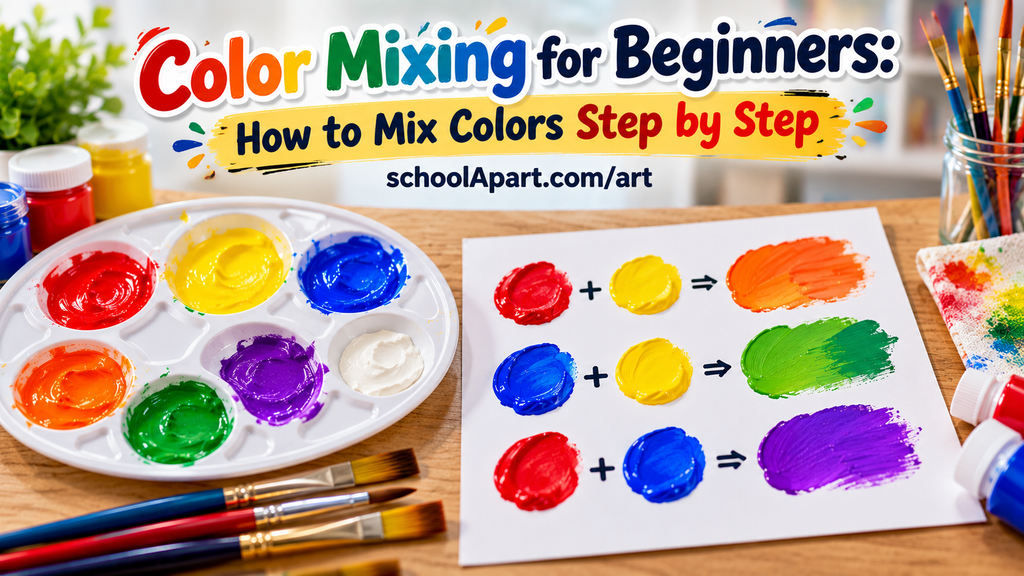
- Red + Yellow = Orange
- Yellow + Blue = Green
- Blue + Red = Purple
The exact result can change depending on the type of paint, the amount of each color, and the specific pigments being used.
Color mixing is useful for painting, coloring, illustration, and many school art projects.
If you are new to color basics, first read our guide to Colour Theory Explained and then use this article for practical mixing practice.
What Are the Primary Colors?
Traditional beginner art lessons commonly start with three primary colors:
- Red
- Yellow
- Blue
These colors are used as the starting point for learning basic color mixing.
A simple way to remember them is:
Primary Colors → Mix → New Colors
However, the exact behavior of paints can vary because different pigments have different properties.
What Are Secondary Colors?
Secondary colors are created by mixing two primary colors.
1. Red + Yellow = Orange
Mix red with yellow to create orange.
Try:
- More yellow → lighter, warmer orange
- More red → deeper, redder orange
2. Yellow + Blue = Green
Mix yellow and blue to create green.
Try:
- More yellow → yellow-green
- More blue → blue-green
3. Blue + Red = Purple
Mix blue and red to create purple.
Try using different amounts of each color to create different purple shades.
Basic Color Mixing Chart
| Colors Mixed | Result |
|---|---|
| Red + Yellow | Orange |
| Yellow + Blue | Green |
| Blue + Red | Purple |
| Red + White | Pink |
| Blue + White | Light Blue |
| Yellow + White | Light Yellow |
| Black + White | Gray |
Remember that actual paint results can vary depending on the pigments and materials you use.
How to Mix Colors Step by Step
You can practice color mixing with a simple process.
Step 1: Choose Your Colors
Start with a small selection of paints.
For beginners, you can start with:
- Red
- Yellow
- Blue
- White
You can add other colors later.
Step 2: Prepare Your Palette
Place a small amount of each color on your palette.
Do not use too much paint at first.
Using small amounts makes it easier to experiment without wasting materials.
Step 3: Start With Equal Amounts
Take a small amount of two colors.
For example:
Red + Yellow
Mix approximately equal amounts first.
Observe the new color.
Step 4: Change the Amounts
Now experiment with different proportions.
For example:
More yellow + less red
and then:
More red + less yellow
You will notice that the resulting colors are different.
This is one of the easiest ways to understand color mixing.
Step 5: Record Your Results
Create a simple color-mixing chart.
Write down:
- Colors used
- Approximate amounts
- Resulting color
- Any observations
This turns color mixing into a useful practice exercise.
How to Make Different Shades
Mixing colors is not only about creating completely new colors. You can also change the lightness, darkness, and intensity of a color.
Add White
Adding white generally makes a color lighter.
For example:
Blue + White → Light Blue
Red + White → Pink
This is useful when creating lighter areas in a painting or illustration.
Add a Darker Color Carefully
You can make a color darker by mixing in a darker color, but use small amounts.
Adding too much dark pigment can quickly change the color.
For beginners, it is better to add a little at a time.
How to Make Different Greens
Green is particularly useful for nature drawings and paintings.
Start with:
Yellow + Blue = Green
Then experiment.
Yellow-Green
Use:
- More yellow
- Less blue
This can work well for young leaves and bright grass.
Blue-Green
Use:
- More blue
- Less yellow
This can create a cooler green.
Darker Green
You can experiment with adding a small amount of a darker color to your green.
Always add small amounts and mix gradually.
How to Make Different Oranges
Start with:
Red + Yellow = Orange
Then change the proportions.
Warm Orange
Use more red.
Bright Yellow-Orange
Use more yellow.
You can create many variations by changing the ratio of the two colors.
These variations can be useful for flowers, fruits, sunsets, and illustrations.
How to Make Different Purples
Start with:
Blue + Red = Purple
Then experiment with the proportions.
Bluish Purple
Use more blue.
Reddish Purple
Use more red.
This simple experiment helps beginners understand that one color can have many variations.
What Happens When You Mix White?
White is useful for creating lighter versions of colors.
For example:
- Red + White → Pink
- Blue + White → Light Blue
- Green + White → Light Green
- Purple + White → Light Purple
Try adding white gradually rather than mixing a large amount at once.
What Happens When You Mix Black?
Black can make colors darker, but beginners should use it carefully.
A very small amount can significantly change a color.
Instead of immediately adding lots of black, try adding a tiny amount and checking the result.
For some paintings, artists may also use darker colors or complementary colors to create shadows instead of relying only on black.
What Are Warm and Cool Colors?
Colors can also be described as warm or cool.
Warm Colors
Common examples include:
- Red
- Orange
- Yellow
Warm colors can create a feeling of energy, warmth, or brightness.
Cool Colors
Common examples include:
- Blue
- Green
- Some purples
Cool colors can create a feeling of calmness or distance.
Understanding warm and cool colors can help you make better choices when creating artwork.
Easy Color Mixing Exercises for Beginners
You do not need complicated projects to practice.
Exercise 1: Primary Color Mixing
Create three sections on your palette:
- Red + Yellow
- Yellow + Blue
- Blue + Red
Record the results.
Exercise 2: Change the Ratio
Choose one combination.
For example:
Yellow + Blue
Make three versions:
- More yellow
- Equal amounts
- More blue
Compare the results.
Exercise 3: Create a Shade Scale
Choose one color.
Mix it with increasing amounts of white.
Create a row from:
Dark → Medium → Light
This is a simple way to understand how color value changes.
Exercise 4: Make a Color Mixing Chart
Create a grid with your main colors.
Mix pairs of colors and fill each section with the resulting color.
A color chart can become a useful reference for future artwork.
Common Color Mixing Mistakes Beginners Make
1. Using Too Much Paint
You only need a small amount for practice.
Start small and add more when necessary.
2. Mixing Too Many Colors
Mixing many colors together can produce dull or muddy results.
Start with two colors at a time.
3. Adding Too Much Black
Black can quickly overpower another color.
Use it sparingly.
4. Not Cleaning the Brush
A brush carrying another color can unintentionally change your mixture.
Clean your brush between different color combinations.
5. Mixing Without Recording Results
If you create a useful color but cannot remember how you made it, repeating the same result can be difficult.
Keep a simple color chart.
6. Expecting Every Paint to Mix the Same Way
Different paints and pigments can produce different results.
Experiment with the materials you actually use.
What Materials Do You Need for Color Mixing?
You can start with basic materials:
- A few primary-color paints
- White paint
- A palette
- Paintbrushes
- Water if required by your paint type
- Drawing or painting paper
- A pencil for labeling your color chart
You do not need expensive materials to begin learning.
For a broader beginner supply checklist, see Art Supplies for Beginners.
Color Mixing for Different Types of Art
Color mixing can be used in many areas of art.
Watercolor
Watercolors can be mixed on a palette or sometimes layered to create different visual effects.
Beginners should practice using small amounts of pigment and water.
See our guide to Watercolor Painting for Beginners.
Acrylic Painting
Acrylic paints can be mixed directly on a palette.
Because acrylic paint can dry relatively quickly, beginners should practice mixing efficiently.
Coloring
Color mixing concepts are also useful when working with colored pencils, crayons, and markers, although the process is different from physically mixing wet paint.
Our Coloring for Beginners guide explains the basics of getting started.
Why Should Students Practice Color Mixing?
Color mixing can help students:
- Understand how colors relate to each other
- Develop observation skills
- Improve painting skills
- Explore creativity
- Make more intentional color choices
- Create different shades and variations
- Understand how materials behave
It is also a simple activity that can be practiced through small experiments.
A Simple Beginner Color-Mixing Routine
Try this short practice routine:
5 minutes: Mix the three basic primary-color combinations.
5 minutes: Experiment with different color ratios.
5 minutes: Add white to create lighter versions.
5 minutes: Record your results in a color chart.
With regular practice, you will become more comfortable predicting and creating different colors.
Final Thoughts
Color mixing becomes easier when you stop thinking of it as memorizing formulas and start treating it as an experiment.
Begin with a few basic colors, mix small amounts, change the proportions, observe the results, and record what you learn.
You do not need dozens of paints to create interesting color variations. Learning how colors behave is more important than simply owning more colors.
Start with simple combinations and gradually experiment with more colors as your painting skills improve.
Quick Color Mixing Reference
Red + Yellow → Orange
Yellow + Blue → Green
Blue + Red → Purple
Color + White → Lighter version
Color + darker color → Darker variation
The exact result can vary depending on the pigments and materials used, so always experiment with your own paints.
FAQ
1. What is color mixing?
Color mixing is the process of combining colors to create a new color or a different variation of an existing color.
2. What are the three primary colors?
Traditional beginner art lessons commonly use red, yellow, and blue as the three primary colors.
3. What colors make orange?
Red and yellow can be mixed to create orange.
4. What colors make green?
Yellow and blue can be mixed to create green.
5. What colors make purple?
Blue and red can be mixed to create purple.
6. How do you make a color lighter?
Adding white can make many colors lighter.
7. How do you make a color darker?
You can experiment with a darker color or a small amount of black, depending on the result you want.
8. Why does my mixed color look muddy?
Using too many colors, contaminated brushes, or certain pigment combinations can create dull or muddy results.
9. How can beginners practice color mixing?
Start with two colors at a time, change their proportions, and record the results in a color chart.
10. Do different paints mix differently?
Yes. Different paints and pigments can behave differently, so the exact result may vary.
11. Can I practice color mixing with watercolor?
Yes. Watercolor is suitable for practicing basic color mixing.
12. Can I mix colors with acrylic paint?
Yes. Acrylic paints can be mixed on a palette to create different colors and variations.
13. Do I need many colors to start?
No. A small selection of basic colors is enough for beginner practice.
14. What is a color mixing chart?
A color mixing chart is a visual record showing what happens when different colors are combined.
15. Why is color mixing important for students?
It helps students understand color relationships, develop observation skills, and make more intentional choices in artwork.


Leave a Reply