
Learn what Generative AI is in this simple guide for school students. Explore how it works, its examples, uses for learning and creativity, and responsible AI use.
✨ What Is Generative AI? A Simple Guide for School Students
Have you ever wondered how a computer can write a story, create a picture from a text description, or help you brainstorm ideas for a school project? 🎨
One technology that makes these things possible is called Generative AI.
Generative AI is becoming an important part of education, creativity and everyday digital life. It can help students explore new ideas, understand topics, practice writing and experiment with different forms of creative work.
But how does Generative AI work? Is it the same as Artificial Intelligence? Can it always provide correct information?
In this guide, we will explore Generative AI through simple explanations, everyday examples and practical ideas for school students.
💡 Remember: Generative AI can help you learn and create, but it should not replace your own thinking, imagination or effort.
🤖 What Is Generative AI?
Generative AI is a type of Artificial Intelligence that can create new content, such as text, images, audio and video, based on patterns learned during training.
In simple words:
✨ Generative AI is technology that can generate content in response to instructions or other inputs.
For example, a student might ask a Generative AI tool to:
- ✍️ Write a short story about a magical forest.
- 🎨 Create an image of a house on the Moon.
- 📚 Explain a difficult science topic in simple language.
- 💡 Suggest ideas for a school project.
- 📝 Help brainstorm an essay introduction.
- 🎵 Generate a short piece of music.
The AI system processes the request and generates content based on its design, training and input.
However, different Generative AI systems have different capabilities. A text-generating system may not be able to create images, while an image-generating system may specialize in visual content.
🧩 Why Is It Called Generative AI?
The word generative comes from the idea of generating or producing something.
Traditional computer programs often follow predefined instructions to perform specific tasks. Generative AI systems can produce new outputs based on patterns learned during training.
For example:
📥 Your instruction: “Write a short story about a brave little bird.”
⚙️ AI processing: The system processes your prompt using its trained model.
📤 Generated output: A new story about a brave little bird.
The result is generated by the AI system rather than simply being a fixed answer written in advance for that exact request.
💡 Important: Generating new content does not mean that AI has human imagination, personal experiences or feelings. It creates outputs through computational processes.
🌍 Examples of Generative AI in Everyday Life
Generative AI can create different types of content depending on the system.
✍️ 1. Text Generation
Text-generating AI can produce written content such as:
- Short stories
- Explanations
- Summaries
- Poems
- Example questions
- Brainstorming suggestions
For example, a student can ask an AI tool to explain the water cycle using simple words.
🎨 2. Image Generation
Image-generating AI can create pictures from text descriptions or other inputs.
For example, a student might request an illustration of a treehouse surrounded by colourful flowers.
The AI system uses its learned patterns to generate a visual result.
🎵 3. Audio and Music Generation
Some Generative AI systems can create music, sound effects or synthetic speech.
These tools may be used for creative experiments, presentations and other suitable activities.
🎬 4. Video Generation
Some systems can generate short video clips from text prompts, images or other inputs.
The capabilities and limitations depend on the particular tool.
💬 5. Conversational Responses
Generative AI chatbots can generate responses to questions, explain concepts, suggest ideas and help users explore a topic.
However, an answer that sounds convincing is not necessarily correct.
🌟 Key idea: Generative AI can create different kinds of content, but the quality and accuracy of the output can vary.
⚙️ How Does Generative AI Work?
Generative AI systems can be complex, but students can understand the basic idea through a simple process.
📚 Step 1: Training
Many Generative AI models are trained using large collections of data, such as text, images or audio.
During training, the model learns patterns and relationships in the data.
Different types of models use different training methods.
🧠 Step 2: Learning Patterns
The model adjusts its internal parameters during training to improve its ability to perform a particular task.
For example, a language model can learn statistical patterns in language, including how words and sentences relate to one another.
An image-generation model may learn patterns associated with visual features.
💬 Step 3: Receiving a Prompt
A user provides an instruction, question or other input.
This instruction is commonly called a prompt.
For example:
“Create a short story about a student who discovers a hidden garden.”
✨ Step 4: Generating Content
The system processes the prompt and generates an output using its trained model.
A language model may generate text, while an image model may produce a picture.
🔎 Step 5: Reviewing the Result
The user reviews the generated content and checks whether it is useful, appropriate and accurate.
The result may need editing, correction or further verification.
The basic learning process:
📚 Training → 🧠 Learned Patterns → 💬 Prompt → ✨ Generated Output → 🔎 Human Review
This is a simplified explanation. Different Generative AI systems work in different ways.
If you want to understand the foundations first, read How Does Artificial Intelligence Work?.
🆚 What Is the Difference Between AI and Generative AI?
Artificial Intelligence is the broader field. Generative AI is one category within it.
| Artificial Intelligence | Generative AI |
|---|---|
| A broad field of technology | A category of AI focused on generating content |
| Can recognize patterns, classify information or make predictions | Can generate text, images, audio, video and other content |
| May produce a classification, score, prediction or recommendation | Often produces newly generated content in response to an input |
| Includes many different kinds of systems | Includes systems designed for content generation |
💡 A simple example
Imagine two AI systems.
🐱 System A: Looks at a picture and predicts whether it contains a cat or a dog.
✍️ System B: Generates a short story about a cat and a dog becoming friends.
System A is performing an image-recognition task. System B is performing a content-generation task.
Both involve AI, but their main purposes are different.
Not all AI is Generative AI, and Generative AI is not limited to text or chatbots.
🎓 How Can Students Use Generative AI?
Students can use Generative AI to support learning and creativity when they use it thoughtfully.
Here are some practical examples.
📚 1. Understand Difficult Topics
Students can ask AI to explain a topic using simpler language or a different example.
For example:
“Explain the water cycle in simple language for a school student.”
The student should then compare the explanation with a textbook or another reliable source.
✍️ 2. Explore Story Ideas
Students can use AI to brainstorm story settings, characters or possible endings.
For example:
“Suggest five interesting story ideas about friendship and teamwork.”
The student can choose an idea, develop it and write an original story in their own style.
🎨 3. Explore Drawing Ideas
Generative AI can help students brainstorm visual concepts for drawing and art activities.
For example:
“Suggest five easy drawing ideas based on nature for a beginner.”
Students can use these ideas as inspiration and create their own artwork.
💡 4. Brainstorm School Project Ideas
AI can suggest possible project topics, questions or ways to organize a presentation.
For example:
“Suggest five simple science project ideas that a school student can explore safely using everyday materials.”
Students should check whether the suggestions are suitable for their age, available materials, school requirements and safety rules.
📝 5. Practise Writing
Students can use Generative AI to explore vocabulary, improve clarity or brainstorm ways to organize their ideas.
For example:
“Give me three ways to start an essay about the importance of trees. Explain how each introduction is different.”
The student can learn from the examples and write their own introduction.
🌟 Best practice: Use Generative AI to explore, practise and improve—not simply to produce work that you submit without understanding.
🧠 Can Generative AI Think Like a Human?
Generative AI can produce content that looks creative or intelligent, but it does not experience the world in the same way a human does.
A student writing a story may draw on personal memories, feelings, relationships and experiences.
A Generative AI system produces content through computational processes based on its training, model design and input.
It can help explore possibilities, but it does not replace human experience, judgement or personal creativity.
💡 Remember: AI can generate ideas, but your own perspective helps make your work meaningful.
⚠️ Can Generative AI Make Mistakes?
Yes! Generative AI can make mistakes.
It may generate incorrect facts, misleading explanations, invented details or content that does not answer the question properly.
For example, an AI-generated explanation of a historical event might include an incorrect date. A generated science answer might confuse two different concepts.
🔎 How should students check AI-generated content?
- 📚 Compare important facts with textbooks and reliable educational sources.
- 🔍 Check dates, names, numbers and other specific details.
- ❓ Ask follow-up questions if something is unclear.
- 👩🏫 Ask a teacher when you are unsure.
- 🧠 Use your own judgement instead of accepting every answer.
⚠️ Important: A fluent and confident answer is not proof that the information is correct.
For a deeper explanation, read How Does Artificial Intelligence Work? and explore why AI outputs need careful evaluation.
🛡️ How Can Students Use Generative AI Responsibly?
Responsible use is an essential part of learning about Generative AI.
🔐 Protect Your Privacy
Avoid sharing passwords, private documents, sensitive personal information or other people’s private information with AI tools.
Follow the tool’s age requirements and involve a parent, teacher or trusted adult when needed.
📚 Be Honest About Your Work
Do not submit AI-generated work as your own when doing so breaks your school’s or teacher’s rules.
Follow assignment instructions and disclose AI assistance when required.
🧠 Keep Learning Independently
Try to understand the topic yourself rather than relying on AI to do every task.
Use AI explanations as a starting point, then practise what you have learned.
🔎 Check Information Before Using It
Verify important facts before including them in homework, presentations or school projects.
🎨 Add Your Own Creativity
Use generated suggestions as inspiration. Make your own choices, develop your ideas and improve the final result.
🤝 Respect Other People
Use AI in ways that respect others’ privacy, dignity and creative work. Avoid generating or sharing harmful or misleading content about other people.
Responsible AI use means combining useful technology with honesty, safety, independent thinking and human judgement.
🎯 Generative AI Is a Tool, Not a Replacement for Learning
Imagine two students preparing for a school assignment.
Student A: Asks AI for a complete answer, copies it and submits it without understanding the topic.
Student B: Uses AI to understand the topic, checks the facts, develops personal ideas and writes an answer independently.
Which approach creates a better learning opportunity?
Student B is more actively involved in the learning process.
The purpose of AI education is not to make students dependent on technology. It is to help them become confident, creative and responsible users of it.
At SchoolApart, we encourage students to:
🧠 Think → ❓ Question → 🔎 Check → ✏️ Practise → 🎨 Create → 🔄 Improve
🗺️ Continue Your AI Learning Journey
This article is part of the SchoolApart AI learning journey.
You can explore these resources next:
🤖 Understand AI
Start with What Is Artificial Intelligence (AI)? A Simple Guide for School Students.
⚙️ Learn How AI Works
Read How Does Artificial Intelligence Work? A Simple Guide for School Students.
🌐 Explore the Complete AI Hub
Visit AI for School Students for beginner-friendly resources about AI basics, learning, creativity, prompting, critical thinking and responsible AI use.
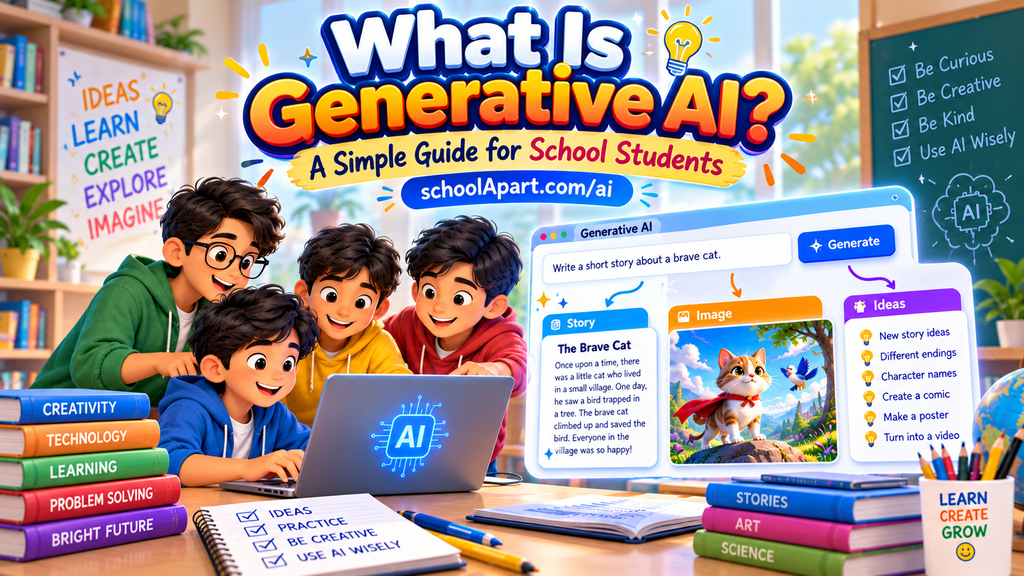
Generative AI is a type of Artificial Intelligence that can generate content such as text, images, audio and video.
It can help students explore ideas, understand difficult topics, practise writing and experiment with creativity.
However, Generative AI is not perfect. Its output may contain mistakes, and using it without thinking can reduce opportunities to learn independently.
The best approach is to use AI as a learning assistant while remaining curious, creative, thoughtful and responsible.
💡 Understand AI. Use AI. Create with AI. Think Critically About AI. Use AI Responsibly.
That is how students can make Generative AI a useful part of their learning journey.
❓ Frequently Asked Questions
1. What is Generative AI in simple words?
Generative AI is a type of Artificial Intelligence that can create content such as text, images, audio or video based on patterns learned during training and the inputs it receives.
2. What are some examples of Generative AI?
Examples include systems that generate stories, summarize text, create images from descriptions, produce synthetic audio or generate video. The capabilities vary between tools.
3. What is the difference between AI and Generative AI?
Artificial Intelligence is the broader field of technology. Generative AI is a category of AI designed to generate content. Other AI systems may classify information, recognize objects or make predictions instead.
4. How does Generative AI work?
Many Generative AI models are trained on data to learn patterns. When a user provides a prompt, the model processes the input and generates content based on its learned patterns and design.
5. Can students use Generative AI for studying?
Yes. Students can use Generative AI to explore explanations, brainstorm ideas, practise writing and generate practice questions. They should verify important information and follow school rules.
6. Can Generative AI create images?
Yes. Some Generative AI systems can create images from text descriptions or other inputs. The quality and suitability of the results depend on the system and the instructions provided.
7. Can Generative AI give wrong answers?
Yes. Generative AI can produce incorrect, incomplete or misleading information. Students should check important facts using reliable sources.
8. Does Generative AI think like humans?
No. It can generate content that appears creative or intelligent, but it does not experience the world in the same way humans do. Human judgement and personal experience remain important.
9. Is Generative AI safe for school students?
It depends on the tool, the student’s age, the activity and how the tool is used. Students should follow age requirements, protect personal information and seek guidance from parents or teachers when necessary.
10. Should students use Generative AI to complete all their homework?
No. AI should support learning rather than replace it. Students should understand their assignments, follow teacher instructions and complete their work honestly.
11. What is an AI prompt?
An AI prompt is an instruction, question or other input provided to an AI system. A clear prompt can help a system produce a more relevant output, although it cannot guarantee accuracy.
12. Why should students learn about Generative AI?
Learning about Generative AI helps students understand modern technology, explore creative possibilities, evaluate generated information and develop responsible AI habits.

Leave a Reply