
Learn what Artificial Intelligence (AI) is in this simple guide for school students. Understand AI, Generative AI, everyday AI uses, limitations and responsible AI use.
🤖 What Is Artificial Intelligence (AI)? A Simple Guide for School Students
Artificial Intelligence, commonly called AI, is one of the most important technologies shaping the world today. Students may already use AI-powered technology every day without realizing it.
When a search engine shows useful results 🔎, a video platform recommends a video 🎬, a phone recognizes a face 📱, or an AI chatbot answers a question 💬, Artificial Intelligence may be involved.
But what exactly is AI?
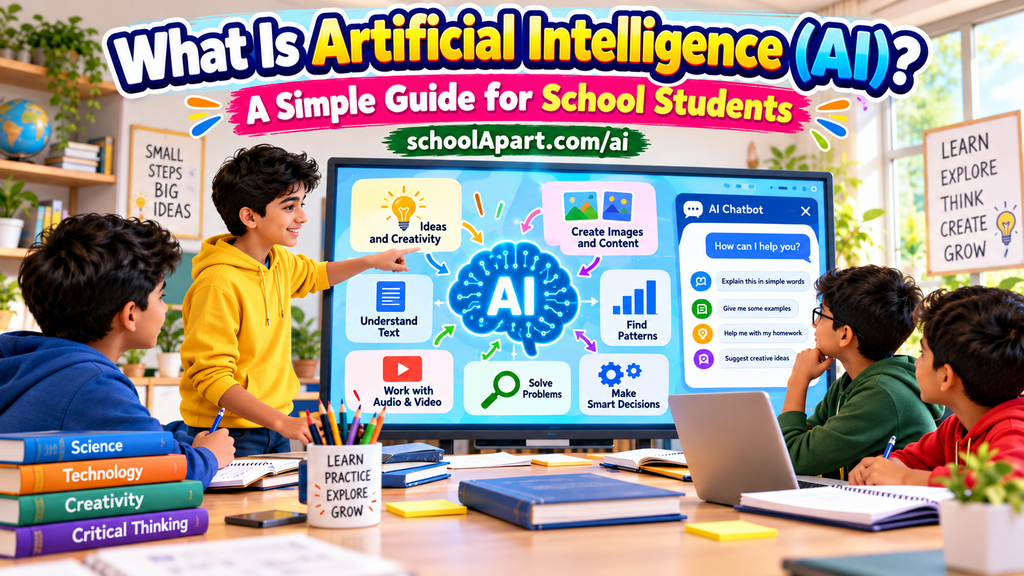
Artificial Intelligence (AI) is a technology that allows computer systems to perform certain tasks that can involve abilities such as understanding information, recognizing patterns, generating content, making predictions and responding to questions.
For school students, learning about AI is not only about learning how to use AI tools. It is also about understanding what AI can do, what its limitations are, and how to use it responsibly.
💡 SchoolApart AI Principle
AI should not replace a student’s thinking. It should support learning, creativity, problem-solving and productivity.
🤖 What Is Artificial Intelligence?
Artificial Intelligence (AI) is a field of technology that involves creating computer systems that can perform tasks requiring abilities such as learning from information, recognizing patterns, understanding language, generating content and making decisions or predictions.
💡 In simple words:
AI is technology that enables computers to perform certain tasks in ways that can appear intelligent.
AI does not think exactly like a human being.
Instead, different AI systems are designed and trained to perform particular types of tasks.
For example, one AI system may recognize objects in images 🖼️, while another may generate text ✍️ or answer questions 💬.
🧩 A Simple Example of AI
Imagine showing a computer thousands of pictures of cats 🐱 and dogs 🐶.
The computer can be trained using these examples to identify patterns associated with cats and dogs.
Later, when it receives a new picture, an AI system may analyze the image and predict whether it contains a cat or a dog.
🔄 The basic idea:
Pictures → Learning from examples → Recognizing patterns → Prediction
This is a simple example of how AI can use patterns in information to produce an output.
The computer is not thinking about cats and dogs in exactly the same way a human does. It is processing information using algorithms and a model designed for the task.
⚙️ How Does AI Work?
AI systems can be complicated, but students can understand the basic idea through a simple process:
📥 Input → 🧠 Processing → 🔎 Pattern Recognition → 📤 Output
For example:
📥 Input: A question from a student
⬇️
🧠 AI processing: The AI analyzes the question using its trained model.
⬇️
📤 Output: The AI generates a response.
Different AI systems work differently, so there is no single process that explains every type of AI.
However, many modern AI systems depend on large amounts of data, algorithms and trained models to perform their tasks.
📚 Want to understand this in more detail?
SchoolApart will explore how Artificial Intelligence works in a separate article.
🌍 Where Do Students See AI?
AI is not limited to robots 🤖 or futuristic machines.
Students may encounter AI in many everyday technologies.
🔎 Search Engines
Search engines use sophisticated systems to understand queries and provide relevant results.
🎬 Video and Music Recommendations
Streaming platforms can analyze patterns in what people watch or listen to and recommend other content.
🗣️ Voice Assistants
Voice-based systems can process spoken language and respond to requests.
📱 Face and Image Recognition
Some devices and applications can recognize faces, objects or other visual patterns.
🌐 Translation Tools
AI-powered systems can help translate text between languages.
💬 AI Chatbots
Generative AI systems and chatbots can answer questions, explain concepts, summarize information and generate different types of content.
📚 Educational Applications
Some learning platforms use AI to personalize practice, provide feedback or adapt learning activities.
💡 Did You Know?
You may already be interacting with AI several times a day without realizing it.
🚀 What Can AI Do?
AI can perform many different tasks depending on how it has been designed and trained.
Some examples include:
- 🔎 Recognizing patterns
- 📊 Processing large amounts of information
- 💬 Understanding and generating language
- 🖼️ Recognizing images
- 📈 Making predictions
- 🎯 Recommending content
- 🌐 Translating languages
- ✍️ Generating text
- 🎨 Generating images and other media
- 💡 Helping users brainstorm ideas
- 📚 Providing explanations
- 🧩 Assisting with certain problem-solving tasks
The abilities of an AI system depend on the technology behind it.
⚠️ Remember: Not every AI system can perform every task.
✨ What Is Generative AI?
Generative AI is a type of AI that can generate new content based on patterns learned from its training.
Depending on the system, Generative AI can produce:
- ✍️ Text
- 🎨 Images
- 🎵 Audio
- 🎬 Video
- 💻 Code
- 📄 Other forms of content
For example, an AI system may generate a short story from a user’s instruction or create an image based on a text description.
Generative AI has become especially important for students because it can be used for learning, brainstorming and creative activities.
⚠️ But there is something important to remember:
AI-generated content may contain mistakes.
So students should check important information instead of automatically assuming that an AI answer is correct.
🤖 Is AI the Same as a Robot?
No.
AI and robots are not the same thing.
🤖 Robot
A robot is a physical machine that can interact with the physical world.
🧠 AI
AI is a technology that enables computer systems to perform certain tasks involving capabilities such as pattern recognition, language processing or prediction.
A robot may use AI, but AI does not require a physical robot.
For example, an AI chatbot can exist entirely as software without having a physical body.
💡 Easy way to remember:
Robot = Physical machine
AI = Technology that can perform certain intelligent tasks
🧠 Is AI the Same as Human Intelligence?
No.
AI can perform impressive tasks, but that does not mean AI has human intelligence in exactly the same way people do.
Humans can experience emotions ❤️, develop personal experiences, understand social situations, form relationships and make judgements based on many different aspects of life.
AI systems operate using their design, data, algorithms and models.
Therefore, students should avoid thinking of AI as simply a human brain inside a computer.
💡 A better way to understand AI:
AI is a powerful technology designed to perform particular tasks, not a replacement for human thinking.
⚠️ Can AI Make Mistakes?
Yes!
AI systems can produce incorrect, incomplete or misleading information.
This can happen for different reasons, including limitations in the model, the information available to it, the way a question is asked, or the nature of the task.
Generative AI can sometimes produce an answer that sounds confident but is actually incorrect.
🔎 What should students do?
Students should learn to:
- ❓ Question AI-generated information
- ✅ Check important facts
- 📚 Compare information with reliable sources
- 👩🏫 Ask teachers when they are unsure
- 📖 Use textbooks and trusted educational resources
- 🚫 Avoid blindly copying AI-generated answers
⚠️ Important:
Using AI responsibly includes knowing when not to trust an answer without checking it.
📚 Why Should School Students Learn About AI?
AI is becoming increasingly important in education, technology, creativity and many areas of everyday life.
Learning about AI can help students develop:
- 🧠 Critical thinking
- 🧩 Problem-solving skills
- 🎨 Creativity
- ❓ Better questioning skills
- 🔎 Information evaluation skills
- 💻 Technology awareness
- 🛡️ Responsible digital habits
Students do not need to become AI engineers to benefit from AI literacy.
Understanding the basic ideas behind AI can help them become more confident and responsible technology users.
🎓 How Can Students Use AI?
AI can be useful as a learning assistant when students use it thoughtfully.
For example, students can use AI to:
- 📚 Ask for another explanation of a difficult concept
- 💡 Brainstorm ideas
- 📝 Practice questions
- 🧠 Create revision questions
- 🔎 Explore a topic
- 📋 Organize ideas
- 💭 Improve understanding
- 📌 Get examples
- 🧩 Work through a learning problem step by step
The important point is that students should remain actively involved.
❌ Less useful approach
“Give me the answer.”
✅ Better learning approach
“Explain how to solve this problem step by step and then give me a similar problem to try myself.”
The second approach gives the student an opportunity to understand and practice.
💡 AI Should Support Student Thinking
SchoolApart’s AI section follows a simple principle:
🧠 AI should support a student’s learning, creativity, problem-solving and productivity—not replace the student’s thinking.
Students can use AI to explore ideas, ask questions and learn new concepts.
But students should still:
🧠 Think → ❓ Question → 🔎 Check → ✏️ Practice → 🎨 Create → 🔄 Improve
This is much more valuable than simply:
💬 Ask AI → 📋 Copy → ✅ Submit
🌟 The goal of AI education
The goal is not to make students dependent on AI.
The goal is to help students become:
🧠 Knowledgeable + 🎨 Creative + 🔎 Critical + 🛡️ Responsible AI Users
🗺️ The SchoolApart AI Learning Journey
This article is the first step in the SchoolApart AI learning journey.
Students can gradually move through five stages:
1️⃣ 🧠 Understand AI
Learn what Artificial Intelligence is and how it is used.
2️⃣ 🛠️ Use AI
Learn how AI can support learning and everyday tasks.
3️⃣ 🎨 Create with AI
Explore how AI can help with creativity and ideas.
4️⃣ 🔎 Think Critically About AI
Learn how to question, check and evaluate AI-generated information.
5️⃣ 🛡️ Use AI Responsibly
Learn about safety, privacy, honesty and responsible AI use.
👉 Explore the complete AI for School Students learning hub to continue this journey.
🌟 Final Thoughts
Artificial Intelligence is not simply a futuristic idea.
It is already part of many technologies students use today.
Understanding AI can help students make better decisions about technology and use AI more effectively.
But learning AI should never mean giving up independent thinking.
The most valuable skill is not simply knowing how to ask AI for an answer.
It is knowing:
💡 When to use AI
🛠️ How to use AI
🔎 How to question its answers
✅ How to check information
🧠 When human thinking should take the lead
🌟 Understand AI → Use AI → Create with AI → Think Critically About AI → Use AI Responsibly
That is the approach SchoolApart follows for AI education.
❓ Frequently Asked Questions
🤖 What is Artificial Intelligence in simple words?
Artificial Intelligence, or AI, is technology that allows computer systems to perform certain tasks that can involve abilities such as recognizing patterns, understanding language, generating content, making predictions and processing information.
🤖 Is AI a robot?
No. AI is a technology, while a robot is a physical machine. Robots can use AI, but many AI systems exist entirely as software.
🧠 Can AI think like humans?
AI can perform some tasks that appear intelligent, but it does not think and experience the world exactly like a human being. AI systems work according to their design, data, algorithms and models.
⚠️ Can AI make mistakes?
Yes. AI can produce incorrect or misleading information. Students should verify important information using reliable sources.
✨ What is Generative AI?
Generative AI is a type of AI that can create new content such as text, images, audio or other media based on patterns learned during training.
📚 Why should students learn AI?
AI literacy can help students understand modern technology, use AI more effectively, develop critical thinking and learn how to use AI safely and responsibly.
🎓 Can students use AI for studying?
Yes. AI can be used as a learning assistant for activities such as explanations, brainstorming, practice questions and revision. Students should remain actively involved and follow their school’s rules about AI use.
🚫 Should students depend on AI for every answer?
No. AI should support learning rather than replace independent thinking. Students should question, verify and understand the information they receive from AI.
💡 What is the most important AI skill for students?
One important skill is AI literacy—understanding what AI can do, recognizing its limitations, asking useful questions, checking its information and using it responsibly.
📖 Where can students learn more about AI?
Students can continue with the SchoolApart AI learning hub, which covers AI basics, learning with AI, creativity, prompting, critical thinking and responsible AI use.


Leave a Reply