

Practise abacus addition and subtraction with beginner-friendly questions, step-by-step examples, mixed exercises, and answers to check your work.
Abacus Addition and Subtraction Practice Questions
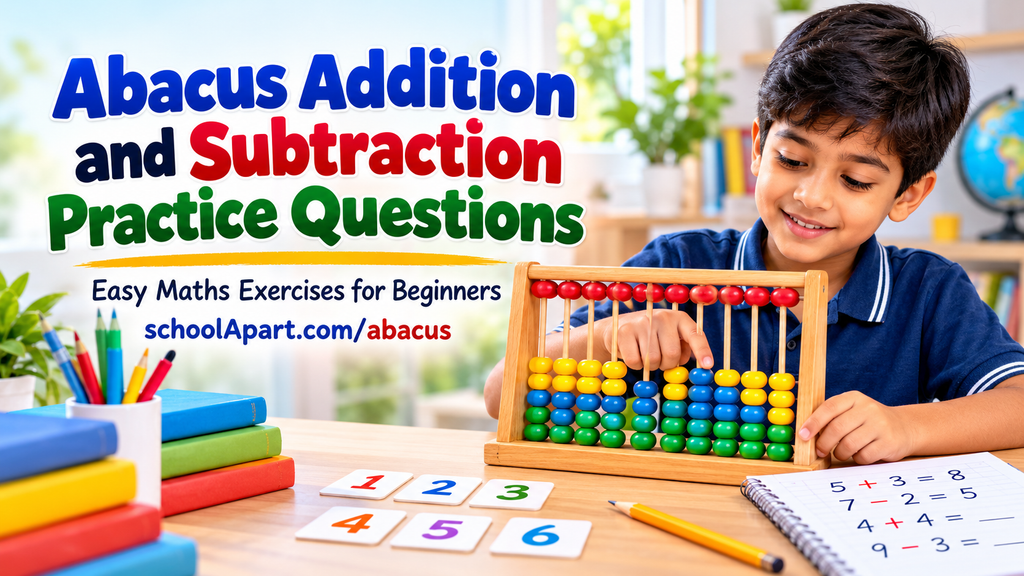
Learning abacus addition and subtraction becomes easier when students practise regularly. After learning how to represent numbers and perform basic calculations, the next step is to solve simple questions independently.
This guide provides abacus addition and subtraction practice questions for beginners, including easy sums, subtraction exercises, mixed calculations, worked examples, and an answer key.
Students can use a physical abacus to solve the questions. Learners who have already started mental abacus practice can also try solving some questions without moving physical beads.
The questions progress from easy to more challenging calculations. Use the bead arrangement and calculation method taught in your abacus course, as rules can differ between abacus systems.
What You Need Before Starting
Before attempting these exercises, make sure you understand the following basics:
- How to represent numbers on an abacus
- How to read numbers shown by the beads
- How place value works
- How to perform basic addition
- How to perform basic subtraction
If you are new to abacus learning, begin with these SchoolApart guides:
- What Is Abacus? A Complete Beginner’s Guide for Kids
- Abacus Numbers 1–9: Learn Numbers with an Abacus
- Abacus Place Value: Ones, Tens and Hundreds
- How to Read Numbers on an Abacus
Once you understand these concepts, you are ready to practise addition and subtraction.
How to Practise Addition and Subtraction on an Abacus
Follow these steps when solving a question.
- Set the first number on your abacus.
- For addition, add the next number using the method taught in your course.
- For subtraction, subtract the required value from the number shown.
- Read the final bead arrangement.
- Write down the answer and check it using ordinary arithmetic.
For example, to solve 4 + 3, represent 4 first and then add 3. The final result is 7.
To solve 8 − 3, represent 8 and subtract 3. The final result is 5.
These examples show the arithmetic results. The exact bead movements depend on the abacus system and the method you have learned.
Easy Abacus Addition Practice Questions
Start with small numbers. These questions help beginners become comfortable with addition.
Level 1: Basic Addition
Solve each question using your abacus.
- 2 + 3 = _____
- 4 + 1 = _____
- 5 + 2 = _____
- 3 + 4 = _____
- 6 + 1 = _____
- 2 + 5 = _____
- 4 + 4 = _____
- 7 + 2 = _____
- 5 + 3 = _____
- 6 + 3 = _____
Practice tip: Represent the first number carefully before adding the second number. Read the final bead position rather than guessing the answer.
Level 2: Addition with Larger Numbers
When you are comfortable with small sums, try adding two-digit numbers.
- 12 + 5 = _____
- 14 + 3 = _____
- 21 + 6 = _____
- 23 + 4 = _____
- 15 + 12 = _____
- 24 + 13 = _____
- 31 + 16 = _____
- 42 + 15 = _____
- 26 + 22 = _____
- 35 + 14 = _____
These questions help you practise addition across ones and tens. Use the correct place-value positions on your abacus.
Level 3: Three-Number Addition
Try adding three numbers in each question.
- 2 + 3 + 1 = _____
- 4 + 2 + 3 = _____
- 5 + 1 + 2 = _____
- 6 + 2 + 1 = _____
- 10 + 5 + 3 = _____
- 12 + 4 + 2 = _____
- 15 + 3 + 1 = _____
- 21 + 5 + 2 = _____
Work through one number at a time. After adding each number, check the bead arrangement before continuing.
Easy Abacus Subtraction Practice Questions
Subtraction helps learners understand how numbers decrease when a quantity is taken away.
Level 1: Basic Subtraction
Solve these questions using your abacus.
- 5 − 2 = _____
- 7 − 3 = _____
- 8 − 4 = _____
- 9 − 2 = _____
- 6 − 1 = _____
- 7 − 5 = _____
- 9 − 4 = _____
- 8 − 3 = _____
- 6 − 2 = _____
- 5 − 1 = _____
Practice tip: Begin with the first number and subtract the second number carefully. Make sure the final bead arrangement represents the remaining value.
Level 2: Subtraction with Larger Numbers
Once you can solve basic subtraction, try these two-digit questions.
- 14 − 3 = _____
- 18 − 5 = _____
- 25 − 4 = _____
- 29 − 7 = _____
- 36 − 12 = _____
- 47 − 15 = _____
- 58 − 24 = _____
- 69 − 32 = _____
- 75 − 23 = _____
- 84 − 41 = _____
Pay attention to the tens and ones positions. If a calculation requires exchanging values between place positions, follow the borrowing or complement method taught in your course.
Level 3: Subtraction with Three Numbers
Solve these questions from left to right.
- 9 − 2 − 3 = _____
- 8 − 1 − 4 = _____
- 15 − 3 − 2 = _____
- 20 − 5 − 4 = _____
- 25 − 2 − 3 = _____
- 32 − 10 − 5 = _____
- 46 − 12 − 4 = _____
- 58 − 20 − 8 = _____
For example, in 9 − 2 − 3, first calculate 9 − 2 = 7. Then subtract 3 from 7 to get 4.
Mixed Abacus Addition and Subtraction
Now practise both operations together. Read each question carefully before starting.
- 4 + 3 − 2 = _____
- 8 − 3 + 2 = _____
- 5 + 4 − 1 = _____
- 9 − 4 + 3 = _____
- 12 + 5 − 3 = _____
- 18 − 6 + 4 = _____
- 21 + 7 − 5 = _____
- 30 − 8 + 6 = _____
- 24 + 13 − 7 = _____
- 45 − 12 + 8 = _____
- 36 + 14 − 20 = _____
- 57 − 23 + 11 = _____
- 62 + 15 − 27 = _____
- 74 − 31 + 16 = _____
- 85 + 12 − 34 = _____
Important: Solve the operations in the order shown, moving from left to right. For example, calculate the addition first when it appears first, then perform the subtraction on the resulting value.
Challenge Questions
These questions are for students who can already perform basic addition and subtraction with confidence.
- 125 + 34 = _____
- 146 − 52 = _____
- 238 + 41 = _____
- 365 − 123 = _____
- 214 + 135 = _____
- 428 − 216 = _____
- 156 + 72 − 48 = _____
- 320 − 85 + 24 = _____
- 245 + 136 − 121 = _____
- 500 − 175 + 63 = _____
Use an abacus with enough rods for the numbers you are practising. If you are following a structured abacus course, make sure these calculations match the level and methods you have already learned.
Answer Key
Finish each exercise before checking the answers. If an answer is incorrect, solve that question again on your abacus and identify where the bead arrangement changed incorrectly.
Level 1: Basic Addition Answers
| Question | Answer |
|---|---|
| 2 + 3 | 5 |
| 4 + 1 | 5 |
| 5 + 2 | 7 |
| 3 + 4 | 7 |
| 6 + 1 | 7 |
| 2 + 5 | 7 |
| 4 + 4 | 8 |
| 7 + 2 | 9 |
| 5 + 3 | 8 |
| 6 + 3 | 9 |
Level 2: Larger Addition Answers
| Question | Answer |
|---|---|
| 12 + 5 | 17 |
| 14 + 3 | 17 |
| 21 + 6 | 27 |
| 23 + 4 | 27 |
| 15 + 12 | 27 |
| 24 + 13 | 37 |
| 31 + 16 | 47 |
| 42 + 15 | 57 |
| 26 + 22 | 48 |
| 35 + 14 | 49 |
Level 3: Three-Number Addition Answers
| Question | Answer |
|---|---|
| 2 + 3 + 1 | 6 |
| 4 + 2 + 3 | 9 |
| 5 + 1 + 2 | 8 |
| 6 + 2 + 1 | 9 |
| 10 + 5 + 3 | 18 |
| 12 + 4 + 2 | 18 |
| 15 + 3 + 1 | 19 |
| 21 + 5 + 2 | 28 |
Basic Subtraction Answers
| Question | Answer |
|---|---|
| 5 − 2 | 3 |
| 7 − 3 | 4 |
| 8 − 4 | 4 |
| 9 − 2 | 7 |
| 6 − 1 | 5 |
| 7 − 5 | 2 |
| 9 − 4 | 5 |
| 8 − 3 | 5 |
| 6 − 2 | 4 |
| 5 − 1 | 4 |
Larger Subtraction Answers
| Question | Answer |
|---|---|
| 14 − 3 | 11 |
| 18 − 5 | 13 |
| 25 − 4 | 21 |
| 29 − 7 | 22 |
| 36 − 12 | 24 |
| 47 − 15 | 32 |
| 58 − 24 | 34 |
| 69 − 32 | 37 |
| 75 − 23 | 52 |
| 84 − 41 | 43 |
Three-Number Subtraction Answers
| Question | Answer |
|---|---|
| 9 − 2 − 3 | 4 |
| 8 − 1 − 4 | 3 |
| 15 − 3 − 2 | 10 |
| 20 − 5 − 4 | 11 |
| 25 − 2 − 3 | 20 |
| 32 − 10 − 5 | 17 |
| 46 − 12 − 4 | 30 |
| 58 − 20 − 8 | 30 |
Mixed Calculation Answers
| Question | Answer |
|---|---|
| 4 + 3 − 2 | 5 |
| 8 − 3 + 2 | 7 |
| 5 + 4 − 1 | 8 |
| 9 − 4 + 3 | 8 |
| 12 + 5 − 3 | 14 |
| 18 − 6 + 4 | 16 |
| 21 + 7 − 5 | 23 |
| 30 − 8 + 6 | 28 |
| 24 + 13 − 7 | 30 |
| 45 − 12 + 8 | 41 |
| 36 + 14 − 20 | 30 |
| 57 − 23 + 11 | 45 |
| 62 + 15 − 27 | 50 |
| 74 − 31 + 16 | 59 |
| 85 + 12 − 34 | 63 |
Challenge Question Answers
| Question | Answer |
|---|---|
| 125 + 34 | 159 |
| 146 − 52 | 94 |
| 238 + 41 | 279 |
| 365 − 123 | 242 |
| 214 + 135 | 349 |
| 428 − 216 | 212 |
| 156 + 72 − 48 | 180 |
| 320 − 85 + 24 | 259 |
| 245 + 136 − 121 | 260 |
| 500 − 175 + 63 | 388 |
How to Improve Your Abacus Practice
The goal is to develop accurate calculation habits before trying to solve questions quickly.
1. Practise a Little Every Day
Set aside a short, regular practice period that suits your learning level. Solve a few questions carefully instead of rushing through a large worksheet.
2. Focus on Accuracy First
If an answer is incorrect, repeat the calculation and check the bead positions. Try to understand the mistake before moving to the next question.
3. Keep a Practice Record
Write down the date, number of questions attempted, correct answers, and questions that need more practice. This makes it easier to notice which skills need attention.
4. Practise Different Question Types
Do not practise only addition or only subtraction. Once you are comfortable with both, include mixed calculations so you learn to recognise the operation required by each question.
5. Progress Gradually
Move from single-digit numbers to two-digit numbers, then to mixed operations and larger calculations. Do not move to a harder level simply because you can solve one question correctly.
6. Try Mental Practice When Ready
If you are learning mental abacus, try imagining the bead movements after you can solve the same type of calculation reliably with a physical abacus.
For more guidance, read Mental Abacus: How to Calculate Without a Physical Abacus.
FAQ
1. How can beginners practise abacus addition?
Beginners can start with single-digit sums, represent the first number on the abacus, add the next number using their learned method, and read the final result. Gradually progress to larger numbers.
2. How can I practise abacus subtraction?
Represent the starting number, subtract the required value according to your abacus method, and read the remaining value. Start with small numbers before practising two-digit subtraction.
3. How many abacus questions should a student practise daily?
There is no fixed number that suits every learner. Begin with a manageable set of questions that can be solved accurately, then adjust the amount as the learner becomes more comfortable.
4. Should students use an abacus or solve questions mentally?
Beginners should use the learning method they have been taught. A physical abacus helps learners practise bead positions, while mental practice is appropriate when they are ready to imagine those movements.
5. Are these questions suitable for school students?
Yes. These exercises begin with simple arithmetic and gradually introduce larger numbers. Students should select the section that matches their current abacus skills.
6. What should I learn after addition and subtraction?
After mastering the basics, continue practising mixed calculations and number representation. Learners following a structured course can then move to more advanced topics, such as multiplication, when their instructor considers them ready.
7. Can I use these questions without a physical abacus?
Yes. You can use them for ordinary arithmetic practice or mental calculation. However, if your goal is to learn a specific abacus method, practise with the appropriate abacus as well.
Start Your Next Abacus Practice Session
Regular practice helps you become more familiar with numbers, place value, and calculation steps. Work through the questions at your own pace, check your answers, and repeat the exercises that you find difficult.
Continue learning with the SchoolApart guides:
- Abacus Addition for Beginners
- Abacus Subtraction for Beginners
- How to Learn Abacus Step by Step for Beginners
- SchoolApart Abacus Learning Hub
Choose a small set of questions, practise carefully, and build your skills one step at a time.







Leave a Reply