

Learn what mental abacus is and how students can gradually learn to visualize an abacus and perform calculations without a physical abacus.
Mental Abacus: How to Calculate Without a Physical Abacus
Learning to use a physical abacus is only the beginning of abacus learning. With regular practice, students can gradually learn to visualize the abacus in their mind and perform calculations without physically moving the beads.
This skill is commonly known as mental abacus.
Mental abacus combines number understanding, visualization, calculation and concentration. It should not be treated as a shortcut or something beginners need to learn immediately. Instead, it develops gradually after a learner becomes comfortable using a physical abacus.
In this guide, you will learn what mental abacus means, how it works, when to start learning it, and how beginners can practice it step by step.
What Is Mental Abacus?
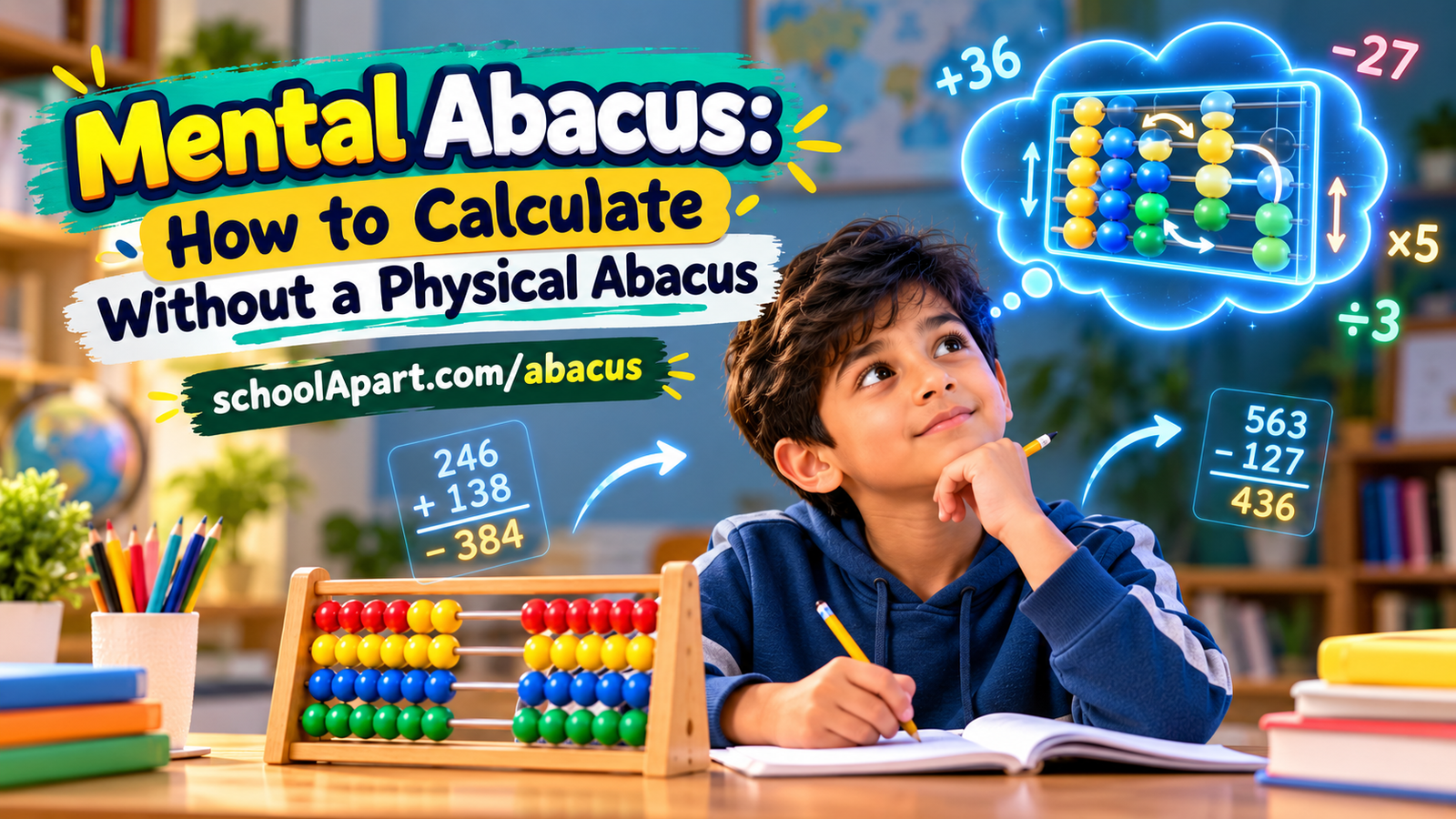
Mental abacus is the ability to visualize an abacus mentally and use that mental image to perform calculations without physically touching an abacus.
Instead of moving real beads, the learner imagines the beads moving.
For example, when solving:
3 + 2 = 5
a beginner may physically move beads on an abacus.
With mental abacus practice, the learner gradually learns to imagine those bead movements and calculate the answer mentally.
The physical abacus becomes a visual model that the learner can eventually reproduce in their mind.
How Does Mental Abacus Work?
Mental abacus learning generally develops from physical practice to mental visualization.
The basic progression is:
Physical Abacus → Visualization → Mental Bead Movement → Mental Calculation
At first, the learner needs the physical abacus to understand how numbers are represented.
After enough practice, the learner begins to remember the position and movement of the beads.
Eventually, the learner can imagine the abacus without having it in front of them.
The calculation is then performed using the imagined bead movements.
Can You Learn Mental Abacus Without a Physical Abacus?
For beginners, a physical abacus is very useful for building the foundation.
Mental abacus is generally developed after learning:
- Abacus structure
- Bead values
- Number representation
- Place value
- Number reading
- Basic addition
- Basic subtraction
Trying to start directly with mental abacus without understanding how a physical abacus works can make the learning process more difficult.
A better approach is to first become comfortable with the physical abacus and then gradually reduce dependence on it.
Mental Abacus vs Physical Abacus
The physical abacus and mental abacus are not two completely different calculation methods.
The physical abacus provides the foundation for mental visualization.
| Physical Abacus | Mental Abacus |
|---|---|
| Uses a real abacus | Uses an imagined abacus |
| Beads are physically moved | Bead movements are visualized |
| Helpful for beginners | More advanced skill |
| Provides visual feedback | Relies on mental visualization |
| Builds foundational skills | Builds mental calculation ability |
The goal is not necessarily to replace the physical abacus immediately.
Instead, physical practice helps the learner develop the mental model needed for visualization.
When Should You Start Learning Mental Abacus?
There is no single age or fixed number of days after which every learner should start mental abacus.
The important factor is foundation.
A learner should first be comfortable with:
- Recognizing numbers
- Representing numbers on an abacus
- Understanding place value
- Reading numbers from an abacus
- Performing basic addition
- Performing basic subtraction
Once these skills become reasonably comfortable, mental visualization can be introduced gradually.
How to Learn Mental Abacus Step by Step
Step 1: Master the Physical Abacus
Start by becoming comfortable with a physical abacus.
Learn how to:
- Represent numbers
- Read numbers
- Move beads correctly
- Understand place value
- Perform simple calculations
Do not rush into mental calculation.
The physical abacus provides the visual foundation for everything that comes later.
Step 2: Look at the Bead Positions Carefully
When solving a calculation, pay attention to the position of the beads.
Try to notice:
- Which beads are active
- Which beads are inactive
- Which column represents each place value
- How the number changes when a bead moves
This helps your brain create a stronger visual representation of the abacus.
Step 3: Perform Simple Calculations Slowly
Start with very simple calculations.
For example:
2 + 1 = 3
4 + 2 = 6
7 − 3 = 4
Use the physical abacus and focus on the movement of the beads.
Accuracy is more important than speed.
Step 4: Close Your Eyes and Visualize
Once you are comfortable with simple calculations, try visualizing the abacus.
You can:
- Look at the abacus.
- Represent a simple number.
- Observe the bead positions.
- Close your eyes.
- Try to imagine the same abacus.
At first, the mental image may disappear quickly.
That is normal.
With practice, the visualization can gradually become clearer.
Step 5: Imagine Moving the Beads
After you can visualize the abacus, imagine moving the beads.
For example:
3 + 2
Imagine the number 3 on the abacus.
Then mentally visualize the additional bead movements required to add 2.
Finally, read the resulting number.
Start with very small calculations.
Step 6: Practice Without Looking at the Abacus
Once visualization becomes easier, try solving simple calculations without looking at the physical abacus.
For example:
2 + 3 = ?
5 + 2 = ?
8 − 3 = ?
After answering mentally, check the result using the physical abacus or another reliable method.
This gives you feedback and helps identify mistakes.
Step 7: Gradually Increase the Difficulty
Do not jump from single-digit calculations to complicated problems.
Increase difficulty gradually.
A possible progression is:
Single-digit addition
↓
Single-digit subtraction
↓
Two-number calculations
↓
Mixed addition and subtraction
↓
Larger numbers
↓
Longer calculation sequences
The exact progression can vary depending on the learner.
Mental Abacus Practice for Beginners
Beginners should start with short and simple exercises.
Exercise 1: Simple Addition
Try solving mentally:
2 + 3 = ?
4 + 1 = ?
5 + 2 = ?
3 + 4 = ?
Exercise 2: Simple Subtraction
Try:
5 − 2 = ?
7 − 3 = ?
9 − 4 = ?
8 − 5 = ?
Exercise 3: Mixed Calculation
After becoming comfortable with individual operations, try:
3 + 2 − 1 = ?
5 + 3 − 2 = ?
7 − 2 + 3 = ?
These exercises help learners gradually become comfortable with changing bead positions mentally.
How to Improve Mental Abacus Skills
Mental abacus is a skill that develops through repeated practice.
Here are some useful habits.
Practice Regularly
Short, consistent practice can be more useful than occasional long sessions.
Focus on Accuracy
Make sure your calculations are correct before trying to increase speed.
Visualize Clearly
Try to imagine the abacus structure and bead positions as clearly as possible.
Start Small
Use simple numbers and short calculations before moving to more complex problems.
Check Your Answers
Use the physical abacus or another calculation method to verify your answers while learning.
Increase Difficulty Gradually
Once a particular level becomes comfortable, introduce slightly more challenging calculations.
Mental Abacus and Speed Calculation
Speed can improve with practice, but it should not be the first goal.
A useful learning sequence is:
Understanding → Accuracy → Visualization → Consistency → Speed
If a learner tries to calculate quickly before developing a clear mental image of the abacus, mistakes can increase.
The aim is to make the mental process more natural over time.
Mental Abacus for Kids
Children can gradually develop mental abacus skills after learning the basic physical abacus techniques.
For school students, a simple progression can be:
Learn the Abacus
→ Understand Numbers
→ Learn Place Value
→ Practice Addition
→ Practice Subtraction
→ Visualize the Abacus
→ Perform Simple Mental Calculations
→ Increase Difficulty
The learning pace should match the child’s existing skills.
There is no need to rush into advanced mental calculations.
Common Mistakes When Learning Mental Abacus
Starting Too Early
Mental abacus should build on a strong physical-abacus foundation.
Trying to Memorize Answers
The goal is to visualize the abacus and understand the calculation rather than simply memorize answers.
Focusing Only on Speed
Speed should come after accuracy and understanding.
Skipping Practice
Visualization becomes easier through repeated practice.
Moving to Difficult Problems Too Quickly
If simple calculations are not yet comfortable, increasing the difficulty can create unnecessary confusion.
Does Mental Abacus Mean Doing Mental Math?
Mental abacus and mental math are related, but they are not exactly the same thing.
Mental math is a broad term for performing calculations in your head using different strategies.
Mental abacus involves using a mentally visualized abacus as part of the calculation process.
So, mental abacus can be considered one approach to mental calculation.
For a broader comparison, see:
Abacus vs Mental Math: Which Is Better for Kids?
Mental Abacus vs Calculator
A calculator gives a numerical result electronically.
Mental abacus learning focuses on developing a calculation process based on number representation and visualization.
The two serve different purposes.
A calculator can be useful for quickly checking an answer, while mental abacus practice is a learning activity designed to develop calculation and visualization skills.
For children learning abacus, the purpose is not simply to compete with a calculator.
The goal is to develop mathematical skills through structured practice.
How Long Does It Take to Learn Mental Abacus?
There is no universal time required to develop mental abacus skills.
Progress depends on:
- Previous abacus experience
- Practice frequency
- Age and learning stage
- Calculation level
- Ability to visualize bead positions
- Consistency of practice
Some learners may become comfortable with basic visualization sooner than others.
Instead of focusing on a fixed number of days, it is better to measure progress by skills:
Can I visualize the abacus?
Can I imagine bead movements?
Can I solve simple calculations mentally?
Can I maintain accuracy as the calculations become longer?
A Simple Mental Abacus Learning Routine
A beginner can use a simple practice routine:
| Practice | Focus |
|---|---|
| 5 minutes | Review numbers and bead positions |
| 5 minutes | Physical abacus practice |
| 5 minutes | Visualization |
| 5 minutes | Simple mental calculations |
| 5 minutes | Check answers and review mistakes |
The duration can be adjusted according to the learner’s age and ability.
Consistency is more important than following an exact timetable.
Mental Abacus Learning Path
A complete learning path can look like this:
Stage 1 — Foundation
Understand the abacus → Learn beads → Learn numbers
Stage 2 — Number Skills
Place value → Represent numbers → Read numbers
Stage 3 — Basic Calculation
Addition → Subtraction
Stage 4 — Visualization
Imagine the abacus → Visualize bead positions → Imagine bead movements
Stage 5 — Mental Calculation
Simple addition → Simple subtraction → Mixed calculations
Stage 6 — Improvement
Accuracy → Consistency → Speed → More challenging calculations
This gradual progression helps learners develop mental abacus skills without skipping the necessary foundation.
Learn Mental Abacus with SchoolApart
SchoolApart’s Abacus Learning Hub is designed to guide students from basic abacus concepts toward calculation, practice and mental visualization.
If you are just starting, first follow:
Then return to this guide as you begin developing mental abacus skills.
The overall learning path is:
Learn the Physical Abacus → Practice Calculations → Develop Visualization → Learn Mental Abacus → Practice for Accuracy and Speed
For practical demonstrations, learners can also continue with the SchoolApart Abacus Course on YouTube.
Frequently Asked Questions
What is mental abacus?
Mental abacus is the ability to visualize an abacus mentally and use that visualization to perform calculations without physically moving the beads.
Can beginners learn mental abacus?
Yes, but beginners should first develop a strong understanding of the physical abacus, numbers, place value and basic calculations.
Can children learn mental abacus?
Yes. Children can gradually develop mental abacus skills through structured learning and regular practice.
Do I need a physical abacus to learn mental abacus?
A physical abacus is very useful during the early stages because it helps learners understand bead positions and movements. Mental visualization can then be developed gradually.
Is mental abacus the same as mental math?
Not exactly. Mental math is a broad term for calculations performed mentally, while mental abacus uses a visualized abacus as part of the calculation process.
How can I improve mental abacus speed?
First focus on accurate visualization and calculation. Once accuracy becomes consistent, gradually increase the difficulty and speed of practice.
How long does it take to learn mental abacus?
There is no fixed learning period. Progress depends on the learner’s previous experience, practice routine and ability to visualize the abacus.
Conclusion
Mental abacus is an advanced stage of abacus learning in which the learner gradually moves from a physical abacus to a mental image of the abacus.
The process should be gradual:
Physical Abacus → Visualization → Mental Bead Movement → Mental Calculation
Start with numbers and place value, build strong addition and subtraction skills, and then gradually introduce mental visualization.
Do not worry about speed in the beginning.
Understand first. Practice regularly. Build accuracy. Then develop speed.
Once the mental image becomes more familiar, learners can gradually perform calculations without physically touching an abacus.








Leave a Reply