

Learn abacus place value step by step. Understand ones, tens and hundreds on an abacus and learn how to represent two- and three-digit numbers.
Abacus Place Value: Ones, Tens and Hundreds
Place value is one of the most important concepts to understand when learning abacus.
After learning how to represent numbers 1–9, the next step is to understand how an abacus represents ones, tens, hundreds and larger numbers.
Abacus Beads and Their Functions Explained: A Beginner’s Guide
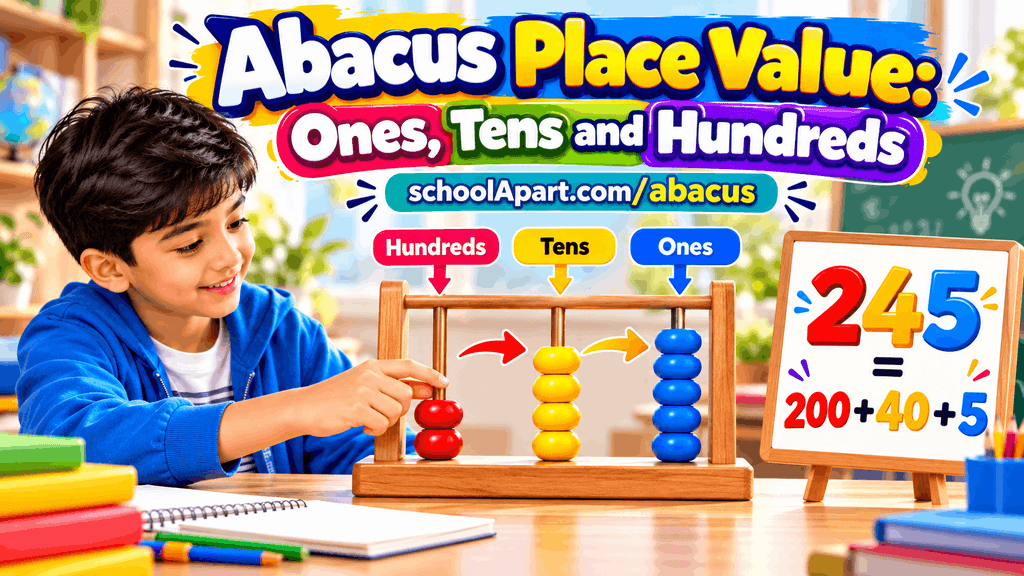
For example, the number 245 is not simply a collection of three digits. Each digit has a different place value:
- 2 hundreds = 200
- 4 tens = 40
- 5 ones = 5
So:
245 = 200 + 40 + 5
An abacus makes this concept visual because different columns represent different place values.
In this beginner-friendly guide, you will learn how place value works on an abacus and how to represent two- and three-digit numbers step by step.
What Is Place Value?
Place value tells us the value of a digit based on its position in a number.
Consider:
25
The digit 2 is in the tens place.
The digit 5 is in the ones place.
So:
25 = 2 tens + 5 ones
Or:
25 = 20 + 5
Now consider:
348
Here:
- 3 is in the hundreds place
- 4 is in the tens place
- 8 is in the ones place
Therefore:
348 = 300 + 40 + 8
Understanding this idea is essential for abacus learning.
How Does Place Value Work on an Abacus?
An abacus uses different vertical columns to represent different place values.
A simple place-value arrangement looks like this:
Hundreds | Tens | Ones
The rightmost column represents ones.
The column immediately to its left represents tens.
The next column to the left represents hundreds.
So:
Hundreds → Tens → Ones
This allows the abacus to represent multi-digit numbers.
Ones Place
The ones place is the starting point for single-digit numbers.
Numbers such as:
1, 2, 3, 4, 5, 6, 7, 8, 9
are represented in the ones column.
For example:
7 = 7 ones
When you learn numbers 1–9 on an abacus, you are primarily working with the ones place.
If you have not learned this yet, first read:
Abacus Numbers 1–9: Learn Numbers with an Abacus
Tens Place
The column to the left of the ones column represents tens.
One ten is equal to:
10 ones
Two tens equal:
20
Three tens equal:
30
And so on.
For example:
24
can be broken down as:
2 tens + 4 ones
or:
20 + 4
The tens column represents the 2, while the ones column represents the 4.
Hundreds Place
The column to the left of the tens column represents hundreds.
One hundred equals:
10 tens
or:
100 ones
For example:
326
can be broken down into:
3 hundreds + 2 tens + 6 ones
Therefore:
326 = 300 + 20 + 6
The three digits are represented in three different abacus columns.
Place Value Chart
A simple place value chart is:
| Place | Value |
|---|---|
| Hundreds | 100 |
| Tens | 10 |
| Ones | 1 |
Each position represents a ten-times increase as you move from right to left.
Ones → Tens → Hundreds
1 → 10 → 100
Understanding a Number on an Abacus
Let’s take the number:
245
Break it into place values:
2 hundreds + 4 tens + 5 ones
So:
245 = 200 + 40 + 5
On an abacus:
- Hundreds column → 2
- Tens column → 4
- Ones column → 5
The three columns together represent 245.
The important idea is that the same digit can have different values depending on its position.
For example:
- 2 in the ones place = 2
- 2 in the tens place = 20
- 2 in the hundreds place = 200
Why Is Place Value Important in Abacus Learning?
Place value is essential because abacus calculations are based on the position of numbers.
Without understanding place value, it becomes difficult to correctly represent:
- Two-digit numbers
- Three-digit numbers
- Addition
- Subtraction
- Multiplication
- Division
A strong understanding of place value makes later abacus lessons much easier.
How to Represent Two-Digit Numbers on an Abacus
Once you understand ones and tens, start practicing two-digit numbers.
For example:
Number 12
Break it down:
1 ten + 2 ones
So:
12 = 10 + 2
The tens column represents 1.
The ones column represents 2.
Number 35
Break it down:
3 tens + 5 ones
So:
35 = 30 + 5
The tens column represents 3.
The ones column represents 5.
Number 48
Break it down:
4 tens + 8 ones
So:
48 = 40 + 8
The tens column represents 4.
The ones column represents 8.
Practice Two-Digit Numbers
Try representing these numbers on your abacus:
14
23
37
45
58
62
76
89
For each number, identify:
Tens → Ones
For example:
58 → 5 tens + 8 ones
How to Represent Three-Digit Numbers
After becoming comfortable with two-digit numbers, move to hundreds.
For a three-digit number, use:
Hundreds → Tens → Ones
Number 125
Break it down:
1 hundred + 2 tens + 5 ones
So:
125 = 100 + 20 + 5
Number 246
Break it down:
2 hundreds + 4 tens + 6 ones
So:
246 = 200 + 40 + 6
Number 583
Break it down:
5 hundreds + 8 tens + 3 ones
So:
583 = 500 + 80 + 3
Practice Three-Digit Numbers
Try representing these numbers:
123
245
316
428
507
632
745
891
For each number, identify:
Hundreds → Tens → Ones
For example:
428 → 4 hundreds + 2 tens + 8 ones
What About Zero in Place Value?
Zero is also important in place value.
Consider:
205
This number contains:
- 2 hundreds
- 0 tens
- 5 ones
So:
205 = 200 + 0 + 5
The zero tells us that there are no tens.
Another example is:
340
This contains:
- 3 hundreds
- 4 tens
- 0 ones
So:
340 = 300 + 40 + 0
Understanding zero becomes important when reading larger numbers on an abacus.
Abacus Place Value and Number Reading
Once you understand place value, reading numbers from an abacus becomes easier.
Instead of looking at all the beads as one group, look at each column.
For example:
Hundreds | Tens | Ones
If the columns represent:
3 | 5 | 7
the number is:
357
Because:
3 hundreds + 5 tens + 7 ones = 357
This is the basic process of reading a multi-digit number on an abacus.
Abacus Place Value Practice
Practice 1: Identify the Place
For each number, identify the place of the highlighted digit.
24
The digit 2 is in the ______ place.
Answer: Tens
356
The digit 5 is in the ______ place.
Answer: Tens
781
The digit 7 is in the ______ place.
Answer: Hundreds
Practice 2: Expand the Number
Write each number using place values.
23 = 20 + 3
145 = 100 + 40 + 5
326 = 300 + 20 + 6
Now try:
57 = ?
284 = ?
619 = ?
Practice 3: Build the Number
Combine the place values.
3 tens + 4 ones = ?
Answer: 34
2 hundreds + 5 tens + 7 ones = ?
Answer: 257
6 hundreds + 3 tens + 1 one = ?
Answer: 631
Common Mistakes in Abacus Place Value
Starting from the Wrong Column
Beginners sometimes confuse which column represents ones.
Remember:
Right → Ones
Next → Tens
Next → Hundreds
Treating All Digits as the Same Value
The digit 5 does not always mean five.
For example:
5 ones = 5
5 tens = 50
5 hundreds = 500
The position changes the value.
Ignoring Zero
A zero can hold a place even when that column has no active value.
For example:
304
contains zero tens.
Moving to Calculations Too Quickly
Before learning addition and subtraction, make sure you can confidently represent and read multi-digit numbers.
How to Practice Place Value at Home
Place value can be practiced with a physical abacus at home.
A simple routine is:
Step 1: Choose a Number
Start with a two- or three-digit number.
Step 2: Break It Down
For example:
472
becomes:
4 hundreds + 7 tens + 2 ones
Step 3: Represent It
Use the appropriate abacus columns.
Step 4: Read It
Look at the abacus and say the number.
Step 5: Check It
Compare your representation with the original number.
Repeat this with different numbers.
Place Value Practice for Kids
For school students, turn practice into a simple number game.
Ask the learner:
“Show me 24.”
Then:
“Show me 135.”
Then:
“What number is on the abacus?”
This helps develop both representation and number-reading skills.
You can gradually introduce larger numbers as the learner becomes comfortable.
What Comes After Abacus Place Value?
Once you understand:
- Ones
- Tens
- Hundreds
- Number representation
- Number reading
you are ready to begin abacus calculation.
The next major skill is:
Abacus Addition
You can start with simple addition and gradually move toward more challenging calculations.
A good learning sequence is:
Numbers 1–9
→ Place Value
→ Number Reading
→ Addition
→ Subtraction
→ Multiplication
→ Division
→ Mental Abacus
→ Practice and Speed
Learn Abacus Step by Step with SchoolApart
SchoolApart’s Abacus Learning Hub is designed to take learners through abacus concepts in a logical order.
If you are following the beginner pathway, you can now move through:
What Is Abacus?
↓
How to Learn Abacus Step by Step
↓
Abacus Numbers 1–9
↓
Abacus Place Value
↓
Abacus Addition
↓
Abacus Subtraction
↓
Advanced Calculation
↓
Mental Abacus
The website provides the explanations and learning resources, while the SchoolApart Abacus Course on YouTube can be used for practical video lessons and demonstrations.
Understanding place value is a major step in learning abacus.
After learning numbers 1–9, you can expand your skills by learning how different abacus columns represent:
Ones → Tens → Hundreds
For example:
245 = 2 hundreds + 4 tens + 5 ones
Once you can confidently represent and read two- and three-digit numbers, you will have a strong foundation for learning abacus addition and subtraction.
The learning path is simple:
Numbers → Place Value → Number Reading → Calculation → Mental Abacus
Keep practicing one step at a time, and build accuracy before trying to increase speed.
Frequently Asked Questions
What is place value in an abacus?
Place value is the value represented by each abacus column. The rightmost column represents ones, followed by tens, hundreds and larger places.
What are the ones, tens and hundreds places?
On a standard base-ten number system, ones represent 1, tens represent 10 and hundreds represent 100.
Which abacus column represents ones?
The rightmost active place-value column is generally used for ones. The columns to the left represent tens, hundreds and higher places.
How do you represent 25 on an abacus?
Represent 2 in the tens column and 5 in the ones column. Therefore, 25 means 2 tens and 5 ones.
How do you represent 125 on an abacus?
Represent 1 in the hundreds column, 2 in the tens column and 5 in the ones column.
Why is place value important for abacus learning?
Place value helps learners correctly represent and read multi-digit numbers and provides the foundation for abacus addition, subtraction and other calculations.
What comes after learning abacus place value?
The next step is generally learning to read multi-digit numbers and then beginning basic abacus addition and subtraction.
Can children learn abacus place value at home?
Yes. Children can practice place value at home using a physical abacus and simple two- and three-digit numbers.








Leave a Reply