

Learn abacus division for beginners with easy examples, step-by-step methods, solved problems, practice questions, and answers.
Abacus Division for Beginners
Division is an important mathematical skill that helps children understand how a quantity can be shared equally or divided into groups. For beginners, learning division with an abacus can provide a visual, hands-on way to explore these ideas.
An abacus represents numbers using beads. By connecting bead movements with simple division problems, children can practise dividing quantities, finding quotients and understanding remainders.
If you are just starting, there is no need to begin with complicated calculations. First, understand what division means, practise with small numbers and learn how division relates to multiplication.
In this guide, you will learn abacus division for beginners through simple explanations, step-by-step examples, solved problems and practice questions.
What Is Division on an Abacus?
Division means splitting a quantity into equal groups or finding how many times one number fits into another.
For example:
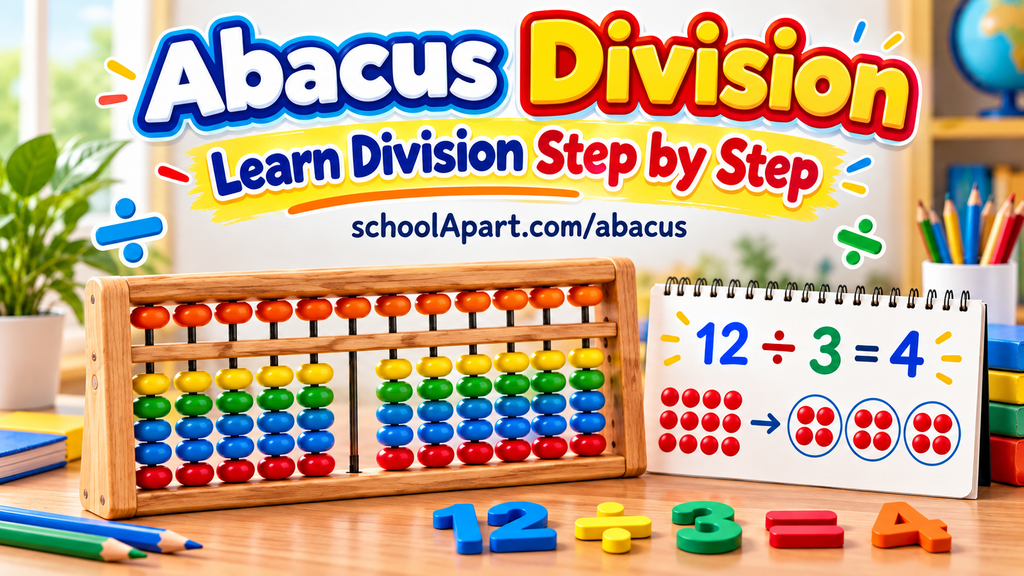
12 ÷ 3 = 4
This means 12 items can be divided into 3 equal groups, with 4 items in each group.
On an abacus, beads represent numbers. A beginner can use the beads to represent the total quantity and then explore how that quantity can be divided into equal groups.
There are two important terms to understand:
- Dividend: The number being divided.
- Divisor: The number by which we divide.
- Quotient: The answer to a division problem.
- Remainder: The amount left over when a quantity cannot be divided equally into whole-number groups.
For example, in 12 ÷ 3 = 4:
- Dividend = 12
- Divisor = 3
- Quotient = 4
- Remainder = 0
Understanding these terms will make it easier to learn division step by step.
How Does Division Work on an Abacus?
Before starting division exercises, children should understand how an abacus represents numbers.
On a place-value abacus, different rods represent different place values, such as ones, tens and hundreds. The beads on each rod represent the value assigned to that position according to the abacus design and method being taught.
For example, a number such as 24 contains 2 tens and 4 ones. Representing numbers correctly is an important foundation for learning arithmetic operations.
If you are new to the abacus, first learn:
- How to represent numbers.
- How to read numbers on an abacus.
- How ones and tens work.
- How to add and subtract using the abacus.
You can begin with these guides:
- Abacus Numbers 1–9
- How to Read Numbers on an Abacus
- Abacus Place Value: Ones, Tens and Hundreds
- How to Represent Numbers on an Abacus
Important: There are different abacus types and division teaching methods. The examples below use a beginner-friendly grouping and repeated-subtraction approach to explain the meaning of division. They are not a complete description of every formal soroban division algorithm. If you follow a particular abacus course, use its prescribed bead movements and quotient-placement method.
Learn Abacus Division Step by Step
Start with simple division problems in which the answer is a whole number and there is no remainder.
Example 1: 6 ÷ 2 = 3
Suppose you have 6 beads or objects and want to divide them into groups of 2.
Step 1: Represent the total quantity, 6.
Step 2: Make groups of 2, counting one group at a time.
Step 3: Count the groups: 2, 4, 6.
You can make 3 groups of 2.
Therefore:
6 ÷ 2 = 3
The quotient is 3, and the remainder is 0.
This example introduces the idea that division can mean finding how many equal groups can be made from a total quantity.
Example 2: 12 ÷ 3 = 4
Now consider a slightly larger number.
Step 1: Start with a total of 12.
Step 2: Divide the quantity into equal groups of 3.
Step 3: Count the groups.
- First group: 3
- Second group: 6 in total
- Third group: 9 in total
- Fourth group: 12 in total
You have made 4 groups.
Therefore:
12 ÷ 3 = 4
The quotient is 4, with no remainder.
You can use beads or other small objects to make the grouping visible before solving the problem on your abacus.
Example 3: 15 ÷ 5 = 3
Step 1: Represent the total quantity, 15.
Step 2: Count in groups of 5.
- 5
- 10
- 15
Step 3: Count the groups. There are 3 groups of 5.
Therefore:
15 ÷ 5 = 3
The quotient is 3, and the remainder is 0.
Example 4: 20 ÷ 4 = 5
Step 1: Start with 20.
Step 2: Count in groups of 4.
- 4
- 8
- 12
- 16
- 20
Step 3: Count the groups. There are 5 groups.
Therefore:
20 ÷ 4 = 5
The quotient is 5, with no remainder.
What Have You Learned?
These examples show that division can be understood as equal grouping or repeated subtraction.
For instance, 12 ÷ 3 = 4 can also be understood as subtracting 3 repeatedly from 12 until nothing remains:
12 − 3 − 3 − 3 − 3 = 0
You subtracted 3 four times, so the answer is 4.
This is a useful way to understand division before moving on to the formal bead movements used in a structured abacus method.
Understanding Division with Remainders
Sometimes a number cannot be divided equally into whole-number groups. In that situation, there is a remainder.
For example:
14 ÷ 4 = 3 remainder 2
Here is why.
Step 1: Start with 14.
Step 2: Make groups of 4.
- First group: 4
- Second group: 8 in total
- Third group: 12 in total
Step 3: You have made 3 complete groups, using 12 items.
Step 4: There are 2 items left.
Therefore:
14 ÷ 4 = 3 remainder 2
The quotient is 3, and the remainder is 2.
The remainder must be smaller than the divisor in a division problem expressed with a whole-number quotient and remainder.
For example, in 14 ÷ 4, the remainder is 2, which is smaller than 4.
Beginners should first become comfortable with exact division before moving to remainders or more advanced division methods.
How Is Division Related to Multiplication?
Division and multiplication are closely connected. Multiplication can help children check whether a division answer is correct.
For example:
12 ÷ 3 = 4
To check the answer, multiply the quotient by the divisor:
4 × 3 = 12
The result is the original dividend, so the answer is correct.
For a division problem with a remainder, use this relationship:
Dividend = Divisor × Quotient + Remainder
For example:
14 ÷ 4 = 3 remainder 2
Check:
4 × 3 + 2 = 14
Therefore, the answer is correct.
This relationship is useful when children begin solving division questions independently.
Once your child understands the basics of multiplication, connect the two operations through practice. Read Abacus Multiplication for Beginners to continue learning.
Tips for Learning Abacus Division Effectively
Division may feel difficult at first, especially when a child is still learning number representation and place value. A gradual learning plan can make practice more manageable.
1. Master Number Representation First
Before beginning division, make sure your child can represent and read numbers correctly on the abacus.
A weak understanding of place value can make more advanced calculations confusing.
2. Start with Small Numbers
Begin with simple problems such as:
- 4 ÷ 2
- 6 ÷ 3
- 8 ÷ 2
- 10 ÷ 5
- 12 ÷ 3
Move to larger numbers only when your child understands the earlier examples.
3. Use Physical Objects to Explain Division
Beads, counters, pencils or small toys can help children understand equal grouping.
For example, give your child 12 objects and ask them to divide them into groups of 3. Once the child understands the idea, connect it with the corresponding number calculation.
4. Follow One Consistent Method
Different abacus systems may teach division using different procedures. Follow the method used in your learning programme rather than mixing techniques from different tutorials.
For formal abacus calculations, correct bead movements and quotient placement matter.
5. Focus on Accuracy Before Speed
Do not expect beginners to solve division problems quickly. Let them understand the steps and check their answers first.
As the method becomes familiar, regular practice may help improve fluency.
6. Practise for Short Periods
A short, focused session can be more useful than a long session in which the child becomes tired or frustrated.
For a beginner, try a few problems at a time and adjust the duration to the child’s age, interest and current lesson.
7. Review Mistakes Calmly
If a child gives an incorrect answer, check whether they misunderstood the division concept, counted the groups incorrectly or made an error in the abacus method.
Explain the missed step and let the child try again without pressure.
Common Mistakes to Avoid in Abacus Division
Mistake 1: Starting with Difficult Problems
Beginning with large numbers or complicated division procedures can confuse a learner who has not mastered basic concepts.
Better approach: Begin with small numbers and progress gradually.
Mistake 2: Confusing the Divisor and Quotient
In 12 ÷ 3 = 4, the divisor is 3 and the quotient is 4.
Better approach: Read the problem aloud and identify what number is being divided, what number divides it and what the answer represents.
Mistake 3: Ignoring Place Value
In larger calculations, children need to understand the values represented by the different rods.
Better approach: Review ones, tens and hundreds before moving to more advanced division.
Mistake 4: Mixing Different Abacus Methods
Following one method in class and a different method at home can create confusion.
Better approach: Follow the same instructional sequence as the child’s course or teacher.
Mistake 5: Prioritising Speed Over Understanding
A quick answer is not useful if the child does not understand the calculation.
Better approach: Focus on correct steps, explain mistakes and build fluency gradually.
Mistake 6: Skipping Multiplication Practice
Multiplication helps children understand the relationship between equal groups and division.
Better approach: Review multiplication facts and use multiplication to check division answers.
Abacus Division Practice Questions for Beginners
Try the following questions after reviewing the examples. Encourage your child to work independently and then check the answers.
Beginner Level
- 4 ÷ 2 = ?
- 6 ÷ 3 = ?
- 8 ÷ 2 = ?
- 10 ÷ 2 = ?
- 12 ÷ 4 = ?
Intermediate Level
- 15 ÷ 3 = ?
- 18 ÷ 6 = ?
- 20 ÷ 5 = ?
- 24 ÷ 4 = ?
- 30 ÷ 5 = ?
Division with Remainders
- 7 ÷ 2 = ?
- 11 ÷ 3 = ?
- 14 ÷ 4 = ?
- 17 ÷ 5 = ?
- 19 ÷ 4 = ?
Answers
- 2
- 2
- 4
- 5
- 3
- 5
- 3
- 4
- 6
- 6
- 3 remainder 1
- 3 remainder 2
- 3 remainder 2
- 3 remainder 2
- 4 remainder 3
After checking the answers, ask your child to explain how they solved two or three questions. This can help reveal whether they understand the division concept or are only recalling answers.
For more beginner calculation practice, try Abacus Addition and Subtraction Practice Questions for Beginners.
What Should You Learn After Abacus Division?
Once you understand number representation, place value, addition, subtraction, multiplication and division, you can continue practising these operations with gradually more challenging questions.
Your next steps may include:
- Reviewing addition and subtraction.
- Practising multiplication and division facts.
- Solving mixed-operation exercises.
- Checking calculations using inverse operations.
- Building accuracy through regular practice.
- Exploring mental abacus techniques when you are ready.
Remember that the best learning sequence depends on your current level and the abacus method you follow.
Visit the SchoolApart Abacus Learning Hub to explore the available beginner guides and calculation lessons.
Abacus division for beginners becomes easier when children first understand what division means. Start with equal groups, small numbers and clear examples before progressing to larger calculations or formal abacus division procedures.
Review place value and multiplication, follow one consistent method, and focus on accuracy before speed. Use the practice questions to check understanding and revisit earlier concepts whenever necessary.
With patient guidance and regular practice, the abacus can be a useful tool for exploring division and strengthening basic calculation skills.
Frequently Asked Questions About Abacus Division
1. What is abacus division?
Abacus division is the process of solving division problems using an abacus. Learners use bead representations and a structured calculation method to find the quotient and, when applicable, the remainder.
2. Can beginners learn division on an abacus?
Yes. Beginners can start with the meaning of division, equal grouping and simple number problems. Formal abacus division methods should be introduced according to the learner’s current level and teaching programme.
3. What should I learn before abacus division?
Learn how to represent numbers, understand place value and perform basic addition and subtraction. A working knowledge of multiplication also helps with division.
4. How do you solve 12 ÷ 3 on an abacus?
A beginner can understand the problem by making groups of 3 from a total of 12. Four groups can be made, so 12 ÷ 3 = 4. Formal bead movements depend on the abacus system and method being taught.
5. What is a quotient in division?
The quotient is the answer to a division problem. In 12 ÷ 3 = 4, the quotient is 4.
6. What is a remainder in division?
A remainder is the amount left over when a quantity cannot be divided equally into whole-number groups. For example, 14 ÷ 4 = 3 remainder 2.
7. Is division harder than multiplication on an abacus?
Some beginners may find division more challenging because it involves understanding how quantities relate to one another and applying a structured procedure. Difficulty varies by learner and method. A strong foundation in multiplication can help.
8. Can I practise abacus division at home?
Yes. You can practise at home using a suitable abacus, reliable instructional materials and exercises that match your current level. Follow one consistent method and ask a teacher for help if the bead movements are unclear.
9. How can I check an abacus division answer?
For exact division, multiply the quotient by the divisor. The result should equal the dividend. For division with a remainder, use: dividend = divisor × quotient + remainder.
10. Should beginners learn division with remainders immediately?
It is generally helpful to begin with exact division, where nothing is left over. Introduce remainders after the learner understands equal grouping and basic division.
11. Does abacus division improve calculation speed?
Regular practice may help learners become more fluent with the method they are learning. However, speed is not guaranteed, and understanding and accuracy should come first.
12. Can children use an abacus for school division?
An abacus can provide additional practice with number representation and division concepts. Children should also learn the division methods required by their school curriculum.








Leave a Reply