

Learn abacus multiplication for beginners with easy examples, step-by-step methods, multiplication tables, practice questions, and answers.
Abacus Multiplication for Beginners
Learning multiplication on an abacus can help children understand how numbers combine to produce a result. Instead of memorising multiplication facts alone, learners can connect multiplication with repeated addition, number representation, and place value.
If you already know how to represent numbers on an abacus and understand basic addition, you are ready to begin learning multiplication.
In this guide, you will learn what abacus multiplication means, how multiplication relates to repeated addition, how to practise simple multiplication problems, and how to check your answers.
What Is Abacus Multiplication?
Abacus multiplication is a method of working out multiplication problems using an abacus. The beads help represent numbers and keep track of the values involved in a calculation.
For example:
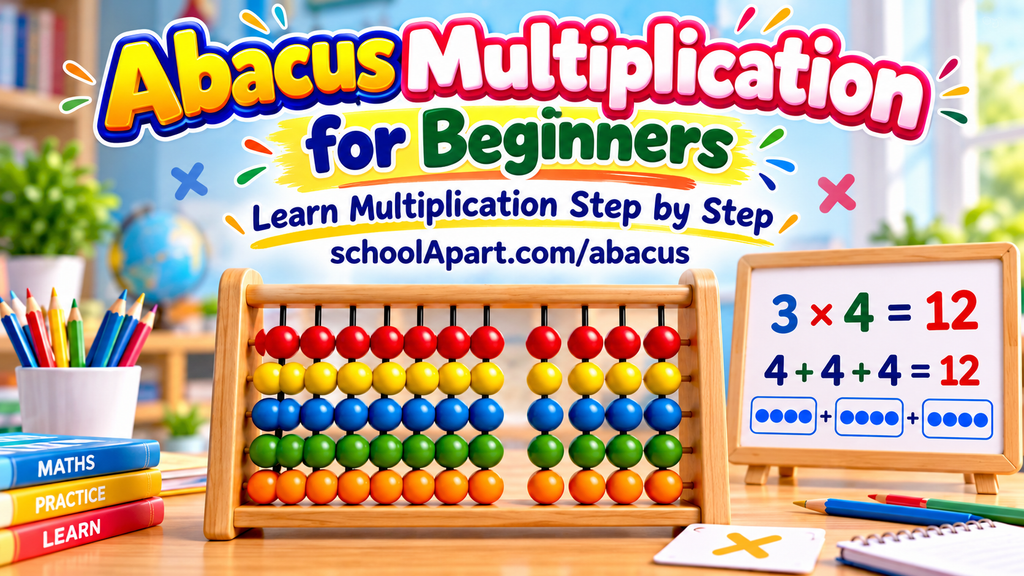
3 × 4 = 12
This means three groups of four make twelve.
You can understand this calculation as:
4 + 4 + 4 = 12
This connection between multiplication and repeated addition is a useful starting point for beginners.
As you progress, you can learn more advanced abacus multiplication methods that use place value, partial products, and specific bead-moving techniques.
Important: Different abacus systems use different bead arrangements and calculation methods. The introductory examples in this article explain multiplication concepts rather than prescribing one universal bead-moving algorithm.
What Should You Know Before Learning Abacus Multiplication?
Before starting multiplication, make sure you understand these basic skills:
- How to represent numbers on your abacus.
- How Ones, Tens, and Hundreds work.
- How to read a number represented by beads.
- How to perform simple addition.
- How to move beads correctly according to your abacus model.
If you are still learning these skills, start with the Abacus Learning Hub and follow the beginner lessons before moving to multiplication.
Step 1: Understand Multiplication as Repeated Addition
The easiest way to understand multiplication is to think of it as adding the same number several times.
For example:
2 × 3 = 6
This means two groups of three.
3 + 3 = 6
Similarly:
4 × 2 = 8
This means four groups of two.
2 + 2 + 2 + 2 = 8
You can use your abacus to represent the numbers and follow the addition process. Start with small numbers so that you can focus on understanding the calculation rather than moving beads quickly.
More Examples
| Multiplication | Repeated addition | Answer |
|---|---|---|
| 2 × 4 | 4 + 4 | 8 |
| 3 × 5 | 5 + 5 + 5 | 15 |
| 4 × 3 | 3 + 3 + 3 + 3 | 12 |
| 5 × 2 | 2 + 2 + 2 + 2 + 2 | 10 |
Remember that repeated addition is a beginner learning method. More advanced multiplication techniques can calculate larger products without adding the same number repeatedly.
Step 2: Practice Simple Multiplication on an Abacus
Let us begin with a small example.
Example 1: Calculate 2 × 3
We need to find the total of two groups of three.
- Understand the calculation: 2 × 3.
- Rewrite it as 3 + 3.
- Use your abacus to represent the first group of three.
- Add another group of three using the addition rules for your abacus.
- Read the final value.
The answer is 6.
Example 2: Calculate 3 × 4
Three groups of four can be written as:
4 + 4 + 4 = 12
To practise this calculation:
- Start with zero on your abacus.
- Add four.
- Add another four.
- Add four again.
- Read the final value.
The answer is 12.
This exercise connects multiplication with the addition skills you have already learned.
Example 3: Calculate 4 × 5
Four groups of five are:
5 + 5 + 5 + 5 = 20
The answer is 20.
You can check the result by counting the total value represented by the beads.
Step 3: Learn the Multiplication Tables
Knowing multiplication tables can make abacus multiplication easier because you can recognise familiar number combinations.
Begin with the 2, 3, 4, and 5 times tables.
Table of 2
| Calculation | Answer |
|---|---|
| 2 × 1 | 2 |
| 2 × 2 | 4 |
| 2 × 3 | 6 |
| 2 × 4 | 8 |
| 2 × 5 | 10 |
| 2 × 6 | 12 |
| 2 × 7 | 14 |
| 2 × 8 | 16 |
| 2 × 9 | 18 |
| 2 × 10 | 20 |
Table of 3
| Calculation | Answer |
|---|---|
| 3 × 1 | 3 |
| 3 × 2 | 6 |
| 3 × 3 | 9 |
| 3 × 4 | 12 |
| 3 × 5 | 15 |
| 3 × 6 | 18 |
| 3 × 7 | 21 |
| 3 × 8 | 24 |
| 3 × 9 | 27 |
| 3 × 10 | 30 |
After becoming comfortable with these tables, practise the 4, 5, and 6 times tables. You do not need to memorise every table in one day. Regular practice is more useful than rushing.
Step 4: Understand Place Value in Multiplication
Place value becomes especially important when multiplying larger numbers.
For example:
12 × 3 = 36
The number 12 contains one ten and two ones.
You can understand the calculation by splitting 12 into its place values:
12 × 3 = (10 × 3) + (2 × 3)
= 30 + 6
= 36
This is called the partial-products approach. It helps learners understand why multiplication with larger numbers works.
On an abacus, the Tens and Ones rods help represent these values. The exact bead-moving steps depend on the abacus system and the multiplication method being taught.
Another Example: 23 × 2
Split 23 into 20 and 3.
23 × 2 = (20 × 2) + (3 × 2)
= 40 + 6
= 46
The answer is 46.
This approach helps children connect multiplication with place value instead of treating larger numbers as a completely new topic.
Step 5: Practice Two-Digit Multiplication
Once you understand multiplication with single-digit numbers, begin practising two-digit calculations.
Try these examples:
Example 1: 14 × 2
Split 14 into 10 and 4.
14 × 2 = (10 × 2) + (4 × 2)
= 20 + 8
= 28
Example 2: 21 × 3
Split 21 into 20 and 1.
21 × 3 = (20 × 3) + (1 × 3)
= 60 + 3
= 63
Example 3: 32 × 3
Split 32 into 30 and 2.
32 × 3 = (30 × 3) + (2 × 3)
= 90 + 6
= 96
These examples demonstrate the mathematics behind multiplication. To learn a particular Soroban multiplication algorithm, follow instructions designed specifically for that abacus system.
Step 6: Check Your Multiplication Answers
Checking your answer helps you identify mistakes before moving to harder problems.
You can use these methods:
1. Check with Repeated Addition
For 3 × 4, add 4 three times.
4 + 4 + 4 = 12
If your answer is different, review your calculation.
2. Check with Place Value
For 23 × 2, calculate the Tens and Ones parts separately.
20 × 2 = 40
3 × 2 = 6
40 + 6 = 46
3. Estimate the Answer
For 19 × 3, you know that 20 × 3 = 60. Therefore, 19 × 3 should be slightly less than 60.
The exact answer is 57.
Estimation is useful for spotting answers that are much too large or too small.
Common Mistakes in Abacus Multiplication
1. Starting with Large Calculations
Beginners sometimes try difficult multiplication problems before mastering basic addition and place value.
Start with simple calculations such as 2 × 3 and 3 × 4.
2. Confusing the Multiplication Sign
The expression 3 × 4 means three groups of four, or four groups of three. Both give 12, but it helps to describe the groups clearly when first learning multiplication.
3. Ignoring Place Value
When calculating 23 × 2, the 2 in 23 represents 20, not 2.
Always separate Tens and Ones when learning larger multiplication problems.
4. Rushing to Improve Speed
Accuracy should come before speed. Incorrect bead movements can lead to incorrect answers, so practise slowly until the process becomes familiar.
5. Mixing Different Abacus Methods
A simple counting abacus and a Japanese Soroban do not use identical bead arrangements. Do not combine instructions from different systems without understanding their rules.
Abacus Multiplication Practice Questions
Try these exercises before checking the answers.
Exercise A: Easy Multiplication
- 2 × 3 = ?
- 2 × 5 = ?
- 3 × 4 = ?
- 4 × 2 = ?
- 5 × 3 = ?
- 4 × 4 = ?
- 3 × 6 = ?
- 5 × 5 = ?
Exercise B: Intermediate Multiplication
- 12 × 2 = ?
- 14 × 3 = ?
- 21 × 2 = ?
- 23 × 2 = ?
- 32 × 3 = ?
- 15 × 4 = ?
- 24 × 3 = ?
- 31 × 3 = ?
Exercise C: Challenge Questions
- 16 × 5 = ?
- 22 × 4 = ?
- 35 × 2 = ?
- 42 × 3 = ?
- 27 × 3 = ?
Answers
Exercise A
- 6
- 10
- 12
- 8
- 15
- 16
- 18
- 25
Exercise B
- 24
- 42
- 42
- 46
- 96
- 60
- 72
- 93
Exercise C
- 80
- 88
- 70
- 126
- 81
Check each answer using repeated addition or the partial-products method. If you make a mistake, work through the calculation again rather than memorising the answer alone.
How to Practice Abacus Multiplication at Home
A short, regular practice routine can help you build confidence.
- Begin with simple multiplication facts.
- Use repeated addition to understand what multiplication means.
- Practise with your physical abacus rather than only reading examples.
- Move on to two-digit multiplication after understanding single-digit calculations.
- Use place value to split larger numbers into manageable parts.
- Check your answers before attempting the next question.
- Focus on accuracy before increasing speed.
Parents can help by giving children a few simple problems and asking them to explain how they reached each answer.
What Should You Learn Next?
After learning basic multiplication, the next step is to practice more challenging multiplication problems and eventually learn division.
Follow this learning sequence:
- Review Abacus Addition for Beginners.
- Review Abacus Subtraction for Beginners.
- Practise Abacus Addition and Subtraction Practice Questions.
- Learn how to represent numbers and understand place value.
- Continue with division when you are comfortable with multiplication.
You can find the related lessons through the SchoolApart Abacus Learning Hub.
Abacus multiplication becomes easier when you understand the relationship between multiplication, repeated addition, and place value.
Start with small numbers, practise multiplication tables, and gradually move to two-digit calculations. Use your abacus actively, check your answers, and follow the rules of your particular abacus system.
With regular practice, you can build a stronger foundation for more advanced calculations and prepare to learn abacus division.
Frequently Asked Questions
1. What is abacus multiplication?
Abacus multiplication is the process of calculating multiplication problems using an abacus. Beginners can start by understanding multiplication as repeated addition and then learn more advanced calculation methods.
2. Can beginners learn multiplication on an abacus?
Yes. Beginners can start with small multiplication facts, practise repeated addition, and gradually move to larger calculations as they become comfortable with number representation and place value.
3. What should I learn before abacus multiplication?
Learn how to represent numbers on an abacus, understand place value, read bead arrangements, and perform basic addition. These skills provide a foundation for multiplication.
4. How can I calculate 3 × 4 using an abacus?
Understand 3 × 4 as three groups of four. Add 4 three times using your abacus. The total is 12.
5. Is abacus multiplication the same on every abacus?
No. Different abacus systems use different bead arrangements and calculation techniques. The examples in this article explain multiplication concepts, while advanced bead-moving algorithms may vary by system.
6. Do I need to memorise multiplication tables?
Knowing multiplication tables can make calculations easier and faster. However, beginners can first understand multiplication through repeated addition and practise tables gradually.
7. How can I improve my abacus multiplication speed?
Build accuracy first. Practise regularly, learn multiplication facts, and follow a consistent method for your abacus. Increase speed gradually without sacrificing accuracy.
8. Can I learn abacus multiplication at home?
Yes. You can practise with a physical abacus, beginner lessons, and structured exercises. Follow one learning method consistently and check your answers regularly.
9. What is the next topic after abacus multiplication?
Abacus division is a suitable next topic once you understand basic multiplication and place value. Continue practising multiplication while learning the next calculation skill.
10. Is repeated addition useful for learning multiplication?
Yes. Repeated addition helps beginners understand why multiplication works. As learners progress, they can use multiplication facts and more efficient methods instead of adding the same number repeatedly.








Leave a Reply