

Learn how to read numbers on an abacus step by step. Understand bead positions, ones, tens and hundreds, and practice reading numbers for beginners and kids.
How to Read Numbers on an Abacus
Reading numbers on an abacus is an important skill for beginners.
After learning how to represent numbers 1–9 and understanding ones, tens and hundreds, the next step is learning how to look at an abacus and identify the number represented by the beads.
The basic process is simple:
Look at the beads → Identify their values → Check the place value → Read the number
With regular practice, learners can gradually recognize numbers more quickly without counting every bead individually.
This guide explains how to read numbers on an abacus step by step.
What Does It Mean to Read an Abacus?
Reading an abacus means looking at the position of the beads and determining which number they represent.
For example, if an abacus represents:
5
you should be able to identify the number as 5.
When the number becomes larger, you also need to understand place value.
For example:
245
means:
- 2 hundreds
- 4 tens
- 5 ones
Therefore:
245 = 200 + 40 + 5
So reading an abacus is not simply about counting beads. It is about understanding bead values + place value + position.
Understand the Abacus Before Reading Numbers
Before practicing number reading, you should understand the basic parts of your abacus.
A typical school abacus contains:
- A frame
- Vertical columns or rods
- Beads
- A central bar or divider
The beads represent numerical values, while the columns represent different place values.
If you are new to abacus learning, first read:
What Is Abacus? A Complete Beginner’s Guide for Kids
You should also be comfortable with:
Abacus Numbers 1–9
and:
Abacus Place Value: Ones, Tens and Hundreds
These provide the foundation for reading larger numbers.
How to Read a Single-Digit Number
Start with single-digit numbers.
Practice reading:
1, 2, 3, 4, 5, 6, 7, 8, 9
Look at the bead arrangement and identify the number it represents.
At first, you may need to count or check the bead values.
That is completely normal.
With practice, you should gradually recognize common bead patterns without counting every bead.
Step 1: Find the Active Beads
The first thing to do is identify which beads are in the active or working position according to the abacus system you are using.
Do not start calculating immediately.
First ask:
Which beads are active?
Then determine their values.
The exact appearance of active beads can vary between abacus types, so always follow the convention of the abacus you are learning with.
Step 2: Identify the Bead Values
Once you identify the active beads, determine what each bead represents.
In a common school abacus system:
- Lower beads represent unit values.
- A higher-value bead represents five.
- Different columns represent different place values.
This allows a single column to represent numbers from 0 to 9.
For example:
6 = 5 + 1
7 = 5 + 2
8 = 5 + 3
9 = 5 + 4
Understanding these combinations makes number recognition easier.
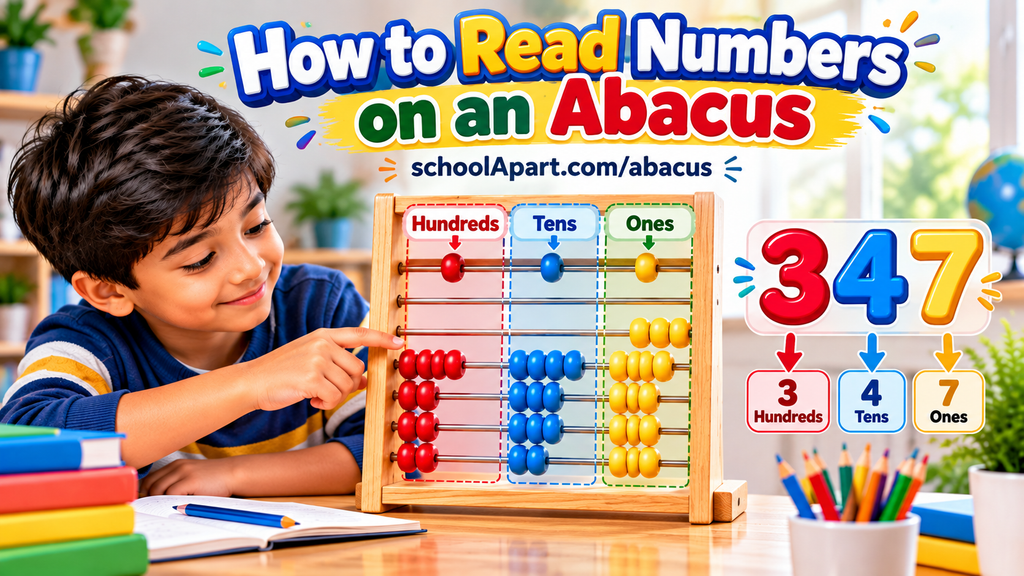
Step 3: Find the Ones Column
When reading a multi-digit number, first identify the ones column.
The ones column is generally the rightmost place-value column being used.
Then move left:
Ones → Tens → Hundreds → Thousands
For example:
Hundreds | Tens | Ones
This order helps you read the complete number correctly.
Step 4: Read Each Column
Now read the columns one at a time.
Suppose the columns represent:
3 | 4 | 7
The number is:
347
because:
- 3 hundreds = 300
- 4 tens = 40
- 7 ones = 7
Therefore:
347 = 300 + 40 + 7
This is the basic method for reading a multi-digit number on an abacus.
How to Read Two-Digit Numbers
Start with simple two-digit numbers.
Example: 24
Break it down:
2 tens + 4 ones
Therefore:
24 = 20 + 4
Read the tens column first, then the ones column.
Example: 58
Break it down:
5 tens + 8 ones
Therefore:
58 = 50 + 8
Example: 73
Break it down:
7 tens + 3 ones
Therefore:
73 = 70 + 3
Practice several two-digit numbers before moving to three-digit numbers.
How to Read Three-Digit Numbers
Once two-digit numbers are comfortable, start reading three-digit numbers.
Use:
Hundreds → Tens → Ones
Example: 125
1 hundred + 2 tens + 5 ones
So:
125 = 100 + 20 + 5
Example: 246
2 hundreds + 4 tens + 6 ones
So:
246 = 200 + 40 + 6
Example: 583
5 hundreds + 8 tens + 3 ones
So:
583 = 500 + 80 + 3
The key is to read each place-value column separately before combining the digits.
How to Read Numbers with Zero
Zero can make number reading slightly more challenging for beginners.
Consider:
205
The number contains:
- 2 hundreds
- 0 tens
- 5 ones
Therefore:
205 = 200 + 0 + 5
You still need to recognize the empty or zero-value tens position.
Another example:
340
means:
- 3 hundreds
- 4 tens
- 0 ones
So:
340 = 300 + 40 + 0
Understanding zero is important when reading larger numbers.
How to Read a Number Step by Step
Whenever you see an abacus arrangement, use this simple process:
1. Find the Place-Value Columns
Identify:
Ones → Tens → Hundreds
or the larger places being used.
2. Identify Active Beads
Look at which beads are positioned to represent a value.
3. Determine Each Column’s Value
Read each column separately.
4. Write the Digits
Convert each column into its corresponding digit.
5. Combine the Digits
Read the complete number from left to right.
For example:
4 | 2 | 6
becomes:
426
because:
4 hundreds + 2 tens + 6 ones = 426
Abacus Number Reading Practice
Practice reading the following numbers from an abacus.
Beginner Level
3
6
8
4
9
Two-Digit Level
12
25
37
48
65
79
Three-Digit Level
123
245
316
428
507
631
784
Try to read each number without counting every bead repeatedly.
Random Number Reading Practice
Sequential practice is useful, but random practice is even more important for developing recognition.
Practice numbers such as:
7 → 24 → 3 → 58 → 91 → 6 → 135 → 407 → 829
The goal is to quickly switch between different place-value patterns.
How to Improve Abacus Number Reading Speed
Speed should come after accuracy.
Use this progression:
Understand → Read Correctly → Practice → Recognize Faster
Practice Short Sessions
Spend a few minutes each day reading different abacus arrangements.
Use Random Numbers
Avoid practicing only:
1 → 2 → 3 → 4 → 5
Instead, use random combinations.
Start Small
Begin with single-digit numbers.
Then move to two-digit numbers.
Then three-digit numbers.
Avoid Counting Every Bead
As your understanding improves, try to recognize bead patterns directly.
Check Your Answers
After reading a number, compare your answer with the actual number.
This helps you identify mistakes.
Abacus Reading Practice for Kids
For school students, number reading can be turned into a simple activity.
A parent or teacher can represent a number on the abacus and ask:
“What number is this?”
The child looks at the abacus and gives the answer.
Start with:
1–9
Then move to:
10–99
Then:
100–999
You can make the activity more challenging by showing numbers randomly.
Common Mistakes When Reading an Abacus
Reading from the Wrong Side
For multi-digit numbers, make sure you understand which column is the ones column.
Ignoring Place Value
A digit’s position determines its value.
For example:
3 in ones = 3
3 in tens = 30
3 in hundreds = 300
Counting Instead of Recognizing
Counting beads every time can make reading slower.
Try to understand bead patterns.
Forgetting Zero
Numbers such as 205 and 304 contain zero in one of their places.
Do not skip that place.
Trying to Read Too Quickly
Accuracy should come before speed.
Abacus Reading vs Abacus Calculation
Reading an abacus and calculating with an abacus are related but different skills.
Abacus Reading
You look at an existing bead arrangement and identify the number.
Abacus Calculation
You change the bead arrangement to perform operations such as:
- Addition
- Subtraction
- Multiplication
- Division
Strong number-reading skills make calculation easier because you become more comfortable understanding bead positions.
Why Learn to Read Numbers Before Addition?
Before performing calculations, you need to understand what the abacus is showing.
For example, if you cannot confidently identify:
24
then performing:
24 + 13
will be more difficult.
A good learning sequence is:
Represent Numbers → Read Numbers → Understand Place Value → Calculate
This creates a strong foundation for abacus arithmetic.
What Comes After Learning to Read an Abacus?
Once you can confidently read single-, two- and three-digit numbers, you can begin learning basic abacus calculation.
The next major topic is:
Abacus Addition for Beginners
You can start with simple addition problems and gradually increase the difficulty.
The overall learning path becomes:
Abacus Numbers 1–9
↓
Abacus Place Value
↓
How to Read Numbers on an Abacus
↓
Abacus Addition
↓
Abacus Subtraction
↓
Multiplication
↓
Division
↓
Mental Abacus
↓
Practice & Speed
Learn Abacus with SchoolApart
SchoolApart’s Abacus Learning Hub is designed to take students through abacus learning step by step.
If you are following the beginner pathway, you have now completed three important foundation skills:
Numbers → Place Value → Number Reading
The next stage is calculation.
For practical demonstrations, you can also continue with the SchoolApart Abacus Course on YouTube.
The website can be used to understand the concepts, while video lessons can help demonstrate bead movements and practical exercises.
Conclusion
Learning to read numbers on an abacus is an essential foundation for abacus calculation.
The process is simple:
Identify the beads → Understand their values → Find the place values → Read each column → Combine the digits
Start with single-digit numbers, then practice two-digit and three-digit numbers.
Remember:
Accuracy first. Speed later.
Once you can confidently read numbers from an abacus, you are ready to move to the next stage—abacus addition.
Frequently Asked Questions
How do you read numbers on an abacus?
Identify the active beads, determine their values, identify the place-value columns, and read the digits from left to right.
Which side do you read an abacus from?
For multi-digit numbers, identify the ones column first and then read the place-value columns from left to right as hundreds, tens and ones.
How do you read a two-digit number on an abacus?
Identify the tens column and the ones column. For example, 24 means 2 tens and 4 ones.
How do you read a three-digit number on an abacus?
Read the hundreds, tens and ones columns. For example, 356 means 3 hundreds, 5 tens and 6 ones.
Why is place value important when reading an abacus?
Place value tells you what each digit represents. The same digit can have different values depending on its column.
How can I get faster at reading an abacus?
Practice regularly with random numbers. Focus on accuracy first, then gradually work on faster number recognition.
Should children count every bead?
Beginners may count or check beads while learning, but with practice they should gradually learn to recognize common bead patterns without counting every bead.
What should I learn after reading numbers on an abacus?
The next step is generally basic abacus addition, followed by subtraction and more advanced calculations.








Leave a Reply