

Learn how to choose the best abacus for beginners. Compare abacus types, beads, rods, size, and useful features for children learning math.
Best Abacus for Beginners: How to Choose the Right Abacus
Choosing the best abacus for beginners can make learning numbers and basic mathematics easier and more enjoyable. An abacus helps children understand numbers through physical movement, visual patterns, and hands-on practice. However, not every abacus is designed for the same purpose.
Some abacuses are mainly used for counting and understanding numbers, while others are designed for structured arithmetic training, including addition, subtraction, multiplication, and division.
So, which abacus should a beginner choose?
The right choice depends on the learner’s age, learning goals, the type of calculations they want to practise, and the teaching method they plan to follow.
In this guide, you will learn about different types of abacuses, important features to check before buying one, common mistakes to avoid, and how to select a suitable abacus for a child who is just starting to learn mathematics.
What Is an Abacus?
An abacus is a counting tool that uses movable beads arranged on rods or wires. By moving the beads, learners can represent numbers and perform mathematical calculations.
It is commonly used to teach number recognition, place value, counting, and arithmetic. With structured practice, learners can progress from using a physical abacus to performing calculations mentally.
If you are new to this topic, start with our guide: What Is Abacus? A Complete Beginner’s Guide for Kids.
Which Is the Best Abacus for Beginners?
For most children who are learning to count, recognise numbers, and understand basic place value, a sturdy, easy-to-use educational abacus is a sensible starting point.
However, if the goal is to learn formal abacus arithmetic through a course, choose a model that matches the bead arrangement and calculation method used by that course.
Consider these options:
- For basic counting: Choose a simple counting abacus with clearly visible, easy-to-move beads.
- For place value and larger numbers: Choose an abacus with enough rods to represent the numbers taught in the lessons.
- For structured abacus arithmetic: Choose the specific type of abacus recommended by the instructor or learning programme.
- For regular practice: Prioritise stable construction, smooth bead movement, and a comfortable size.
There is no single abacus that is best for every learner. The most suitable model is one that matches the learner’s current level and future learning goals.
Types of Abacus for Beginners
Before choosing an abacus, it helps to understand the main types available.
1. Simple Counting Abacus
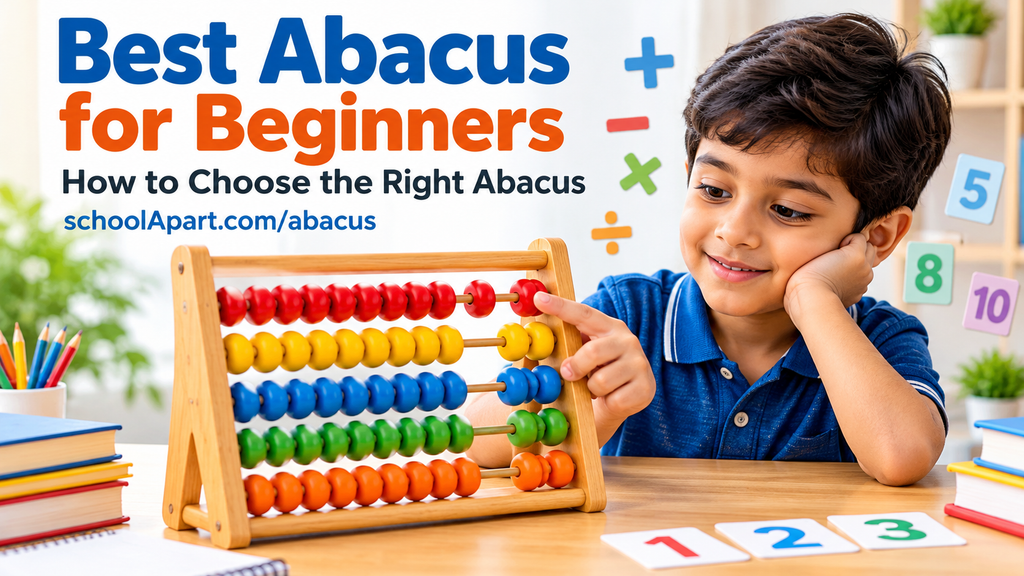
A counting abacus is designed to help children understand numbers through visual and hands-on activities.
It often has several rows of coloured beads. Children can move the beads to practise counting, grouping, comparing quantities, and recognising number patterns.
Best for:
- Young children learning to count
- Beginners who need visual support
- Basic number recognition
- Early mathematics activities at home or school
A simple counting abacus is a useful introduction to numbers. However, it may not be suitable for every formal abacus arithmetic programme.
2. Japanese Soroban
The Japanese soroban is a structured abacus commonly used for arithmetic training. Its typical design has one upper bead and four lower beads on each rod, separated by a horizontal divider.
The beads represent numerical values according to their positions. Learners use specific finger movements and rules to perform calculations.
Best for:
- Learners following a soroban-based course
- Structured arithmetic practice
- Understanding place value and bead combinations
- Progressing towards mental abacus techniques
If a course teaches the soroban method, choose a soroban that matches the course requirements.
3. Chinese Suanpan
The Chinese suanpan is another traditional abacus. A common design has two upper beads and five lower beads on each rod.
Its bead arrangement differs from the Japanese soroban, so the calculation methods and bead values taught for one system should not automatically be applied to the other.
Best for:
- Learners studying the Chinese abacus system
- People interested in traditional abacus methods
- Structured learning with an instructor familiar with the suanpan
For a complete beginner, it is usually better to follow one consistent system rather than switch between different bead arrangements without guidance.
4. Modern Educational Abacus
Modern educational abacuses are available in different shapes, sizes, colours, and bead arrangements. Some are intended for basic counting, while others are designed for more structured arithmetic practice.
Before buying one, check how its beads are arranged and whether it matches the learning method you intend to follow.
Best for:
- Home learning
- School mathematics activities
- Beginners who need a practical learning aid
- Guided practice with a teacher or online lessons
Remember that an attractive design alone does not make an abacus suitable for every type of calculation.
Affiliate Disclosure: As an Amazon Associate, I earn from qualifying purchases. This means SchoolApart may earn a commission if you buy through qualifying links, at no additional cost to you.
7 Things to Check Before Choosing an Abacus
The following features can help you select a suitable abacus for a beginner.
1. Match the Abacus to the Learning Goal
First, decide what the learner needs to do with the abacus.
If the goal is simply to learn counting, a basic counting abacus may be enough. If the learner wants to practise formal abacus addition and subtraction, a model designed for that calculation system is more appropriate.
For structured training, check the recommended model before buying.
2. Check the Number of Rods
The rods determine how many place-value positions the abacus can represent.
For example, a three-rod abacus can represent ones, tens, and hundreds in a typical place-value arrangement. An abacus with more rods can represent larger numbers.
For beginners, choose enough rods for the numbers they are expected to learn. A learner does not necessarily need a very large abacus from the beginning.
Learn more in our guide to Abacus Place Value: Ones, Tens and Hundreds.
3. Look for Clearly Visible Beads
Beads should be easy to distinguish and see. Different colours may help beginners identify rows or groups, particularly when the abacus is used for counting activities.
However, colours are not a substitute for learning the correct numerical values and bead positions.
Choose a design that allows the learner to focus on the calculation rather than struggle to see the beads.
4. Check Bead Movement
The beads should move smoothly without being excessively loose.
If the beads are too tight, the learner may find it difficult to move them accurately. If they slide too easily, keeping track of their positions may become frustrating.
A stable frame and smooth bead movement make regular practice more comfortable.
5. Choose a Comfortable Size
The abacus should be large enough for the learner to see the beads and move them comfortably.
For home learning, a model that fits securely on a desk or table can be convenient. A compact model may be easier to carry, while a larger one may be easier to demonstrate during lessons.
The best size depends on the learner’s needs and where the abacus will be used.
6. Check Build Quality and Safety
Look for a sturdy frame, securely attached rods, and beads that do not come loose easily.
For young children, avoid models with sharp edges, damaged parts, or small detachable pieces that could present a choking hazard. Follow the manufacturer’s age guidance and supervise young children during use.
Durability matters because an abacus is meant to be handled repeatedly during practice.
7. Make Sure It Matches the Teaching Method
This is particularly important if the learner will follow online lessons or an abacus course.
Different abacus systems can use different bead arrangements and calculation rules. A learner may become confused if the physical abacus does not match the one shown in the lessons.
Before purchasing, check:
- Which abacus system the teacher uses
- How many beads are present on each rod
- Whether the number of rods is sufficient
- Whether the course recommends a particular model
Consistency between the learning material and the physical abacus makes it easier to follow demonstrations.
How Many Rods Should a Beginner Abacus Have?
There is no universal number of rods that is best for every beginner. The appropriate number depends on the abacus system and the numbers the learner will practise.
For example:
- Three rods: Can be useful for introducing ones, tens, and hundreds in a basic place-value activity.
- More rods: Allow learners to represent larger numbers and practise calculations involving more place-value positions.
- Course-specific abacus: Should have the rod arrangement recommended by the instructor or programme.
For early counting, the number of rods may be less important than clear beads and easy movement. For structured arithmetic, the recommended layout and calculation method matter more.
Is a Wooden or Plastic Abacus Better?
Both wooden and plastic abacuses can be suitable for beginners. The material alone does not determine how effective an abacus will be for learning.
Wooden Abacus
A wooden abacus may have a solid frame and a traditional appearance. Build quality varies, so check whether the rods and beads are secure and the frame is smooth.
Plastic Abacus
A plastic abacus may be lightweight and easy to carry. Some models have brightly coloured beads that are easy for beginners to distinguish.
Check the quality of the plastic, the stability of the frame, and whether the beads move comfortably.
Which should you choose?
Choose the model that is sturdy, easy to use, appropriately sized, and compatible with the learner’s course. A well-made plastic abacus can be more suitable than a poorly made wooden one, and vice versa.
Can a Beginner Learn Abacus Without a Teacher?
Yes, beginners can start learning basic counting and number representation with an abacus at home. A clear guide, regular practice, and simple exercises can help them develop familiarity with the beads.
However, learners who want to follow a structured arithmetic system may benefit from lessons that explain the correct bead values, finger movements, and calculation methods.
A practical learning sequence is:
- Understand what an abacus is and how its beads work.
- Learn how to represent numbers.
- Practise place value and reading numbers.
- Learn addition and subtraction.
- Practise regularly before moving to more advanced calculations.
You can follow our How to Learn Abacus Step by Step for Beginners guide to understand the learning sequence.
How to Start Practising with a New Abacus
Once you have selected a suitable model, begin with short and simple activities.
Step 1: Identify the Beads and Rods
Look at the bead arrangement and understand how the rods are organised. If you are using a formal arithmetic abacus, learn the bead values for that particular system first.
Step 2: Practise Counting
For a basic counting abacus, move the beads one at a time and count aloud. Repeat the activity until the learner can connect the physical movement with the number being represented.
Step 3: Learn to Represent Numbers
Practise showing simple numbers on the abacus. Follow the rules of the selected system rather than assuming that every abacus uses the same bead values.
Use our guide, Abacus Numbers 1–9: Learn Numbers with an Abacus, for an introduction to number representation.
Step 4: Learn to Read the Abacus
After representing numbers, practise identifying the number shown by the beads.
Our guide, How to Read Numbers on an Abacus, explains this beginner skill.
Step 5: Move to Basic Calculations
When the learner understands number representation, begin simple calculations using the appropriate method.
You can continue with Abacus Addition for Beginners and Abacus Subtraction for Beginners.
Do not rush through the stages. Accurate understanding is more useful than moving to advanced calculations before the basics are clear.
Common Mistakes to Avoid When Buying an Abacus
Avoid these common mistakes when choosing an abacus for a beginner:
- Choosing only by appearance: Bright colours can be helpful, but the abacus must also suit the learning goal.
- Ignoring the bead arrangement: Different systems use different arrangements and calculation rules.
- Buying more rods than necessary: Choose a practical model for the learner’s current level and planned lessons.
- Overlooking build quality: Loose beads, unstable frames, and rough edges can make practice difficult.
- Switching systems too early: Learn one method consistently before trying another.
- Expecting instant results: An abacus is a learning tool. Understanding and accuracy develop through practice.
Choosing carefully at the beginning can help avoid confusion and unnecessary replacement costs.
Best Abacus for Beginners: Final Recommendation
The best abacus for beginners is the one that supports the learner’s current needs and matches the method they will use to learn.
For basic counting, choose a simple educational counting abacus with visible beads and a stable frame. For structured arithmetic training, choose the correct system—such as a Japanese soroban—according to the instructor’s recommendation. If a course uses a different system, follow that course’s specifications instead.
Before buying, check the bead arrangement, number of rods, ease of movement, size, safety, and build quality.
Most importantly, remember that buying an abacus is only the first step. Regular practice, clear explanations, and a gradual learning sequence help beginners use it effectively.
Ready to begin? Visit the SchoolApart Abacus Learning Hub for beginner-friendly guides on abacus basics, number representation, calculations, and further learning.
Frequently Asked Questions
1. Which abacus is best for beginners?
A simple counting abacus is suitable for learning basic numbers. For formal arithmetic training, choose an abacus that matches the method taught by the instructor or course.
2. Is a soroban good for beginners?
Yes. A Japanese soroban can be suitable for beginners who want to learn its structured arithmetic method. They should first learn the correct bead values and calculation rules.
3. How many rods should a beginner abacus have?
The number of rods depends on the learning goal. Three rods can introduce ones, tens, and hundreds, while additional rods allow larger numbers to be represented. Follow the requirements of the selected course.
4. Is a wooden or plastic abacus better for kids?
Both can work well. Choose one with a stable frame, securely attached beads, smooth movement, and a size that the learner can handle comfortably.
5. Can children learn abacus at home?
Yes. Children can begin with counting, number representation, and place value at home. Structured lessons can help them learn a consistent arithmetic method as they progress.
6. Can one abacus be used for addition and subtraction?
Yes, provided the abacus is appropriate for the calculation method being taught. Learners should understand number representation and the system’s rules before progressing to calculations.
7. Does every abacus use the same bead arrangement?
No. For example, the Japanese soroban and Chinese suanpan have different traditional bead arrangements. Always learn the rules associated with the specific system you use.
8. What should I learn after choosing an abacus?
Start with number representation and place value, then learn to read numbers. After mastering these basics, practice addition and subtraction before progressing to more advanced calculations.



Leave a Reply