

Discover the best age to start learning abacus, signs of readiness, benefits for children, and simple ways parents can support abacus practice at home.
Best Age to Start Learning Abacus
At what age should a child start learning abacus? This is a common question for parents who want to help their children develop number skills and become more comfortable with mathematics.
There is no single perfect age for every child. Many abacus learning programmes accept children from around 4–7 years old, but the right starting point depends on a child’s age, interest, attention span, number recognition and readiness to follow simple instructions.
Some children may enjoy exploring an abacus at an early age, while others benefit from starting structured lessons a little later. The goal is not to begin as early as possible. It is to make learning numbers enjoyable, understandable and suitable for the child.
In this guide, you will learn about the best age to start learning abacus, the potential benefits for children, how to practise at home and how parents can support their child’s progress.
What Is the Best Age to Start Learning Abacus?
For many children, around 5–7 years old can be a practical age to begin structured abacus learning. However, this is a general guideline, not a strict rule. Some programmes introduce simple abacus activities to younger children, while some children are more comfortable starting later.
The most important factor is whether the child is ready to engage with numbers and follow simple learning activities.
Abacus Learning by Age
Ages 3–4: Exploring Numbers and Beads
At this stage, some children may enjoy moving beads, counting objects and recognising small quantities. Keep activities playful and short. There is no need to expect formal calculation skills.
Parents can introduce simple activities such as counting toys, grouping objects and moving beads one at a time.
Ages 4–5: Building Early Number Awareness
Children who recognise small numbers and enjoy counting may be ready to explore beginner abacus activities. They can start with simple counting, number recognition and understanding how moving beads represents quantities.
Readiness varies widely at this age, so avoid comparing one child with another.
Ages 5–7: Beginning Structured Abacus Learning
This can be a suitable stage for many children to start a structured beginner programme. Children may be ready to learn number representation, place value and simple addition when these concepts match their current skills.
Start with basic concepts before moving to more difficult calculations.
Ages 8 and Above: Learning Step by Step
Older children can also learn abacus. They may already understand basic arithmetic, which can help them connect bead movements with mathematical operations.
Their learning plan should match their existing number knowledge rather than assume they must start at the same point as a younger child.
Signs Your Child May Be Ready to Learn Abacus
Instead of focusing only on age, observe whether your child:
- Shows interest in numbers, counting or simple maths games.
- Can follow short, simple instructions.
- Enjoys hands-on learning activities.
- Can focus on a short activity with suitable guidance.
- Is beginning to recognise numbers or understand quantities.
- Is willing to try an activity without feeling pressured.
A child does not need to demonstrate every sign before beginning. These are simply helpful indicators for parents.
Should You Start Abacus Before School?
You can introduce an abacus as a counting toy before your child starts school if the child enjoys it. At this stage, focus on exploration, counting and recognising quantities rather than formal lessons.
For structured learning, consider the child’s readiness and the teaching approach. Early learning should complement play, language development, physical activity and other age-appropriate experiences.
Parent tip: Let your child’s interest and readiness guide the decision. Starting earlier does not automatically mean learning faster or achieving better results.
Benefits of Learning Abacus for Children
An abacus is a hands-on mathematical tool that allows children to represent numbers by moving beads. When used with clear instruction and regular practice, it can help children understand some basic mathematical concepts.
The benefits depend on the child, the quality of instruction and the consistency of practice. Abacus learning should support mathematics education, not replace a broad learning experience.
1. Helps Children Understand Numbers
Moving beads gives children a visual and physical way to represent quantities. Instead of seeing numbers only as written symbols, they can explore how quantities change when beads are moved.
For example, a child can represent the number 4 by moving four beads and then add one more bead to see how the quantity becomes 5.
2. Builds Counting Skills
Beginner abacus activities involve counting beads, recognising quantities and representing numbers. These activities can give children additional opportunities to practise counting in an organised way.
Parents should also connect abacus activities with real-life counting, such as counting pencils, books or toys.
3. Introduces Place Value
An abacus can help children visualise how numbers are organised into places such as ones, tens and hundreds.
For example, the number 23 contains 2 tens and 3 ones. Representing this number on an appropriate abacus can help children explore the relationship between the digits and their values.
For a detailed explanation, read Abacus Place Value: Ones, Tens and Hundreds.
4. Provides Practice with Addition and Subtraction
Children can use bead movements to explore simple addition and subtraction. With suitable guidance, they can observe how quantities increase or decrease during a calculation.
Start with small numbers and familiar examples. Move to more complex calculations only when the child understands the basics.
You can continue with Abacus Addition for Beginners and Abacus Subtraction for Beginners.
5. Encourages Attention During Practice
Following a sequence of bead movements requires a child to pay attention to the task. Regular, manageable activities can provide opportunities to practise following instructions and completing a calculation.
However, abacus learning does not guarantee improvements in attention in every child. Progress depends on many factors, including the child’s learning needs and the quality of practice.
6. Supports Visual and Hands-On Learning
Some children find it easier to understand mathematical ideas when they can see and manipulate objects. An abacus offers a concrete way to explore number concepts before relying entirely on written calculations.
It can be particularly useful when combined with counting objects, drawing number representations and solving simple written problems.
7. Encourages Regular Maths Practice
A structured abacus routine gives children an additional way to engage with numbers. Short activities can help make practice part of a regular learning routine.
The objective should be understanding and accuracy rather than completing calculations as quickly as possible.
8. Can Introduce Mental Calculation Gradually
As children become familiar with the physical abacus, some programmes introduce visualisation techniques that involve imagining bead movements.
This approach is often associated with mental abacus practice. Children should first understand the physical movements and number concepts before being expected to calculate mentally.
Learn more in Mental Abacus: How to Calculate Without a Physical Abacus.
What Parents Should Remember About Abacus Benefits
Abacus learning is one way to practise mathematics, but it is not a guarantee of exceptional intelligence, improved memory or higher school grades.
Children still need a balanced mathematical education that includes number sense, reasoning, written calculations, problem-solving and understanding mathematical concepts.
How to Practice Abacus at Home
Parents do not necessarily need to be professional abacus teachers to support beginner practice. They can help by creating a comfortable learning environment, following suitable beginner materials and encouraging consistent practice.
If your child is enrolled in an abacus programme, follow the instructor’s method and sequence. Avoid introducing conflicting techniques before the child understands the current lesson.
Step 1: Choose a Suitable Abacus
Choose an abacus appropriate for the child’s age and learning level. For a beginner, the beads should move comfortably, the rods should be easy to distinguish and the frame should be stable.
A simple beginner model is often sufficient. You do not need to purchase an advanced or expensive abacus to begin.
See Best Abacus for Beginners: How to Choose the Right Abacus for guidance.
Step 2: Begin with Numbers and Bead Movements
Before attempting calculations, help your child understand the abacus.
Begin with activities such as:
- Identifying the rods or columns.
- Moving beads in a consistent way.
- Counting beads and matching them to quantities.
- Representing simple numbers.
- Returning the abacus to its starting position.
Use your chosen learning resource to make sure the child follows the correct method for that abacus.
You can also read Abacus Beads and Their Functions Explained.
Step 3: Follow a Simple Daily Routine
The following is an example routine for a beginner. Adjust the duration to the child’s age, attention span and lesson requirements.
| Activity | Suggested time |
|---|---|
| Review previously learned concepts | 2–3 minutes |
| Practise the current bead or number skill | 3–5 minutes |
| Complete a few guided exercises | 3–5 minutes |
| Review and celebrate progress | 1–2 minutes |
A short session of around 5–15 minutes may be enough for some beginners. Younger children may prefer even shorter activities, while older children may be comfortable practising for longer.
These times are flexible suggestions, not a compulsory daily target.
Step 4: Focus on Accuracy Before Speed
Children sometimes become frustrated when they are encouraged to calculate quickly before they understand the method.
Help your child move through these stages:
- Understand the concept.
- Follow the correct bead movements.
- Complete the calculation accurately.
- Repeat the method until it becomes familiar.
- Gradually work towards greater fluency when ready.
Speed should develop through understanding and practice, not pressure.
Step 5: Connect Abacus Practice with Everyday Activities
Make number learning part of ordinary family activities.
For example:
- Count five pencils and represent the number on the abacus.
- Count objects while arranging them in groups.
- Ask your child to represent a number you say aloud.
- Compare two small quantities.
- Practise simple addition using objects before representing it on the abacus.
These activities help children connect abstract number symbols with familiar quantities.
Step 6: Use Practice Questions at the Right Level
When your child understands basic addition or subtraction, introduce a few questions that match the current lesson.
Do not give too many questions at once. Review mistakes calmly and identify whether the child needs help with the number concept, bead movement or calculation sequence.
For additional exercises, use Abacus Addition and Subtraction Practice Questions for Beginners.
Step 7: Review Progress Regularly
Once a week, check what your child can do independently.
Ask questions such as:
- Can the child represent familiar numbers?
- Can the child explain or demonstrate the bead movements?
- Which activities feel easy?
- Which concept needs more practice?
- Does the child still enjoy learning?
Use these observations to adjust practice. Progress may be uneven, and revisiting an earlier concept is a normal part of learning.
How Parents Can Help Children Learn Abacus
Parents play an important supporting role, particularly when children are beginning a new learning activity. The aim is to encourage understanding, confidence and consistency without turning every practice session into a test.
Choose the Right Learning Method
Use a beginner-friendly learning programme or reliable instructional resource. Make sure lessons progress from basic concepts to more difficult calculations.
If you are unsure where to begin, read How to Learn Abacus Step by Step for Beginners.
Make Learning Enjoyable
Use short activities, familiar examples and positive feedback. Celebrate effort and improvement rather than comparing your child with siblings, classmates or online demonstrations.
If your child becomes tired or frustrated, take a break and return to the activity later.
Avoid Excessive Pressure
Do not force long practice sessions or insist on rapid calculations. Too much pressure can make a child associate mathematics with anxiety instead of curiosity.
Give the child time to understand each stage. It is acceptable to repeat a lesson or take longer to learn a skill.
Encourage Independence
At first, you may need to demonstrate bead movements and guide the child through each step. Gradually allow the child to attempt familiar exercises independently.
Offer help when needed, but avoid correcting every small movement before the child has had a chance to think.
Select an Appropriate Abacus
Choose a model that is easy for your child to handle and suitable for the learning method being used. A stable frame, clearly visible beads and comfortable movement are more important than decorative features.
The best choice is one that supports the child’s current learning needs.
Coordinate Home Practice with Lessons
If your child attends abacus classes or follows a structured online course, practise the concepts currently being taught. Ask the instructor which activities to repeat at home and which skills need more attention.
Consistency between lessons and home practice can make learning more organised.
Recognise Progress Beyond Speed
Progress can include representing numbers correctly, understanding place value, explaining a calculation or solving a problem with less assistance.
Fast calculation is not the only sign of learning. A child who understands why an answer is correct is building an important mathematical foundation.
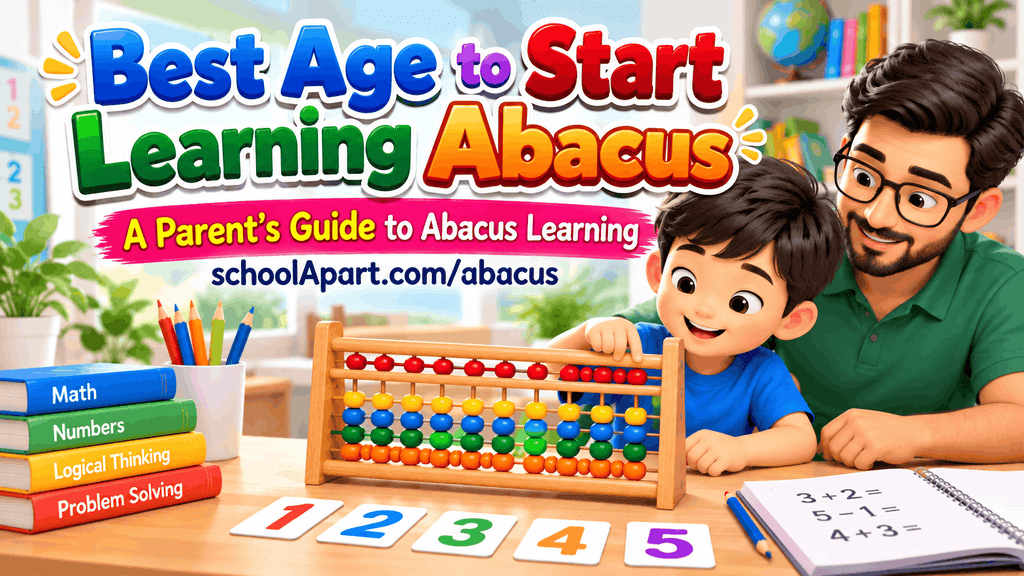
The best age to start learning abacus depends on the child, not just the number of years they have lived. Around 5–7 years old can be a useful starting point for many structured programmes, but younger children may enjoy simple counting activities and older children can begin successfully too.
Look for readiness, introduce concepts gradually and keep practice short enough to remain enjoyable. With suitable guidance and regular, pressure-free activities, an abacus can become a useful tool for exploring numbers and developing calculation skills.
Parents do not need to rush the process. Help your child build a solid understanding of numbers first, then move towards more advanced calculations at a comfortable pace.
Frequently Asked Questions About the Best Age to Start Learning Abacus
1. What is the best age to start learning abacus?
For many children, around 5–7 years old can be a practical time to begin structured abacus lessons. However, readiness, interest and the teaching method matter more than a fixed age.
2. Can a 3-year-old learn abacus?
Some 3-year-olds may enjoy playing with beads and exploring simple counting activities. Keep these activities informal and age-appropriate rather than expecting structured calculations.
3. Is 4 years old too early to learn abacus?
Not necessarily. A child who enjoys counting and can engage with simple activities may benefit from introductory experiences. The programme should match the child’s developmental stage.
4. Can a 7-year-old start learning abacus?
Yes. Seven-year-olds can begin learning abacus, even if they have never used one before. Start with basic number representation and progress according to their understanding.
5. Is 10 years old too late to start abacus?
No. Older children can learn abacus too. Their starting level should be based on their current mathematical knowledge and familiarity with the abacus.
6. How long should a child practise abacus every day?
Some beginners may do well with around 5–15 minutes of practice, depending on age, attention span and lesson difficulty. Short, focused sessions are preferable to forcing a tired child to continue.
7. Can parents teach abacus at home?
Parents can support beginner practice at home using reliable instructional resources. It is important to follow a consistent method and seek guidance when a concept or technique is unclear.
8. Does learning abacus improve intelligence?
Abacus practice can help children work with numbers and practise calculation skills, but it should not be presented as a guaranteed way to increase intelligence. Outcomes vary among children.
9. Does abacus help children with school mathematics?
Abacus can provide additional practice with counting, number representation and calculations. It works best alongside school mathematics and should not replace understanding mathematical concepts.
10. Should children learn addition before multiplication on an abacus?
Beginners generally benefit from learning number representation and basic addition and subtraction before moving to more advanced operations. Follow a structured learning sequence suited to the child’s level.
11. Is a physical abacus necessary for learning?
A physical abacus is useful when a child is learning bead movements and number representation. Some programmes also use digital tools or visual demonstrations, but the method should provide clear, consistent instruction.
12. How can I tell whether my child is ready for abacus?
Look for interest in counting, the ability to follow short instructions and willingness to participate in simple hands-on activities. These are helpful signs, not strict entry requirements.
13. Should I make my child practise faster?
No. Prioritise understanding and accuracy first. Gradually increasing fluency can come later when the child is comfortable with the method.
14. What should my child learn first on an abacus?
Begin with the structure of the abacus, bead movements, numbers and number representation. Then introduce place value and simple calculations as the child becomes ready.
15. How do I choose an abacus for my child?
Choose a stable, easy-to-use model with clearly visible beads that matches the learning method. Read the Best Abacus for Beginners guide before making a decision.



Leave a Reply