

Learn how to represent numbers on an abacus step by step. Understand place-value rods, move beads correctly, and practise with easy examples.
How to Represent Numbers on an Abacus
An abacus is a useful learning tool that helps children understand numbers through beads and place value. Instead of only reading numbers on paper, learners can use an abacus to build numbers, see how digits represent different values, and practice basic mathematics.
If you already know the numbers from 1 to 9 and understand ones, tens, and hundreds, the next step is learning how to represent numbers on an abacus.
How to Read Numbers on an Abacus
Abacus Beads and Their Functions Explained: A Beginner’s Guide
In this beginner-friendly guide, you will learn how to identify the place-value rods, move beads correctly, represent single-digit and multi-digit numbers, and practise with simple examples.
What Does It Mean to Represent a Number on an Abacus?
Representing a number on an abacus means arranging the beads to show a particular number.
For example, to represent the number 4, you move four beads on the Ones rod. To represent 23, you show two beads on the Tens rod and three beads on the Ones rod.
The exact bead positions depend on the type of abacus you use. This guide uses a simple educational place-value abacus in which each bead on a rod represents one unit of that rod’s place value.
On other abacus models, such as a Japanese Soroban, beads have different values and must be moved according to that model’s rules.
Understanding the Place-Value Rods
Before representing numbers, you need to understand the value of each rod.
On a basic place-value abacus, the rods represent different positions in a number.
| Rod | Place value | Value of one bead |
|---|---|---|
| Ones | Units | 1 |
| Tens | Tens | 10 |
| Hundreds | Hundreds | 100 |
| Thousands | Thousands | 1,000 |
The Ones rod represents individual units. The Tens rod represents groups of ten, while the Hundreds rod represents groups of one hundred.
For example, the number 352 contains:
- 3 hundreds = 300
- 5 tens = 50
- 2 ones = 2
Therefore, 352 = 300 + 50 + 2.
Understanding these values makes it easier to represent larger numbers correctly.
Step 1: Identify the Ones Rod
Start by finding the Ones rod on your abacus.
On a multi-column place-value abacus, each rod represents a different place value. The Ones rod is the column used to represent single units.
To represent the number 3:
- Find the Ones rod.
- Move three beads into the counting position.
- Check that exactly three beads are counted.
You have now represented the number 3.
Similarly, move seven beads on the Ones rod to represent 7.
Remember: Count only the beads in the active counting position. Beads outside that position are not included in the represented number.
Step 2: Represent Numbers from 1 to 9
Practise representing single-digit numbers before moving to larger numbers.
| Number | Beads on Ones rod |
|---|---|
| 1 | 1 bead |
| 2 | 2 beads |
| 3 | 3 beads |
| 4 | 4 beads |
| 5 | 5 beads |
| 6 | 6 beads |
| 7 | 7 beads |
| 8 | 8 beads |
| 9 | 9 beads |
For each number, move the required number of beads into the counting position.
After representing a number, count the active beads again to check your answer.
Practise these numbers in random order rather than always starting from 1. This helps you recognise numbers more confidently.
Step 3: Represent Two-Digit Numbers
Two-digit numbers use the Tens and Ones rods.
For example, the number 24 contains:
- 2 tens = 20
- 4 ones = 4
To represent 24:
- Move two beads into the counting position on the Tens rod.
- Move four beads into the counting position on the Ones rod.
- Read the rods from left to right, starting with Tens and then Ones.
- Combine the values: 20 + 4 = 24.
Your abacus now represents 24.
Example: Represent 37
The number 37 contains 3 tens and 7 ones.
- Tens rod: 3 beads, representing 30
- Ones rod: 7 beads, representing 7
Total = 30 + 7 = 37.
The key rule is that a bead’s value depends on its rod. Three beads on the Ones rod represent 3, while three beads on the Tens rod represent 30.
Step 4: Represent Three-Digit Numbers
To represent a three-digit number, use the Hundreds, Tens, and Ones rods.
Let’s represent 246.
- Move two beads on the Hundreds rod.
- Move four beads on the Tens rod.
- Move six beads on the Ones rod.
- Add the place values: 200 + 40 + 6 = 246.
The abacus now represents 246.
Example: Represent 583
The number 583 contains:
- 5 hundreds = 500
- 8 tens = 80
- 3 ones = 3
Therefore, 583 = 500 + 80 + 3.
Represent the number by placing five beads on Hundreds, eight on Tens, and three on Ones.
Check each rod separately before reading the complete number.
Step 5: How to Represent Numbers Containing Zero
Zero is important because it shows that a particular place-value position has no units.
For example, consider the number 205.
- Hundreds: 2 beads, representing 200
- Tens: 0 beads, representing 0 tens
- Ones: 5 beads, representing 5
Therefore, 205 = 200 + 0 + 5.
The Tens rod has no active beads, but the Tens position must still be included when reading the number.
Now consider 470:
- Hundreds: 4 beads
- Tens: 7 beads
- Ones: 0 beads
This represents 400 + 70 + 0 = 470.
Important: An empty rod does not mean you should ignore its place in the number. The position of zero helps distinguish numbers such as 205 and 25.
Step 6: Represent Numbers with Different Digits
Practise reading each digit and assigning it to the correct rod.
| Number | Hundreds | Tens | Ones |
|---|---|---|---|
| 124 | 1 | 2 | 4 |
| 306 | 3 | 0 | 6 |
| 451 | 4 | 5 | 1 |
| 708 | 7 | 0 | 8 |
| 925 | 9 | 2 | 5 |
For example, 306 contains three hundreds, zero tens, and six ones.
Always read the number from the highest place value to the lowest place value. Do not confuse the number of beads with the total value represented by those beads.
Step 7: Change One Number into Another
Once you can represent numbers, practise changing the beads to show a different number.
Suppose your abacus represents 23 and you want to represent 25.
- Keep two active beads on the Tens rod.
- Increase the active beads on the Ones rod from three to five.
- Check the new number: 20 + 5 = 25.
Now change 25 to 34.
- Change the Tens rod from two active beads to three.
- Change the Ones rod from five active beads to four.
- Check the result: 30 + 4 = 34.
For these beginner examples, reset or adjust the active beads carefully. More advanced abacus systems may use specific rules for adding and removing beads.
Common Mistakes to Avoid
1. Using the Wrong Rod
Three beads on the Ones rod represent 3, but three beads on the Hundreds rod represent 300.
Always identify the place value before counting beads.
2. Forgetting Zero
When representing 406, the Tens rod must represent zero tens. Do not accidentally leave an active bead on that rod.
3. Reading the Number in the Wrong Order
Read from Hundreds to Tens to Ones for a three-digit number. For a two-digit number, read Tens before Ones.
4. Counting Inactive Beads
Some abacus models distinguish active and inactive beads. Follow the counting position used by your particular model and count only the beads that represent the number.
5. Mixing Different Abacus Systems
A simple counting abacus and a Japanese Soroban do not always use the same bead-value rules. Learn the rules for your specific abacus before attempting more advanced calculations.
Abacus Number Representation Practice
Try these exercises before checking the answers.
Exercise A: Represent These Numbers
Use the appropriate rods to represent:
- 6
- 18
- 42
- 135
- 207
- 564
- 809
- 972
Exercise B: Write the Number
Identify the number represented by each set of place values.
- 2 hundreds, 3 tens, 4 ones
- 5 hundreds, 0 tens, 7 ones
- 4 hundreds, 6 tens, 0 ones
- 1 hundred, 8 tens, 9 ones
- 7 hundreds, 0 tens, 2 ones
Answers
Exercise A: These are the numbers you should represent on your abacus: 6, 18, 42, 135, 207, 564, 809, and 972.
Exercise B:
- 234
- 507
- 460
- 189
- 702
If your represented number does not match the answer, check each rod separately. Correcting one place-value position at a time makes mistakes easier to find.
Tips for Practising at Home
You can improve your number-representation skills with a few minutes of regular practice.
- Begin with single-digit numbers.
- Move to two-digit numbers when you can represent 1–9 confidently.
- Practise numbers containing zero, such as 105, 230, and 408.
- Ask a parent or teacher to call out a number and represent it on your abacus.
- Read the represented number aloud.
- Reset the beads between exercises when necessary.
- Practise slowly and focus on accuracy before trying to increase speed.
Abacus Addition and Subtraction Practice Questions for Beginners
Parents can support children by calling out simple numbers and asking them to show each number on the abacus. Keep the exercises short and encouraging.
What Should You Learn Next?
After learning how to represent numbers, practise reading different bead arrangements and checking the value of each rod.
The next useful topics are understanding how abacus beads work, reviewing place value, and learning beginner addition and subtraction.
Continue with the related SchoolApart Abacus lessons to build your skills step by step.
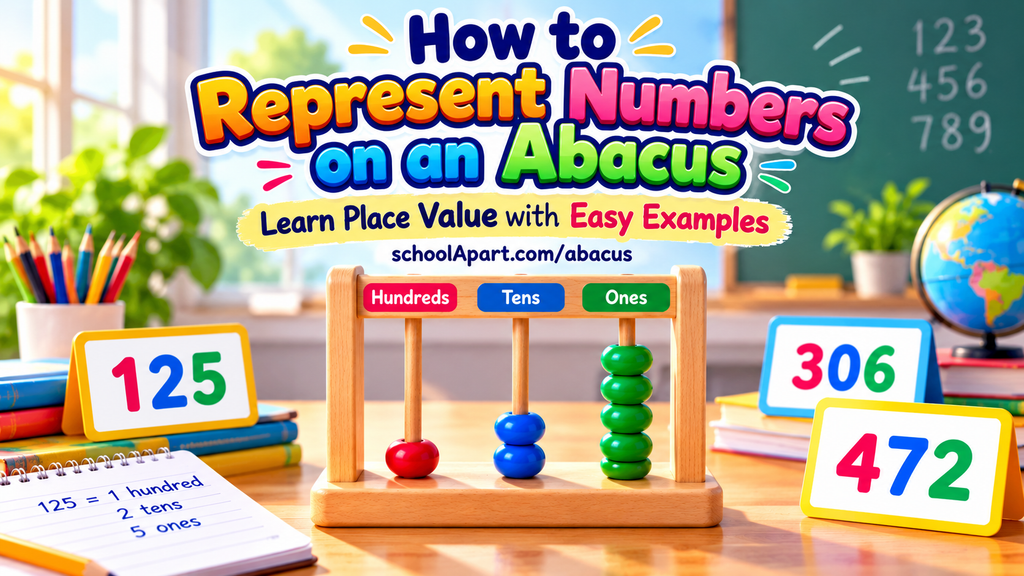
Learning how to represent numbers on an abacus helps children connect digits with their place values. Start with single-digit numbers, move on to Tens and Hundreds, and practise numbers containing zero.
With regular practice, you can become more confident at building, reading, and checking numbers on an abacus. Once these basics are clear, you will be better prepared to learn abacus addition and subtraction.
Frequently Asked Questions
1. What does it mean to represent a number on an abacus?
It means arranging the beads on the appropriate rods to show a number. Each rod represents a place value, such as Ones, Tens, or Hundreds.
2. How do you represent 25 on an abacus?
On a basic place-value abacus, use two active beads on the Tens rod and five on the Ones rod. Together, these represent 20 + 5 = 25.
3. How do you represent 105 on an abacus?
Use one active bead on the Hundreds rod, no active beads on the Tens rod, and five active beads on the Ones rod. This represents 100 + 0 + 5 = 105.
4. Why is place value important when using an abacus?
Place value tells you what each digit represents. Without it, you might count the beads correctly but read the complete number incorrectly.
5. Can beginners learn to represent numbers on an abacus at home?
Yes. Beginners can start with single-digit numbers, then practise two-digit and three-digit numbers. Regular practice and checking each rod carefully help build confidence.
6. Is number representation the same on every abacus?
No. Different abacus designs use different bead arrangements and rules. A basic counting abacus may use one bead per unit on a rod, while a Soroban uses upper and lower beads with different values. Follow the instructions for your specific model.







Leave a Reply