

Learn how to use an abacus step by step. Follow this beginner-friendly guide to learn abacus numbers, place value, addition, subtraction, multiplication and mental abacus.
How to Learn Abacus Step by Step for Beginners
Learning abacus is a step-by-step process. Beginners first learn the value of abacus beads, then learn how to represent numbers, understand place value, perform calculations, and gradually develop the ability to calculate mentally.
If you are a student or parent looking for a simple way to understand how to learn abacus, this guide provides a clear learning path from the basics to mental calculation.
The goal is not to learn everything at once. The best approach is to build one skill at a time and practice regularly.
What Is Abacus Learning?
Abacus learning is a method of developing calculation skills using an abacus as a visual and hands-on mathematical tool.
Instead of only writing numbers on paper, learners use beads to represent numerical values. With practice, they gradually become familiar with numbers, place value and calculation patterns.
Over time, students can learn to visualize an abacus mentally and perform calculations without physically moving the beads. This is commonly known as mental abacus or mental calculation using an abacus.
If you are completely new to the topic, start with our guide:
What Is Abacus? A Complete Beginner’s Guide for Kids
How to Learn Abacus Step by Step
A beginner should follow a logical sequence rather than jumping directly into difficult calculations.
A simple abacus learning path is:
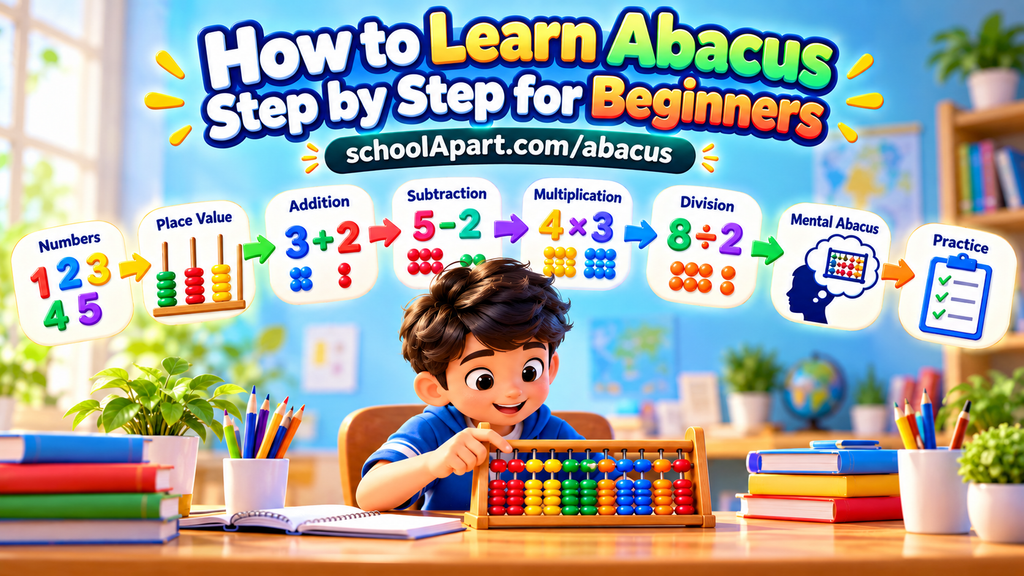
Understand the Abacus → Learn Beads and Values → Learn Numbers → Understand Place Value → Read Numbers → Learn Addition → Learn Subtraction → Learn Multiplication → Learn Division → Develop Mental Abacus Skills → Practice for Accuracy and Speed
Let’s look at each stage.
Step 1: Understand What an Abacus Is
Before learning calculations, understand the basic structure of an abacus.
A traditional school abacus consists of:
- A frame
- Vertical rods
- Beads
- A central bar or divider
- Different place-value columns
The beads are moved toward or away from the central bar to represent numbers.
You do not need to memorize complicated calculations at this stage. The first goal is simply to understand how the abacus represents numbers.
Step 2: Learn the Abacus Beads and Their Values
The next step is learning what the beads represent.
In a common school abacus, each column represents a place value. Depending on the abacus system, beads above and below the central bar have different values.
For beginners, the important thing is to understand that moving beads changes the numerical value represented on the abacus.
Practice moving the beads slowly and observe how the represented number changes.
At this stage, focus on:
- Identifying the beads
- Understanding bead values
- Moving beads correctly
- Returning the abacus to its starting position
- Recognizing simple numbers
Abacus Beads and Their Functions Explained: A Beginner’s Guide
Accuracy is more important than speed.
Step 3: Learn Abacus Numbers 1–9
Once you understand the beads, begin learning how to represent the numbers 1 to 9.
Practice each number individually.
For example, do not try to learn 1–9 only by looking at written numbers. Physically represent each number on the abacus and say the number aloud.
A useful beginner exercise is:
1 → 2 → 3 → 4 → 5 → 6 → 7 → 8 → 9
Then practice randomly:
3 → 7 → 1 → 9 → 5 → 2 → 8 → 4 → 6
This helps you recognize numbers more quickly.
Step 4: Learn Place Value
After learning single-digit numbers, the next important concept is place value.
You should understand:
- Ones
- Tens
- Hundreds
- Thousands
For example:
5 = 5 ones
25 = 2 tens + 5 ones
348 = 3 hundreds + 4 tens + 8 ones
The abacus makes place value visual because different columns represent different numerical positions.
Understanding place value properly will make later addition, subtraction and other calculations much easier.
Step 5: Learn How to Read Numbers on an Abacus
After learning how to represent numbers, practice reading them.
Look at an abacus arrangement and identify the number it represents.
Start with:
- Single-digit numbers
- Two-digit numbers
- Three-digit numbers
For example:
7 → 24 → 135 → 428
Do not rush.
Your goal is to look at the bead arrangement and recognize the number accurately.
This skill becomes especially important when you later begin mental abacus practice.
Step 6: Learn Abacus Addition
Once you can confidently represent and read numbers, begin abacus addition.
Start with simple problems.
For example:
2 + 3 = 5
Then move to slightly more challenging calculations:
12 + 5 = 17
24 + 13 = 37
The basic learning process is:
- Represent the first number.
- Add the second number using the appropriate beads.
- Read the resulting number.
- Check the answer.
Do not focus on speed initially.
Learn the correct bead movements first.
Step 7: Learn Abacus Subtraction
After becoming comfortable with addition, start learning subtraction.
Begin with simple examples:
5 − 2 = 3
Then gradually move to larger numbers:
18 − 5 = 13
45 − 23 = 22
The purpose of beginner subtraction practice is to understand how bead movements represent taking away a value.
Abacus Subtraction for Beginners: Learn Subtraction Step by Step
Practice slowly and check your answers.
Step 8: Practice Addition and Subtraction Together
Once you understand both operations individually, combine them.
For example:
7 + 2 − 3 = 6
Then gradually increase the number of steps.
Mixed practice helps you become comfortable switching between addition and subtraction.
At this stage, accuracy should still be your main goal.
Abacus Addition and Subtraction Practice Questions for Beginners
Speed will develop naturally with regular practice.
Step 9: Learn Abacus Multiplication
After building a strong foundation in addition and subtraction, you can move to multiplication.
Start with simple multiplication facts.
For example:
2 × 3 = 6
4 × 5 = 20
6 × 7 = 42
Do not start with complicated multi-digit multiplication.
First become comfortable with the basic multiplication process and gradually increase the difficulty.
A strong understanding of addition and place value will make multiplication easier to learn.
Step 10: Learn Abacus Division
Division can be introduced after the learner is comfortable with the earlier calculation skills.
Begin with simple examples:
8 ÷ 2 = 4
15 ÷ 3 = 5
24 ÷ 6 = 4
The difficulty can then be increased gradually.
Division generally requires more understanding than basic addition and subtraction, so beginners should not rush into it.
Step 11: Start Mental Abacus Practice
One of the advanced goals of abacus learning is developing the ability to visualize the abacus mentally.
Instead of physically moving beads, the learner imagines the abacus and mentally performs the required movements.
This is often called mental abacus.
For example, after sufficient practice with a physical abacus, a learner may gradually begin to visualize:
5 + 3 = 8
without physically moving the beads.
Mental abacus should not be treated as the first step. It should come after the learner develops a strong foundation with the physical abacus.
Step 12: Improve Accuracy Before Speed
Many beginners make the mistake of trying to calculate as quickly as possible.
That is not the best starting point.
Follow this order:
Accuracy → Understanding → Consistency → Speed
First, make sure your answers are correct.
Then work on performing the same calculations consistently.
Once your accuracy becomes reliable, gradually increase your calculation speed.
Step 13: Practice a Little Every Day
Regular practice is more useful than occasional long sessions.
A beginner can create a simple practice routine:
| Practice Area | Suggested Focus |
|---|---|
| Number recognition | 5–10 minutes |
| Place value | 5 minutes |
| Addition | 10 minutes |
| Subtraction | 10 minutes |
| Mental visualization | 5 minutes |
| Review | 5 minutes |
The exact practice time can vary depending on the learner’s age and level.
The important thing is consistency.
How to Learn Abacus at Home Through Online Lessons
You can learn abacus at home by following online lessons, watching demonstrations, and practising regularly with a physical abacus. Online learning can be helpful for beginners who want to learn at their own pace.
1. Choose Beginner-Friendly Lessons
Start with lessons that explain the basic parts of an abacus, bead values, and place value. Follow the lessons in order instead of jumping directly to advanced calculations.
2. Keep an Abacus Ready
Keep a suitable abacus beside you while watching a lesson. Move the beads yourself rather than only watching someone else demonstrate the steps.
3. Practise Along with Each Lesson
Pause the video when necessary and repeat the examples on your own abacus. Begin with number representation, then move on to reading numbers, addition, and subtraction.
4. Follow a Regular Practice Routine
Set aside a short period for practice each day. Focus on accuracy first, and gradually increase the difficulty as your skills improve.
5. Check Your Progress
After each lesson, try a few questions without looking at the answers. Review any mistakes and repeat the exercise until you can represent the numbers correctly.
6. Use Free Online Learning Resources
Beginner-friendly educational articles and video lessons can help you understand each concept step by step. You can use the SchoolApart Abacus Learning Hub to find related lessons on numbers, place value, bead functions, and basic calculations.
Tip: Online lessons work best when you actively practise with an abacus. Watching videos alone is not a substitute for moving the beads and solving exercises yourself.
How Long Does It Take to Learn Abacus?
There is no single fixed time for learning abacus.
The learning period depends on factors such as:
- Age
- Previous mathematics experience
- Practice frequency
- Learning method
- Difficulty level
- Individual learning pace
A beginner who practices regularly can gradually progress from basic number representation to arithmetic operations and eventually mental visualization.
Instead of focusing only on how many days it takes, focus on mastering each stage before moving to the next one.
Can Kids Learn Abacus at Home?
Yes, beginners can start learning abacus at home with a suitable abacus, structured lessons and regular practice.
A simple home-learning sequence is:
Numbers → Place Value → Number Reading → Addition → Subtraction → Multiplication → Division → Mental Abacus → Practice
Parents can support the learning process by encouraging regular practice rather than putting pressure on the child to calculate quickly.
For children, short and consistent practice sessions can be easier to manage than long sessions.
How to Practice Abacus at Home
A simple home routine can include:
Number Practice
Choose random numbers and represent them on the abacus.
Number Reading
Ask the learner to identify numbers shown on the abacus.
Calculation Practice
Start with simple addition and subtraction problems.
Mental Visualization
After sufficient physical practice, encourage the learner to visualize the abacus.
Speed Practice
Only after accuracy becomes consistent, introduce timed practice.
You can also use structured video lessons to follow a step-by-step learning sequence.
Common Mistakes Beginners Should Avoid
Trying to Learn Everything at Once
Abacus is a progressive skill. Learn one concept before moving to the next.
Focusing on Speed Too Early
Fast incorrect answers are less useful than accurate answers.
Skipping Place Value
A weak understanding of place value can make later calculations difficult.
Practicing Irregularly
Long gaps between practice sessions can make learning less consistent.
Moving to Mental Abacus Too Soon
Mental abacus should be developed gradually after building sufficient physical abacus skills.
A Simple Abacus Learning Roadmap
Here is the complete beginner roadmap in one place:
Stage 1 — Foundation
Understand the abacus → Learn beads → Learn numbers 1–9
Stage 2 — Number Skills
Learn place value → Represent numbers → Read numbers
Stage 3 — Calculation
Addition → Subtraction → Mixed addition and subtraction
Stage 4 — Advanced Calculation
Multiplication → Division
Stage 5 — Mental Abacus
Visualization → Mental calculation
Stage 6 — Improvement
Accuracy → Consistency → Speed → Regular practice
This sequence gives beginners a clear direction without trying to learn everything simultaneously.
Learn Abacus Through SchoolApart
The SchoolApart Abacus Learning Hub is designed to organize abacus learning into a simple progression for school students and beginners.
You can start with the basics and gradually move toward calculation, mental abacus and practice.
Recommended Learning Order
- Understand what an abacus is
- Learn abacus numbers
- Understand place value
- Learn to read numbers
- Learn addition
- Learn subtraction
- Learn multiplication
- Learn division
- Learn mental abacus
- Practice for accuracy and speed
As new SchoolApart Abacus lessons and practice resources are added, learners can follow the learning path step by step.
Learn Abacus Through Video Lessons
Reading can help you understand the concepts, but watching a demonstration can make bead movements easier to follow.
Once you are ready for practical lessons, continue with the SchoolApart Abacus Course on YouTube.
The video learning path can follow the same sequence:
Basics → Numbers → Place Value → Addition → Subtraction → Multiplication → Division → Mental Abacus → Practice & Speed
This allows learners to use the website for explanations and the video lessons for practical demonstration and guided learning.
Frequently Asked Questions (FAQ)
What is the best way to learn abacus?
The best approach is to learn abacus progressively: understand the beads and their values, learn numbers and place value, then move to addition, subtraction, multiplication, division and eventually mental abacus.
Can beginners learn abacus?
Yes. Beginners can start with basic number representation and gradually develop calculation skills through regular practice.
Can children learn abacus at home?
Yes. Children can begin learning abacus at home using a suitable abacus, structured lessons and consistent practice.
Should I learn addition or subtraction first?
Beginners generally start with simple addition and then learn subtraction. Once both are understood, they can be practiced together.
When should I start mental abacus?
Mental abacus should generally come after you have developed a strong understanding of the physical abacus, numbers and basic calculations.
How can I improve my abacus speed?
First improve accuracy and consistency. Then gradually introduce timed practice and increasingly challenging calculations.
Is abacus difficult to learn?
The basic concepts can be learned progressively. The difficulty increases as calculations become more advanced, so regular practice is important.
Can abacus help with mental calculation?
Abacus learning can be used to develop calculation and visualization skills. With practice, learners may progress toward performing calculations mentally by visualizing an abacus.
Start Your Abacus Learning Journey
Learning abacus does not require you to master everything in one day.
Start with the basics, understand how the beads represent numbers, build a strong foundation in place value, and then gradually move through addition, subtraction, multiplication, division and mental abacus.
Understand → Learn → Practice → Improve → Visualize → Calculate
Start with the basics and move forward one skill at a time.








Leave a Reply