

Compare abacus and calculator learning for kids. Understand how they work, their benefits, limitations, and when each method is useful.
Abacus vs Calculator: Which Is Better for Kids?
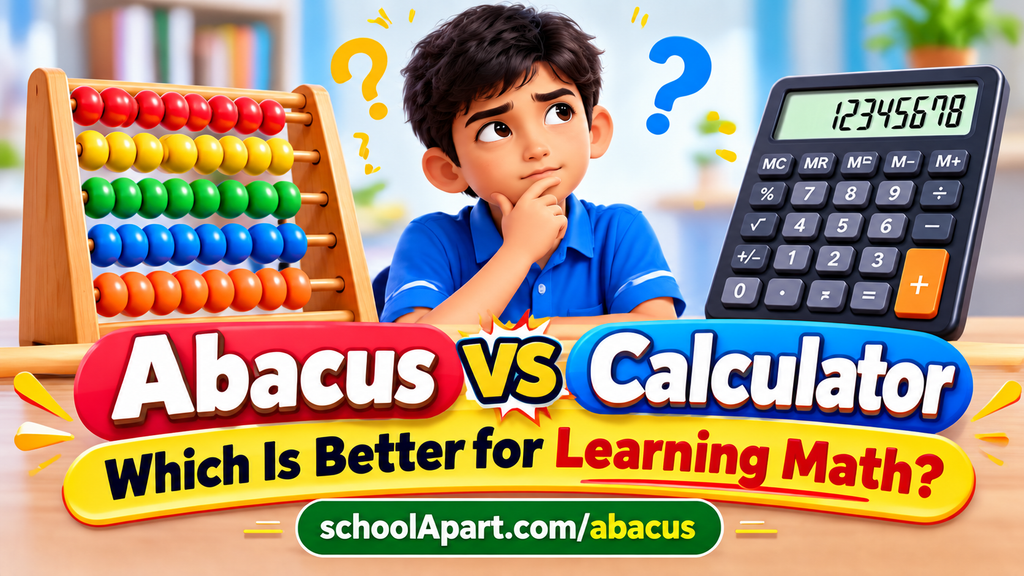
An abacus and a calculator are both useful tools for working with numbers, but they serve different purposes.
An abacus helps learners represent numbers using beads and perform calculations through physical movements. A calculator performs calculations electronically and can provide answers quickly.
For children who are learning mathematics, understanding the difference between an abacus and a calculator can help parents and teachers choose the right tool for each learning activity.
In this guide, we will compare abacus vs calculator, including how they work, their advantages, limitations, and when each one is useful.
What Is an Abacus?
An abacus is a calculation tool that uses beads arranged on rods or wires. Each column represents a place value, such as ones, tens, or hundreds.
Learners move beads to represent numbers and perform calculations.
For example, a child can use an abacus to understand how numbers are represented and how addition or subtraction changes their values.
An abacus can support hands-on mathematics learning because children can see and manipulate the quantities represented by the beads.
Read our beginner’s guide: What Is Abacus?
What Is a Calculator?
A calculator is an electronic device or software tool that performs mathematical calculations.
Depending on the calculator, students can use it for addition, subtraction, multiplication, division, percentages, and other mathematical operations.
For example:
248 + 135 = 383
A calculator can produce the answer quickly without requiring the student to move beads or calculate each step manually.
However, getting the correct answer from a calculator does not automatically mean that a student understands the mathematical concept behind the calculation.
Abacus vs Calculator: Key Differences
| Feature | Abacus | Calculator |
|---|---|---|
| How it works | Uses bead positions and movement | Uses electronic computation |
| Number representation | Visible through bead positions | Usually displayed as digits |
| Hands-on learning | Yes | Limited |
| Speed | Depends on skill and calculation | Usually very fast |
| Learning basic number concepts | Can support hands-on understanding | Can check answers |
| Complex calculations | Depends on the method and learner’s skill | Many calculations are handled easily |
| Electricity or battery | Traditional abacus does not need power | Electronic calculators generally need power |
| Mental calculation practice | Can support progression toward mental abacus | Usually supplies the answer directly |
| Best use | Number representation and calculation practice | Quick calculations and checking work |
Neither tool is best for every situation. The right choice depends on what the student needs to learn or accomplish.
Abacus vs Calculator for Learning Mathematics
1. Understanding Numbers
An abacus allows children to see numbers represented through bead positions.
For example, the number 24 can be represented as 2 tens and 4 ones.
This visual representation can help learners connect digits with place value.
A calculator displays the number 24, but it generally does not show the same physical representation of tens and ones.
Better suited for: Hands-on practice with number representation — an abacus can be particularly useful here.
2. Learning Addition and Subtraction
With an abacus, students perform calculations by changing bead positions.
For example:
5 + 2 = 7
The learner represents 5 and then changes the bead positions to represent 7.
A calculator can also solve the problem quickly, but the student may not need to perform the calculation independently.
For beginners, an abacus can be a useful learning aid. A calculator is helpful for checking answers after students have attempted the problem themselves.
3. Calculation Speed
Electronic calculators generally produce answers faster than a person using a physical abacus.
An experienced abacus learner may also calculate quickly, but speed depends on training, the calculation method, and the difficulty of the problem.
It is not accurate to assume that every abacus learner will calculate faster than every calculator user.
Better suited for: Quick electronic calculations — a calculator is usually the more convenient option.
4. Mental Calculation
Abacus training may help learners progress toward visualizing an abacus mentally and performing calculations without a physical tool.
This approach is often called mental abacus.
However, mental calculation ability varies between learners and develops through practice. Using an abacus does not guarantee that every child will achieve the same level of mental calculation skill.
Learn more: Mental Abacus: How to Calculate Without a Physical Abacus.
5. Solving Complex Calculations
Calculators can handle many calculations that would be time-consuming to perform manually.
Depending on the device, students may be able to calculate percentages, work with fractions, use scientific functions, or solve more advanced numerical problems.
An abacus can also be used for calculations within the learner’s trained method, but complex operations require additional skill and practice.
Better suited for: Conveniently handling a wide range of calculations — a calculator is generally more practical.
Does an Abacus Train the Brain Better Than a Calculator?
This question is related to the purpose of using each tool.
An abacus requires learners to manipulate bead positions and follow calculation steps. This provides an opportunity to practice number representation and calculation procedures.
A calculator automates the calculation itself, allowing students to focus on other tasks, such as checking results or exploring mathematical problems.
However, it would be misleading to claim that an abacus always trains the brain better or that calculators harm mathematical ability. Outcomes depend on how each tool is used, the learner’s age and experience, and the learning activity.
For children, a balanced approach is often more useful than treating the two tools as competitors.
Advantages of an Abacus
An abacus offers several potential benefits for beginner mathematics learning.
- Visual number representation: Children can see how numbers are represented using beads.
- Hands-on practice: Moving beads makes calculation an active learning task.
- Place-value practice: Different columns can represent ones, tens, hundreds, and higher values.
- Calculation practice: Students can repeatedly practice addition and subtraction.
- A path toward mental abacus: With suitable training, some learners progress toward mental visualization.
These benefits depend on appropriate instruction and regular practice.
Read more: Abacus Place Value: Ones, Tens and Hundreds.
Advantages of a Calculator
A calculator is useful in many learning situations.
- Fast answers: It performs many calculations quickly.
- Convenience: Students can check answers without manually repeating every calculation.
- Support for advanced mathematics: Suitable calculators can handle functions beyond basic arithmetic.
- Error checking: Students can compare their own answers with calculator results.
- Practical problem-solving: It can help when the focus is on interpreting a problem rather than practicing arithmetic.
A calculator is a useful mathematical tool, especially when students already understand the underlying concepts.
Can Children Use Both an Abacus and a Calculator?
Yes. Children can use both tools for different purposes.
A practical learning routine could look like this:
- Learn the number concept using an abacus.
- Practice addition or subtraction without a calculator.
- Write down the answer.
- Use a calculator to check the result.
- Review any mistakes and repeat the calculation.
This approach allows students to practice calculation skills while also learning to verify answers.
For example, a student can solve 27 + 15 using an abacus, write down the answer, and then use a calculator to check whether the result is 42.
The aim is not to avoid calculators altogether. It is to use them at the right time for the right purpose.
Should Beginners Learn Abacus Before Using a Calculator?
An abacus can be a helpful starting tool for children who are learning number representation and basic calculations.
However, there is no universal rule that every student must learn an abacus before using a calculator.
The choice depends on the child’s learning needs, school curriculum, age, and the type of mathematics being studied.
For basic arithmetic practice, children can benefit from learning how numbers work before relying heavily on automated answers. An abacus is one way to support that process, alongside counting objects, number lines, written calculations, and other teaching methods.
Abacus vs Calculator: Which Is Better for Kids?
The answer depends on the learning goal.
| Learning goal | Suggested tool |
|---|---|
| Understanding number representation | Abacus |
| Practicing bead-based addition and subtraction | Abacus |
| Learning place value through physical representation | Abacus |
| Checking arithmetic answers | Calculator |
| Performing calculations quickly | Calculator |
| Working with advanced numerical functions | Suitable calculator |
| Practicing both calculation and answer checking | Both |
For a child who is just beginning to learn arithmetic, an abacus can be a useful hands-on learning aid. As mathematical skills develop, calculators become increasingly useful for checking work and handling more complicated calculations.
How to Start Learning Abacus
If you want your child to learn abacus, follow a gradual learning path:
- Understand what an abacus is.
- Learn how numbers are represented.
- Practice ones, tens, and hundreds.
- Learn how to read numbers on an abacus.
- Practice addition and subtraction.
- Progress to more advanced calculations.
Start here: How to Learn Abacus Step by Step.
You can also visit the SchoolApart Abacus Learning Hub for more beginner-friendly lessons.
An abacus and a calculator are useful in different ways.
An abacus can support hands-on learning, number representation, place value, and calculation practice. A calculator is convenient for quick answers, checking work, and handling a wide range of calculations.
For children learning mathematics, the most useful approach is to understand the concepts, practice calculations, and use a calculator when it helps with checking or solving problems.
The better tool is the one that supports the student’s current learning goal. In many situations, an abacus and a calculator can complement each other rather than compete.
Frequently Asked Questions
Is an abacus better than a calculator?
An abacus can be useful for hands-on learning and practicing number representation. A calculator is generally more convenient for fast calculations. The better choice depends on the task.
Does an abacus improve mental math?
Abacus practice may help some learners develop mental calculation skills, particularly when they progress toward visualizing bead positions. Results vary with practice and instruction.
Should children use calculators while learning mathematics?
Children can use calculators to check answers and solve appropriate problems. However, they should also practice basic arithmetic and understand the concepts behind their calculations.
Is abacus faster than a calculator?
A calculator generally produces answers faster than a person using a physical abacus. Experienced abacus learners can also calculate quickly, depending on their training and the problem.
Can a child learn both abacus and calculator skills?
Yes. Children can learn calculation through an abacus and use calculators to verify answers or handle more complex numerical tasks.
What should children learn before starting abacus?
It helps to become familiar with counting and basic numbers. Children can then learn bead positions, place value, number reading, and simple calculations step by step.




Leave a Reply