

Learn the 5 basic shapes for drawing and discover how circles, squares, rectangles, triangles, and ovals can help you create simple objects, animals, cartoons, and more.
5 Basic Shapes for Drawing: How to Use Them to Create Simple Drawings
Learning to draw becomes much easier when you stop trying to copy a complete object all at once.
A house is not just a house.
A car is not just a car.
A face is not just a face.
Most drawings can be simplified into smaller forms that are easier to understand and construct.
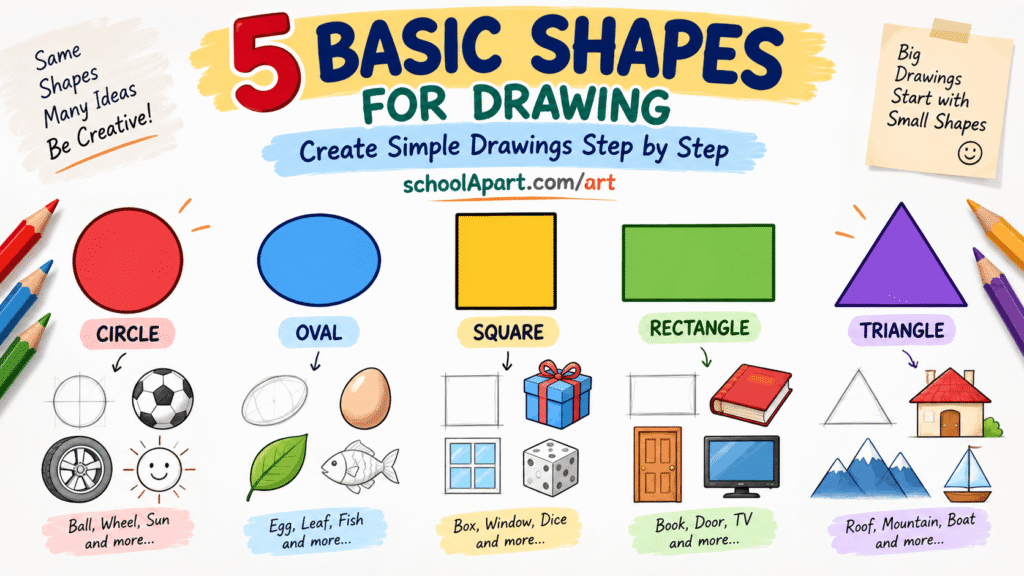
Among the many forms artists use, five basic shapes are especially useful for beginners: circle, oval, square, rectangle, and triangle.
These simple shapes can be combined, modified, stretched, rotated, overlapped, and refined to create a huge variety of drawings.
A circle can become a ball, wheel, eye, or head.
An oval can become an egg, face, leaf, or animal body.
A rectangle can become a book, door, building, or vehicle body.
A square can become a box, window, or part of a character.
A triangle can become a roof, mountain, tree, ear, or other pointed form.
The goal is not to make every drawing look geometric.
The goal is to use these shapes as building blocks.
In this guide, you will learn the five basic shapes for drawing, what each shape can be used for, how artists combine them, and several practical exercises that will help you become more comfortable using shapes in your own drawings.
What Are the 5 Basic Shapes for Drawing?
The five basic shapes are:
- Circle
- Oval
- Square
- Rectangle
- Triangle
These shapes are simple, but they can be used in many different ways.
You can use them to:
- Build objects
- Construct characters
- Simplify animals
- Create landscapes
- Understand proportions
- Develop three-dimensional forms
- Plan compositions
- Create cartoon drawings
- Practise observation
The important thing is to understand that a basic shape is usually a starting point, not necessarily the final shape of the drawing.
For example, a circle may be used to construct a head, but the finished head will not necessarily remain a perfect circle.
1. Circle
The circle is one of the most useful shapes in drawing.
It has no corners and creates a simple rounded form.
You will find circles everywhere in both natural and manufactured objects.
What Can You Draw With Circles?
Circles can help you draw:
- Balls
- Wheels
- Eyes
- Buttons
- Plates
- Clocks
- Fruits
- Cartoon heads
- Sun
- Bubbles
- Coins
A circle can also become the foundation for a three-dimensional sphere.
Circle as a Construction Shape
Imagine that you want to draw a simple cartoon face.
Instead of immediately drawing the eyes, nose, mouth, ears, and hair, begin with a circle or oval.
This gives you an overall framework.
You can then add:
- Eyes
- Nose
- Mouth
- Ears
- Hair
The circle provides a starting structure.
Circle to Sphere
A circle is a two-dimensional shape.
But with light and shadow, you can make it appear three-dimensional.
Think about a simple ball.
Start with:
Circle → Light → Shadow → Highlight → Sphere
The outline stays circular, but the shading creates the impression of volume.
This is an important step in learning how to draw three-dimensional objects.
Circle Drawing Exercise
Take a sheet of paper and draw 20 circles.
Do not worry about perfection.
Make them:
- Small
- Large
- Wide
- Narrow
- Light
- Dark
Then turn some circles into:
- Balls
- Eyes
- Fruits
- Wheels
- Cartoon faces
This exercise helps you understand how one basic shape can become many different things.
2. Oval
The oval is similar to a circle, but it is stretched in one direction.
Ovals are extremely important because many objects appear elliptical when viewed from different angles.
What Can You Draw With Ovals?
Ovals can help create:
- Eggs
- Faces
- Eyes
- Leaves
- Balloons
- Fruits
- Animal bodies
- Cartoon heads
- Bowls
- Cups
Ovals are particularly useful when drawing organic subjects.
Oval for Drawing Faces
The human head is often simplified into an oval during the early stages of portrait drawing.
The oval helps establish:
- Overall head height
- Head width
- Facial centre
- Position of facial features
After the basic structure is established, the artist can refine the jaw, cheeks, ears, hair, and other features.
This is why understanding simple forms can also help when learning portrait drawing.
SchoolApart’s portrait lessons such as Human Face Drawing Basics and the individual guides for eyes, nose, lips, ears, hair, and hands can be studied alongside this foundational concept.
Oval for Drawing Eyes
An eye is not simply a circle.
The visible eye opening is often closer to an almond-like curved shape, while the eyeball itself is spherical.
For beginners, an oval or simplified curved form can be useful for understanding the overall eye structure before adding the iris, pupil, eyelids, and eyelashes.
Oval Drawing Exercise
Draw:
- 10 vertical ovals
- 10 horizontal ovals
- 10 narrow ovals
- 10 wide ovals
Then turn some into:
- Eggs
- Leaves
- Eyes
- Balloons
- Fruits
This exercise helps you become comfortable with changing the direction and proportions of a simple form.
3. Square
The square has four equal sides and four corners.
It is especially useful when drawing objects that have strong geometric or structural forms.
What Can You Draw With Squares?
Squares can help create:
- Windows
- Boxes
- Blocks
- Tiles
- Buildings
- Signs
- Simple patterns
- Cartoon objects
- Geometric designs
Squares are also useful when learning how flat shapes can become three-dimensional objects.
Square to Cube
A square is flat.
A cube has volume.
By adding additional planes and using perspective, a square can become part of a cube.
For example:
Square → Add side plane → Add top/bottom relationship → Cube
This is one reason basic shapes are so important for drawing.
You are not only learning flat shapes.
You are beginning to understand form.
Square Drawing Exercise
Draw several squares of different sizes.
Then turn them into:
- Windows
- Boxes
- Buildings
- Tiles
- Blocks
After that, try turning some squares into simple cubes.
This introduces you to perspective and three-dimensional drawing.
4. Rectangle
A rectangle has four sides, with opposite sides generally equal in length.
Rectangles are extremely common in everyday objects.
What Can You Draw With Rectangles?
Rectangles can help you draw:
- Books
- Doors
- Tables
- Buildings
- Phones
- Screens
- Cabinets
- Boxes
- Vehicle bodies
- Signs
- Furniture
If you look around a room, you will probably notice many rectangular forms.
Rectangle for Object Drawing
Imagine you want to draw a book.
Instead of immediately drawing every page and cover detail, start with a simple rectangle.
Then add:
- Thickness
- Pages
- Cover
- Spine
- Perspective
- Shadow
The rectangle becomes the structural foundation.
Rectangle for Buildings
A simple building can begin with a rectangle.
Then you can add:
- Roof
- Windows
- Door
- Chimney
- Walls
- Balcony
The final drawing may look complicated, but its basic structure can remain very simple.
Rectangle Drawing Exercise
Find five rectangular objects around you.
For example:
- Book
- Phone
- Door
- Table
- Box
Draw each object first as a simple rectangle.
Then gradually add the details.
This exercise teaches you to identify structure before detail.
5. Triangle
The triangle has three sides and three corners.
It is particularly useful for pointed and angular forms.
What Can You Draw With Triangles?
Triangles can help create:
- Roofs
- Mountains
- Trees
- Flags
- Arrows
- Animal ears
- Party hats
- Cones
- Simple geometric objects
Triangles are especially useful in simple landscape and cartoon drawings.
Triangle for Drawing a House
A very simple house can be constructed from:
Rectangle → Building
plus:
Triangle → Roof
Add:
- Door
- Windows
- Chimney
- Fence
and you already have a recognizable house.
This demonstrates an important principle:
Different basic shapes can work together to create a more complex object.
Triangle for Drawing Mountains
A simple mountain can begin with a triangle.
But natural mountains are rarely perfect triangles.
After creating the basic triangular structure, you can make the sides irregular and add:
- Snow
- Rocks
- Trees
- Shadows
- Clouds
- Background mountains
The triangle is simply the starting framework.
The 5 Basic Shapes at a Glance
| Shape | Common Uses | Example Subjects |
|---|---|---|
| Circle | Rounded forms | Ball, wheel, head |
| Oval | Elongated rounded forms | Egg, eye, leaf |
| Square | Equal-sided structures | Window, block, box |
| Rectangle | Structural objects | Book, door, building |
| Triangle | Pointed forms | Roof, mountain, tree |
These five shapes can be combined in countless ways.
How Artists Combine Basic Shapes
Very few drawings consist of only one shape.
Most drawings use several shapes together.
For example, a simple house might use:
Rectangle + Triangle + Squares + Small Rectangles
A simple car might use:
Rectangle + Circles + Smaller Rectangles + Curved Forms
A cartoon character might use:
Circle + Ovals + Triangles + Curved Lines
An animal might use:
Ovals + Circles + Triangles + Long Curved Forms
The skill is not memorizing a list of shapes.
The skill is learning to see shapes inside objects.
How to Identify Basic Shapes in Anything You See
Choose an object around you.
Do not immediately draw its outline.
Instead, ask:
Question 1: What is the largest form?
Is it:
- Round?
- Oval?
- Rectangular?
- Square?
- Triangular?
Question 2: What smaller forms are attached to it?
Look for:
- Circles
- Ovals
- Rectangles
- Squares
- Triangles
Question 3: Which parts overlap?
Some forms may sit in front of others.
Question 4: What forms are three-dimensional?
Look for:
- Spheres
- Cubes
- Cylinders
- Cones
- Boxes
This way of observing is more useful than simply memorizing shapes.
Example: Drawing a Simple House From 5 Basic Shapes
Let’s use the five shapes in a single drawing.
Step 1: Rectangle
Draw a rectangle for the main body of the house.
Step 2: Triangle
Place a triangle above it to create the roof.
Step 3: Rectangles
Add a rectangle for the door.
Step 4: Squares
Add squares for windows.
Step 5: Circle
Add a circular detail such as a window, decoration, or sun in the surrounding scene.
You have now combined several basic shapes into one recognizable drawing.
After that, add:
- Door details
- Window frames
- Roof texture
- Chimney
- Trees
- Grass
- Path
- Shadows
Example: Drawing a Simple Car From Basic Shapes
A car can also be simplified.
Main body
Start with a rectangle or elongated box.
Wheels
Use two circles.
Windows
Use smaller rectangles or trapezoid-like forms.
Lights
Use small circles or rectangles.
Details
Add:
- Doors
- Mirrors
- Handles
- Bumpers
The finished car will no longer look like a collection of perfect geometric shapes.
That is normal.
The basic shapes were construction tools.
Example: Drawing a Simple Tree
A tree can begin with two main groups of forms.
Trunk
Use a rectangle or elongated irregular form.
Foliage
Use several circles or ovals.
Then modify the outlines so the tree looks more natural.
Add:
- Branches
- Leaves
- Bark
- Ground
- Shadow
For a more complete nature drawing lesson, explore Step-by-Step Nature Drawing.
Example: Drawing a Simple Animal
Let’s imagine a simple cartoon cat.
Start with:
- Oval → Body
- Circle/Oval → Head
- Triangles → Ears
- Small circles → Eyes
- Small shapes → Nose
- Curved line → Mouth
- Long curved shape → Tail
Then refine the body and add fur.
The animal becomes much easier to construct when you stop trying to draw the complete silhouette immediately.
Basic Shapes and 3D Forms
Learning the five flat shapes is only the beginning.
Artists also learn to think about three-dimensional forms.
Some useful relationships are:
Circle → Sphere
Square → Cube
Rectangle → Box
Triangle → Pyramid
Oval → Elliptical/rounded form
You can then combine these forms to construct more complicated subjects.
For example, a simple character can be constructed using:
- Sphere-like head
- Box-like torso
- Cylindrical arms
- Cylindrical legs
This is an important bridge between simple drawing and more advanced form construction.
Basic Shapes and Shading
Shapes become much more interesting when you add light and shadow.
Imagine a circle.
Without shading, it looks flat.
Add a light source and gradually introduce:
- Highlight
- Light area
- Midtone
- Core shadow
- Reflected light
- Cast shadow
The circle can begin to look like a sphere.
The same principle applies to other forms.
A cube can show different planes.
A cylinder can show a gradual value transition.
A cone can show changing light across its surface.
If you want to study this further, continue with Shading Techniques for Beginners and Light and Shadow in Drawing.
Basic Shapes and Perspective
Perspective changes how shapes appear when viewed from different angles.
A square viewed straight on may look like a square.
Viewed from an angle, it may appear more like a distorted quadrilateral.
A circle viewed at an angle may appear as an oval.
This is why artists need to understand both shape and viewpoint.
Practising simple boxes and cylinders is an excellent way to begin learning perspective.
For a deeper lesson, see Perspective Drawing Explained.
5 Basic Shapes Drawing Practice
Now let’s turn the five shapes into a practical exercise.
Exercise 1: Shape Recognition
Look around your room.
Find:
- Five circles
- Five ovals
- Five squares
- Five rectangles
- Five triangles
You do not need to draw them yet.
Simply identify them.
This trains your observation.
Exercise 2: Draw the Five Shapes
On one page, create five sections.
Draw:
Circle
Oval
Square
Rectangle
Triangle
Repeat the exercise several times.
Focus on control rather than perfection.
Exercise 3: Turn Shapes Into Objects
Create:
Circle
Ball
Oval
Egg
Square
Box
Rectangle
Book
Triangle
Mountain
This teaches you that a shape can represent many different things.
Exercise 4: Combine Shapes
Create one drawing using at least three shapes.
Try:
- House
- Robot
- Car
- Animal
- Cartoon character
Do not add details until the basic construction looks correct.
A 7-Day Practice Plan for the 5 Basic Shapes
Day 1 — Circles
Practice circles and turn them into balls, wheels, and simple faces.
Day 2 — Ovals
Practice eggs, eyes, leaves, and simple animal bodies.
Day 3 — Squares
Practice boxes, windows, blocks, and cubes.
Day 4 — Rectangles
Practice books, doors, buildings, and simple furniture.
Day 5 — Triangles
Practice roofs, mountains, trees, and simple pointed forms.
Day 6 — Combine Shapes
Create houses, cars, animals, and cartoon characters.
Day 7 — Draw From Observation
Choose an object around you.
Identify its basic shapes.
Then draw it using those shapes before adding details.
This final exercise is the most important because it teaches you to apply the concept to real subjects.
Common Mistakes When Learning Basic Shapes
Mistake 1: Thinking Every Object Is Only One Shape
A house is not simply a triangle.
A face is not simply an oval.
A car is not simply a rectangle.
Most subjects are combinations of forms.
Mistake 2: Drawing the Final Outline Immediately
Beginners often try to copy the final contour.
This can make proportion difficult.
Instead, use shapes as construction guides first.
Mistake 3: Making Every Shape Perfect
A drawing does not need mathematically perfect geometric shapes.
What matters more is:
- Placement
- Proportion
- Structure
- Observation
Mistake 4: Ignoring Three-Dimensional Form
A circle is useful, but learning to think of it as a sphere opens up much more advanced drawing possibilities.
Mistake 5: Adding Details Too Early
Details cannot repair incorrect proportions.
Build the structure first.
How to Practise These Shapes Every Day
You do not need a long drawing session.
A simple daily exercise can take 10–15 minutes.
3 minutes
Draw circles and ovals.
3 minutes
Draw squares and rectangles.
2 minutes
Draw triangles.
5 minutes
Combine the shapes into one simple object.
For example:
Circle + Rectangle + Triangle → Simple character or object
If you practise consistently, your hand will gradually become more comfortable with these forms.
For a broader structured routine, see the Daily Art Practice Routine on SchoolApart.
Why These Five Shapes Matter
The five basic shapes are useful because they provide a simple visual vocabulary.
When you see an object, you can begin translating it into forms you already understand.
Instead of seeing:
“That is a difficult object.”
you can start thinking:
“I can see a rectangle here, an oval there, two circles, and a smaller triangle.”
This is a major change in the way beginners approach drawing.
You stop trying to reproduce everything at once.
You begin constructing.
What Should You Learn After the 5 Basic Shapes?
Once you are comfortable with these shapes, the next step is not simply learning more flat shapes.
Instead, begin applying them to:
- Simple objects
- 3D forms
- Perspective
- Light and shadow
- Shading
- Cartoon drawing
- Nature drawing
- Portrait construction
- Figure drawing
- Complete compositions
This creates a natural path from beginner drawing to more advanced skills.
Key Takeaways
The five basic shapes for drawing are:
- Circle
- Oval
- Square
- Rectangle
- Triangle
Remember:
- Shapes are building blocks, not always final outlines.
- One object can contain several basic shapes.
- Basic shapes can be combined to create complex drawings.
- Shapes can also be developed into three-dimensional forms.
- Shading can turn flat shapes into forms with volume.
- Perspective changes how shapes appear from different viewpoints.
- Observation is just as important as drawing practice.
- Regular practice will make shape construction more natural.
The goal is not to draw perfect circles, squares, or triangles forever.
The goal is to learn how to see the shapes inside the things you want to draw.
Once you develop that habit, drawing becomes much more manageable.
Frequently Asked Questions
1. What are the 5 basic shapes for drawing?
The five basic shapes commonly used by beginners are the circle, oval, square, rectangle, and triangle.
2. Why are basic shapes important in drawing?
They help artists simplify complicated subjects and establish structure, proportion, and placement before adding details.
3. What can I draw with basic shapes?
You can create houses, cars, animals, cartoon characters, trees, faces, books, cups, landscapes, and many everyday objects.
4. Which basic shape is most useful for drawing?
There is no single most useful shape. Circles, ovals, squares, rectangles, and triangles each serve different purposes.
5. Can I draw a face using basic shapes?
Yes. An oval can help establish the head, while smaller shapes and lines can be used to construct the facial features.
6. Can I draw animals using basic shapes?
Yes. Many animals can be simplified into combinations of ovals, circles, triangles, and elongated forms.
7. Can basic shapes be used for realistic drawing?
Yes. Artists often use simple forms as construction guides before developing realistic details.
8. How do I practise basic shapes for drawing?
Start by drawing circles, ovals, squares, rectangles, and triangles. Then combine them to create simple objects.
9. Should I draw basic shapes lightly?
Yes. Light construction lines are easier to modify and erase when you refine the drawing.
10. Can a circle become a sphere?
Yes. With appropriate light and shadow, a flat circle can be made to appear like a three-dimensional sphere.
11. Can a square become a cube?
Yes. With perspective and additional planes, a square can become part of a three-dimensional cube.
12. Why are ovals important in drawing?
Ovals are useful for representing rounded forms and objects viewed from different angles. They are also useful in portrait and figure construction.
13. How can shapes help with proportion?
Shapes give you simple reference points for comparing the size and position of different parts of an object.
14. Can children learn drawing with these five shapes?
Yes. These shapes are simple enough for children and beginners to practise while learning observation and construction.
15. What should I learn after basic shapes?
After basic shapes, you can study object drawing, 3D forms, perspective, shading, light and shadow, composition, and more advanced subjects.
You do not need to master hundreds of complicated techniques before you can begin drawing.
Start with five simple shapes:
Circle. Oval. Square. Rectangle. Triangle.
Learn to recognize them.
Learn to draw them.
Then learn to combine them.
A house can become a rectangle and triangle.
A car can become rectangles and circles.
A face can begin with an oval.
An animal can be constructed from ovals, circles, and triangles.
A three-dimensional object can begin with a simple geometric form.
The more you practise this way of seeing, the easier it becomes to understand the structure of the things around you.
Learn the shapes. See the structure. Build the drawing.


Leave a Reply