
Learn how students can use AI for learning, understand difficult topics, create study notes, practice quizzes, improve writing, and study responsibly.
How Can Students Use AI for Learning? A Practical Guide
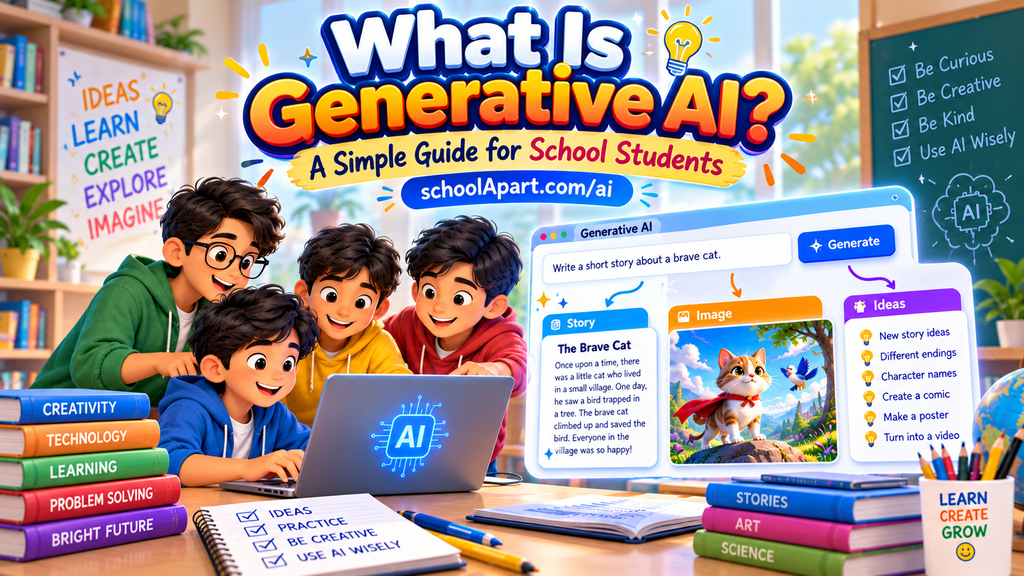
Artificial Intelligence (AI) is changing how people learn, work, and solve problems. For school students, AI can be a helpful learning assistant when it is used wisely. It can explain difficult topics, create practice questions, help organize study notes, and support creative thinking.
But does using AI mean students no longer need to study by themselves? Absolutely not!
AI works best when students use it to understand ideas, practise skills, and improve their own work—not to avoid thinking or simply copy answers.
In this guide, you will learn how students can use AI for learning, explore practical examples, and discover simple ways to use AI safely and responsibly.
What Does It Mean to Use AI for Learning?
Using AI for learning means asking AI tools to help you understand a subject, practise a skill, explore ideas, or organize your studies.
For example, you can ask an AI tool to explain photosynthesis in simple words, prepare a short maths quiz, or help you understand a difficult English sentence.
AI can respond to your questions and adjust explanations based on the instructions you provide. However, its answers are not always correct, so you should check important information.
If you are new to this topic, start with our guide: What Is Artificial Intelligence (AI)? A Simple Guide for School Students.
10 Ways Students Can Use AI for Learning
1. Understand Difficult Topics
Sometimes, a textbook explanation may seem too complicated. AI can explain the same topic in simpler language or provide an everyday example.
Example prompt:
“Explain the water cycle in simple English for a Class 6 student. Use short sentences and give one real-life example.”
You can also ask AI to explain a topic step by step or compare two similar concepts.
Learning tip: After reading the explanation, close it and explain the topic in your own words. This helps you check whether you really understand it.
2. Create Practice Questions and Quizzes
Practice helps students remember what they learn. AI can create questions based on a subject, chapter, or difficulty level.
You can request:
- Multiple-choice questions
- True-or-false questions
- Short-answer questions
- Vocabulary exercises
- Revision quizzes
Example prompt:
“Create 10 multiple-choice questions about the solar system for a Class 5 student. Show the questions first and provide the answer key separately.”
Try answering the questions before checking the answers. If you make a mistake, ask AI to explain why the correct answer is right.
3. Make Study Notes
AI can help organize information into short notes, summaries, or revision points.
For example, after studying a chapter, you can ask AI to summarize the main ideas in simple language. You can also request a list of important terms and their meanings.
Example prompt:
“Summarize the following lesson into 8 short revision points for a school student. Keep the important facts and explain difficult words simply.”
Always compare AI-generated notes with your textbook and class materials. A summary may leave out important details or include errors.
4. Improve English and Vocabulary
Students learning English can use AI to practise grammar, vocabulary, sentence formation, and conversation.
You can ask AI to:
- Explain grammar rules with examples
- Correct sentences and explain the corrections
- Teach five new words with meanings
- Create short English conversations
- Help you practise speaking through suitable voice features, if available
Example prompt:
“Teach me five useful English words for everyday conversation. Give a simple meaning and one example sentence for each word.”
Try writing your own sentences with the new words. This makes learning more active than simply reading a list.
5. Get Hints for Solving Problems
AI can help students understand how to approach a difficult maths or science problem.
Instead of asking for the final answer immediately, request a hint or a step-by-step explanation.
Example prompt:
“Help me solve this maths problem one step at a time. Give me the first hint and wait for me to try before showing the next step.”
This approach encourages independent thinking and helps you understand the method behind the answer.
Remember: Always check calculations and reasoning. AI can make mistakes, even when an explanation sounds convincing.
6. Prepare a Study Timetable
Planning your study time can make revision more manageable. AI can help you create a timetable based on your subjects, available time, and upcoming tests.
Example prompt:
“Create a simple 7-day revision timetable for a school student who has four subjects to study. Include short study sessions, breaks, practice questions, and revision time.”
Review the timetable and adjust it to match your school schedule, homework, rest, and personal needs.
A realistic plan that you can follow is more useful than a perfect-looking plan that is too difficult to maintain.
7. Learn Science Through Examples
Science becomes easier to understand when students connect ideas with real-life situations.
You can ask AI to explain gravity, electricity, plant growth, the human digestive system, or other topics using simple examples.
Example prompt:
“Explain how electricity reaches a home in simple language for a Class 7 student. Use an easy analogy and list the main steps.”
You can also ask for labelled-diagram descriptions or ideas for safe school projects. Follow your teacher’s instructions and appropriate safety guidance before attempting any experiment.
8. Develop Writing and Creative Thinking
AI can help students brainstorm ideas for essays, stories, speeches, and school projects.
For example, if you need to write about protecting the environment, you can ask AI for possible points, examples, or an outline.
Example prompt:
“Give me five ideas for a school paragraph about protecting the environment. Do not write the paragraph for me. Help me choose the best ideas.”
Use the suggestions as a starting point, then write in your own words. Add your own examples, opinions, and experiences.
This way, AI supports your creativity without replacing it.
9. Revise Before an Examination
AI can help you review topics before a test by preparing practice questions, flashcards, and short revision activities.
Example prompt:
“Help me revise the topic of the human digestive system. Ask me one question at a time, wait for my answer, and explain any mistakes in simple language.”
You can use this method for history, geography, science, English, and other subjects.
Remember that AI-generated questions may not match your actual examination. Use your syllabus, textbook, and teacher’s guidance as your main sources for revision.
10. Explore New Topics and Interests
Learning is not limited to classroom subjects. AI can help students explore topics such as space, nature, inventions, art, languages, and world history.
You can ask follow-up questions to explore a topic more deeply or request explanations suited to your age and level.
Example prompt:
“Teach me five interesting facts about the Moon. Explain each fact in simple language and tell me how I can verify the information.”
Use AI to develop curiosity, ask better questions, and discover subjects you may want to learn more about.
How to Ask AI Better Questions
The quality of an AI response often depends on how clearly you explain what you need.
A useful prompt usually includes four things:
- Topic: What do you want to learn?
- Level: Which class or learning level should the explanation suit?
- Format: Do you want examples, steps, a quiz, or short notes?
- Goal: What do you want to understand or practise?
For example, instead of writing:
“Explain fractions.”
Try this:
“Explain fractions for a Class 5 student using simple English, three everyday examples, and five practice questions. Give me hints before revealing answers.”
Clear instructions help AI provide a more relevant response. You can also ask it to simplify, explain again, or provide a different example when something is unclear.
A Simple AI Study Routine
Here is one way to use AI as part of your regular study routine.
Step 1: Learn the topic. Read your textbook or class notes first.
Step 2: Ask questions. Use AI to clarify ideas you do not understand.
Step 3: Practise independently. Solve problems or answer questions without looking at the explanation.
Step 4: Check your understanding. Ask AI for feedback or compare your answers with reliable learning materials.
Step 5: Review mistakes. Identify what went wrong and try again.
This routine keeps you actively involved in learning instead of depending entirely on AI.
Important Rules for Using AI Responsibly
AI can be useful, but students should understand its limitations and use it responsibly.
Check the Information
AI sometimes produces incorrect facts, calculations, explanations, or references. Compare important answers with textbooks, trusted educational resources, or guidance from your teacher.
Do Your Own Work
Do not simply copy AI-generated homework, essays, or project answers and present them as your own. Follow your school’s rules about AI use and acknowledge assistance when required.
Protect Your Privacy
Do not share passwords, home addresses, phone numbers, private school records, or other sensitive personal information with AI tools. Ask a parent or teacher for guidance if you are unsure what is safe to share.
Think Before You Trust an Answer
Ask yourself:
- Does the answer make sense?
- Can I verify the main facts?
- Do I understand the explanation?
- Can I explain the idea without looking at AI?
These questions help you become a more independent learner.
Balance AI With Other Learning Methods
Use textbooks, classroom discussions, experiments, reading, writing, and conversations with teachers and classmates. AI is one learning aid—not a replacement for every other method.
For a broader introduction to the technology behind these tools, read How Does Artificial Intelligence Work? A Simple Guide for School Students.
Common Mistakes Students Should Avoid
Students may get less benefit from AI if they use it without thinking carefully. Avoid these common mistakes:
- Copying answers without understanding: Read the explanation and solve similar problems yourself.
- Trusting every response: Verify important facts and calculations.
- Asking vague questions: Include your class level, topic, and preferred format.
- Using AI for every task: Try solving a problem independently before requesting help.
- Ignoring school rules: Follow your teacher’s instructions on acceptable AI use.
- Sharing private information: Keep personal and sensitive details out of prompts.
The goal is not to use AI as much as possible. The goal is to learn more effectively.
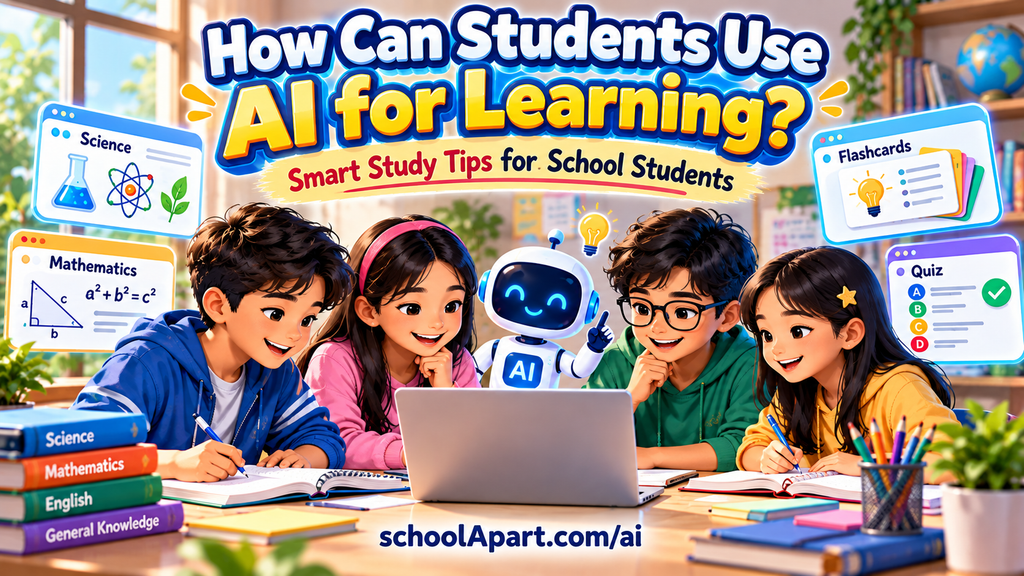
AI can help school students understand difficult topics, practise questions, improve English, organize study notes, plan revision, and explore new interests.
However, the best results come when students stay curious, think independently, check information, and practise what they learn.
Start with one simple task, such as asking AI to explain a difficult topic or prepare a short quiz. Then use what you learn to solve problems and explain ideas in your own words.
Remember: AI should support your learning, not replace your thinking.
Explore more student-friendly guides in our AI Learning Hub to understand artificial intelligence and learn how to use it responsibly.
Frequently Asked Questions (FAQ)
1. How can students use AI for learning?
Students can use AI to understand difficult topics, create practice questions, summarize lessons, improve language skills, plan study schedules, and revise for examinations. They should verify information and complete their own work.
2. Is AI useful for school students?
Yes. AI can provide explanations, examples, practice activities, and personalized study support. However, its usefulness depends on how students use it and whether they check its answers.
3. Can AI help students with homework?
AI can explain concepts, provide hints, suggest approaches, and help students identify mistakes. Students should follow school rules and avoid submitting AI-generated work as their own.
4. How can students use AI to prepare for exams?
Students can ask AI to create practice quizzes, flashcards, revision summaries, and topic-based questions. They should also study their official syllabus, textbooks, and teacher-provided materials.
5. Can AI make mistakes when teaching students?
Yes. AI can provide incorrect information, misleading explanations, or wrong calculations. Students should verify important information with reliable sources and ask teachers when they are unsure.
6. Is it safe for students to use AI tools?
AI can be used more safely when students follow age requirements and school rules, protect personal information, check answers, and seek guidance from a parent or teacher when needed.
7. Will using AI improve students’ learning?
AI may support learning when students use it to understand concepts, practise skills, and receive feedback. Simply copying answers or depending on AI for every task may prevent students from developing independent thinking.
8. Should students use AI instead of textbooks?
No. Textbooks, teachers, classroom activities, and reliable educational resources remain important. AI should complement these learning methods, not replace them.

Leave a Reply