

Discover 15 practical personality development activities for students to build confidence, communication, teamwork, leadership and social skills at school and home.
Personality Development Activities for Students
Personality development is not only about speaking confidently or making a good impression. It also includes learning how to communicate, work with others, solve problems, understand emotions and take responsibility.
Students can develop these skills through simple activities at school and home. They do not always need special equipment or expensive resources. Everyday classroom tasks, group games, short presentations and conversations can provide valuable learning opportunities.
In this guide, you will discover 15 practical personality development activities for students that encourage confidence, communication, teamwork, leadership and other essential life skills.
If you want to understand the bigger picture first, read our guide to Personality Development for Students: A Complete Guide.
Why Are Personality Development Activities Important for Students?
Activities allow students to practise skills instead of only reading about them. They also provide opportunities to learn from experience and improve gradually.
Personality development activities can help students:
- Express their thoughts more clearly.
- Participate in classroom discussions.
- Listen carefully to other people.
- Work cooperatively with classmates.
- Develop confidence when trying new tasks.
- Make thoughtful decisions.
- Understand their strengths and areas for improvement.
- Become more responsible and independent.
Every student develops at a different pace. The goal is not to make everyone behave in the same way. It is to help each student develop useful skills while respecting individual differences.
15 Personality Development Activities for Students
The following activities can be adapted for different ages, learning levels and classroom situations. Younger students may need more guidance, while older students can complete many activities independently or in groups.
1. Self-Introduction Activity
Skills developed: Confidence, communication and self-awareness.
Ask students to introduce themselves to a small group. They can share their name, favourite subject, interests and one thing they would like to learn.
Encourage each student to speak in complete sentences and listen when others are introducing themselves.
How to practise:
- Give students a few minutes to prepare.
- Let them introduce themselves to a partner.
- Invite volunteers to introduce themselves to the class.
- Give supportive feedback on clarity and confidence.
Students who feel shy can begin with a partner before speaking to a larger group.
2. Show and Tell
Skills developed: Speaking, organisation and confidence.
Ask students to choose an appropriate object, drawing, book or school project and explain it to their classmates.
They can describe what it is, why they selected it and what they find interesting about it.
This activity helps students organise their thoughts and speak about a familiar topic.
Practice tip: Begin with a one-minute presentation. Gradually increase the speaking time as students become more comfortable.
3. Daily Confidence Challenge
Skills developed: Self-confidence and willingness to try new things.
Give students one small challenge each day. Examples include asking a question in class, sharing an idea, reading aloud or volunteering for a classroom task.
Students can record the challenge they attempted and what they learned from it.
The aim is not to perform perfectly. The aim is to take a manageable step beyond a familiar routine.
For more practical speaking techniques, explore How to Speak Confidently: Simple Tips for Students.
4. Storytelling Circle
Skills developed: Communication, imagination and listening.
Ask students to sit in a circle. One student begins a simple story with a sentence, and each participant adds another sentence to continue it.
For example, the first student might begin with, “One morning, our class discovered a mysterious box in the library.”
Each student adds a suitable idea while listening to what came before.
This activity encourages creative thinking, turn-taking and clear expression.
5. Active Listening Game
Skills developed: Listening, attention and respectful communication.
Pair students and ask one student to speak about a favourite hobby, book or school activity for one minute. The other student listens without interrupting.
Afterward, the listener summarises two or three points from the conversation. Then the students switch roles.
This simple exercise teaches students that communication involves understanding others, not only speaking.
6. Ask a Good Question
Skills developed: Curiosity, communication and classroom participation.
Give students a topic such as nature, books, sports, science or daily routines. Ask them to prepare two thoughtful questions about it.
Students can practise asking their questions in pairs before sharing them with the class.
Teach them to ask questions politely, listen to the answers and request clarification when something is unclear.
This activity can help students participate more actively in learning.
7. Role-Playing Everyday Situations
Skills developed: Social skills, empathy and problem-solving.
Prepare short scenarios based on everyday school situations, such as:
- Asking a teacher for help.
- Welcoming a new classmate.
- Requesting to join a group activity.
- Apologising after a mistake.
- Resolving a disagreement respectfully.
Students act out the situations in pairs or small groups. After each role-play, discuss which responses were helpful and why.
Avoid presenting only one personality type as correct. Students should learn that respectful communication can take different forms.
8. Team-Building Challenge
Skills developed: Cooperation, teamwork and problem-solving.
Divide students into small groups and give each group a simple task, such as building the tallest free-standing paper tower using a limited number of sheets.
Set a time limit and ask students to plan their approach before starting.
After the activity, discuss how the group shared ideas, handled disagreements and decided what to do next.
The focus should be on cooperation and learning rather than declaring one student the best leader.
9. Group Discussion
Skills developed: Communication, reasoning and respect for different opinions.
Choose an age-appropriate topic, such as the benefits of reading, keeping the classroom clean or developing healthy study habits.
Ask students to share their opinions and explain their reasons. Encourage them to listen carefully and respond to ideas rather than criticising the person who expresses them.
Give quieter students the option to contribute in a small group before speaking to the entire class.
10. Mini Public Speaking Challenge
Skills developed: Public speaking, confidence and organisation.
Ask students to prepare a short talk on a familiar topic, such as their favourite book, a memorable school activity or an interesting fact.
A simple structure can make the task easier:
- Introduce the topic.
- Explain two or three main points.
- End with a short conclusion.
Students can first practise alone or with a partner, then speak to a small group.
For more guidance, explore our guide to speaking confidently.
11. Problem-Solving Activity
Skills developed: Critical thinking, decision-making and patience.
Present students with a practical problem. For example, a group has to complete a classroom project but has limited materials and time.
Ask them to identify the problem, suggest possible solutions, compare the options and choose a reasonable plan.
Afterward, discuss what worked and what they might change next time.
This activity helps students understand that thoughtful decisions often require considering more than one option.
12. Student Leadership Rotation
Skills developed: Leadership, responsibility and cooperation.
Assign rotating classroom responsibilities, such as organising learning materials, helping prepare a group activity or reminding classmates about shared tasks.
Give each student a suitable opportunity to contribute.
Explain that leadership is not about controlling others. It involves listening, supporting the group, completing responsibilities and setting a positive example.
Rotation also helps students discover different ways to contribute.
13. Appreciation Circle
Skills developed: Positive communication, empathy and relationship-building.
Invite students to share a specific, sincere appreciation for a classmate’s helpful action or effort.
For example, a student might say, “Thank you for explaining the instructions when I was confused.”
Set clear rules: comments must be respectful, specific and voluntary. No student should be pressured to speak or become the centre of attention.
This activity encourages students to notice helpful behaviour and communicate appreciation.
14. Strengths and Improvement Worksheet
Skills developed: Self-awareness, reflection and goal-setting.
Ask students to complete three short statements:
- Something I do well is…
- Something I want to improve is…
- One step I can take this week is…
Students should choose realistic goals, such as asking one question during a lesson, listening without interrupting or completing a responsibility on time.
Reviewing the worksheet after a week can help them recognise their progress.
Remind students that an area for improvement is not a personal failure. It is simply a skill they can practise.
15. Weekly Personal Growth Journal
Skills developed: Self-reflection, responsibility and consistency.
At the end of each week, ask students to write or draw answers to a few simple questions:
- What new thing did I try this week?
- When did I work well with others?
- What was challenging?
- What did I learn from a mistake?
- What would I like to practise next week?
Younger students can use drawings or short verbal answers. Older students can write a few sentences.
The purpose is to notice gradual improvement rather than compare progress with classmates.
How to Choose the Right Personality Development Activities
Not every activity suits every student or situation. Choose activities according to students’ ages, comfort levels, interests and learning needs.
| Main goal | Suitable activities |
|---|---|
| Building confidence | Self-introduction, daily confidence challenge, show and tell |
| Improving communication | Storytelling, active listening, asking questions |
| Practising public speaking | Mini speeches, show and tell, group discussions |
| Developing social skills | Role-playing, appreciation circle, active listening |
| Learning teamwork | Team-building challenge, group discussion |
| Developing leadership | Student leadership rotation, problem-solving |
| Improving self-awareness | Strengths worksheet, personal growth journal |
Start with one or two activities. Observe how students respond and adjust the difficulty when needed.
A Simple Weekly Personality Development Plan
Teachers and parents can use this sample schedule to introduce regular practice without making it feel like extra schoolwork.
| Day | Activity | Suggested time |
|---|---|---|
| Monday | Self-introduction or confidence challenge | 10 minutes |
| Tuesday | Active listening game | 10–15 minutes |
| Wednesday | Team-building or problem-solving | 15–20 minutes |
| Thursday | Storytelling or mini speaking challenge | 10–15 minutes |
| Friday | Strengths worksheet or growth journal | 10 minutes |
This is a flexible example, not a fixed rule. You can change the activities according to the students’ needs and available time.
How Parents and Teachers Can Support Students
Adults can make personality development activities more effective by providing encouragement and opportunities to practise.
Encourage effort instead of perfection
Praise students for trying, preparing and improving. Avoid suggesting that mistakes mean they lack confidence or ability.
Create a supportive environment
Allow students to ask questions and express opinions without fear of embarrassment. Correct mistakes respectfully and privately when appropriate.
Respect different personalities
Some students enjoy speaking in front of a group, while others prefer thinking quietly before responding. Both can develop valuable communication and leadership skills.
Give students meaningful choices
Let students choose a topic, select a role or suggest an activity when possible. Having a voice in the process can make participation more comfortable.
Practise regularly
Short, repeated opportunities are often easier to maintain than occasional demanding activities. Encourage progress at a comfortable pace.
Common Mistakes to Avoid
When organising personality development activities, avoid these common mistakes:
- Forcing every student to speak publicly: Offer gradual participation options.
- Comparing students: Focus on individual progress rather than ranking personalities.
- Rewarding only the loudest students: Recognise listening, thoughtful ideas, cooperation and preparation too.
- Making activities too difficult: Begin with manageable challenges and increase difficulty gradually.
- Treating confidence as a fixed trait: Explain that confidence can grow through practice and experience.
- Ignoring reflection: Give students a chance to discuss what they learned after each activity.
A supportive approach helps students practise skills without feeling that they must change their entire personality.
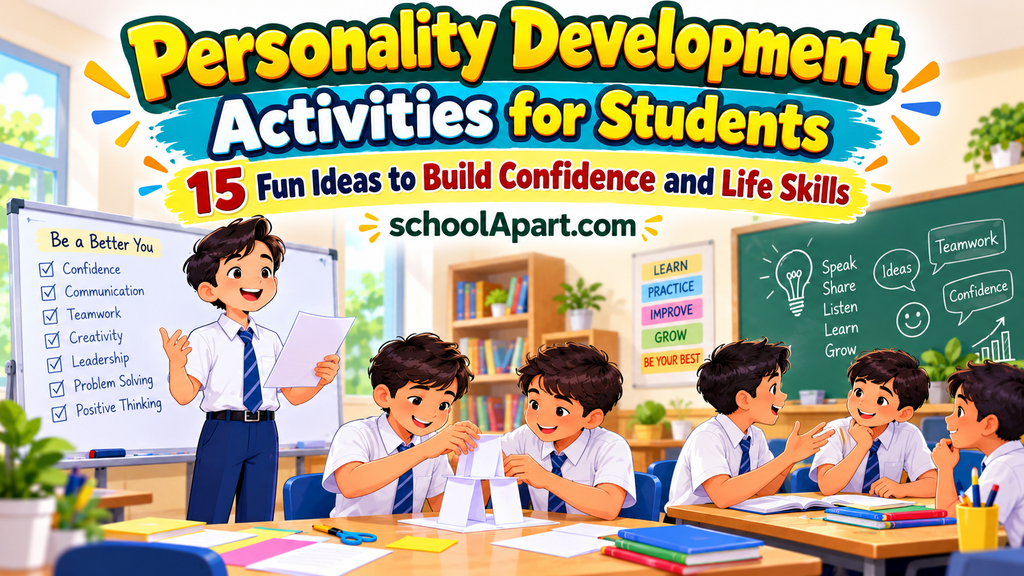
Personality development activities give students practical opportunities to practise confidence, communication, teamwork, leadership and self-awareness.
Start with simple exercises such as self-introduction, storytelling or active listening. Gradually introduce group challenges, speaking activities and personal reflection as students become more comfortable.
Parents and teachers can support this process by encouraging effort, respecting individual differences and creating a safe environment for learning.
For more guidance, visit the SchoolApart Personality Development & Confidence Building Hub. You can also read Personality Development for Students: A Complete Guide and How to Speak Confidently: Simple Tips for Students to continue learning.
Small activities, practised regularly, can help students develop useful skills for school and everyday life.
Frequently Asked Questions
1. What are personality development activities for students?
Personality development activities are practical exercises that help students develop skills such as confidence, communication, teamwork, leadership, self-awareness and problem-solving.
2. Which activities are best for personality development?
Self-introduction, storytelling, role-playing, active listening, group discussions, team challenges and personal reflection are useful starting points. The best choice depends on the students’ age and learning goals.
3. How can teachers conduct personality development activities in the classroom?
Teachers can organise short speaking exercises, pair discussions, group challenges, role-playing and reflection tasks. Activities should have clear instructions and allow students to participate comfortably.
4. Can personality development activities be done at home?
Yes. Families can practise storytelling, reading aloud, daily conversations, simple decision-making tasks, cooperative games and weekly reflection.
5. How do activities help students build confidence?
Activities give students opportunities to try manageable challenges, practise skills and learn from experience. Repeated practice can help them feel more prepared for similar situations.
6. Which activities improve communication skills?
Storytelling, active listening, show and tell, role-playing, group discussions and question-asking exercises can help students practise clear expression and respectful conversation.
7. Which activities help students develop teamwork?
Paper-tower challenges, group projects, cooperative games and shared problem-solving tasks encourage students to plan together, share responsibilities and listen to different ideas.
8. How can shy students participate in these activities?
Start with individual preparation, written responses, partner conversations or small groups. Let students gradually choose more challenging opportunities without forcing them to speak publicly before they feel ready.
9. How often should students practise personality development activities?
Students can practise brief activities several times a week. Regular, manageable practice is more important than following a rigid schedule.
10. Are personality development activities suitable for younger students?
Yes. Activities can be simplified with pictures, storytelling, turn-taking games, simple introductions and guided group tasks. Instructions should match students’ developmental levels.
11. What is the difference between confidence-building and personality development activities?
Confidence-building activities focus mainly on helping students feel more comfortable attempting tasks and expressing themselves. Personality development activities cover a wider range of skills, including communication, teamwork, responsibility and self-awareness.
12. How can parents know whether an activity is helping?
Look for gradual changes, such as greater willingness to participate, clearer expression, better listening or more independent task completion. Progress may be small and will differ from student to student.

Leave a Reply