
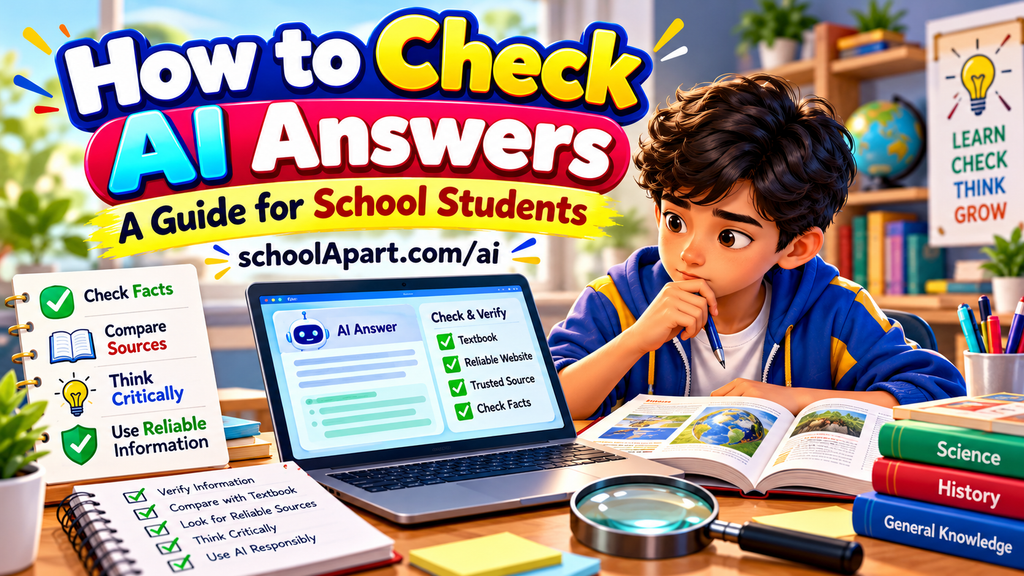
Learn how to check AI answers, spot mistakes, verify facts with reliable sources, and use AI responsibly for schoolwork and learning.
How to Check AI Answers: A Guide for School Students
Artificial Intelligence (AI) can explain difficult topics, answer questions, and help students practise new skills. But there is one important thing every student should remember: AI can make mistakes.
An AI answer may sound confident and look correct, but it can still contain incorrect facts, outdated information, confusing explanations, or made-up details.
That is why students should learn how to check AI answers before using them for homework, projects, revision, or research.
In this guide, you will learn simple ways to verify AI-generated information, recognize possible mistakes, and use reliable sources to support your learning.
Why Should Students Check AI Answers?
AI tools generate responses based on patterns learned from data and the instructions they receive. They do not guarantee that every answer is true.
An AI tool may:
- Give an incorrect fact or date.
- Make a mistake in a mathematical calculation.
- Confuse two similar people, places, or concepts.
- Provide information that is no longer up to date.
- Mention a book, website, or reference that does not exist.
- Leave out important details needed to understand a topic.
Checking information helps you avoid learning incorrect facts and builds an important skill: critical thinking.
7 Ways to Check AI Answers
1. Compare the Answer With Your Textbook
Your school textbook, class notes, and teacher-provided materials are good starting points for checking answers related to your syllabus.
Suppose AI tells you that a particular planet is the largest planet in the Solar System. Check the relevant section in your science textbook or a trusted astronomy resource before using the information.
Look for:
- Correct names and definitions
- Important facts and dates
- Accurate formulas and explanations
- Details that match your lesson
If the AI answer disagrees with your textbook, do not immediately assume either one is correct. Ask your teacher or consult another reliable source.
2. Check More Than One Reliable Source
For important facts, compare the AI answer with two independent, trustworthy sources whenever practical.
Depending on the subject, useful sources may include:
- School textbooks and official educational materials
- Government websites for official information
- Universities and recognized educational institutions
- Scientific organizations and established reference resources
- Original documents or official announcements
For example, if AI gives you information about a country’s population, look for a recent official statistical source and check the date of the data.
Important: Two websites may repeat the same incorrect information. Look for credible sources that provide evidence, not just matching statements.
3. Verify Dates, Names, Numbers, and Formulas
Specific details are often easy to check and especially important in schoolwork.
When reading an AI answer, pay extra attention to:
- Dates and historical events
- Names of people and places
- Scientific measurements
- Mathematical calculations
- Formulas and units
- Quotations and references
For maths, solve the problem yourself and check each step. You can also use a calculator to verify arithmetic, but remember that a calculator cannot tell you whether you selected the correct formula or method.
For history or current affairs, check dates against reliable sources. If the question concerns recent events, make sure the information is up to date.
4. Ask AI to Explain Its Answer
If you do not understand an answer, ask AI to explain the reasoning in simple steps. This can help you identify confusing parts or notice where you need to do more checking.
Try this prompt:
“Explain your answer step by step in simple English for a school student. Identify any facts that should be checked with a reliable source.”
You can also ask:
“What assumptions are you making in this answer?”
However, remember that an explanation from AI is not proof that the answer is correct. AI may repeat the same mistake in a longer explanation.
Use the explanation to guide your investigation, not as the final evidence.
5. Check Whether Sources and References Are Real
Sometimes AI may provide a website name, book title, research paper, quotation, or link that is incorrect or does not exist.
Before using a reference in a school project:
- Open the actual website or document.
- Confirm that the page exists.
- Check whether it supports the specific claim.
- Look at the author or organization responsible for it.
- Check the publication or update date when relevant.
Never include a reference in your project just because an AI tool supplied it. Verify that you can actually find and read the source.
6. Look for Missing Details or Different Viewpoints
An answer can contain true statements but still be incomplete or misleading.
For example, an AI explanation of an environmental issue might mention one cause while leaving out several other important factors.
Ask yourself:
- Is the answer explaining the whole topic or just one part?
- Are there important exceptions?
- Does the topic have more than one reasonable viewpoint?
- Is the answer based on evidence?
- Would another trusted source explain it differently?
This is particularly useful for history, social science, environmental studies, and topics involving different interpretations.
7. Ask a Teacher or Trusted Adult When Unsure
If two reliable sources disagree, the answer seems unusual, or you still do not understand the explanation, ask your teacher, parent, or another knowledgeable adult for help.
This is especially important for health, safety, legal matters, and other topics where incorrect advice could cause harm.
You do not need to verify every simple sentence in the same way. Focus extra attention on important facts, unfamiliar claims, and information you plan to use in schoolwork.
A Simple AI Answer-Checking Checklist
Before using an AI answer, ask yourself these questions:
- Does the answer match my textbook or class notes?
- Have I checked important facts with reliable sources?
- Are names, dates, numbers, and formulas correct?
- Do the cited sources actually exist and support the claim?
- Is the answer complete enough for my question?
- Do I understand the explanation in my own words?
- Have I followed my school’s rules for using AI?
If you cannot answer one of these questions confidently, do a little more checking before relying on the information.
Example: How to Check an AI Answer in Practice
Imagine you ask an AI tool:
“Which planet is the largest in the Solar System?”
AI answers:
“Jupiter is the largest planet in the Solar System.”
Here is how you can check it:
Step 1: Identify the claim. The answer says Jupiter is the largest planet.
Step 2: Check a trusted source. Look at a school science textbook or a reliable astronomy resource.
Step 3: Compare the information. Confirm that the source identifies Jupiter as the largest planet.
Step 4: Understand the fact. Learn why Jupiter is classified as the largest planet rather than simply memorizing the answer.
Step 5: Explain it yourself. Try to answer the question again without looking at AI.
This is a simple example, but the same process can help you check science facts, historical dates, definitions, and other school topics.
How to Use AI Without Depending on It
Checking answers is only one part of responsible AI use. Students should also make sure AI supports their learning instead of replacing their own effort.
Here are some useful habits:
- Try to answer a question yourself before asking AI.
- Request hints when solving difficult problems.
- Ask for explanations rather than only final answers.
- Practise similar questions without AI.
- Write assignments in your own words.
- Follow your teacher’s rules about AI assistance.
- Avoid sharing personal or confidential information with AI tools.
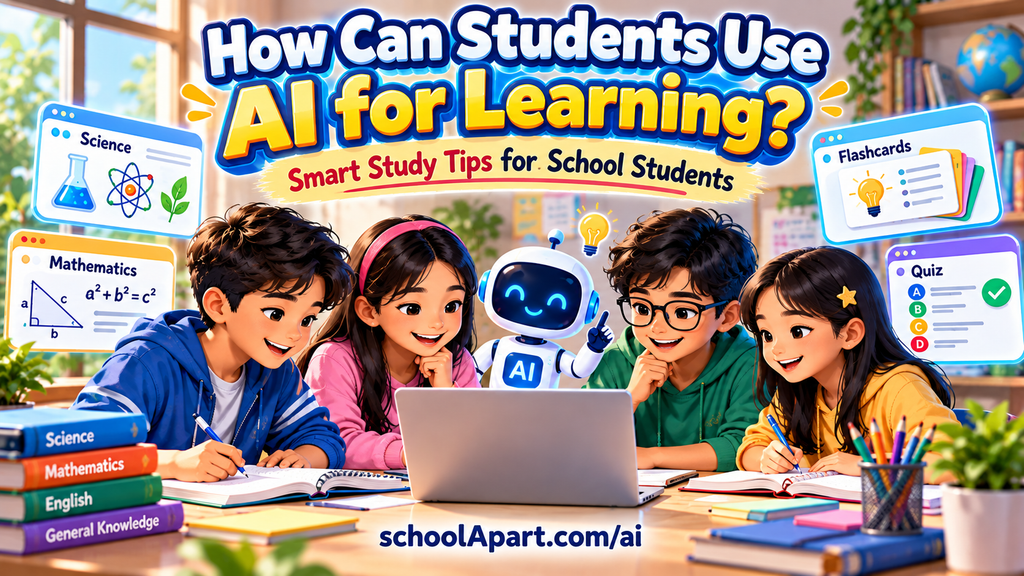
If you want practical examples of using AI in everyday study, read How Can Students Use AI for Learning? A Practical Guide.
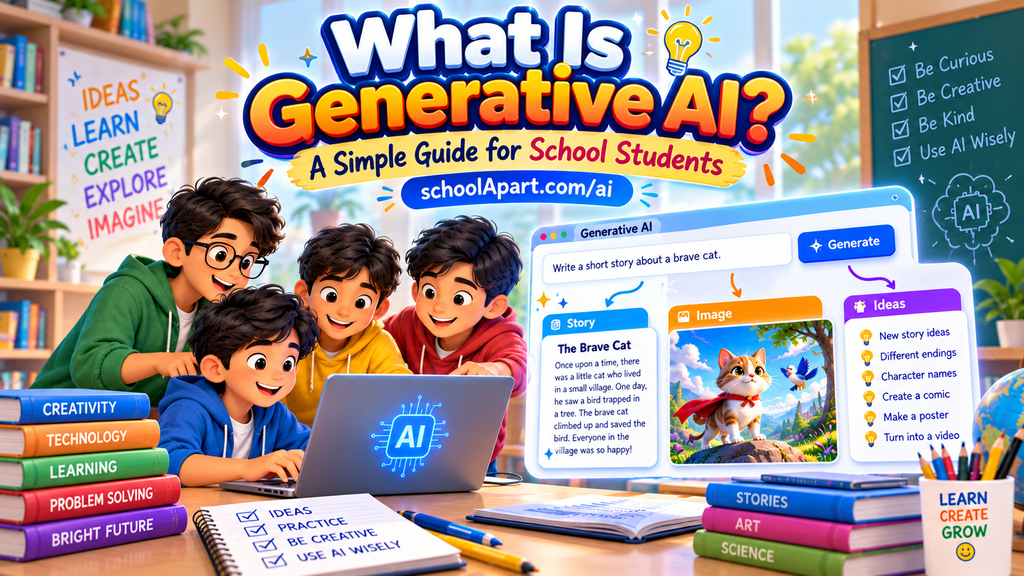
You can also explore What Is Generative AI? A Simple Guide for School Students to understand the technology behind tools that generate text, images, and other content.
Common Mistakes to Avoid When Checking AI Answers
Trusting an Answer Because It Sounds Confident
Clear language does not guarantee accuracy. Check the evidence behind important claims.
Using Only One Source
One source may contain errors or incomplete information. Compare independent, reliable sources when the claim matters.
Believing That a Link Proves a Claim
A link may lead to an unrelated page or fail to support the statement. Open the source and read the relevant information yourself.
Asking AI Whether Its Own Answer Is Correct
AI may repeat or defend an earlier mistake. Use independent sources rather than relying only on AI to verify AI.
Copying Information Without Understanding It
Even a correct answer is less useful if you cannot explain it yourself. Take time to understand the idea and practise applying it.
AI can be a helpful study assistant, but its answers should not be treated as automatically correct.
Students can check AI answers by comparing them with textbooks, consulting reliable sources, verifying specific details, examining references, and asking teachers for help when necessary.
Most importantly, do not stop at checking whether an answer is correct. Make sure you understand why it is correct and can explain it in your own words.
Remember: Use AI to support your thinking, verify important information, and keep learning independently.
Visit our AI Learning Hub for more student-friendly guides on understanding AI, using it for learning, and developing responsible digital skills.
Frequently Asked Questions (FAQ)
1. How can students check AI answers?
Students can compare AI answers with textbooks, class notes, official educational resources, and other trustworthy sources. They should also verify dates, names, numbers, calculations, and references.
2. Can AI give wrong answers?
Yes. AI tools can produce incorrect facts, misleading explanations, outdated information, and references that do not exist. Always check important information before using it.
3. Is AI a reliable source of information for school projects?
AI can help students understand topics and find ideas, but it should not automatically be treated as an authoritative source. Verify claims using reliable sources and follow your school’s rules for acknowledging AI assistance.
4. How many sources should students use to verify an AI answer?
For important claims, comparing two independent, trustworthy sources is a useful starting point. Some topics may require more sources, especially when the information is complex or sources disagree.
5. Should students trust AI-generated references?
No. Students should open each reference, confirm that it exists, and check whether it actually supports the claim. AI may generate incorrect or nonexistent references.
6. What should students do if AI and a textbook give different answers?
Check the exact wording of the question, consult another reliable source, and ask a teacher if the disagreement remains. Do not automatically assume that either answer is correct.
7. Can students ask AI to check its own answers?
They can ask AI to explain its reasoning or identify claims that need verification. However, AI may repeat its own mistakes, so independent sources are essential.
8. Why is critical thinking important when using AI?
Critical thinking helps students question information, examine evidence, recognize missing details, and make informed decisions instead of accepting every AI response without checking.

Leave a Reply