

Help kids practise English conversation at school with 25 easy dialogues for classrooms, teachers, classmates, lunch breaks, and everyday school activities.
English Conversation at School for Kids: 25 Easy Dialogues for Daily Practice
School is one of the best places for children to practise English in real-life situations. Students can use English to greet teachers, ask questions, talk to classmates, borrow books, participate in group activities, and communicate during breaks.
- Spoken English for Kids: Complete Beginner’s Guide — Learn the basics of spoken English.
Children do not need to speak long or complicated sentences to begin. Simple expressions such as “May I come in?”, “Could you please explain it again?” and “Would you like to play with us?” can help them communicate more confidently.
- How to Learn Spoken English at Home — Build a practical home learning routine.
- How to Improve English Speaking Skills for Kids — Develop speaking confidence through practice.
In this guide, you will find 25 easy English conversations for school students. Each dialogue focuses on a familiar school situation and includes useful expressions that children can practise at home or in the classroom.
Parents and teachers can use these conversations for speaking practice, pair activities, role-play, and classroom warm-ups.
Why Should Kids Practise English Conversation at School?
Practising English conversations helps children learn how to use language in everyday situations instead of memorising sentences without understanding them.
Here are some benefits:
- Better speaking confidence: Children become more comfortable expressing their thoughts in English.
- Improved listening: They practise understanding questions, instructions, and responses.
- Useful classroom vocabulary: They learn words and expressions related to lessons, books, homework, and school activities.
- More active participation: Students can practise asking questions, answering teachers, and working with classmates.
- Better communication skills: They learn how to request help, take turns, and speak politely.
Children learn at different speeds. Encourage them to practise a few sentences at a time and focus on clear communication rather than speaking perfectly.
25 English Conversations at School for Kids
These dialogues are arranged by everyday school situations. Beginners can start with the shorter conversations and gradually practise the longer ones.
1. Greeting the Teacher
Situation: A student greets the teacher before class.
Student: Good morning, Ma’am!
Teacher: Good morning! How are you today?
Student: I am fine, thank you. How are you?
Teacher: I am doing well, thank you.
Student: I am happy to be here.
Useful sentences:
- Good morning, Ma’am/Sir.
- How are you today?
- I am fine, thank you.
2. Asking Permission to Enter the Classroom
Situation: A student arrives after the lesson has started.
Student: May I come in, Ma’am?
Teacher: Yes, please come in.
Student: I am sorry I am late.
Teacher: That is all right. Please take your seat.
Student: Thank you, Ma’am.
Useful sentences:
- May I come in?
- I am sorry I am late.
- Please take your seat.
3. Introducing Yourself to a New Classmate
Situation: Two students meet for the first time.
Student A: Hello! What is your name?
Student B: My name is Alex. What is your name?
Student A: I am Sam. Nice to meet you.
Student B: Nice to meet you, too.
Student A: Which class are you in?
Student B: I am in Class Four.
Useful sentences:
- What is your name?
- Nice to meet you.
- Which class are you in?
4. Asking About the Timetable
Situation: A student wants to know which lesson comes next.
Student A: Do you know our next subject?
Student B: I think we have English.
Student A: What time does the class start?
Student B: It starts in five minutes.
Student A: Thank you for telling me.
Useful sentences:
- What is our next subject?
- What time does the class start?
- Thank you for telling me.
5. Asking a Question in Class
Situation: A student wants to ask the teacher something.
Student: Excuse me, Sir. May I ask a question?
Teacher: Of course. Go ahead.
Student: What does this word mean?
Teacher: It means something that is easy to understand.
Student: Thank you for explaining it.
Useful sentences:
- May I ask a question?
- What does this word mean?
- Thank you for explaining it.
6. Asking the Teacher to Explain Again
Situation: A student does not understand a lesson.
Student: Ma’am, I do not understand this part.
Teacher: Which part is difficult for you?
Student: Could you please explain it again?
Teacher: Certainly. Let us go through it step by step.
Student: Thank you. I understand it better now.
Useful sentences:
- I do not understand this part.
- Could you please explain it again?
- I understand it better now.
7. Answering a Question in Class
Situation: The teacher asks a question.
Teacher: Who can tell me the answer?
Student: May I try, Ma’am?
Teacher: Yes, please.
Student: I think the answer is twenty-four.
Teacher: Good try! Your answer is correct.
Student: Thank you, Ma’am.
Useful sentences:
- May I try?
- I think the answer is…
- Your answer is correct.
8. Asking for Help with Classwork
Situation: A student needs help completing an exercise.
Student A: Could you help me with this question?
Student B: Sure. Which question is it?
Student A: Number five.
Student B: Let us read it together.
Student A: Oh, now I understand. Thank you!
Useful sentences:
- Could you help me?
- Which question is it?
- Let us read it together.
9. Borrowing a Pencil
Situation: A student has forgotten a pencil.
Student A: Excuse me, can I borrow your pencil?
Student B: Sure. Here you are.
Student A: Thank you. I will return it after class.
Student B: No problem.
Student A: Here is your pencil. Thanks again!
Useful sentences:
- Can I borrow your pencil?
- Here you are.
- I will return it after class.
10. Borrowing a Book from a Classmate
Situation: A student wants to look at a classmate’s book.
Student A: May I look at your science book?
Student B: Of course. Here it is.
Student A: Thank you. I missed the last page of the notes.
Student B: You can copy them from my book.
Student A: That is very kind of you.
Useful sentences:
- May I look at your book?
- I missed the notes.
- That is very kind of you.
11. Talking About Homework
Situation: Two students discuss their homework.
Student A: Have you finished your homework?
Student B: Yes, I finished it yesterday.
Student A: Was it difficult?
Student B: A little, but I managed to do it.
Student A: I still have two questions left.
Student B: You can ask the teacher for help.
Useful sentences:
- Have you finished your homework?
- Was it difficult?
- I still have two questions left.
12. Talking About a Favourite Subject
Situation: Students discuss their favourite school subjects.
Student A: What is your favourite subject?
Student B: My favourite subject is science.
Student A: Why do you like it?
Student B: I enjoy learning how things work.
Student A: That sounds interesting. I like English.
Student B: What do you like about English?
Student A: I enjoy reading stories and learning new words.
Useful sentences:
- What is your favourite subject?
- Why do you like it?
- I enjoy learning new things.
13. Talking to a Friend Before Class
Situation: Two classmates talk before the lesson begins.
Student A: Hi! Did you have a good morning?
Student B: Yes, I did. How about you?
Student A: I had a busy morning.
Student B: Why?
Student A: I almost forgot to pack my notebook.
Student B: At least you remembered it!
Useful sentences:
- How about you?
- I had a busy morning.
- At least you remembered it!
14. Asking to Join a Group
Situation: A student wants to participate in a group activity.
Student A: Are you working on the project together?
Student B: Yes, we are making a science poster.
Student A: May I join your group?
Student B: Of course! We need someone to draw the pictures.
Student A: Great! I enjoy drawing.
Student B: Perfect. Let us plan our poster.
Useful sentences:
- May I join your group?
- We are working on a project.
- Let us plan our work.
15. Talking During Lunch Break
Situation: Friends talk during lunch.
Student A: What did you bring for lunch?
Student B: I brought a vegetable sandwich.
Student A: That looks delicious.
Student B: Would you like to try a piece?
Student A: Yes, please. Thank you!
Student B: You are welcome.
Useful sentences:
- What did you bring for lunch?
- Would you like to try some?
- You are welcome.
16. Inviting a Friend to Play
Situation: Students want to play during the school break.
Student A: Would you like to play football?
Student B: Yes! Who else is playing?
Student A: Jamie and Riley are joining us.
Student B: Great! Where shall we meet?
Student A: Let us meet near the playground.
Student B: All right. See you there!
Useful sentences:
- Would you like to play?
- Who else is joining us?
- See you there!
17. Asking the Teacher for Permission to Leave
Situation: A student needs to leave the classroom briefly.
Student: Excuse me, Ma’am. May I go to the washroom?
Teacher: Yes, you may.
Student: Thank you.
Teacher: Please return as soon as you can.
Student: Of course, Ma’am.
Useful sentences:
- May I go to the washroom?
- Yes, you may.
- Please return soon.
18. Talking About a School Project
Situation: Two students plan their project.
Student A: When is our project due?
Student B: We need to submit it on Friday.
Student A: Have you chosen a topic?
Student B: Yes. I suggest we make a poster about plants.
Student A: Good idea! I can write the facts.
Student B: And I can draw the pictures.
Useful sentences:
- When is our project due?
- Have you chosen a topic?
- I can write the facts.
19. Asking About a Test
Situation: Students discuss an upcoming test.
Student A: Are you ready for the English test?
Student B: I have revised most of the lessons.
Student A: Which topic do you find difficult?
Student B: I need to practise grammar a little more.
Student A: We can revise together after school.
Student B: That would be helpful. Thank you!
Useful sentences:
- Are you ready for the test?
- I need to practise more.
- We can revise together.
20. Talking About a School Event
Situation: Students discuss an upcoming school programme.
Student A: Are you taking part in the school programme?
Student B: Yes, I am going to recite a poem.
Student A: That sounds exciting! When is it?
Student B: It is next Wednesday.
Student A: I hope you do well.
Student B: Thank you! I am practising every day.
Useful sentences:
- Are you taking part?
- When is it?
- I am practising every day.
21. Asking the Teacher for Feedback
Situation: A student wants to improve an assignment.
Student: Sir, could you please check my work?
Teacher: Certainly. Let me have a look.
Student: Is there anything I should improve?
Teacher: Your ideas are good. Try to organise them more clearly.
Student: I will make the changes. Thank you.
Useful sentences:
- Could you please check my work?
- Is there anything I should improve?
- I will make the changes.
22. Apologizing to a Classmate
Situation: A student accidentally knocks another student’s book onto the floor.
Student A: Oh, I am sorry. I knocked your book down.
Student B: That is okay. It was an accident.
Student A: Let me pick it up for you.
Student B: Thank you.
Student A: I will be more careful next time.
Useful sentences:
- I am sorry.
- It was an accident.
- I will be more careful.
23. Asking for Directions at School
Situation: A student is looking for the library.
Student A: Excuse me, where is the library?
Student B: It is on the first floor, next to the computer room.
Student A: How do I get there?
Student B: Go upstairs and turn left.
Student A: Thank you for your help.
Student B: You are welcome.
Useful sentences:
- Where is the library?
- How do I get there?
- Turn left.
24. Talking to a Teacher After Class
Situation: A student wants to ask the teacher something after the lesson.
Student: Excuse me, Ma’am. Do you have a minute?
Teacher: Yes. What would you like to ask?
Student: I would like to know how I can improve my writing.
Teacher: Try reading regularly and practising a little every day.
Student: Thank you. I will follow your advice.
Useful sentences:
- Do you have a minute?
- What would you like to ask?
- I will follow your advice.
25. Saying Goodbye After School
Situation: Two classmates leave school at the end of the day.
Student A: Are you going home now?
Student B: Yes. My bus is about to leave.
Student A: All right. See you tomorrow!
Student B: See you! Have a nice evening.
Student A: You too. Bye!
Useful sentences:
- Are you going home now?
- See you tomorrow!
- Have a nice evening.
Useful English Expressions for School Students
These expressions are helpful in many classroom and school situations.
| Expression | When to Use It |
|---|---|
| May I come in? | Asking permission to enter |
| May I ask a question? | Asking the teacher something |
| Could you explain it again? | When a lesson is unclear |
| I do not understand. | Explaining a difficulty |
| Could you help me, please? | Asking for assistance |
| May I borrow your pencil? | Asking to use a classmate’s item |
| I have finished my work. | Telling the teacher you are done |
| Could you repeat that? | Asking someone to say something again |
| May I join your group? | Joining a group activity |
| What is our next subject? | Asking about the timetable |
| When is the homework due? | Asking about a deadline |
| Would you like to play? | Inviting a friend |
| It is your turn. | Taking turns in an activity |
| I am sorry. | Apologising |
| Thank you for your help. | Showing appreciation |
| Could you check my answer? | Asking for feedback |
| Where is the library? | Asking for directions |
| I agree with you. | Expressing agreement |
| I have a different idea. | Sharing another opinion politely |
| See you tomorrow! | Saying goodbye |
How to Practise English Conversations at School
Children can improve their speaking skills by practising a little every day. Parents and teachers can use these simple methods.
1. Practise One Dialogue at a Time
Choose a short conversation and read it together. Explain unfamiliar words before asking children to practise speaking.
2. Take Turns Playing Different Roles
One student can play the teacher while another plays the student. Then switch roles and repeat the conversation.
This gives children a chance to practise different questions and responses.
3. Use Real Classroom Situations
Practise expressions when children actually need them. For example, practise asking permission before an activity or asking for help during a homework exercise.
Real situations help children understand when to use each expression.
4. Encourage Students to Change the Sentences
After practising a dialogue, ask children to change a few details.
For example:
Original: May I borrow your pencil?
New version: May I borrow your ruler?
This helps children use familiar sentence patterns in new situations.
5. Ask Follow-Up Questions
After a conversation, encourage children to add one or two new questions.
For example:
Student A: What is your favourite subject?
Student B: My favourite subject is science.
Student A: Why do you like it?
Student B: Because I enjoy experiments.
This makes practice more natural and interactive.
6. Use Pair and Group Activities
Teachers can divide students into pairs or small groups. Each group can practise a different conversation and perform it for the class.
Encourage students to listen respectfully and support one another.
7. Correct Mistakes Gently
Let children finish speaking before offering corrections. Model the correct sentence and give them a chance to try again.
The aim is to develop confidence, clear communication, and a willingness to participate.
A Simple 7-Day School Conversation Practice Plan
| Day | Topic | Practice Activity |
|---|---|---|
| Day 1 | Greetings and introductions | Practise Conversations 1 and 3. |
| Day 2 | Classroom questions | Practise Conversations 5 and 6. |
| Day 3 | Classmates and borrowing items | Practise Conversations 9 and 10. |
| Day 4 | Homework and subjects | Practise Conversations 11 and 12. |
| Day 5 | Group activities and lunch | Practise Conversations 14 and 15. |
| Day 6 | Projects and tests | Practise Conversations 18 and 19. |
| Day 7 | Directions and goodbyes | Practise Conversations 23 and 25. |
Five to ten minutes of practice can be a useful starting point. Adjust the time to suit children’s ages, interest, and language level.
Common Mistakes to Avoid
Memorising Without Understanding
Children should understand the meaning of each sentence and when to use it. Explain unfamiliar expressions before practising.
Being Afraid to Ask Questions
Students should feel comfortable asking teachers for clarification. Teach them polite expressions such as “Could you please explain it again?”
Speaking Only During English Lessons
Encourage children to use simple English during group activities, classroom tasks, and conversations with friends whenever appropriate.
Expecting Perfect Grammar Immediately
Mistakes are a normal part of learning. Focus on clear communication and gradually improve grammar and pronunciation.
Correcting Every Mistake in Public
Avoid embarrassing children when they make mistakes. Give supportive feedback and provide opportunities to practise again.
Related English Learning Guides
Explore these SchoolApart.com resources to help children improve vocabulary, pronunciation, and everyday speaking skills.
- Daily English Sentences for Kids — Learn useful sentences for everyday situations.
- English Conversation at Home for Kids — Practise conversations with family members.
- English Pronunciation for Kids — Practise English sounds and clear speech.
- Tongue Twisters for Kids — Make pronunciation practice fun.
- 100 Basic English Words for Kids — Build foundational vocabulary.
- Daily Use English Words for Kids — Learn useful everyday expressions.
- Action Words for Kids — Practise common verbs.
- School Vocabulary for Kids — Learn words used in classrooms and school activities.
- Opposite Words for Kids — Practise common opposite pairs.
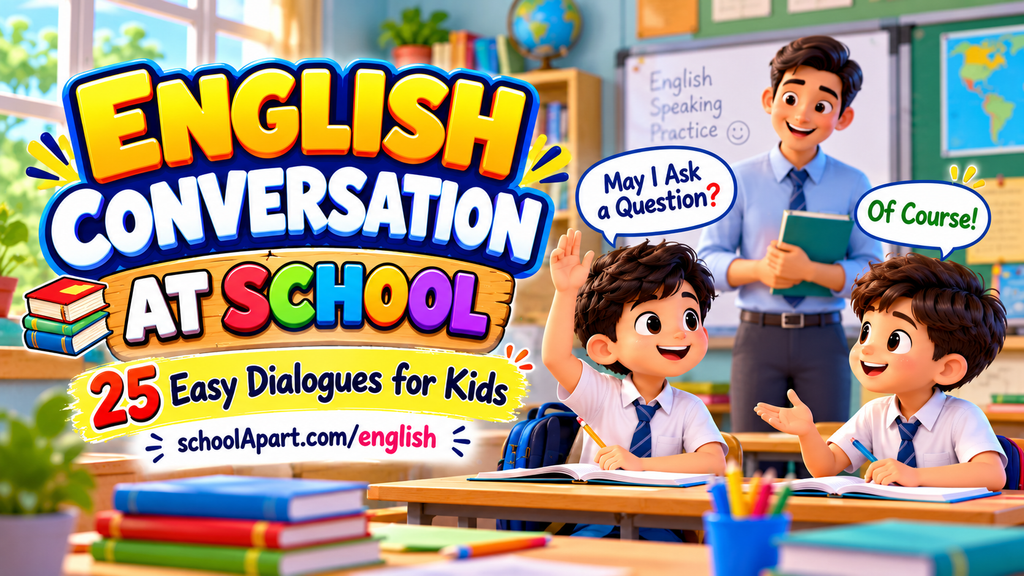
English conversation at school helps children communicate with teachers and classmates in everyday situations. From greetings and classroom questions to homework, group activities, and school events, simple dialogues give students practical opportunities to use English.
Start with short conversations, practise them in pairs, and gradually encourage children to create their own questions and responses. Focus on clear communication, polite expressions, and steady progress rather than perfection.
With regular practice and a supportive learning environment, students can become more comfortable using English at school.
Explore more English learning resources at SchoolApart.com to help children develop vocabulary, pronunciation, and everyday speaking skills.
Frequently Asked Questions
1. What is an English conversation at school?
An English conversation at school is an exchange between students, teachers, or classmates using English. Examples include greeting a teacher, asking a question, borrowing a pencil, or discussing homework.
2. How can kids improve their English conversation skills at school?
Children can practise short dialogues, ask polite questions, participate in group activities, and use simple English expressions in everyday school situations. Regular practice can help them become more comfortable speaking.
3. What are some common English sentences used at school?
Useful examples include “May I come in?”, “May I ask a question?”, “Could you help me, please?”, “I have finished my work,” and “Could you explain it again?”
4. How do students talk to teachers politely in English?
Students can use expressions such as “Excuse me, Ma’am,” “May I ask a question?”, “Could you please explain this?” and “Thank you for your help.”
5. How can beginners practise classroom English?
Beginners can start with short expressions for greetings, asking permission, requesting help, and answering questions. Practising one dialogue at a time can make learning manageable.
6. What should students say when they do not understand a lesson?
Students can say, “I do not understand this part,” “Could you please explain it again?” or “Could you give me another example?”
7. How can children start a conversation with a new classmate?
They can begin with simple questions such as “What is your name?”, “Which class are you in?” or “What is your favourite subject?” They can then ask follow-up questions to continue the conversation.
8. How can teachers use these dialogues in the classroom?
Teachers can organise pair practice, role-play, group performances, and short speaking warm-ups. Students can switch roles and adapt the dialogues to their own school experiences.
9. How long should students practise English conversations?
Five to ten minutes can be a useful starting point. Teachers and parents can adjust the duration according to the students’ ages, confidence, and attention span.
10. Should students memorise all the dialogues?
No. Students can use the dialogues as examples, but they should also understand the meaning and practise changing words to create their own conversations.
11. What is the difference between school vocabulary and school conversation?
School vocabulary teaches individual words related to school, such as classroom, notebook, and teacher. School conversation shows children how to use words and expressions in complete dialogues.
12. How can students become more confident speaking English in class?
Students can start with familiar expressions, practise with a supportive partner, and gradually participate in longer conversations. Encouragement and respectful feedback help create a comfortable learning environment.
13. Can parents help children practise school conversations at home?
Yes. Parents can act as teachers or classmates during role-play activities. They can practise asking questions, requesting help, and talking about school activities with their children.
14. What should students do if they make a mistake while speaking English?
They should continue speaking and try again when needed. Mistakes are a normal part of learning, and gentle corrections can help students improve over time.



Leave a Reply