

Learn how to improve spoken English at home with simple daily conversations, vocabulary practice, listening activities, games, and speaking exercises for kids.
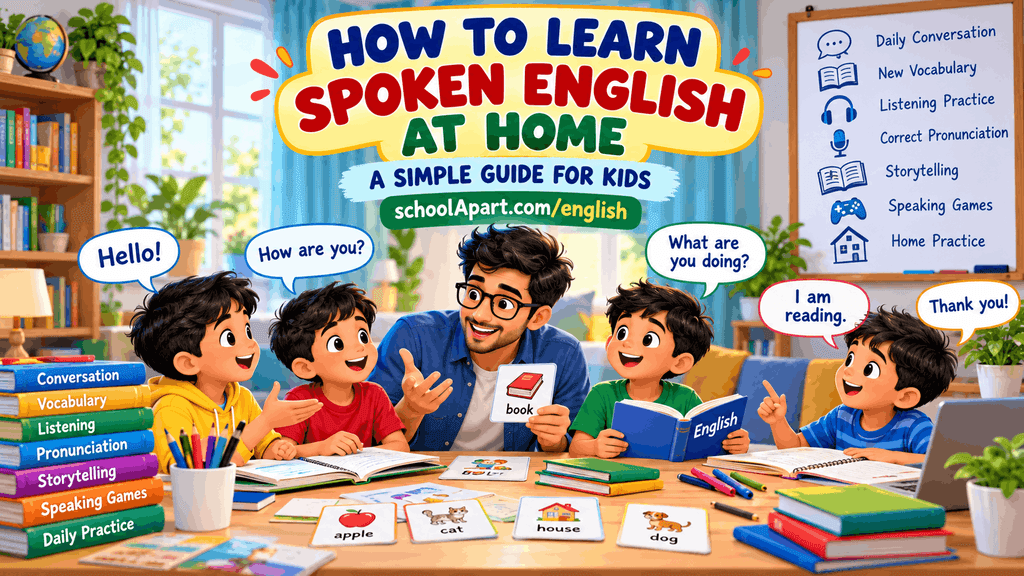
How to Learn Spoken English at Home: A Simple Guide for Kids
Children can learn spoken English at home through simple conversations, regular listening, useful vocabulary, and everyday speaking practice. They do not need expensive classes or complicated grammar lessons to begin.
A few minutes of English practice every day can help children become more familiar with English words, sentences, pronunciation, and conversations.
The key is to make English a regular part of everyday life rather than treating it only as a school subject.
Spoken English for Kids: Complete Beginner’s Guide to Learn English Speaking
This guide explains how parents can help children learn spoken English at home with simple and practical activities.
Can Kids Learn Spoken English at Home?
Yes. Children can develop spoken English skills at home when they get regular opportunities to listen to and speak English.
A child can practice English while:
- Getting ready for school
- Eating breakfast
- Playing
- Reading books
- Doing homework
- Drawing
- Cleaning up toys
- Talking about school
- Getting ready for bed
For example, instead of turning every practice session into a formal lesson, a parent can simply ask:
What are you doing?
The child can answer:
I am drawing.
This is already useful speaking practice.
How Can Kids Learn Spoken English at Home?
A simple home-learning process can follow these steps:
Listen → Learn Words → Make Sentences → Speak → Practice → Improve
Children should first hear English regularly. Then they can learn useful words and use those words in simple sentences.
With repeated practice, they can gradually participate in longer conversations.
1. Create a Simple English Environment at Home
You do not need to speak English all day.
Start with a few familiar situations.
For example, during breakfast:
Parent: Are you hungry?
Child: Yes, I am hungry.
During study time:
Parent: Are you ready to study?
Child: Yes, I am ready.
Before going outside:
Parent: Where are your shoes?
Child: They are here.
These small conversations make English part of everyday life.
2. Start With Simple English Sentences
Beginners should not start with complicated sentences.
Use short sentences that children can understand and repeat.
Useful examples
- I am hungry.
- I am thirsty.
- I am tired.
- I am happy.
- I am ready.
- This is my book.
- This is my pencil.
- I like apples.
- I like playing.
- I am reading.
- I am writing.
- I am going to school.
Once children become comfortable with short sentences, introduce slightly longer ones.
For example:
I am reading.
→ I am reading a book.
→ I am reading a storybook.
This creates a natural progression.
3. Teach Useful Vocabulary
Children need vocabulary to communicate.
But there is no need to introduce hundreds of words at once.
Start with familiar topics.
Family
- Mother
- Father
- Brother
- Sister
- Grandfather
- Grandmother
School
- Book
- Pencil
- Bag
- Teacher
- Student
- Classroom
Home
- Room
- Chair
- Table
- Door
- Window
- Bed
Food
- Rice
- Bread
- Apple
- Banana
- Milk
- Egg
After learning a word, encourage the child to use it.
For example:
Apple
This is an apple.
I like apples.
This is much more useful than simply memorizing the word.
4. Practice English Through Daily Conversations
Daily conversation is one of the easiest ways to practice spoken English at home.
Parents can ask simple questions throughout the day.
Morning
Good morning!
Did you sleep well?
Are you ready for school?
After School
How was your day?
What did you learn?
Who did you play with?
During Homework
What are you doing?
Do you need help?
Have you finished your homework?
Before Bed
Are you sleepy?
What did you enjoy today?
What will you do tomorrow?
The questions do not need to be difficult.
The objective is to give children opportunities to listen, understand, and respond.
5. Use the “Question and Answer” Method
Question-and-answer practice is especially useful for beginners.
Start with simple questions.
About the Child
What is your name?
My name is Riya.
How old are you?
I am eight years old.
Where do you live?
I live in Malda.
What is your favourite colour?
My favourite colour is blue.
What do you like?
I like drawing.
As the child improves, questions can become more open-ended.
What did you do today?
What is your favourite game and why?
What did you learn at school?
6. Encourage Children to Speak About Their Day
A simple daily speaking activity is to ask children to talk about their day.
For younger children, start with three sentences.
For example:
I went to school.
I studied English.
I played with my friends.
Older children can gradually speak for one or two minutes.
They might talk about:
- School
- Friends
- Homework
- Games
- Food
- A story they read
- Something interesting they saw
This activity develops both vocabulary and confidence.
7. Use Picture Description Activities
Pictures give children something concrete to talk about.
Show a picture and ask:
- What can you see?
- Who is there?
- What are they doing?
- What colour is it?
- Where are they?
- What do you think will happen next?
For example:
I can see a boy.
He is playing football.
He is wearing a blue shirt.
There are trees behind him.
Do not worry if the child makes small grammar mistakes at first. Encourage them to keep speaking.
8. Read Simple English Stories
Reading can support spoken English because children encounter new words and sentence patterns.
Choose age-appropriate stories with:
- Short sentences
- Familiar vocabulary
- Pictures
- Repetition
- Simple dialogue
After reading, ask questions.
Who is the main character?
Where did the story happen?
What happened at the end?
You can also ask the child to retell the story using their own words.
9. Practice English Through Role Play
Role play allows children to use English in imaginary real-life situations.
Try situations such as:
At a Shop
Customer: Can I have an apple, please?
Shopkeeper: Sure.
Customer: How much is it?
At School
Student: May I come in?
Teacher: Yes, come in.
Student: Thank you.
At Home
Parent: Where is your school bag?
Child: It is on the chair.
Role play makes speaking practice more active and enjoyable.
10. Play English Speaking Games
Games can make repetition less boring.
Guess the Object
Give clues:
It is round.
It is orange.
You can eat it.
The child guesses:
Orange!
What Am I Doing?
Act out an activity.
The child says:
You are jumping.
You are running.
You are reading.
Word Chain
Start with a simple word.
Cat → Tiger → Rabbit → Tree
For older children, make a sentence with each word.
These games can turn vocabulary practice into speaking practice.
11. Use English During Play
Playtime can also become an English-learning opportunity.
If children are playing with toys, use simple English:
Give me the red car.
Where is the ball?
Put the car here.
Whose turn is it?
Let’s play together.
The child gradually learns that English is not only something to study—it is also a language for communication.
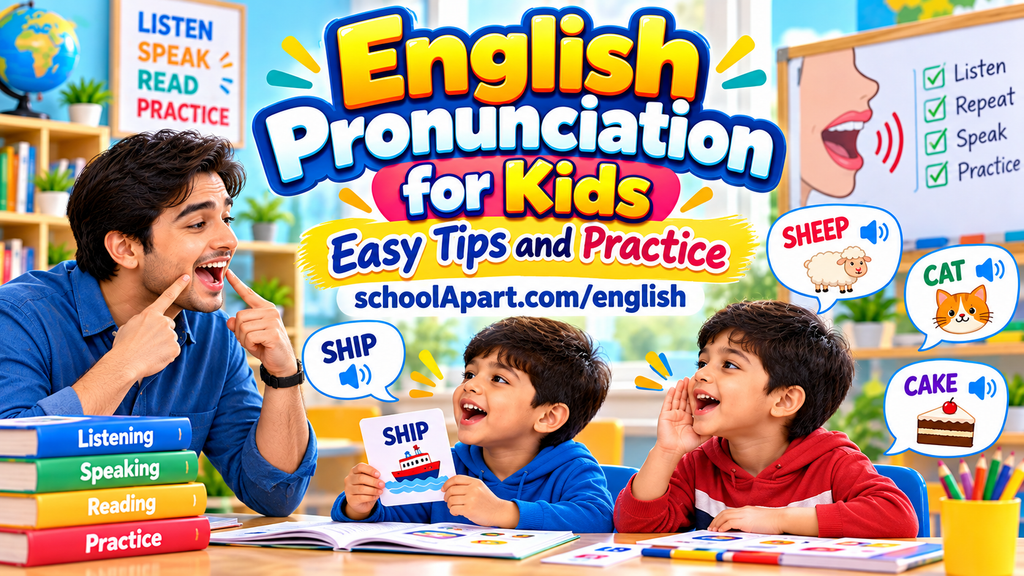
12. Practice Pronunciation Through Listening and Repetition
Children should hear English regularly and repeat useful words and sentences.
A simple method is:
Listen → Repeat → Use
For example:
Parent says:
“Good morning.”
Child repeats:
“Good morning.”
Then use it naturally the next morning.
Pronunciation does not need to be perfect from the beginning.
The focus should be on clear communication and gradual improvement.
13. Teach Children Useful English Questions
Children need to know how to ask questions, not just answer them.
Start with:
- What is this?
- What is your name?
- Where are you going?
- Where is my book?
- Who is he?
- Who is she?
- What are you doing?
- Can you help me?
- May I come in?
- Can I have this?
Question practice helps children become active participants in conversations.
14. Use the “English Corner” Method
You can create a small English-learning space at home.
It does not need to be a separate room.
A small table or wall can contain:
- Picture cards
- Vocabulary cards
- Simple sentences
- Storybooks
- English labels
- A small notebook
For example, label familiar objects:
Door
Window
Table
Chair
Book
Bag
Children repeatedly see the words and gradually become familiar with them.
15. Keep an English Speaking Notebook
Give the child a notebook for English practice.
Each day, write:
5 New Words
For example:
- School
- Friend
- Book
- Play
- Teacher
3 Sentences
I went to school.
I read a book.
I played with my friend.
1 Question
What did you learn today?
This creates a simple daily speaking routine.
A Simple 20-Minute Spoken English Routine
Parents who want a structured routine can try this:
5 Minutes — Listening
Listen to a short English story, dialogue, or age-appropriate audio.
5 Minutes — Vocabulary
Learn five useful words.
5 Minutes — Speaking
Make sentences using those words.
5 Minutes — Conversation
Talk about the child’s day or another familiar topic.
This routine can be adjusted according to the child’s age and attention span.
Consistency is more important than making every session long.
A 7-Day Spoken English Practice Plan
Here is a simple weekly plan.
| Day | Practice Topic |
|---|---|
| Monday | Family |
| Tuesday | School |
| Wednesday | Food |
| Thursday | Toys and Games |
| Friday | Daily Activities |
| Saturday | Storytelling |
| Sunday | Review and Conversation |
For each topic, learn a few words and use them in sentences.
How Parents Should Correct English Mistakes
Correction is useful, but the way you correct a child matters.
Suppose the child says:
“I goed to school.”
Instead of immediately saying:
“Wrong!”
you can naturally model the correct sentence:
“Oh, you went to school?”
The child hears the correct form without feeling embarrassed.
The goal is to correct gently and keep the conversation going.
Don’t Force Children to Speak English All the Time
English practice should be regular, but children should not feel pressured to speak English every minute.
If a child is tired or uncomfortable, give them a break.
A positive learning environment is more useful than constant pressure.
The goal is to make children feel:
“I can try speaking English.”
rather than:
“I must speak perfect English.”
Common Mistakes to Avoid
1. Teaching Too Many Words
A smaller number of useful words is easier to remember and use.
2. Focusing Only on Grammar
Grammar is important, but speaking also requires listening, vocabulary, pronunciation, and confidence.
3. Correcting Every Mistake
Too much correction can make children afraid to speak.
4. Making Practice Too Long
Short, regular sessions can work well for young learners.
5. Using Difficult English
Start with language the child can understand.
6. Comparing Children
Children learn at different speeds.
7. Expecting Immediate Fluency
Spoken English develops through continued exposure and practice.
How to Make Spoken English Fun at Home
Try to connect English with things children already enjoy.
Drawing
Ask:
What are you drawing?
Playing
Ask:
What are you playing?
Cooking
Ask:
What are we making?
Reading
Ask:
What is the story about?
Watching a Picture
Ask:
What can you see?
This makes English a natural part of the child’s daily activities.
How Long Should Kids Practice English at Home?
There is no fixed amount of time that works for every child.
For beginners, 10–20 minutes of focused practice can be a practical starting point.
Some children may enjoy longer activities, while younger children may benefit from several short activities throughout the day.
The important thing is regular exposure.
A little English every day is better than a long session once in a while.
What Should Kids Learn First?
A useful progression is:
Step 1: Everyday Words
Learn familiar objects, people, actions, and places.
Step 2: Simple Sentences
This is my book.
I like apples.
Step 3: Questions and Answers
What is your name?
My name is Sam.
Step 4: Short Conversations
Practice conversations at home and school.
Step 5: Speaking Activities
Use:
- Picture description
- Storytelling
- Role play
- Games
- Show and tell
Step 6: Longer Conversations
Gradually encourage children to talk about their experiences, interests, and ideas.
Final Tips for Parents
If you want to help your child learn spoken English at home:
- Speak simple English regularly.
- Use everyday situations for practice.
- Teach useful vocabulary.
- Ask simple questions.
- Encourage complete sentences.
- Read English stories together.
- Use pictures and games.
- Practice pronunciation naturally.
- Give children time to answer.
- Correct mistakes gently.
- Praise effort.
- Keep practice enjoyable.
- Do not compare your child with others.
- Focus on regular practice rather than perfection.
Children can learn spoken English at home when English becomes a regular part of their everyday life.
You do not need complicated lessons to begin. Start with simple words, short sentences, daily questions, stories, games, and conversations.
The most useful routine is simple:
Listen → Understand → Speak → Practice → Improve
Give your child time, encouragement, and plenty of opportunities to communicate.
With regular practice, children can gradually become more comfortable using English in everyday situations.
FAQ
Can my child learn spoken English at home?
Yes. Children can develop spoken English skills at home through regular listening, vocabulary practice, simple conversations, storytelling, games, and everyday communication.
How can I start teaching spoken English at home?
Start with familiar words and simple sentences. Use English during everyday activities such as breakfast, homework, playing, reading, and getting ready for school.
How much English should a child practice every day?
There is no fixed requirement. A short, regular practice session of around 10–20 minutes can be a practical starting point, depending on the child’s age and attention span.
What should kids learn first in spoken English?
Begin with everyday vocabulary, simple sentences, common questions, and short conversations. Gradually introduce longer speaking activities.
How can I improve my child’s English speaking confidence?
Give your child regular opportunities to speak without making them afraid of mistakes. Encourage their effort, listen patiently, and correct errors gently.
Should parents speak only English at home?
No. Parents do not need to use English all the time. Even short English conversations during everyday activities can provide useful practice.
How can I teach English vocabulary to children?
Choose familiar topics such as family, school, food, toys, and daily activities. Teach a few useful words and encourage children to use each word in a sentence.
How can I make English practice fun?
Use stories, pictures, role play, guessing games, drawing, toys, storytelling, and simple conversations connected to activities children already enjoy.



Leave a Reply