
Discover the different types of Optical Illusion Art, from Hidden Image and Op Art to Anamorphic and Impossible Objects. Learn how each illusion works, where it is used, and which style is best for beginners.
15 Types of Optical Illusion Art Explained
Have you ever looked at a drawing and noticed something strange?
At first, you saw only a tree. A few seconds later, you realized the branches formed a human face.
Or perhaps you looked at a black-and-white image and suddenly discovered that what seemed to be a vase was actually two people looking at each other.
That fascinating moment of surprise is what makes Optical Illusion Art so special.
Benefits of Learning Art for Kids: 25+ Ways Art Helps Children Learn and Grow
Unlike traditional drawings, optical illusion artworks challenge the brain. They encourage viewers to slow down, observe carefully, and discover hidden meanings. Every illusion invites the audience to see more than what appears at first glance.
For artists, optical illusion is not simply about making confusing pictures. It is about understanding how the human brain interprets lines, shapes, colors, shadows, and perspective. By carefully arranging these visual elements, artists can create images that appear to move, change, hide objects, or even look impossible.
Today, Optical Illusion Art is found everywhere:
- Fine art galleries
- School art competitions
- Graphic design
- Logo design
- Digital illustration
- Advertising
- Architecture
- Street painting
- Social media artwork
- Educational activities
Because there are many different ways to create visual illusions, Optical Illusion Art has developed into several unique styles over the years. Each style follows different artistic principles and produces a different viewing experience.
Some illusions hide animals inside landscapes.
Some create impossible buildings.
Some make flat paper look three-dimensional.
Others seem to move even though they are completely still.
Understanding these different styles helps students appreciate art more deeply while also improving their observation, drawing, and creative thinking skills.
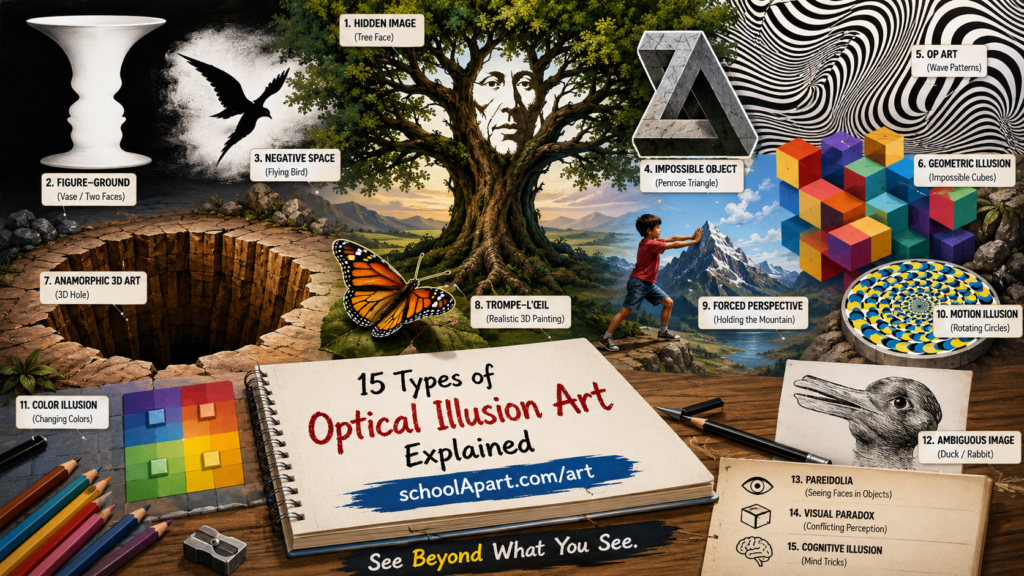
This guide explores the 15 most important types of Optical Illusion Art, explaining how each one works, where it is commonly used, and why it continues to inspire artists around the world.
Whether you are a beginner, an art student, a teacher, or simply curious about illusion drawings, this comprehensive guide will help you understand the fascinating world of optical illusion art.
Table of Contents
- What Is Optical Illusion Art?
- Why Are There Different Types of Optical Illusion Art?
- How Optical Illusions Trick the Human Brain
- The 15 Main Types of Optical Illusion Art
- Hidden Image Illusion
- Double Image Illusion
- Figure–Ground Illusion
- Negative Space Illusion
- Impossible Object Illusion
- Op Art (Optical Art)
- Geometric Illusion
- Perspective Illusion
- Anamorphic Art
- Trompe-l’œil Art
- Forced Perspective Art
- Motion Illusion
- Color Illusion
- Ambiguous Illusion
- Face Illusion
- Comparison of Different Optical Illusion Styles
- Which Type Is Best for Beginners?
- Frequently Asked Questions
What Is Optical Illusion Art?
Optical Illusion Art is a form of visual art designed to make viewers perceive something that differs from physical reality.
Instead of presenting a straightforward image, illusion art intentionally creates uncertainty. The viewer’s eyes collect visual information, while the brain attempts to interpret it. When the artist carefully manipulates shapes, patterns, lighting, colors, perspective, or negative space, the brain can produce multiple interpretations of the same image.
That is why one person may notice something immediately, while another person may require several seconds—or even minutes—to discover the hidden picture.
This interaction between vision and perception makes Optical Illusion Art one of the most engaging forms of artistic expression.
Unlike ordinary drawings, illusion art transforms the viewer into an active participant.
Instead of simply looking at a picture, the viewer explores it.
Why Are There Different Types of Optical Illusion Art?
Not every illusion is created in the same way.
Some artists rely on perspective.
Others use geometry.
Some depend on hidden objects.
Others manipulate color contrast or negative space.
Because artists use different visual techniques to create different psychological effects, Optical Illusion Art has naturally evolved into many separate categories.
Each category teaches a different artistic skill.
For example:
- One style improves observation.
- Another develops perspective drawing.
- Another strengthens composition.
- Some focus on creative storytelling.
- Others emphasize mathematics and geometry.
Understanding these categories helps artists choose the right approach for their artwork.
The Science Behind Optical Illusion Art
Optical illusions are not mistakes made by your eyes.
They are natural responses of your brain.
Your eyes collect millions of pieces of visual information every second.
Your brain processes that information by looking for familiar shapes, patterns, colors, and objects.
Most of the time, this process happens almost instantly.
However, when an artist intentionally designs an image that contains conflicting visual information, the brain struggles to decide which interpretation is correct.
This creates an illusion.
For example:
- Your brain naturally searches for faces.
- It groups nearby objects together.
- It separates objects from their background.
- It assumes light comes from above.
- It tries to recognize familiar patterns.
Optical illusion artists understand these natural tendencies and use them creatively.
Instead of fighting the brain, they allow it to “complete” the image in multiple ways.
This is why optical illusion art often feels magical despite being based on careful observation and scientific principles.
How Are Optical Illusion Types Classified?
Although hundreds of illusion techniques exist, most can be grouped into several major categories based on the primary visual principle they use.
The classification generally depends on questions such as:
- Does the illusion hide another image?
- Does it use perspective?
- Does it depend on geometry?
- Does it rely on negative space?
- Does it create impossible objects?
- Does it appear to move?
- Does it change depending on viewing angle?
These categories make it easier for students and artists to study illusion art systematically instead of treating every illusion as completely different.
In the following sections, we will explore the 15 major types of Optical Illusion Art, beginning with one of the oldest and most popular styles: Hidden Image Illusion.
1. Hidden Image Illusion
What Is Hidden Image Illusion?
Hidden Image Illusion is one of the oldest and most enjoyable forms of Optical Illusion Art. In this style, the artist cleverly hides one or more images inside another image. At first glance, viewers usually notice only the main subject. However, after careful observation, they begin to discover additional objects, faces, animals, or symbols concealed within the artwork.
The excitement comes from the moment of discovery. Every new hidden object feels like solving a visual puzzle.
Unlike ordinary drawings that communicate a single idea, Hidden Image Illusions encourage viewers to spend more time examining every detail.
How Does It Work?
Artists use several techniques to hide images naturally inside larger compositions.
These include:
- Tree branches forming human faces
- Clouds resembling animals
- Mountain shapes creating silhouettes
- Leaves becoming birds
- Shadows revealing hidden objects
- Rocks forming facial features
The hidden image should blend naturally into the main picture without appearing forced.
Key Characteristics
- One or multiple hidden images
- Requires careful observation
- Encourages slow viewing
- Improves visual attention
- Often uses natural objects to hide shapes
Where Is It Used?
Hidden Image Illusions are common in:
- Children’s puzzle books
- Storybooks
- School art competitions
- Magazine puzzles
- Educational worksheets
- Creative illustration
- Logo design
- Fantasy artwork
Difficulty Level
Beginner to Intermediate
This is one of the easiest illusion styles for new artists because it mainly requires observation and creativity rather than advanced perspective or geometry.
Tips for Drawing Hidden Image Illusions
- Start with one large subject.
- Decide which secondary object you want to hide.
- Use natural outlines instead of obvious borders.
- Avoid making the hidden image too small.
- Test your drawing by asking someone else to find the hidden object.
Beginner Project Idea
Draw a large tree whose branches naturally form the face of an old man.
2. Double Image Illusion
What Is Double Image Illusion?
Double Image Illusion presents two completely different images within the same drawing. Depending on how the viewer looks at the picture, the brain switches between two interpretations.
Unlike Hidden Image Illusions, where one picture is concealed inside another, Double Image Illusions allow both images to share the same lines and shapes.
The viewer can only focus on one interpretation at a time.
How Does It Work?
The artist designs shared outlines that belong to two different objects simultaneously.
For example:
- A young woman and an old woman
- A rabbit and a duck
- A musician and a face
- A vase and two people
The brain continuously changes its interpretation.
Key Characteristics
- Two equally important images
- Shared outlines
- Brain alternates between interpretations
- Strong psychological effect
Where Is It Used?
- Psychology textbooks
- Art education
- Visual perception studies
- Creative posters
- Magazine illustrations
Difficulty Level
Intermediate
Designing two recognizable images with the same outlines requires careful planning.
Tips for Beginners
- Choose two objects with similar outlines.
- Sketch both images separately first.
- Gradually merge the outlines.
- Keep unnecessary details to a minimum.
Beginner Exercise
Create a drawing where a candle also becomes two human faces.
3. Figure–Ground Illusion
What Is Figure–Ground Illusion?
Figure–Ground Illusion changes the relationship between the subject (figure) and the background (ground).
Normally, the brain easily separates an object from its background.
However, in Figure–Ground Illusions, both areas compete equally for attention.
The background can suddenly become the main subject.
How Does It Work?
Artists carefully balance positive and negative shapes.
The black areas may become one image.
The white areas may become another.
The viewer’s attention constantly shifts between both.
Key Characteristics
- Background becomes part of the artwork
- Two interpretations exist simultaneously
- Strong contrast
- Minimal details
- Clean silhouettes
Famous Example
The famous “Vase or Faces” illusion is one of the best-known Figure–Ground examples.
Where Is It Used?
- Logo design
- Graphic design
- Brand identity
- Icon creation
- Visual communication
Difficulty Level
Intermediate
Creating balanced positive and negative spaces requires careful composition.
Tips
- Work in black and white first.
- Simplify shapes.
- Avoid unnecessary textures.
- Focus on silhouette quality.
Beginner Practice
Design two birds using only the empty space between tree branches.
4. Negative Space Illusion
What Is Negative Space Illusion?
Negative Space Illusion creates an image using the empty areas surrounding the main subject rather than the subject itself.
Many beginners only draw the object.
Professional artists also design the spaces around the object.
Those empty spaces can become another meaningful picture.
How Does It Work?
Instead of drawing the hidden image directly, the artist leaves carefully shaped empty areas.
The viewer’s brain naturally recognizes these spaces as another object.
Key Characteristics
- Hidden image appears in empty space
- Strong contrast
- Clean composition
- Minimal lines
- Clever visual balance
Why Is It Important?
Negative Space is one of the most valuable skills every artist should learn because it improves:
- Composition
- Observation
- Shape recognition
- Balance
- Design thinking
Where Is It Used?
- Company logos
- Poster design
- Packaging
- Book covers
- Modern illustration
Difficulty Level
Intermediate
Beginner Project
Create a drawing of two trees where the empty space between them forms a deer.
5. Impossible Object Illusion
What Is Impossible Object Illusion?
Impossible Object Illusions show objects that appear completely realistic but could never exist in the real world.
At first glance, everything looks perfectly normal.
After closer inspection, the viewer realizes the object breaks the laws of geometry and perspective.
This contradiction creates the illusion.
Common Examples
- Impossible triangle
- Endless staircase
- Impossible cube
- Impossible fork
- Infinite loop
How Does It Work?
Artists intentionally manipulate perspective.
Each individual section appears logical.
However, when viewed as a whole, the object becomes physically impossible.
Key Characteristics
- Impossible geometry
- Accurate perspective
- Mathematical precision
- Strong visual confusion
Where Is It Used?
- Mathematics education
- Architecture
- Graphic design
- Puzzle books
- Contemporary art
Difficulty Level
Advanced
Perspective drawing skills are essential.
Tips
- Learn basic perspective first.
- Sketch using construction lines.
- Build each section separately.
- Check every connection carefully.
6. Op Art (Optical Art)
What Is Op Art?
Op Art, short for Optical Art, is one of the most recognizable forms of illusion art.
Instead of hiding objects, Op Art creates visual movement through repeating geometric patterns.
The artwork itself never moves.
However, the viewer feels as if it is:
- vibrating,
- spinning,
- expanding,
- shrinking,
- or flowing.
This sensation is produced entirely by the interaction between repetitive shapes and the human visual system.
How Does It Work?
Artists carefully repeat:
- Lines
- Circles
- Squares
- Waves
- Spirals
- Checkerboard patterns
The spacing, thickness, and contrast cause the eyes to continuously adjust focus.
Key Characteristics
- Repeating patterns
- Strong geometry
- Usually black and white
- Creates movement illusion
- Highly mathematical
Where Is It Used?
- Modern art
- Fashion
- Interior decoration
- Graphic design
- Textile design
- Album covers
Difficulty Level
Intermediate to Advanced
Precision is extremely important.
Beginner Exercise
Create a page filled with evenly spaced curved lines that appear to bulge outward.
7. Geometric Illusion
What Is Geometric Illusion?
Geometric Illusions use mathematical shapes and carefully arranged patterns to deceive the eye.
Unlike Op Art, which focuses mainly on movement, Geometric Illusions emphasize depth, size, distance, alignment, and structure.
Simple shapes can appear larger, smaller, tilted, curved, or distorted depending on their surrounding elements.
Common Shapes Used
- Squares
- Triangles
- Hexagons
- Cubes
- Diamonds
- Circles
Key Characteristics
- Mathematical accuracy
- Clean construction
- Symmetry
- Repetition
- Visual precision
Applications
- Architecture
- Graphic design
- Product design
- Educational diagrams
- Digital illustration
Difficulty Level
Intermediate
Beginner Practice
Draw a cube pattern that appears to flip between two different orientations.
8. Perspective Illusion
What Is Perspective Illusion?
Perspective Illusion creates the impression of depth, distance, or unusual size relationships using perspective techniques.
Although the drawing exists on a flat surface, it appears three-dimensional.
Artists manipulate vanishing points, viewing angles, and proportions to create convincing visual tricks.
How Does It Work?
Perspective controls how objects appear as they move farther away.
By intentionally exaggerating or manipulating these rules, artists can make:
- Small objects look enormous.
- Large objects appear tiny.
- Flat drawings seem three-dimensional.
- Impossible scenes appear believable.
Key Characteristics
- Uses one-, two-, or three-point perspective
- Creates depth
- Strong sense of realism
- Excellent for architectural drawings
- Foundation for many advanced illusion styles
Where Is It Used?
- Architecture
- Interior design
- 3D street art
- Game design
- Film concept art
- Technical illustration
Difficulty Level
Beginner to Advanced
Simple perspective can be learned early, while advanced perspective illusions require significant practice.
Tips for Students
- Master one-point perspective first.
- Practice drawing cubes.
- Learn horizon lines and vanishing points.
- Observe buildings and roads in real life.
- Add shadows to increase realism.
9. Anamorphic Art
What Is Anamorphic Art?
Anamorphic Art is one of the most fascinating forms of Optical Illusion. In this style, the artwork appears distorted or stretched when viewed normally. However, when viewed from a specific angle or through a reflective surface such as a cylindrical mirror, the image suddenly transforms into a perfectly recognizable picture.
Unlike other illusion styles that rely on hidden objects or visual ambiguity, Anamorphic Art depends entirely on viewing position.
This makes it one of the most interactive forms of illusion art.
How Does It Work?
Artists intentionally stretch and distort an image according to mathematical perspective rules.
The distortion is carefully calculated so that the image looks correct only from one particular viewpoint.
If the viewer stands somewhere else, the artwork appears completely distorted.
Key Characteristics
- Distorted appearance from most angles
- Correct image visible from one viewpoint
- Requires advanced perspective knowledge
- Highly realistic when viewed correctly
- Often very large in scale
Where Is It Used?
Anamorphic Art is widely used in:
- 3D street art
- Museum exhibitions
- Interactive installations
- Advertising campaigns
- Public art festivals
- Photography projects
Difficulty Level
Advanced
Because artists must calculate perspective very accurately, this style requires strong drawing and spatial visualization skills.
Beginner Practice
Draw a simple word stretched across a page so that it becomes readable only when viewed from a low angle.
10. Trompe-l’œil Art
What Is Trompe-l’œil Art?
“Trompe-l’œil” is a French phrase meaning “deceive the eye.”
This artistic style creates paintings that look so realistic that viewers believe the painted object is actually real.
Unlike Perspective Illusion or Anamorphic Art, Trompe-l’œil does not hide objects or distort images. Instead, it uses extraordinary realism to trick the viewer.
A painted window may appear open.
A painted bird may seem ready to fly.
A painted letter may look like it can be picked up.
How Does It Work?
Artists combine:
- Accurate perspective
- Detailed textures
- Realistic lighting
- Natural shadows
- Precise proportions
Every detail contributes to convincing the viewer that the painted object exists physically.
Key Characteristics
- Extreme realism
- Highly detailed rendering
- Natural lighting
- Strong shadow effects
- Accurate textures
Applications
- Wall murals
- Museum ceilings
- Classical paintings
- Restaurant decoration
- Luxury interiors
- Architectural decoration
Difficulty Level
Advanced
Mastery of realism, anatomy, perspective, and lighting is essential.
Beginner Exercise
Draw a piece of paper with a folded corner that appears to lift off the page.
11. Forced Perspective Art
What Is Forced Perspective?
Forced Perspective is an illusion created by carefully positioning objects, people, or buildings so that they appear much larger, smaller, closer, or farther away than they actually are.
Unlike many illusion styles that exist only on paper, Forced Perspective often uses photography or real-world environments.
How Does It Work?
The illusion depends on camera angle and object placement.
For example:
- A person appears to hold the Moon.
- A child appears taller than a skyscraper.
- Someone seems to stand inside another person’s hand.
The brain assumes all objects exist at similar distances, creating the illusion.
Key Characteristics
- Uses real objects
- Depends on camera position
- Relies on distance relationships
- Popular in photography
- Easy to understand
Applications
- Tourist photography
- Film production
- Theme parks
- Advertising
- Social media content
Difficulty Level
Beginner
Basic understanding of perspective is enough to start experimenting.
Practice Activity
Photograph a friend “holding” a distant building in the palm of their hand.
12. Motion Illusion
What Is Motion Illusion?
Motion Illusion creates the sensation that a completely still image is moving.
Many viewers report seeing circles rotate, waves ripple, or lines vibrate even though nothing is actually changing.
The movement exists only inside the brain.
Why Does It Happen?
The illusion occurs because the visual system continuously processes contrast, brightness, edge direction, and repeating patterns.
Small eye movements called microsaccades contribute to the impression of motion.
Key Characteristics
- Static image
- Appears animated
- Uses repeating patterns
- Strong contrast
- Eye-catching design
Applications
Motion Illusions appear in:
- Posters
- Modern art
- Digital graphics
- Educational materials
- Book covers
- Optical illusion collections
Difficulty Level
Intermediate
Creating convincing movement requires careful arrangement of patterns and contrast.
Beginner Exercise
Draw several concentric circles with alternating thick and thin curved lines to create a spinning effect.
13. Color Illusion
What Is Color Illusion?
Color Illusion demonstrates how surrounding colors influence the way we perceive another color.
Two identical colors may appear completely different simply because they are placed against different backgrounds.
This phenomenon reveals that color perception depends on context rather than color alone.
How Does It Work?
The human brain constantly compares neighboring colors.
Brightness, saturation, and contrast all influence how a color is interpreted.
Artists intentionally use these relationships to create surprising visual effects.
Key Characteristics
- Based on color interaction
- Influenced by lighting
- Depends on surrounding colors
- Useful for design and painting
- Demonstrates visual perception
Applications
- Graphic design
- Painting
- Fashion
- Product design
- Interior decoration
- User interface design
Difficulty Level
Beginner to Intermediate
Understanding basic color theory makes this style much easier.
Practice Activity
Paint two identical gray squares on different colored backgrounds and compare how different they appear.
14. Ambiguous Illusion
What Is Ambiguous Illusion?
Ambiguous Illusion presents an image that can be interpreted in two or more completely different ways.
Unlike Hidden Image Illusions, where one object is concealed inside another, ambiguous images allow multiple interpretations without hiding anything.
The brain naturally switches between possible meanings.
How Does It Work?
Artists create outlines that support multiple interpretations equally.
Neither interpretation is incorrect.
The brain simply changes focus between them.
Examples
- Duck or rabbit
- Old woman or young woman
- Skull or couple
- Saxophone player or woman’s face
Key Characteristics
- Multiple valid interpretations
- Shared outlines
- Psychological effect
- Encourages observation
- Highly memorable
Applications
- Psychology education
- Art education
- Magazine illustrations
- Visual puzzles
- Creative advertising
Difficulty Level
Intermediate
Designing balanced dual interpretations requires imagination and careful planning.
Beginner Exercise
Create an illustration that could be interpreted as both a fish and a leaf.
15. Face Illusion
What Is Face Illusion?
Face Illusion is a specialized category of Optical Illusion Art in which human faces are created using unexpected objects or hidden within other subjects.
Because the human brain is naturally programmed to recognize faces—a phenomenon known as face perception—even simple arrangements of shapes can appear human.
Artists use this tendency to create remarkable visual surprises.
How Does It Work?
A face may be formed using:
- Trees
- Clouds
- Mountains
- Buildings
- Flowers
- Animals
- Fruits
- Shadows
At first, viewers notice the larger scene.
Later, they recognize the hidden face.
Key Characteristics
- Hidden facial features
- Uses natural forms
- Strong emotional impact
- Highly creative
- Popular in surreal art
Applications
- Surreal illustration
- Fantasy art
- Book covers
- Fine art
- Digital painting
- Concept art
Difficulty Level
Beginner to Intermediate
Because humans naturally recognize faces, this style is enjoyable for beginners while still offering endless creative possibilities.
Beginner Practice
Draw a forest landscape where the arrangement of trees, rocks, and shadows gradually forms the face of an elderly person.
Choosing the Right Type of Optical Illusion Art
With so many styles available, beginners often wonder where to start.
The answer depends on your artistic goals.
If you enjoy storytelling and visual puzzles, Hidden Image Illusion and Face Illusion are excellent starting points because they encourage creativity without requiring advanced technical skills.
If you are interested in logos and graphic design, Negative Space Illusion and Figure–Ground Illusion will help you develop strong composition and visual communication skills.
Artists who love mathematics, architecture, and precision may prefer Geometric Illusion, Perspective Illusion, or Impossible Object Illusion.
Those fascinated by realism should explore Trompe-l’œil Art, while students interested in public installations and interactive artworks may enjoy Anamorphic Art and Forced Perspective Art.
Meanwhile, Motion Illusion, Color Illusion, and Op Art are ideal for artists who want to experiment with patterns, visual rhythm, and perception.
Ultimately, there is no single “best” type of Optical Illusion Art. Each style develops different artistic skills, and many professional artists combine several illusion techniques within a single artwork.
Comparison Table of All 15 Types of Optical Illusion Art
| Type | Main Technique | Difficulty | Best For | Common Applications |
|---|---|---|---|---|
| Hidden Image Illusion | Concealed objects | ⭐ Beginner | Creative drawing | Puzzle books, illustration |
| Double Image Illusion | Shared outlines | ⭐⭐ Intermediate | Visual storytelling | Psychology, art education |
| Figure–Ground Illusion | Positive & negative shapes | ⭐⭐ Intermediate | Graphic design | Logos, branding |
| Negative Space Illusion | Empty space creates images | ⭐⭐ Intermediate | Composition skills | Logo design, posters |
| Impossible Object Illusion | Impossible geometry | ⭐⭐⭐ Advanced | Perspective practice | Architecture, puzzle art |
| Op Art | Repeating geometric patterns | ⭐⭐⭐ Advanced | Pattern design | Modern art, fashion |
| Geometric Illusion | Mathematical shapes | ⭐⭐ Intermediate | Precision drawing | Graphic design |
| Perspective Illusion | Depth and distance | ⭐⭐ Intermediate | Architecture | 3D drawings |
| Anamorphic Art | Distorted perspective | ⭐⭐⭐ Advanced | Street art | Public art installations |
| Trompe-l’œil Art | Hyper-realism | ⭐⭐⭐ Advanced | Realistic painting | Murals, galleries |
| Forced Perspective Art | Camera angle illusion | ⭐ Beginner | Photography | Tourism, advertising |
| Motion Illusion | Static patterns appear moving | ⭐⭐ Intermediate | Visual effects | Posters, digital art |
| Color Illusion | Color interaction | ⭐ Beginner | Painting | Design, branding |
| Ambiguous Illusion | Multiple interpretations | ⭐⭐ Intermediate | Creative thinking | Psychology, puzzles |
| Face Illusion | Hidden facial forms | ⭐ Beginner | Surreal drawing | Illustration, fantasy art |
Which Type Is Best for Beginners?
If you are new to Optical Illusion Art, it is important to begin with styles that focus on observation rather than complex mathematics or perspective.
The following progression is recommended:
Stage 1 – Beginner
- Hidden Image Illusion
- Face Illusion
- Color Illusion
- Forced Perspective
These styles help students develop creativity and visual observation.
Stage 2 – Intermediate
- Negative Space Illusion
- Figure–Ground Illusion
- Double Image Illusion
- Perspective Illusion
- Geometric Illusion
- Motion Illusion
At this stage, students learn composition, balance, perspective, and design thinking.
Stage 3 – Advanced
- Impossible Object Illusion
- Op Art
- Trompe-l’œil Art
- Anamorphic Art
These styles require patience, technical precision, and advanced drawing skills.
Which Optical Illusion Style Is Best for School Students?
For school projects and art competitions, the following styles are especially suitable because they combine creativity with achievable techniques:
Primary School
- Hidden Image Art
- Face Illusion
- Color Illusion
Middle School
- Negative Space Art
- Figure–Ground Illusion
- Double Image Illusion
- Motion Illusion
High School
- Perspective Illusion
- Geometric Illusion
- Impossible Objects
- Op Art
- Anamorphic Art
How to Practice Optical Illusion Art
Improving your illusion drawing skills requires consistent observation and experimentation. Follow this step-by-step practice plan.
Step 1: Learn Basic Drawing
Before creating illusions, practice:
- Straight lines
- Curves
- Basic shapes
- Shading
- Perspective
Strong fundamentals make illusions much easier to create.
Step 2: Observe Real Objects
Look carefully at:
- Trees
- Buildings
- Clouds
- Leaves
- Animals
- Human faces
Train yourself to discover hidden shapes in everyday objects.
Step 3: Sketch Daily
Spend at least 20–30 minutes each day drawing simple illusion ideas.
Daily practice develops visual memory and creativity.
Step 4: Study Professional Artists
Analyze illusion artworks and ask yourself:
- Why does this illusion work?
- Which shapes create confusion?
- How does the artist use light?
- Where is the hidden image?
Learning through observation is one of the fastest ways to improve.
Step 5: Experiment
Try combining multiple illusion styles.
For example:
- Hidden Image + Negative Space
- Face Illusion + Perspective
- Geometric Illusion + Motion
- Op Art + Color Illusion
Many award-winning illusion artworks combine more than one technique.
Common Mistakes Beginners Make
Many students become frustrated because their illusions do not work as expected.
Avoid these common mistakes:
1. Making Hidden Objects Too Obvious
A hidden image should blend naturally into the composition.
2. Ignoring Perspective
Incorrect perspective destroys many illusion drawings.
3. Overusing Details
Too many unnecessary details confuse the viewer instead of creating a clear illusion.
4. Weak Contrast
Illusions often depend on strong differences between light and dark.
5. Poor Composition
The placement of objects is just as important as the drawing itself.
6. Copying Without Understanding
Instead of copying an illusion exactly, study why it works.
Understanding the principle is far more valuable than reproducing the picture.
Benefits of Learning Optical Illusion Art
Studying Optical Illusion Art offers far more than drawing skills.
It helps students develop:
- Observation skills
- Critical thinking
- Spatial awareness
- Creative problem-solving
- Visual communication
- Composition techniques
- Patience
- Attention to detail
- Imagination
- Artistic confidence
These abilities are valuable not only in art but also in architecture, design, engineering, photography, animation, and many creative professions.
Career Opportunities
Students who enjoy Optical Illusion Art can explore careers such as:
- Illustrator
- Graphic Designer
- Concept Artist
- Game Artist
- UI/UX Designer
- Animator
- Street Artist
- Fine Artist
- Visual Designer
- Advertising Creative
- Packaging Designer
- Book Illustrator
- Mural Artist
- Exhibition Designer
- Art Teacher
Optical Illusion Art is one of the most exciting branches of visual art because it transforms simple drawings into interactive experiences. Rather than showing everything immediately, illusion art encourages viewers to slow down, observe carefully, and discover hidden meanings.
From Hidden Image Illusions that conceal animals within landscapes to Impossible Objects that challenge the laws of geometry, each style offers a unique way of exploring creativity and perception.
For beginners, the best approach is to start with simple styles such as Hidden Image, Face Illusion, or Negative Space Art. As confidence grows, more advanced techniques like Op Art, Anamorphic Art, and Trompe-l’œil can provide exciting new creative challenges.
Remember that every great illusion begins with careful observation. The more you practice seeing the world differently, the more original and impressive your illusion artworks will become.
Whether you are a student, teacher, hobbyist, or aspiring professional artist, learning the different types of Optical Illusion Art will expand both your artistic skills and your imagination.
Frequently Asked Questions (FAQ)
1. What is the easiest type of Optical Illusion Art?
Hidden Image Illusion is generally considered the easiest because it focuses on creativity and observation rather than advanced technical drawing.
2. Which Optical Illusion style is best for beginners?
Hidden Image, Face Illusion, Color Illusion, and Forced Perspective are excellent starting points.
3. What is the hardest type of Optical Illusion Art?
Anamorphic Art and Trompe-l’œil Art are among the most challenging because they require advanced perspective, realism, and precision.
4. What is Op Art?
Op Art (Optical Art) uses repeated geometric patterns and high contrast to create the illusion of movement or vibration.
5. What is Negative Space Art?
Negative Space Art creates meaningful images using the empty areas surrounding the main subject instead of drawing the hidden object directly.
6. What is the difference between Hidden Image Illusion and Double Image Illusion?
Hidden Image Illusion conceals one image within another, while Double Image Illusion allows the same outlines to represent two different images.
7. What is Figure–Ground Illusion?
Figure–Ground Illusion allows the foreground and background to switch roles, making viewers perceive different images depending on where they focus.
8. Why does Motion Illusion appear to move?
Repeating patterns, contrast, and tiny involuntary eye movements create the sensation of movement, even though the image is completely still.
9. Is Optical Illusion Art useful for students?
Yes. It improves observation, creativity, concentration, visual analysis, and problem-solving skills.
10. Can Optical Illusion Art be created digitally?
Absolutely. Many artists create illusion artworks using software such as Adobe Illustrator, Photoshop, Procreate, Krita, and Clip Studio Paint.
11. Is Optical Illusion Art used in graphic design?
Yes. Logo designers, advertisers, illustrators, and branding experts frequently use illusion techniques to create memorable visuals.
12. Which illusion style is most popular in competitions?
Hidden Image Illusion, Negative Space Art, Face Illusion, Perspective Illusion, and Op Art are among the most popular choices for school and professional art competitions.
13. How long does it take to learn Optical Illusion Art?
Basic illusion techniques can be learned within a few weeks of regular practice, while mastering advanced styles may take several years.
14. Can children learn Optical Illusion Art?
Yes. Many illusion styles are suitable for children and help improve creativity, observation, and logical thinking.
15. Why is Optical Illusion Art important?
It combines art, science, psychology, and creativity, helping artists understand how humans perceive the visual world.
Leave a Reply