

Confused about pencil grades? Learn the difference between H, HB, B, 2B, 4B, 6B, and more. Discover the complete pencil grading system, the best pencils for drawing, and how beginners can choose the right pencil.
Pencil Grades Explained: A Complete Guide to H, HB, B, 2B, 4B, 6B & More for Beginners
Have you ever looked at a drawing pencil and noticed labels like HB, 2B, 4H, or 6B? Many beginners assume these are simply product names, but they actually indicate the hardness and darkness of the pencil lead.
Choosing the right pencil grade can make a huge difference in your artwork. A hard pencil creates light, crisp lines, while a soft pencil produces darker, richer shading. Professional artists often use several pencil grades together to create depth, texture, and realistic effects.
Whether you’re a school student, a beginner artist, or someone who enjoys sketching as a hobby, understanding pencil grades will help you draw more confidently and improve your artistic skills.
In this guide, you’ll learn:
- What pencil grades mean
- The difference between H, HB, and B pencils
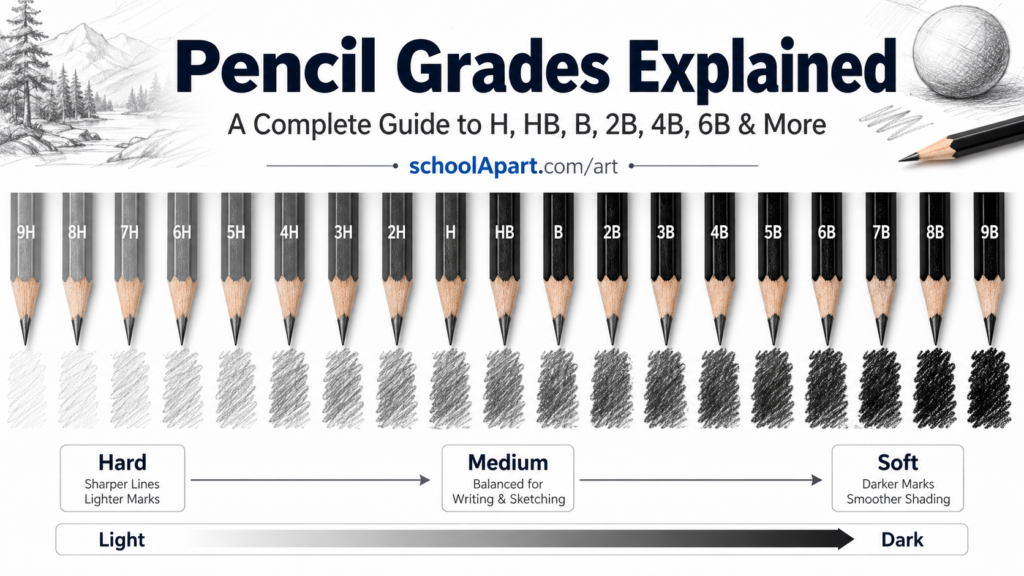
- A complete pencil grades chart
- Which pencil is best for different drawing styles
- How beginners should choose their first drawing pencils
Let’s begin by understanding the pencil grading system.
What Are Pencil Grades?
Pencil grades indicate how hard or soft the graphite core inside a pencil is.
The hardness of the graphite determines two important things:
- How dark the pencil writes or draws
- How hard the pencil feels on paper
Hard pencils leave lighter, finer marks, while soft pencils create darker, smoother lines.
This grading system is used by artists, designers, architects, engineers, and students all over the world.
What Do H, HB, and B Mean?
The letters on a pencil represent its hardness or blackness.
H = Hard
“H” stands for Hard.
Hard pencils contain more clay and less graphite.
Characteristics:
- Light gray lines
- Sharp points
- Less smudging
- Excellent for technical drawing
- Perfect for outlines and fine details
Examples:
- H
- 2H
- 4H
- 6H
- 9H
As the number before “H” increases, the pencil becomes harder and produces lighter lines.
B = Black
“B” stands for Black.
These pencils contain more graphite and less clay.
Characteristics:
- Darker lines
- Softer lead
- Easier shading
- Rich contrast
- Smooth drawing experience
Examples:
- B
- 2B
- 4B
- 6B
- 8B
- 9B
The higher the number before “B”, the softer and darker the pencil becomes.
HB = Hard Black
HB sits almost exactly in the middle of the grading scale.
It offers a balance between hardness and darkness.
Characteristics:
- Medium-dark lines
- Easy to erase
- Suitable for writing
- Good for everyday sketching
- Ideal for beginners
This is why most school pencils are HB pencils.
Understanding the Pencil Hardness Scale
The graphite grading system runs from very hard to very soft.
| Grade | Hardness | Darkness | Best For |
|---|---|---|---|
| 9H | Extremely Hard | Very Light | Technical drawing |
| 8H | Very Hard | Very Light | Precise details |
| 7H | Very Hard | Light | Engineering work |
| 6H | Hard | Light | Fine lines |
| 5H | Hard | Light | Accurate outlines |
| 4H | Medium Hard | Light | Architectural sketches |
| 3H | Medium Hard | Light | Construction lines |
| 2H | Slightly Hard | Light | Initial sketches |
| H | Hard | Light Gray | Clean outlines |
| F | Fine Point | Medium Light | Writing & sketching |
| HB | Medium | Medium | School work & beginners |
| B | Soft | Medium Dark | Sketching |
| 2B | Softer | Dark | General drawing |
| 3B | Soft | Darker | Portraits |
| 4B | Soft | Very Dark | Shading |
| 5B | Softer | Very Dark | Artistic sketches |
| 6B | Very Soft | Rich Black | Deep shadows |
| 7B | Very Soft | Richer Black | Expressive artwork |
| 8B | Extremely Soft | Almost Black | Dramatic shading |
| 9B | Softest | Deepest Black | Maximum contrast |
Understanding the Pencil Grade Order
The grading scale follows a simple pattern.
Hardest
9H → 8H → 7H → 6H → 5H → 4H → 3H → 2H → H
↓
F
↓
HB
↓
B → 2B → 3B → 4B → 5B → 6B → 7B → 8B → 9B
Softest
The farther you move toward H, the lighter and harder the pencil becomes.
The farther you move toward B, the darker and softer the pencil becomes.
What Is the “F” Pencil?
Many beginners notice a pencil marked F and wonder what it means.
The letter F stands for Fine Point.
An F pencil is designed to keep a sharp point for longer than HB while still producing slightly darker lines than H pencils.
It is commonly used for:
- Everyday writing
- Fine sketching
- Technical drawing
- Light illustrations
Although less common than HB, F pencils are appreciated by artists who need precise, clean lines.
Which Pencil Grade Should Beginners Use?
If you’re just starting your drawing journey, you don’t need to buy every pencil grade.
A small set containing the following grades is enough for most beginner projects:
- HB
- 2B
- 4B
- 6B
These four pencils allow you to create:
- Light outlines
- Medium shading
- Dark shadows
- High-contrast drawings
As your skills improve, you can gradually add H pencils for cleaner construction lines and softer B pencils for richer shading.
When Should You Use Each Pencil Grade?
Different drawing tasks require different pencil grades.
H and 2H
Best for:
- Construction lines
- Technical drawings
- Geometry
- Fine details
- Initial sketches
HB
Best for:
- School work
- Everyday writing
- Beginner drawing
- Simple sketches
- Practice exercises
2B
Best for:
- General sketching
- Cartoon drawing
- Nature drawing
- Portrait outlines
- Everyday artwork
4B
Best for:
- Smooth shading
- Creating depth
- Hair drawing
- Landscape sketches
- Portraits
6B
Best for:
- Deep shadows
- Dramatic contrast
- Realistic drawings
- Professional sketching
- Artistic expression
8B–9B
Best for:
- Extremely dark areas
- High-contrast artwork
- Bold artistic effects
These pencils are very soft and should be used carefully because they smudge more easily.
Best Pencil Grades for Different Types of Drawing
Not every drawing requires the same pencil. Choosing the right pencil grade depends on what you want to draw and the level of detail you need. Professional artists often use multiple pencil grades in a single artwork to create smooth transitions from light to dark.
Below are some recommendations for different drawing styles.
Pencil Grades for Sketching
Sketching is usually the first step before creating a detailed drawing. The goal is to capture shapes, proportions, and ideas without making heavy marks.
Recommended Grades
- HB
- B
- 2B
Why?
These pencils create medium-dark lines that are easy to erase and adjust while you work.
Pencil Grades for Shading
Shading creates depth, volume, and realism.
Soft pencils are the best choice because they produce rich, smooth tones.
Recommended Grades
- 2B
- 4B
- 6B
- 8B
Artists often combine several grades to achieve gradual transitions between light and dark areas.
Pencil Grades for Portrait Drawing
Portraits require both precision and smooth shading.
A combination of hard and soft pencils works best.
Recommended Grades
- H or HB for outlines
- 2B for facial features
- 4B for hair
- 6B for shadows
- 8B for deep contrast
Professional portrait artists rarely use only one pencil grade.
Pencil Grades for Landscape Drawing
Landscape drawings include trees, mountains, rivers, clouds, and buildings.
Different textures require different pencils.
Recommended Grades
- HB for basic outlines
- 2B for trees
- 4B for rocks
- 6B for dark shadows
Pencil Grades for Cartoon Drawing
Cartoon illustrations need clean outlines and bold shapes.
Recommended Grades
- HB
- B
- 2B
If you plan to color your cartoons later, avoid using extremely dark pencils for the outlines.
Pencil Grades for Technical Drawing
Technical drawings require accuracy rather than artistic shading.
Recommended Grades
- 2H
- H
- F
These pencils keep a sharp point for a long time and create clean, precise lines.
Pencil Grades for School Students
Students usually don’t need an expensive drawing kit.
A basic set is enough.
Recommended Starter Set
- HB
- 2B
- 4B
- 6B
This combination covers almost every beginner drawing exercise.
H vs B Pencils: What’s the Difference?
Many beginners are confused by the letters H and B.
Here’s a simple comparison.
| Feature | H Pencil | B Pencil |
|---|---|---|
| Meaning | Hard | Black |
| Graphite | Less | More |
| Clay | More | Less |
| Line Color | Light | Dark |
| Smudging | Very Low | Higher |
| Best For | Outlines & technical work | Sketching & shading |
| Erasing | Easy | Slightly harder |
| Texture | Firm | Smooth |
Which One Should You Choose?
Choose H pencils if you want:
- Precise lines
- Technical drawings
- Architectural sketches
- Construction lines
Choose B pencils if you want:
- Dark drawings
- Smooth shading
- Portraits
- Realistic artwork
HB vs 2B vs 4B vs 6B
These four pencil grades are the most popular among beginner artists.
HB Pencil
Ideal for:
- Writing
- School work
- Practice sketches
- Light outlines
Advantages:
- Easy to erase
- Balanced hardness
- Affordable
- Suitable for everyday use
2B Pencil
Ideal for:
- Sketching
- Cartoon drawing
- Basic shading
Advantages:
- Slightly darker
- Smooth drawing
- Beginner-friendly
Many artists consider the 2B pencil the perfect all-round drawing pencil.
4B Pencil
Ideal for:
- Portraits
- Hair
- Nature drawings
- Smooth shading
Advantages:
- Rich black tones
- Excellent blending
- Better depth
6B Pencil
Ideal for:
- Dramatic shadows
- Professional sketching
- High contrast
- Realistic artwork
Advantages:
- Very soft
- Extremely dark
- Excellent for expressive drawings
Which Pencil Should You Buy First?
If you’re buying your first drawing pencils, keep it simple.
Option 1 – Best for Complete Beginners
- HB
- 2B
Perfect for:
- School students
- Children
- Everyday practice
Option 2 – Best Beginner Drawing Kit
- HB
- 2B
- 4B
- 6B
This combination allows you to create almost every type of beginner artwork.
Option 3 – Best Intermediate Set
- 2H
- H
- HB
- B
- 2B
- 4B
- 6B
- 8B
Ideal for students who want to improve their drawing skills.
Common Mistakes Beginners Make
Choosing the wrong pencil isn’t the only mistake new artists make.
Here are some common problems to avoid.
Using Only One Pencil Grade
Many beginners try to complete an entire drawing using only an HB pencil.
Instead, use different grades to create contrast and depth.
Pressing Too Hard
Pressing hard with the pencil can damage the paper and make erasing difficult.
Use light pressure and build up darker tones gradually.
Ignoring Hard Pencils
Some beginners think only soft pencils are useful.
Hard pencils are excellent for planning, construction lines, and fine details.
Buying Too Many Pencils
A large pencil collection won’t automatically improve your drawings.
Master a few grades before expanding your toolkit.
Not Practicing Shading
Owning 6B or 8B pencils won’t help if you don’t practice blending and shading techniques regularly.
Tips for Choosing Drawing Pencils
Keep these simple tips in mind before buying drawing pencils.
- Start with a small pencil set.
- Choose good-quality graphite pencils.
- Keep your pencils sharp.
- Practice with multiple grades.
- Experiment with shading techniques.
- Store pencils in a protective case.
- Replace damaged pencils when necessary.
Recommended Pencil Sets for Beginners
Although many brands manufacture excellent drawing pencils, beginners should focus on quality rather than brand names.
A good beginner set should include:
- HB
- 2B
- 4B
- 6B
Optional additions:
- H
- 2H
- 8B
This range provides enough flexibility for sketches, portraits, landscapes, cartoon drawings, and school art projects.
Pencil Grades Cheat Sheet
Need a quick reference? Use this simple guide whenever you’re choosing a drawing pencil.
| Pencil Grade | Hardness | Darkness | Best Use |
|---|---|---|---|
| 9H–6H | Extremely Hard | Very Light | Engineering, technical drawing |
| 5H–3H | Hard | Light | Construction lines, fine details |
| 2H–H | Slightly Hard | Light Gray | Initial sketches, outlines |
| F | Fine Point | Medium Light | Writing, neat sketching |
| HB | Medium | Medium Gray | Everyday writing, beginner drawing |
| B | Soft | Medium Dark | Sketching |
| 2B | Soft | Dark | General drawing, cartoons |
| 3B–4B | Softer | Dark | Portraits, shading |
| 5B–6B | Very Soft | Very Dark | Deep shadows, realistic art |
| 7B–9B | Extremely Soft | Deepest Black | Dramatic contrast, expressive artwork |
Pro Tips for Using Drawing Pencils
Professional artists don’t rely on just one pencil. They combine different grades to create realistic drawings with depth and texture.
Here are a few simple tips:
- Start every drawing with an H or HB pencil.
- Use 2B for general sketching and darker outlines.
- Add 4B for smooth shading and realistic textures.
- Use 6B or 8B only for the darkest shadows.
- Keep your pencils sharp for clean lines.
- Shade gently instead of pressing hard.
- Blend gradually to create smooth transitions.
- Practice with different pencil grades to understand their unique characteristics.
Remember, your skill improves through practice—not by owning the most expensive pencils.
Understanding pencil grades is one of the first and most important lessons every artist should learn. Knowing the difference between H, HB, and B pencils helps you choose the right tool for sketching, shading, portraits, landscapes, cartoons, and technical drawings.
For most beginners, a simple set containing HB, 2B, 4B, and 6B pencils is enough to complete a wide variety of drawing projects. As your confidence grows, you can gradually add harder and softer grades to expand your artistic possibilities.
Drawing is not about using the “perfect” pencil—it’s about learning when and how to use each pencil effectively. Keep practicing, experiment with different grades, and don’t be afraid to make mistakes. Every sketch brings you one step closer to becoming a better artist.
Frequently Asked Questions (FAQ)
1. What do pencil grades mean?
Pencil grades indicate the hardness and darkness of a graphite pencil. Hard pencils make lighter lines, while soft pencils produce darker lines.
2. What does “H” mean on a pencil?
“H” stands for Hard. H pencils contain more clay, produce lighter marks, and are ideal for technical drawing and fine details.
3. What does “B” mean on a pencil?
“B” stands for Black. B pencils contain more graphite, create darker lines, and are perfect for sketching and shading.
4. What is an HB pencil?
An HB pencil offers a balanced combination of hardness and darkness. It is commonly used for writing, schoolwork, and beginner drawing.
5. What does “F” mean on a pencil?
“F” stands for Fine Point. It keeps a sharp point longer than HB and is suitable for writing and precise sketching.
6. Which pencil is best for beginners?
Most beginners should start with HB, 2B, 4B, and 6B pencils. This small set is enough for outlines, sketching, shading, and simple artwork.
7. Which pencil is best for sketching?
A 2B pencil is one of the best choices for sketching because it creates smooth, dark lines while remaining easy to control.
8. Which pencil is best for shading?
For shading, 4B, 6B, and 8B pencils are excellent because they produce rich, dark tones and blend smoothly.
9. Is 2B darker than HB?
Yes. A 2B pencil is softer and produces darker lines than an HB pencil.
10. Which pencil is darker: 4B or 6B?
A 6B pencil is softer and darker than a 4B pencil, making it ideal for creating deep shadows.
11. Can I draw using only an HB pencil?
Yes. You can create many drawings using only an HB pencil. However, adding 2B and 4B pencils gives you more shading options and better contrast.
12. Which pencils do professional artists use?
Professional artists often use a wide range of grades, from 2H for construction lines to 8B or 9B for rich, dark shading.
13. Are expensive pencils better?
High-quality pencils often provide smoother graphite and more consistent performance, but beginners can learn effectively with affordable, reputable brands.
14. How many drawing pencils do I really need?
A set of four pencils (HB, 2B, 4B, and 6B) is sufficient for most beginners and school students.
15. How can I improve my pencil drawing skills?
Practice regularly, observe real objects, experiment with different pencil grades, learn shading techniques, and draw from simple shapes before attempting complex subjects.
Key Takeaways
- Pencil grades indicate graphite hardness and darkness.
- H pencils are harder and create lighter lines.
- B pencils are softer and create darker lines.
- HB is the most versatile pencil for beginners.
- A four-pencil set (HB, 2B, 4B, and 6B) is enough to start learning.
- Different pencil grades help create depth, contrast, and realistic artwork.
- Regular practice is more important than owning many pencils.




Leave a Reply