

Learn what contour drawing is, how it works, and how beginners can practice contour drawing with simple exercises to improve observation and drawing skills.
Contour Drawing for Beginners: What It Is and How to Practice
Contour drawing is useful for beginners because it encourages careful observation. Rather than drawing what you think an object looks like, you learn to look closely at its actual shape.
✏️ What Is Contour Drawing?
Contour drawing is a drawing technique that focuses on the visible edges and outlines of a subject.
Instead of concentrating on shading, color, or small details, you mainly observe the shape and follow its edges with your pencil or drawing tool.
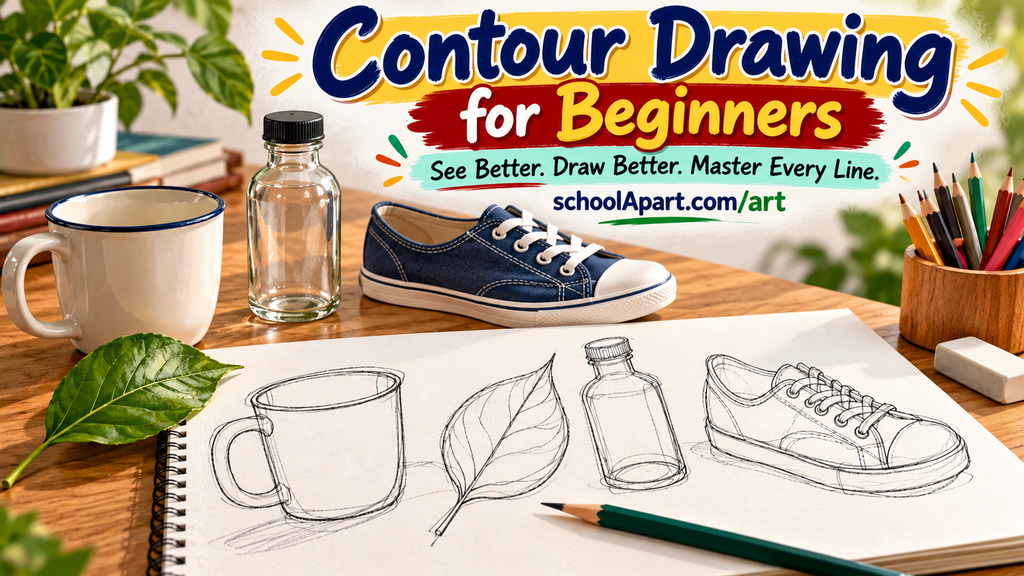
For example, if you are drawing a cup, you can carefully follow:
- The outer edge of the cup
- The rim
- The handle
- The curves and changes in direction
The goal is not necessarily to create a highly detailed finished drawing. The goal is to train your eyes and hand to work together.
🎨 How Does Contour Drawing Work?
Contour drawing is based on a simple idea:
Look carefully → Follow the visible edge → Draw what you see
You can start with a simple object and slowly trace its visible contours with your eyes while drawing them with your pencil.
This process helps you pay attention to:
- Shape
- Curves
- Angles
- Edges
- Proportion
- Relationships between different parts
With regular practice, these observation skills can become useful in many other types of drawing.
🔍 Contour Drawing vs Outline Drawing
Contour drawing and outline drawing are closely related, but they are not always exactly the same.
Outline Drawing
An outline drawing usually focuses on the outer boundary of an object.
Contour Drawing
Contour drawing can focus on the outer edges as well as important visible edges and changes within the subject.
For example, when drawing a shoe, contour drawing may include:
- Outer shape
- Sole
- Opening
- Seams
- Important changes in surface direction
Contour drawing is therefore more about careful observation of edges than simply making an outline.
📝 Why Is Contour Drawing Good for Beginners?
Contour drawing is a useful beginner exercise for several reasons.
👀 1. Improves Observation
You have to look carefully at the subject instead of relying on memory.
✋ 2. Builds Hand-Eye Coordination
Your eyes observe the subject while your hand translates those observations into lines.
📏 3. Helps Understand Proportion
Carefully following edges can help you notice differences in length, width, height, and angle.
✏️ 4. Improves Line Control
Regular practice can make your pencil movements more deliberate.
🧠 5. Reduces Overthinking
Contour exercises encourage you to focus on what you actually see rather than trying to make the drawing perfect immediately.
✏️ How to Do Contour Drawing Step by Step
Follow these simple steps if you are new to contour drawing.
Step 1: Choose a Simple Object
Start with something easy.
Good choices include:
- Cup
- Bottle
- Spoon
- Leaf
- Shoe
- Simple toy
- Plant
- Book
Avoid complicated subjects when you are just starting.
Step 2: Place the Object in Front of You
Put the object somewhere you can clearly see it.
Try to keep the object still.
Good lighting can make its edges easier to observe.
Step 3: Observe Before Drawing
Spend a little time looking at the object.
Notice:
- Where the shape begins
- Where it curves
- Where it changes direction
- Which parts are wider or narrower
- How different parts connect
Do not rush into drawing.
Step 4: Start With a Light Line
Place your pencil lightly on the paper.
Begin at one point on the object’s edge.
You can start at the top, bottom, or another easy point.
Step 5: Follow the Contour
Slowly move your pencil while carefully observing the edge of the object.
Try to match:
- Curves
- Angles
- Direction changes
- Lengths
- Connections
Do not worry if the first attempt is imperfect.
Step 6: Add Important Internal Contours
Once you are comfortable with the outer contour, look for important lines inside the object.
For example, a cup may have:
- Rim
- Handle
- Base
- Internal curves
Only include the edges that help describe the object’s structure.
Step 7: Compare Your Drawing
When you finish, compare the drawing with the real object.
Ask:
- Is the shape too wide?
- Is it too narrow?
- Are the curves correct?
- Are the parts positioned correctly?
- Did I miss an important edge?
Use this comparison to improve your next attempt.
🎯 Easy Contour Drawing Exercises for Beginners
You do not need special art supplies to practice contour drawing.
A pencil and paper are enough.
Exercise 1: Draw a Cup
Place a cup in front of you.
Focus on:
- Rim
- Outer curves
- Handle
- Base
Try drawing the complete contour without worrying about shading.
Exercise 2: Draw a Leaf
A leaf is excellent for beginners.
Observe:
- Outer edge
- Curves
- Tip
- Stem
- Veins
Start with the outside shape and then add a few important internal lines.
Exercise 3: Draw a Shoe
Shoes have many useful contours.
Look at:
- Sole
- Toe
- Opening
- Laces
- Seams
Do not try to draw every small detail. Focus on the most important visible edges.
Exercise 4: Draw a Simple Plant
Choose a small plant with clearly visible leaves.
Focus on:
- Leaf edges
- Stem
- Curves
- Overlapping shapes
This is a good exercise for learning how contours change from one part of a subject to another.
Exercise 5: Blind Contour Drawing
Blind contour drawing is a more challenging variation.
In this exercise, you look mainly at the object instead of constantly looking at your paper while drawing.
The purpose is not to create a perfect picture.
The purpose is to improve:
- Observation
- Concentration
- Hand-eye coordination
- Patience
Start with very simple objects before trying people, hands, or complicated subjects.
🧠 What Is Blind Contour Drawing?
Blind contour drawing is a practice method where you focus your eyes on the subject while drawing its contours with minimal attention to the paper.
Because you are not constantly checking your drawing, the final result may look unusual.
That is completely normal.
The exercise is about observation and coordination, not perfection.
✏️ Contour Drawing Tips for Beginners
1. 👀 Look More Than You Draw
Spend plenty of time observing the subject.
2. 🐢 Draw Slowly
Slow drawing can help you notice small changes in direction and shape.
3. ✋ Keep Your Hand Relaxed
Do not grip the pencil too tightly.
4. ✏️ Use Light Lines
Light lines make it easier to correct mistakes.
5. 📐 Pay Attention to Angles
A small change in an angle can affect the overall appearance of an object.
6. 🔄 Compare Often
Look at your subject and drawing regularly.
7. ❌ Don’t Chase Perfection
The purpose of practice is to improve observation.
8. 🔁 Repeat the Same Object
Drawing the same object several times can help you notice improvement.
🚫 Common Contour Drawing Mistakes
Mistake 1: Drawing From Memory
If you stop observing and draw from memory, the shape may become inaccurate.
Better approach: Keep looking at the subject.
Mistake 2: Drawing Too Quickly
Fast lines can miss important curves and changes.
Better approach: Slow down and follow the contour carefully.
Mistake 3: Adding Too Many Details
Beginners sometimes try to draw every small mark.
Better approach: Start with the most important contours.
Mistake 4: Pressing Too Hard
Heavy lines can make corrections difficult.
Better approach: Start with light pencil pressure.
Mistake 5: Erasing Every Mistake
Trying to make every line perfect can interrupt the learning process.
Better approach: Keep practicing and compare each attempt.
🖼️ Contour Drawing and Other Drawing Skills
Contour drawing is not a separate skill that you have to learn in isolation.
It can support other drawing skills.
Contour Drawing + Basic Shapes
Basic shapes help you understand simple forms, while contour drawing helps you observe their visible edges.
Contour Drawing + Proportion
Careful observation of contours can help you understand the size and position of different parts.
Contour Drawing + Negative Space
Looking at both contours and the empty spaces around a subject can improve observation and accuracy.
Contour Drawing + Object Sketching
Contour practice is useful when learning to sketch real objects from observation.
⏱️ A Simple 15-Minute Contour Drawing Practice
You can create a short daily routine.
5 Minutes — Observe
Choose an object and study its shape.
5 Minutes — Draw
Follow its contours slowly.
5 Minutes — Review
Compare your drawing with the object and identify areas to improve.
You can repeat this exercise with a different object each day.
🎯 Easy Contour Drawing Subjects
If you do not know what to draw, try:
- ☕ Cup
- 🥄 Spoon
- 🍎 Apple
- 🍃 Leaf
- 🧴 Bottle
- 👟 Shoe
- 📚 Book
- ✂️ Scissors
- 🪴 Small plant
- 🧸 Simple toy
Start with simple objects and gradually move to more complex subjects.
🌟 How to Improve Your Contour Drawing
The best way to improve is to practice observation consistently.
Try these habits:
- Draw for 10–15 minutes regularly.
- Use real objects instead of only copying pictures.
- Practice both outer and important internal contours.
- Try blind contour exercises occasionally.
- Repeat familiar objects.
- Compare your drawings over time.
- Do not worry about making every drawing perfect.
Remember that contour drawing is primarily an observation exercise.
Contour drawing is a simple but powerful way to practice drawing.
By focusing on the visible edges of an object, you learn to observe its shape, curves, angles, and proportions more carefully.
You do not need expensive supplies or advanced drawing skills to begin.
Start with a cup, leaf, bottle, or another simple object. Spend a few minutes observing it, then slowly follow its contours with your pencil.
With regular practice, contour drawing can become a useful foundation for sketching, object drawing, and other forms of observational art.
Look carefully, draw slowly, and let your eyes guide your hand.
❓ FAQ
1. What is contour drawing?
Contour drawing is a drawing technique that focuses on observing and drawing the visible edges of a subject.
2. Is contour drawing good for beginners?
Yes. It is a useful beginner exercise for improving observation, line control, and hand-eye coordination.
3. What should I draw for contour practice?
Simple objects such as cups, leaves, bottles, shoes, books, and plants are good choices.
4. What is blind contour drawing?
Blind contour drawing is an exercise where you focus mainly on the subject while drawing its contours with minimal attention to the paper.
5. Does contour drawing improve observation?
Yes. It encourages you to study the actual edges, curves, and proportions of a subject.
6. What materials do I need for contour drawing?
A pencil and drawing paper are enough for beginners.
7. What is the difference between contour drawing and outline drawing?
Outline drawing usually focuses on the outer boundary, while contour drawing can include important visible edges and internal contours.
8. Should I use shading in contour drawing?
Shading is usually not the main focus. Beginners should concentrate on contours and observation first.
9. How long should I practice contour drawing?
A 10–15 minute practice session can be enough for beginners.
10. Can contour drawing improve sketching?
Yes. It can strengthen observation and line-control skills that are useful for sketching.
11. Can I practice contour drawing from photographs?
Yes, but practicing with real objects can provide stronger observation practice because you can study the subject directly.
12. Should contour drawing lines be light or dark?
Beginners should generally start with light lines so they can make adjustments easily.
13. Can contour drawing help with proportion?
Yes. Carefully observing contours can help you notice differences in size, width, height, and angles.
14. Is blind contour drawing supposed to look accurate?
Not necessarily. Blind contour drawing is primarily an observation and coordination exercise.
15. How can I get better at contour drawing?
Practice regularly, observe carefully, draw slowly, use simple objects, and compare your drawings with the real subjects.




Leave a Reply