

Learn what gesture drawing is, why it is useful, and how beginners can practice simple gesture drawing exercises to capture movement, pose, and action.
✏️ What Is Gesture Drawing?
Gesture drawing is a drawing practice that focuses on movement, action, pose, and the overall flow of a subject.
Instead of trying to draw every detail, you quickly capture the main movement and structure of what you see.
For example, when drawing a person walking, you do not need to start with the eyes, fingers, clothing, or small details.
Instead, you focus on:
- The direction of the body
- The main action
- The position of the arms and legs
- The balance of the body
- The overall flow of the pose
The goal is to make the drawing feel active and natural, rather than perfectly detailed.
🎨 Why Is Gesture Drawing Important?
Gesture drawing is especially useful when learning to draw people and moving subjects.
1. 🏃 Captures Movement
Gesture drawing helps you show what a subject is doing rather than simply what it looks like.
2. 👀 Improves Observation
You learn to quickly identify the most important visual information.
3. ✋ Improves Hand-Eye Coordination
Your eyes observe the pose while your hand quickly records it.
4. 🧍 Helps With Figure Drawing
Gesture practice can help you understand the overall structure and movement of the human body.
5. ✏️ Reduces Overfocus on Details
Beginners often spend too much time on small details.
Gesture drawing teaches you to capture the bigger idea first.
🔍 Gesture Drawing vs Contour Drawing
Gesture drawing and contour drawing are both useful observation exercises, but they have different goals.
Contour Drawing
Contour drawing focuses mainly on:
- Edges
- Outlines
- Curves
- Visible contours
Gesture Drawing
Gesture drawing focuses mainly on:
- Movement
- Action
- Pose
- Flow
- Direction
For example:
Contour drawing asks:
“What does the edge of this subject look like?”
Gesture drawing asks:
“How is this subject moving or positioned?”
Contour Drawing for Beginners: What It Is and How to Practice
Both skills can complement each other.
🧠 What Should You Look for in a Gesture Drawing?
When looking at a subject, do not try to notice everything.
Focus on the major visual information.
Look for:
- Main direction of movement
- Body angle
- Spine or central flow
- Position of the shoulders
- Position of the hips
- Direction of the arms
- Direction of the legs
- Overall balance
These elements can help you understand the pose quickly.
✏️ How to Do Gesture Drawing Step by Step
You can start with simple poses.
Step 1: Choose a Subject
You can practice with:
- A person walking
- A person sitting
- A person running
- A person stretching
- A person jumping
- An animal moving
For beginners, start with simple poses.
Step 2: Observe the Overall Pose
Before drawing, look at the subject for a few seconds.
Ask:
What is the main action?
Is the person:
- Standing?
- Walking?
- Sitting?
- Reaching?
- Jumping?
- Bending?
Understanding the action helps you avoid getting distracted by details.
Step 3: Find the Main Line of Action
The line of action is an imaginary line that represents the main flow or movement of a pose.
It does not need to follow the exact outline of the body.
For example:
A running pose may have a strong forward curve.
A standing pose may have a more vertical direction.
A bending pose may have a curved line through the body.
Start your gesture drawing by thinking about this overall movement.
Step 4: Add the Main Body Structure
Once you understand the movement, lightly indicate the major body areas.
You can use simple shapes for:
- Head
- Ribcage
- Pelvis
- Arms
- Legs
Do not add details yet.
Step 5: Show the Direction of the Limbs
Look at the direction of the:
- Upper arms
- Forearms
- Thighs
- Lower legs
Use simple lines to show their movement.
The goal is to communicate the pose quickly.
Step 6: Check the Balance
Ask:
- Which direction is the body leaning?
- Where is the weight?
- Which leg supports the body?
- Are the arms balanced?
- Does the pose feel natural?
These questions help make the gesture more believable.
Step 7: Stop Before Adding Too Many Details
Gesture drawing is usually quick.
Once the movement and pose are clear, stop.
The exercise is successful if someone can understand the action from the drawing.
⏱️ Gesture Drawing Time Limits
One useful way to practice gesture drawing is to use short time limits.
30 Seconds
Focus only on:
- Movement
- Main direction
- Basic pose
1 Minute
Add:
- Main body structure
- Arms
- Legs
2 Minutes
Add a little more:
- Body proportions
- Major shapes
- Important structural details
5 Minutes
You can include more structure while still keeping the drawing focused on the pose.
Beginners can start with 30-second and 1-minute exercises.
📝 Easy Gesture Drawing Exercises for Beginners
Exercise 1: Standing Pose
Choose a simple standing pose.
Focus on:
- Head position
- Spine direction
- Shoulder angle
- Hip angle
- Leg direction
Try to complete the drawing in one or two minutes.
Exercise 2: Walking Pose
Walking is a useful gesture exercise because the body is clearly moving.
Look for:
- Direction of the torso
- Position of the arms
- Position of the legs
- Weight distribution
Do not worry about clothing details.
Exercise 3: Sitting Pose
Sitting poses can help you understand how the body folds and changes direction.
Focus on:
- Back angle
- Hip position
- Thigh direction
- Lower-leg direction
Exercise 4: Running Pose
Running provides a strong sense of movement.
Focus on:
- Main line of action
- Lean of the body
- Arm movement
- Leg movement
Try several quick versions rather than one highly detailed drawing.
Exercise 5: Stretching Pose
A stretching pose can help you practice long curves and extended limbs.
Look for the overall flow of the body rather than individual details.
🧍 Gesture Drawing for Human Figure Practice
Gesture drawing is often used as an early stage of figure drawing.
A useful process is:
Gesture → Basic Structure → Proportion → Details
Gesture
Capture movement and pose.
Basic Structure
Add simple forms for the head, torso, pelvis, arms, and legs.
Proportion
Check the relative size of different body parts.
Details
Add features, clothing, hair, and other details only after the structure works.
This approach can make figure drawing less overwhelming for beginners.
✏️ Gesture Drawing Without Details
One of the biggest mistakes beginners make is trying to create a finished drawing immediately.
Gesture drawing works differently.
A simple drawing with:
- One line for movement
- A basic head
- Simple torso
- Simple limbs
can communicate a pose surprisingly well.
The important question is:
Does the drawing communicate the action?
If yes, the gesture is doing its job.
🚫 Common Gesture Drawing Mistakes
1. Focusing on Details Too Early
Beginners may start with eyes, fingers, clothes, or hair.
Better approach: Start with movement and structure.
2. Drawing Too Slowly
Gesture drawing is usually about capturing the pose quickly.
Better approach: Use short time limits.
3. Ignoring the Line of Action
Without understanding the overall movement, a pose can feel stiff.
Better approach: Identify the main direction first.
4. Making Every Body Part Equally Important
The purpose of gesture drawing is not to finish every part.
Better approach: Capture the overall pose first.
5. Trying to Make Every Line Perfect
Gesture drawing is practice, not a final polished artwork.
Better approach: Use confident, simple lines.
6. Ignoring Weight and Balance
A figure may look unnatural if the body does not appear to support itself.
Better approach: Notice where the body weight seems to be placed.
🎯 How to Improve Your Gesture Drawing
👀 Observe Before Drawing
Take a few seconds to understand the pose.
✏️ Use Simple Lines
Do not overcomplicate the first stage.
⏱️ Practice With Time Limits
Short exercises train you to identify important information quickly.
🔄 Draw the Same Pose More Than Once
Each attempt can help you notice something new.
🧍 Practice Different Actions
Do not practice only standing poses.
Try:
- Walking
- Running
- Sitting
- Bending
- Stretching
- Jumping
📝 Review Your Drawings
Ask:
- Does the pose feel natural?
- Is the movement clear?
- Is the body leaning correctly?
- Did I capture the main action?
📅 A Simple 15-Minute Gesture Drawing Routine
You can practice gesture drawing without spending a long time.
5 Minutes — Quick Poses
Draw several 30-second poses.
5 Minutes — One-Minute Poses
Focus on movement plus basic body structure.
5 Minutes — Longer Pose
Choose one pose and spend a few minutes improving the structure while keeping the gesture clear.
This routine can be repeated regularly.
🎨 Gesture Drawing for Animals and Other Subjects
Gesture drawing is not limited to people.
You can also use it for:
🐕 Animals
Focus on:
- Spine direction
- Head position
- Leg movement
- Overall body flow
🌳 Plants
Observe the direction and movement of stems and branches.
🏃 Sports Actions
Running, jumping, throwing, and kicking are useful gesture subjects.
🚗 Moving Objects
You can even study the direction and flow of moving objects.
The basic idea remains the same:
Capture the overall action before the details.
🧠 Gesture Drawing and Other Drawing Skills
Gesture drawing connects naturally with several other drawing skills.
Gesture + Contour
Gesture captures movement, while contour focuses on visible edges.
Gesture + Proportion
After capturing the pose, proportion helps you check the size relationships between body parts.
Gesture + Basic Shapes
Simple shapes can help you build the body after the gesture is established.
Gesture + Composition
The position and movement of a figure can affect the overall composition of a drawing.
These skills can therefore be practiced together as you progress.
🌟 Beginner Tips
Remember these simple rules:
- Look before drawing.
- Find the main movement.
- Start with simple lines.
- Use short time limits.
- Ignore small details at first.
- Think about balance and weight.
- Practice different poses.
- Do not worry about perfect drawings.
- Repeat exercises regularly.
- Focus on capturing the action.
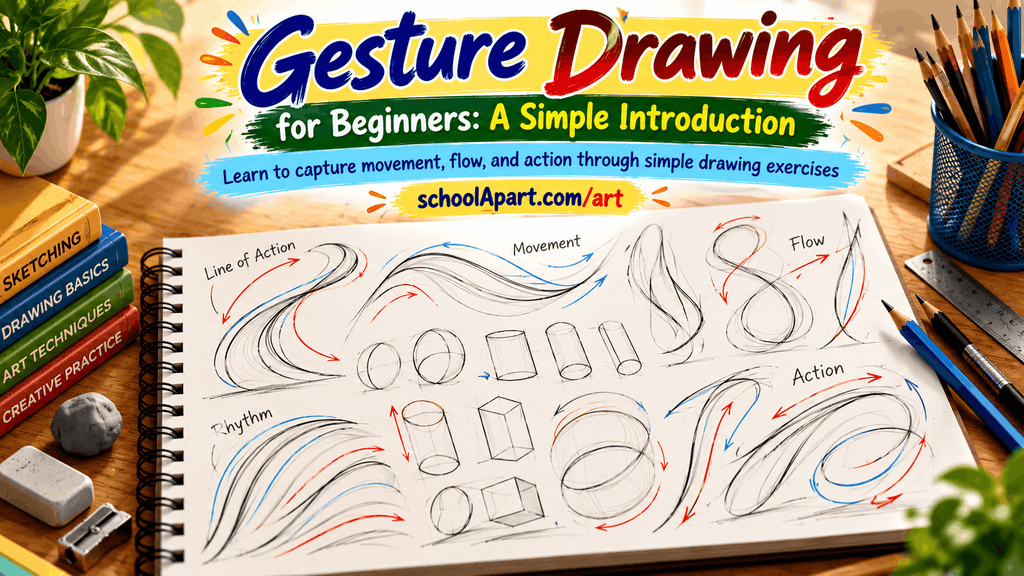
Gesture drawing is a useful way to learn how to capture movement, action, pose, and energy in a drawing.
It is especially valuable for students who want to learn figure drawing, but the basic idea can also be applied to animals, sports, and other moving subjects.
You do not need advanced drawing skills to start.
Choose a simple pose, observe the main movement, draw a few simple lines, and try to capture the action quickly.
With regular practice, gesture drawing can help you become a more confident and observant artist.
Don’t try to draw everything. First, learn to capture what the subject is doing.
❓ FAQ
1. What is gesture drawing?
Gesture drawing is a quick drawing practice that focuses on movement, action, pose, and the overall flow of a subject.
2. Is gesture drawing good for beginners?
Yes. It is a useful practice for improving observation, movement, hand-eye coordination, and figure-drawing skills.
3. What is a line of action in gesture drawing?
A line of action is an imaginary line that represents the main flow or movement of a pose.
4. How long should a gesture drawing take?
Beginners can start with 30-second or 1-minute gesture drawings and gradually move to longer poses.
5. What should I focus on in gesture drawing?
Focus on movement, pose, balance, body direction, and the overall action rather than small details.
6. What is the difference between gesture drawing and contour drawing?
Gesture drawing focuses on movement and action, while contour drawing focuses mainly on visible edges and contours.
7. Can gesture drawing help with figure drawing?
Yes. Gesture drawing is often used as an early step before adding body structure, proportion, and details.
8. Do I need special materials for gesture drawing?
No. A pencil and paper are enough for beginners.
9. Can I practice gesture drawing from photographs?
Yes. Photographs can provide useful pose references, especially for beginners.
10. Can I practice gesture drawing with animals?
Yes. Gesture drawing can be used to capture the movement and body flow of animals.
11. Why does my gesture drawing look stiff?
A stiff gesture may result from focusing too much on details or ignoring the main movement of the pose.
12. Should gesture drawings have details?
Details are usually not the main goal. Beginners should focus on movement and structure first.
13. How can I improve my gesture drawing?
Practice regularly, use short time limits, study different poses, and focus on the main line of action.
14. What is a good gesture drawing exercise?
Drawing several 30-second or 1-minute poses is a simple and effective beginner exercise.
15. Can gesture drawing improve observation skills?
Yes. It trains you to quickly identify the most important visual information in a pose.




Leave a Reply