

Learn about abacus beads and their functions, including upper and lower beads, place values, and how beads represent numbers on different abacus types.
Abacus Beads and Their Functions Explained
An abacus is a mathematical learning tool that uses beads to represent numbers and perform calculations. By moving beads along rods or wires, learners can understand number values, place value, addition, subtraction, and other mathematical operations.
But what do the beads on an abacus actually do? Why do some abacuses have different numbers of beads on each rod? And why does a bead sometimes represent one unit while another bead represents five units?
The answers depend on the type of abacus you use.
In this beginner-friendly guide, you will learn about abacus beads and their functions, understand how beads represent numbers, and discover the difference between a simple counting abacus and a Japanese Soroban.
What Are Abacus Beads?
Abacus beads are movable pieces arranged on rods, wires, or columns. Their positions help represent numbers.
When you move a bead into the counting position, it contributes a particular value to the number shown on the abacus. When you move it away from the counting position, that value is no longer included.
The value represented by a bead depends on two things:
- The type of abacus you are using.
- The position of the bead on the abacus.
For example, on a simple educational counting abacus, each bead on a particular rod may represent one unit of that rod’s place value. On a Japanese Soroban, upper and lower beads have different values.
Understanding these differences is the first step towards using an abacus correctly.
Main Parts of an Abacus
Before learning the functions of beads, it helps to understand the main parts of an abacus.
1. Beads
Beads are the movable pieces used to represent numbers. They may be made of wood, plastic, or another material.
Their colours can help children distinguish columns or count more easily, but colour alone does not determine a bead’s mathematical value.
2. Rods or Wires
Rods or wires hold the beads in place and organise them into columns.
In a place-value abacus, different rods represent different positions, such as Ones, Tens, Hundreds, and Thousands.
3. Frame
The frame holds the rods or wires together and keeps the abacus stable during use.
4. Dividing Bar on a Soroban
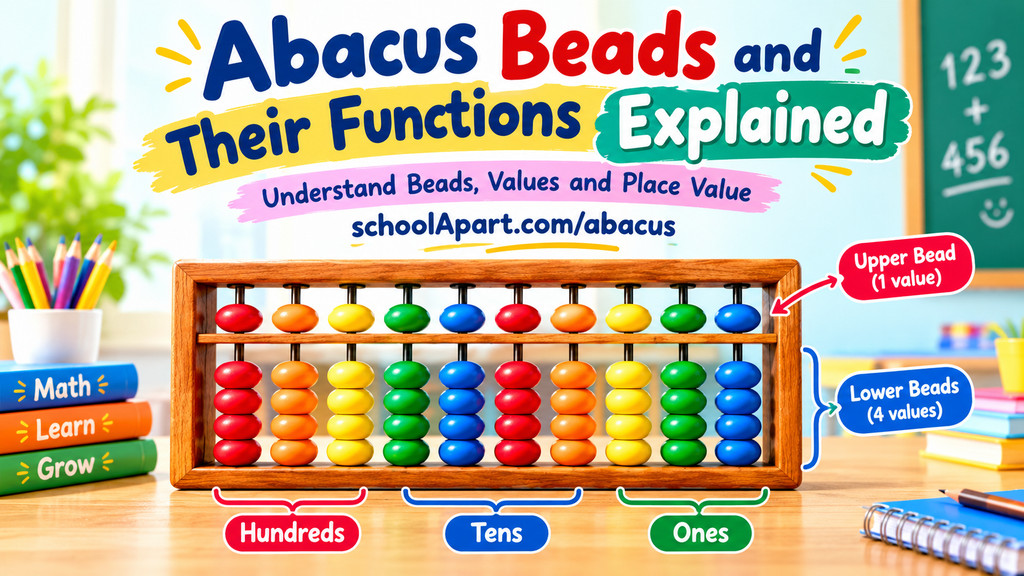
A Japanese Soroban has a horizontal bar separating the upper bead from the lower beads. The beads are counted according to their position relative to this bar.
This is an important feature because upper and lower beads have different values.
Functions of Abacus Beads
The main function of abacus beads is to represent numerical values through their positions. Depending on the abacus design, beads can perform several learning functions.
1. Representing Numbers
Beads help learners build numbers physically.
On a simple counting abacus, moving three beads into the counting position on the Ones rod represents 3.
On a place-value abacus, the same number of active beads on the Tens rod represents 30, while three active beads on the Hundreds rod represent 300.
This helps children understand that a digit’s position affects its value.
2. Showing Place Value
Beads help represent Ones, Tens, Hundreds, and larger place values.
For example, on a basic place-value abacus, the number 246 can be represented using:
- 2 active beads on the Hundreds rod.
- 4 active beads on the Tens rod.
- 6 active beads on the Ones rod.
The total is 200 + 40 + 6 = 246.
3. Supporting Addition
During addition, beads are moved to represent an increase in value.
For example, on a simple counting abacus, you can represent 3 and then add 2 more beads to show 5.
More advanced abacus systems use specific bead-moving rules to handle larger numbers and exchanges between place values.
4. Supporting Subtraction
Subtraction involves reducing the represented value by moving beads out of the counting position.
For example, if a simple counting abacus shows 7 and you move 3 beads away from the counting position, 4 beads remain active.
On more advanced abacuses, subtraction may require borrowing or exchanging values between bead positions.
5. Developing Number Sense
Moving beads helps children connect written digits with quantities and place values.
Instead of memorising a number alone, learners can see how its parts combine to form the whole number.
Regular practice can support understanding of number representation and basic arithmetic. However, progress depends on the learner, the teaching method, and the quality of practice.
Types of Abacus Beads and How They Work
Different abacuses use different bead arrangements. The following sections explain two common designs.
1. Simple Educational Counting Abacus
A simple counting abacus often has several rods or wires, each containing multiple beads.
Depending on its design, the beads may be used to count objects, represent quantities, or demonstrate place value.
For example, a basic place-value model may use:
- Ones rod for units.
- Tens rod for groups of ten.
- Hundreds rod for groups of one hundred.
- Thousands rod for groups of one thousand.
If each active bead represents one unit of its rod’s place value, three active beads on the Hundreds rod represent 300.
Important: Not every educational counting abacus follows exactly the same rules. Follow the instructions for your particular model.
2. Japanese Soroban
A Japanese Soroban uses a more specific bead arrangement.
Each rod normally contains:
- One upper bead, worth 5 units of that rod’s place value when active.
- Four lower beads, each worth 1 unit of that rod’s place value when active.
A horizontal bar separates the upper and lower beads.
Only beads moved towards the bar are counted. Beads moved away from the bar are inactive.
For example, on the Ones rod:
- One active lower bead represents 1.
- Two active lower beads represent 2.
- Three active lower beads represent 3.
- Four active lower beads represent 4.
- One active upper bead represents 5.
- One active upper bead and two active lower beads represent 7.
The upper bead represents five units, while each lower bead represents one unit. On a Tens rod, the same arrangement represents tens rather than ones.
Do not apply these Soroban rules to a simple counting abacus unless its design specifically uses the same system.
What Do Upper and Lower Beads Mean?
Upper and lower beads are particularly important when learning the Soroban.
Upper Bead
The upper bead represents five units of the rod’s place value when moved towards the dividing bar.
For example:
- On the Ones rod, it represents 5.
- On the Tens rod, it represents 50.
- On the Hundreds rod, it represents 500.
Lower Beads
Each lower bead represents one unit of the rod’s place value when moved towards the dividing bar.
For example:
- On the Ones rod, one active lower bead represents 1.
- On the Tens rod, one active lower bead represents 10.
- On the Hundreds rod, one active lower bead represents 100.
The value therefore depends on both the bead’s position and the rod on which it sits.
How to Use Abacus Beads to Represent Numbers
Let’s practise with a Japanese Soroban so you can understand how its upper and lower beads work.
Example 1: Represent the Number 3
- Find the Ones rod.
- Move three lower beads towards the dividing bar.
- Keep the upper bead away from the bar.
- Read the value as 3.
Example 2: Represent the Number 6
- Find the Ones rod.
- Move the upper bead towards the bar to represent 5.
- Move one lower bead towards the bar to represent 1.
- Add the values: 5 + 1 = 6.
Example 3: Represent the Number 8
- Activate the upper bead to represent 5.
- Activate three lower beads to represent 3.
- Add the values: 5 + 3 = 8.
Example 4: Represent the Number 24
On a Soroban:
- On the Tens rod, activate two lower beads to represent 20.
- On the Ones rod, activate four lower beads to represent 4.
The total is 20 + 4 = 24.
These examples illustrate the Soroban system. If you use a simple counting abacus, follow that model’s own bead-counting rules instead.
Common Mistakes When Using Abacus Beads
1. Assuming Every Bead Has the Same Value
In a simple counting abacus, each bead may represent one unit of its rod’s place value. In a Soroban, the upper bead represents five units of the rod’s place value.
Always identify your abacus type first.
2. Counting Inactive Beads
On a Soroban, only beads moved towards the dividing bar count towards the number. Beads away from the bar are inactive.
3. Ignoring Place Value
Three beads on the Tens rod can represent 30, not 3, when each bead represents one unit of that rod’s place value.
4. Confusing Colour with Value
Different bead colours can make learning easier, but the colour itself does not determine the mathematical value.
5. Moving Beads Without Following a Consistent Rule
Always use the correct counting position and follow the rules of your abacus model. Mixing two systems can lead to incorrect numbers.
Abacus Beads Practice Questions
Try these beginner exercises.
Exercise A: Simple Place-Value Abacus
Assume each active bead represents one unit of its rod’s place value.
- What number is represented by 4 active beads on the Ones rod?
- What number is represented by 3 active beads on the Tens rod?
- What number is represented by 2 active beads on the Hundreds rod?
- What number is represented by 2 Hundreds, 4 Tens, and 5 Ones?
- What number is represented by 5 Hundreds, 0 Tens, and 3 Ones?
Answers:
- 4
- 30
- 200
- 245
- 503
Exercise B: Japanese Soroban
Use the upper-bead and lower-bead rules explained above.
- What value does one active lower bead represent on the Ones rod?
- What value does one active upper bead represent on the Ones rod?
- What number is shown by one active upper bead and two active lower beads on the Ones rod?
- What number is represented by two active lower beads on the Tens rod and three active lower beads on the Ones rod?
- What number is represented by one active upper bead on the Tens rod and one active lower bead on the Ones rod?
Answers:
- 1
- 5
- 7
- 23
- 51
Remember to apply the rules of the correct abacus model when checking your answers.
Tips for Practising with Abacus Beads
- Start by identifying the rods and understanding their place values.
- Learn the counting rules for your particular abacus.
- Practise representing numbers before moving on to calculations.
- Reset the beads carefully between exercises.
- Check each rod separately when a number seems incorrect.
- Practise regularly for short periods instead of rushing through many exercises.
- Focus on accuracy before trying to improve speed.
Parents and teachers can make practice engaging by calling out numbers and asking learners to represent them. Begin with simple numbers, then gradually introduce larger numbers and zero.
What Should You Learn After Abacus Beads?
Once you understand the functions of abacus beads, continue with place value and number representation. These skills prepare you for reading numbers and performing calculations.
Follow this learning sequence:
- Learn abacus numbers from 1 to 9.
- Understand Ones, Tens, and Hundreds.
- Learn how to represent numbers on an abacus.
- Practise reading numbers from the beads.
- Begin abacus addition and subtraction.
You can use the related SchoolApart Abacus guides to practise each step.
Abacus beads help learners represent numbers and understand how place value works. Their exact functions depend on the design of the abacus.
A simple educational counting abacus may use beads to represent quantities on different rods, while a Japanese Soroban uses upper and lower beads with specific values.
Learn the rules of your abacus, practise representing numbers, and check each rod carefully. Once you understand how the beads work, you can move on to reading numbers, addition, subtraction, and more advanced calculations.
Frequently Asked Questions
1. What is the function of abacus beads?
Abacus beads represent numerical values. Their positions help learners count, show place value, and perform mathematical calculations.
2. Are all abacus beads worth one?
No. On some simple counting abacuses, each active bead represents one unit of its rod’s place value. On a Japanese Soroban, an active upper bead represents five units of that rod’s place value, while each active lower bead represents one unit.
3. What is the difference between upper and lower beads?
On a Japanese Soroban, the upper bead represents five units of the rod’s place value, while each lower bead represents one unit. Both count only when moved towards the dividing bar.
4. How many beads are there on a Japanese Soroban rod?
A standard Japanese Soroban rod normally has one upper bead and four lower beads.
5. Why are beads arranged on different rods?
The rods represent different place values, such as Ones, Tens, and Hundreds. This arrangement allows learners to represent larger numbers and understand how digits contribute to a number’s total value.
6. Can abacus beads help children learn mathematics?
Abacus practice can help children develop number representation skills and understand place value. Its effectiveness depends on regular practice, appropriate instruction, and the child’s learning needs.
7. What do inactive beads mean?
Inactive beads are beads that are not currently contributing to the represented number. On a Soroban, beads away from the dividing bar are inactive.
8. Can I use any abacus to practise these examples?
The place-value concepts apply broadly, but bead-moving rules vary. The examples involving upper and lower beads specifically use the Japanese Soroban. Follow your abacus model’s instructions.








Leave a Reply