

Learn abacus subtraction step by step with simple examples. Understand bead movement, subtraction rules, and practice easy subtraction problems for beginners and kids.
Abacus Subtraction for Beginners: Step-by-Step Guide
Abacus subtraction is a useful calculation skill that beginners can learn after understanding basic abacus numbers, place value, and addition.
An abacus represents numbers using beads. To subtract, you start with a number, move the appropriate beads to reduce its value, and read the result.
In this guide, you will learn how to do subtraction on an abacus with simple examples, beginner-friendly steps, and practice questions.
What Is Abacus Subtraction?
Abacus subtraction is a method of subtracting one number from another by moving beads on an abacus.
For example:
5 − 2 = 3
You first represent 5 on the abacus. Then you remove the value of 2 by moving the appropriate beads. The remaining value is 3.
Before learning subtraction, it is helpful to understand:
- Abacus numbers 1–9
- Ones, tens, and hundreds
- How to read numbers on an abacus
- Basic abacus addition
Start with our guides on Abacus Numbers 1–9, Abacus Place Value, How to Read Numbers on an Abacus, and Abacus Addition for Beginners.
How Does Subtraction Work on an Abacus?
The basic process is:
- Represent the starting number.
- Identify the number you want to subtract.
- Move the appropriate beads to reduce the value.
- Read the remaining number.
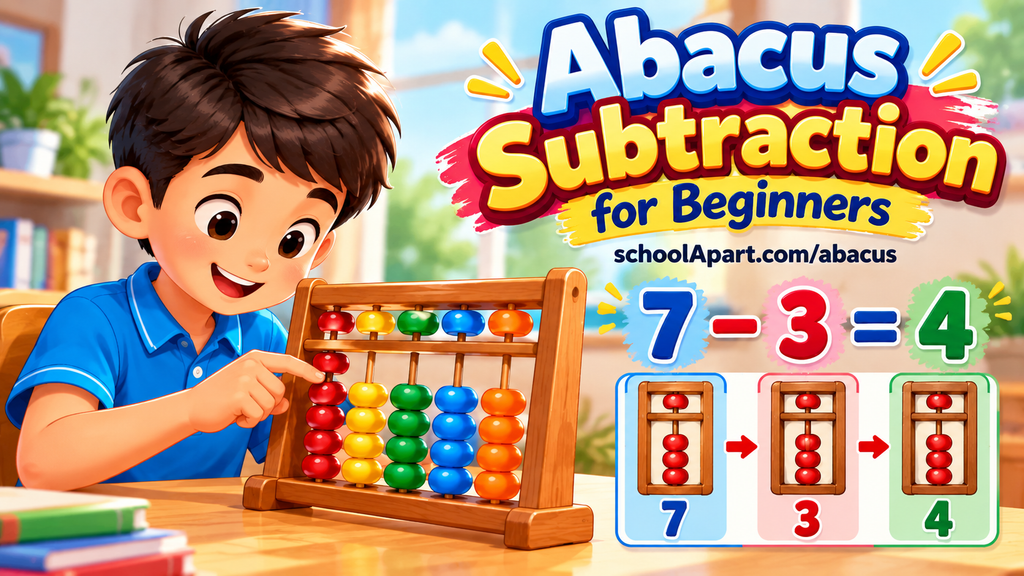
For example, to calculate 7 − 3:
- Set the abacus to 7.
- Subtract 3 using the correct bead movements.
- Read the remaining value.
Answer: 7 − 3 = 4
The exact bead movements depend on the type of abacus and the calculation method you are learning.
Abacus Subtraction for Single-Digit Numbers
Beginners should first practice simple calculations using one-digit numbers.
Example 1: 5 − 2
Start with 5 on the ones column.
Remove 2 from the represented value.
The remaining value is:
5 − 2 = 3
Example 2: 7 − 3
Represent 7.
Subtract 3 by moving the appropriate beads.
The result is:
7 − 3 = 4
Example 3: 9 − 4
Start with 9 and subtract 4.
The remaining value is:
9 − 4 = 5
Practice similar calculations until you become comfortable with the bead movements.
Understanding Bead Movement During Subtraction
Subtraction requires you to understand which beads are active and how their values are represented.
In a common school abacus, beads moved toward the central beam are counted as active. Moving beads away from the beam removes their represented value.
For example, if your abacus represents 6 and you subtract 2, you need to reduce the represented value by 2.
Always check the final bead position to make sure it shows the correct answer.
What If There Are Not Enough Beads to Subtract?
Sometimes, the number you want to subtract cannot be removed directly using the currently available active beads in a column.
For example:
8 − 3 = 5
On some abacus systems, this calculation requires learning bead combinations or complements rather than simply moving three individual beads.
As you progress, you will learn how to use combinations involving 5 and 10. These techniques depend on the abacus system and teaching method.
Beginners should first understand simple subtraction before moving to these more advanced movements.
Abacus Subtraction Using 5
The number 5 is important in many school abacus methods.
Consider:
7 − 2 = 5
Start with 7 and subtract 2. The remaining value is 5.
Another example:
6 − 1 = 5
These calculations help you understand how bead combinations represent different values.
Practice with your specific abacus system so that the movements become familiar.
Abacus Subtraction Using 10
The next step is to learn subtraction involving 10.
For example:
10 − 3 = 7
Represent 10 using the tens and ones columns. Then subtract 3 from the ones value.
The final number is 7.
Another example:
13 − 3 = 10
Start with 13 and subtract 3. The ones column returns to zero, leaving 1 in the tens column.
Understanding place value is essential when subtracting numbers that involve tens.
Two-Digit Abacus Subtraction
Once you understand single-digit subtraction, start practicing two-digit calculations.
Example 1: 15 − 3
Represent 15:
- 1 in the tens column
- 5 in the ones column
Subtract 3 from the ones column.
15 − 3 = 12
Example 2: 28 − 5
Start with 28 and subtract 5.
The result is:
28 − 5 = 23
Example 3: 35 − 12
Represent 35 and subtract 12 by working with the tens and ones places.
- Subtract 2 from the ones place: 5 − 2 = 3.
- Subtract 1 ten from the tens place: 3 tens − 1 ten = 2 tens.
35 − 12 = 23
These examples show why understanding Abacus Place Value: Ones, Tens and Hundreds is important before attempting larger calculations.
Abacus Subtraction with Borrowing
Borrowing, also called regrouping, is needed in some subtraction calculations when the digit in one place is smaller than the digit being subtracted.
For example:
42 − 18 = 24
In written arithmetic, you regroup one ten as ten ones before subtracting 8 from 2.
On an abacus, the equivalent operation uses bead combinations and place-value movements. The exact steps depend on the abacus system and method being taught.
Learn basic subtraction first, then practice regrouping with guidance from your instructor or a suitable demonstration.
Common Mistakes in Abacus Subtraction
1. Starting with the Wrong Number
Always represent the number you are subtracting from before making any changes.
2. Moving the Wrong Beads
Check which beads are active and understand their values before moving them.
3. Confusing Ones and Tens
Keep each digit in the correct place-value column.
4. Forgetting to Reset the Abacus
Before beginning a new calculation, return the abacus to the correct starting position.
5. Focusing on Speed Too Early
Accuracy should come first. Speed develops through correct and consistent practice.
How to Practice Abacus Subtraction
Follow this simple learning routine.
Step 1: Start with easy subtraction
Practice examples such as 5 − 1, 6 − 2, and 8 − 3.
Step 2: Practice different combinations
Do not memorize only a few examples. Try different starting numbers and subtraction values.
Step 3: Learn combinations involving 5
Practice calculations that reach 5 or use 5 as the starting value.
Step 4: Practice subtraction involving 10
Work on calculations such as 10 − 4 and 13 − 3.
Step 5: Move to two-digit numbers
Once single-digit subtraction becomes comfortable, begin practicing calculations with tens and ones.
Step 6: Review your mistakes
If an answer is incorrect, reset the abacus and repeat the calculation slowly.
Abacus Subtraction Practice Questions
Try these problems using your abacus before checking the answers.
Beginner Level
- 5 − 2 = ?
- 6 − 3 = ?
- 8 − 4 = ?
- 9 − 5 = ?
- 7 − 2 = ?
Intermediate Level
- 10 − 4 = ?
- 12 − 3 = ?
- 15 − 5 = ?
- 18 − 6 = ?
- 24 − 12 = ?
Practice Answers
- 3
- 3
- 4
- 4
- 5
- 6
- 9
- 10
- 12
- 12
Abacus Subtraction vs Mental Calculation
Abacus subtraction initially uses physical bead movements to represent and calculate numbers.
With practice, some learners progress toward visualizing an abacus mentally. This approach is often called mental abacus.
Physical abacus practice and mental calculation are related, but they are not identical learning stages.
Read our guide: Mental Abacus: How to Calculate Without a Physical Abacus.
What Should You Learn After Abacus Subtraction?
After learning basic addition and subtraction, you can progress to more advanced calculation skills.
A suggested learning path is:
Abacus Basics → Numbers → Place Value → Reading Numbers → Addition → Subtraction → Multiplication → Division → Mental Abacus
Visit the SchoolApart Abacus Learning Hub to explore the learning path and related beginner guides.
Abacus subtraction becomes easier when you understand number representation, place value, and bead movement.
Start with simple one-digit calculations, practice regularly, and gradually move to two-digit subtraction and regrouping.
Do not rush to calculate quickly. Focus on understanding each step and checking the final bead positions.
Once you become comfortable with subtraction, you will be better prepared to learn more advanced abacus calculation techniques.
Frequently Asked Questions
What is abacus subtraction?
Abacus subtraction is a calculation method that uses bead movements to subtract one number from another.
How do beginners learn subtraction on an abacus?
Beginners should start with simple one-digit subtraction, learn the correct bead movements, and then progress to tens and larger numbers.
Is abacus subtraction difficult?
Basic subtraction can be learned step by step. More advanced calculations may require additional practice with bead combinations and place value.
What should I learn before abacus subtraction?
Learn abacus numbers, place value, reading numbers, and basic addition first.
Can children practice abacus subtraction at home?
Yes. Children can practice simple calculations at home using an abacus, provided they understand the correct bead movements for their abacus system.
What comes after abacus subtraction?
Multiplication is a natural next topic after learning basic addition and subtraction.








Leave a Reply