

Learn how to improve handwriting for kids with simple tips for pencil grip, letter formation, spacing, writing practice, posture, and daily handwriting exercises.
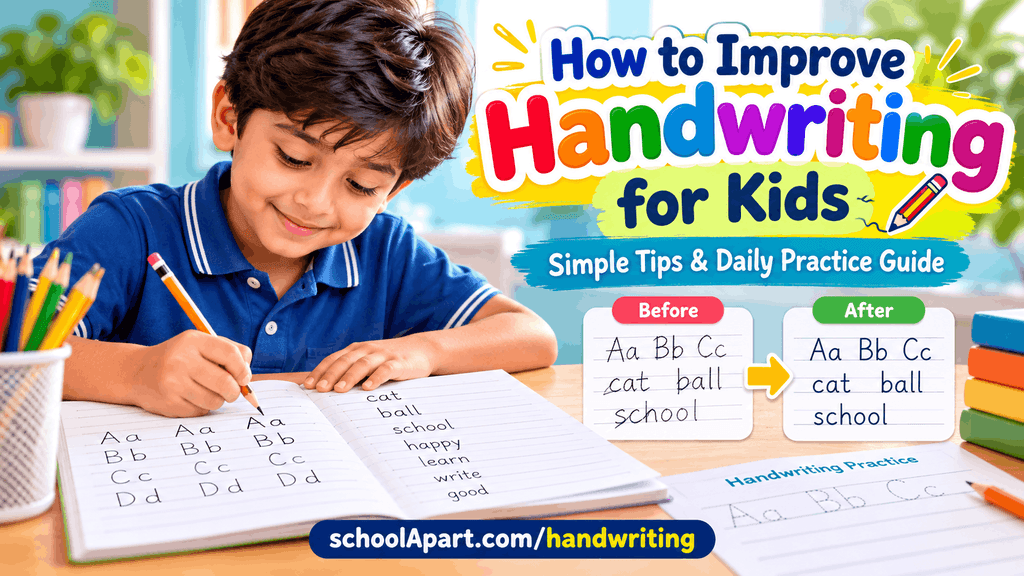
How to Improve Handwriting for Kids: Simple Tips and Practice Guide
Meta Description: Learn how to improve handwriting for kids with simple tips for pencil grip, letter formation, spacing, writing practice, posture, and daily handwriting exercises.
Slug: how-to-improve-handwriting-for-kids
How to Improve Handwriting for Kids
Good handwriting is a useful skill for school students. Clear and neat handwriting makes it easier for teachers to read answers and helps children write more comfortably and confidently.
However, children do not usually develop neat handwriting simply by writing more. They need to learn the right pencil grip, letter formation, spacing, size, alignment, and writing habits.
The good news is that handwriting can improve with regular, simple practice.
In this guide, you will learn how to improve handwriting for kids through practical exercises and everyday writing habits.
Why Is Good Handwriting Important for Kids?
Handwriting is an important part of school learning.
Children use handwriting when they:
- Write classwork
- Complete homework
- Answer questions
- Take notes
- Write exams
- Complete worksheets
- Practise spelling and vocabulary
- Draw and label diagrams
Neat handwriting does not mean every letter has to look perfect. The main goal is to make writing clear, readable, comfortable, and consistent.
1. Start With the Correct Pencil Grip
One of the first things to check is how the child holds the pencil.
A comfortable grip gives the child better control over the pencil and makes writing easier.
A common grip for writing is the tripod grip, where the pencil is generally controlled using the thumb, index finger, and middle finger.
The child should avoid gripping the pencil extremely tightly.
Signs of an uncomfortable grip
- Fingers become tired quickly
- Hand hurts during writing
- The child presses the pencil very hard
- Writing becomes shaky
- The child avoids writing activities
The goal is not to force one exact grip on every child. The important thing is that the grip allows comfortable and controlled writing.
2. Sit in a Comfortable Writing Position
Posture can affect handwriting.
Encourage children to:
- Sit comfortably at a suitable-height table
- Keep both feet supported
- Keep the writing arm comfortably on the table
- Avoid bending too close to the paper
- Keep the shoulders relaxed
- Position the paper comfortably
A child should not have to twist the body or wrist to write.
Good posture can make longer writing activities more comfortable.
3. Choose the Right Pencil
The pencil should be comfortable for the child’s hand.
For younger children, a pencil that is easy to control can be more useful than one that is too thin or slippery.
The child should be able to:
- Hold the pencil comfortably
- Control the pencil easily
- Make clear lines
- Write without excessive pressure
Pencil Grades Explained: A Complete Guide to H, HB, B, 2B, 4B, 6B & More for Beginners
You do not necessarily need expensive stationery to improve handwriting.
A suitable pencil, paper, and regular practice are enough to begin.
4. Practise Basic Lines and Shapes
Before focusing only on letters, children can practise simple strokes.
This helps them develop better pencil control.
Try practising:
- Straight lines
- Horizontal lines
- Vertical lines
- Slanting lines
- Curved lines
- Waves
- Circles
- Loops
- Zigzag lines
For younger children, these activities can be especially useful as pre-writing practice.
A simple exercise is:
Trace → Copy → Write Independently
First let the child trace a pattern.
Then ask the child to copy it.
Finally, ask them to create the same pattern without a guide.
5. Learn Correct Letter Formation
Children should learn how letters are formed rather than simply memorising what they look like.
For each letter, pay attention to:
- Where the pencil starts
- Which direction the stroke moves
- The shape of the letter
- The size of the letter
- Where the pencil stops
For example, when practising the letter a, the child should consistently follow the same basic formation instead of creating a different shape every time.
Correct letter formation helps handwriting become more consistent.
6. Practise One Letter at a Time
Do not try to correct every handwriting problem at once.
Choose one letter or one type of mistake.
For example:
Day 1: a
Day 2: b
Day 3: c
Day 4: d
Or practise letters that the child finds difficult.
Write the letter:
Trace → Copy → Write → Use in Words
For example:
a → apple → ant → animal
This connects letter practice with real writing.
7. Work on Letter Size
Uneven letter size is a common handwriting problem.
Some children write:
- Very large letters
- Very small letters
- Some large and some small letters
- Letters that change size within the same word
Encourage the child to keep letters reasonably consistent.
Using ruled handwriting paper can make this easier.
For example:
cat
The three letters should have a visually consistent size and position.
8. Improve Spacing Between Letters and Words
Spacing makes handwriting much easier to read.
There are two important types of spacing:
Letter spacing
Letters within a word should not be too crowded.
Word spacing
There should be a clear gap between different words.
For example:
❌ Ilikeapples.
Better:
✅ I like apples.
A child can practise leaving a small, consistent space between words.
For younger students, using a finger or a small visual marker can help them understand word spacing.
9. Teach Children to Write on the Line
Line alignment is another important part of neat handwriting.
Children should learn to position letters correctly on ruled paper.
Depending on the type of handwriting paper, letters may have:
- Main body
- Tall parts
- Descending parts
The exact teaching method can vary according to the handwriting style being taught.
The important goal is consistency.
Instead of allowing letters to float above or below the line randomly, encourage the child to use the lines as a guide.
10. Practise Lowercase and Capital Letters Separately
Children should understand when to use capital and lowercase letters.
For example:
Capital: A B C D
Lowercase: a b c d
Practice them separately first.
Then use them in words and sentences.
For example:
School
My school is near my home.
This combines letter formation with real writing.
11. Use Short Daily Handwriting Practice
Long practice sessions are not always necessary.
A short daily routine can be more manageable.
Try a simple 10-minute handwriting routine:
2 minutes
Line and curve practice
3 minutes
Letter practice
3 minutes
Word practice
2 minutes
Sentence practice
The exact time can be adjusted according to the child’s age and attention span.
The important thing is consistency.
12. Copy Short Words
Once the child is comfortable with individual letters, move to simple words.
Start with familiar words such as:
- cat
- dog
- book
- pen
- school
- ball
- tree
- sun
- apple
- friend
Use this progression:
See → Trace → Copy → Write Independently
This gradually reduces dependence on the model.
13. Practise Simple Sentences
After words, move to short sentences.
Examples:
- I have a book.
- This is my pencil.
- I like drawing.
- The sun is bright.
- I go to school.
- My bag is blue.
Ask the child to copy one or two sentences neatly.
Do not focus only on speed.
At this stage, accuracy and consistency are more important than writing quickly.
14. Improve Handwriting Through Copywriting
Copywriting can be a useful handwriting exercise.
Give the child a short sentence to copy.
For example:
I like to read books.
Ask the child to focus on:
- Letter shape
- Letter size
- Spacing
- Alignment
- Neatness
After copying, compare the original and the child’s writing.
Instead of saying only “This is wrong,” identify one thing to improve.
For example:
“Your letters are clear. Now let’s work on keeping the words evenly spaced.”
This makes practice more useful and encouraging.
15. Do Not Focus Only on Speed
Some children try to write very quickly and their handwriting becomes difficult to read.
First develop:
Control → Accuracy → Consistency → Speed
Speed should come gradually.
If the child is still struggling with letter formation, asking them to write faster may make the problem worse.
16. Practise Difficult Letters More Often
Every child may have certain letters that are harder to write.
Observe which letters cause problems.
For example:
- Letters are reversed
- Curves are uneven
- Loops are too large
- Letters are too small
- Letters are written in different forms
Give those letters extra practice.
There is no need to practise the entire alphabet equally every day.
17. Encourage Correct Pencil Pressure
Some children press the pencil too hard.
Others press too lightly.
Try to develop a comfortable middle level of pressure.
A simple test:
Ask the child to draw a line using normal pressure.
Then ask them to draw the same line very hard and very lightly.
This helps them understand the difference.
The goal is controlled writing that does not require excessive force.
18. Use Different Handwriting Activities
Handwriting practice does not always have to mean copying the alphabet.
Try:
Tracing
Trace letters, words, and patterns.
Word Practice
Write familiar words.
Sentence Practice
Copy simple sentences.
Picture Naming
Show a picture and ask the child to write its name.
Dictation
Say a simple word or sentence and ask the child to write it.
Daily Journal
Ask the child to write one or two sentences about their day.
Labeling
Ask children to label parts of a drawing.
These activities make writing more meaningful.
19. Let Children Write About Things They Like
Practice becomes easier when children are interested in the topic.
If a child likes:
- Animals
- Cars
- Drawing
- Sports
- Space
- Nature
- Games
use those subjects for writing practice.
For example:
My favourite animal is a tiger.
This gives the child a reason to write instead of making handwriting feel like repetitive homework.
20. Give One Correction at a Time
Avoid correcting every single mistake.
If a child’s handwriting has five problems, choose one or two priorities.
For example:
This week: Focus on spacing.
Next week:
Focus on letter size.
Then:
Focus on writing on the line.
This makes improvement easier to understand.
21. Praise Improvement, Not Perfection
Children can become frustrated when adults constantly compare their handwriting with someone else’s.
Instead, compare the child’s current writing with their own previous work.
For example:
“Your spacing is better than last week.”
“Your letters are more consistent today.”
“You are keeping your writing on the line much better.”
This encourages children to keep practising.
A Simple 7-Day Handwriting Practice Plan
Here is an easy weekly routine.
| Day | Practice |
|---|---|
| Monday | Lines, curves and pencil control |
| Tuesday | Capital letters |
| Wednesday | Lowercase letters |
| Thursday | Simple words |
| Friday | Short sentences |
| Saturday | Copywriting practice |
| Sunday | Review and free writing |
The routine can be repeated with new letters, words, and sentences each week.
A 10-Minute Daily Handwriting Routine
If you want something even simpler, use this routine every day.
Step 1 — Warm Up
Practise lines, curves, circles, and loops.
Step 2 — Letter Practice
Choose 2–3 letters.
Step 3 — Word Practice
Write 3–5 simple words.
Step 4 — Sentence Practice
Write one or two short sentences.
Step 5 — Review
Look at the writing and identify one thing that improved.
This routine can be adapted for different ages and school levels.
Common Handwriting Mistakes to Avoid
1. Holding the Pencil Too Tightly
This can make writing uncomfortable.
2. Writing Too Fast
Speed can reduce control.
3. Ignoring Letter Formation
Repeating incorrect letter shapes can make them harder to correct later.
4. Inconsistent Letter Size
Letters should have a reasonably consistent size.
5. Poor Word Spacing
Words that are too close together can make sentences difficult to read.
6. Ignoring the Writing Line
Letters should be positioned consistently on the paper.
7. Practising for Too Long
Long sessions can cause tiredness and frustration.
8. Comparing Children
Every child develops handwriting skills at a different pace.
How Parents Can Help Improve Handwriting at Home
Parents do not need to become handwriting teachers.
A few simple habits can help.
Create a regular practice time
Choose a convenient time each day.
Keep practice short
A focused 10-minute session can be enough to begin.
Provide suitable materials
Use comfortable pencils and appropriate ruled paper.
Watch the child’s writing
Look for recurring problems.
Correct gently
Focus on one improvement at a time.
Encourage effort
Praise progress rather than demanding perfection.
Keep practice interesting
Use words, pictures, stories, and topics that the child enjoys.
How Long Does It Take to Improve Handwriting?
There is no fixed time because every child is different.
Some children may show improvement within a few weeks of regular practice, while others may need more time.
Progress depends on factors such as:
- Age
- Current handwriting ability
- Practice frequency
- Pencil control
- Letter formation
- Writing habits
- Attention and motivation
The important thing is to look for gradual improvement.
Instead of asking:
“Is my child’s handwriting perfect?”
ask:
“Is my child’s handwriting becoming clearer and more controlled?”
When Should a Child Get Extra Help?
Most handwriting problems can be improved through appropriate practice and support.
However, if a child consistently finds writing unusually difficult, experiences significant discomfort while writing, or struggles with everyday writing tasks despite regular practice, parents may want to discuss the concern with the child’s teacher or an appropriate professional.
The aim is to understand the child’s individual needs rather than simply demanding neater handwriting.
The Best Way to Improve Handwriting
There is no single magic exercise that suddenly makes handwriting beautiful.
A better approach is:
Correct Grip
↓
Good Writing Position
↓
Pencil Control
↓
Letter Formation
↓
Letter Size
↓
Spacing
↓
Line Alignment
↓
Words
↓
Sentences
↓
Regular Practice
↓
Better Handwriting
The key is to improve one skill at a time.
Final Tips for Better Handwriting
Remember these simple rules:
- Hold the pencil comfortably.
- Sit in a suitable writing position.
- Practise basic lines and curves.
- Learn correct letter formation.
- Keep letter sizes reasonably consistent.
- Leave clear spaces between words.
- Use the writing lines as a guide.
- Practise slowly before trying to write faster.
- Use short daily practice sessions.
- Practise difficult letters more often.
- Use words and sentences instead of only alphabet practice.
- Encourage children instead of comparing them.
- Focus on gradual improvement.
- Make handwriting practice enjoyable.
Good handwriting develops through practice, control, consistency, and patience.
The goal is not perfect handwriting. The goal is handwriting that is clear, comfortable, readable, and appropriate for the child’s age and learning stage.
Start with a few minutes of practice every day and gradually build better writing habits.
Improving handwriting is a gradual process.
Children do not need to spend hours copying pages of letters. A better approach is to identify the specific problem, practise it regularly, and gradually move from letters to words and sentences.
Start small:
Grip → Control → Letters → Words → Sentences → Practice → Improvement
With patience and regular practice, children can develop handwriting that is clearer, neater, and more comfortable to use at school.
Frequently Asked Questions
1. How can I improve my child’s handwriting?
Start by checking pencil grip, writing posture, pencil control, letter formation, spacing, letter size, and line alignment. Then practise these skills regularly through short writing activities.
2. How many minutes should a child practise handwriting?
A short daily session of around 10 minutes can be a practical starting point. Younger children may need shorter sessions, while older students may practise for longer.
3. How can I make my child’s handwriting neat?
Focus on comfortable pencil control, consistent letter formation, appropriate letter size, good spacing, line alignment, and regular practice.
4. Why is my child’s handwriting messy?
Messy handwriting can have several causes, including poor pencil control, inconsistent letter formation, spacing problems, rushing, uncomfortable writing posture, or insufficient practice.
5. How can children improve handwriting speed?
First develop accuracy and control. Once handwriting becomes consistent, children can gradually practise writing faster without sacrificing readability.
6. What is the best pencil grip for handwriting?
A comfortable and controlled grip is important. Many children use a tripod-style grip, but the main goal is comfortable pencil control rather than forcing one exact grip.
7. How can I teach handwriting at home?
Start with basic strokes and letter formation, then move to words and short sentences. Keep practice short, regular, and encouraging.
8. How can I improve spacing in handwriting?
Teach children to leave a consistent gap between words and enough space between letters. Ruled practice paper and simple visual spacing cues can help.
9. Should children practise cursive or print handwriting?
This depends on the child’s school curriculum and learning stage. Children should first develop basic writing control and letter formation before progressing to more advanced handwriting styles.
10. Can handwriting improve with daily practice?
Yes. Regular, focused practice can help children gradually improve pencil control, letter formation, spacing, consistency, and overall readability.





Leave a Reply