

Learn what drawing is, why it is important for school students, the basic materials you need, and simple techniques to start drawing with confidence.
What Is Drawing? A Complete Beginner’s Guide for School Students
Drawing is one of the easiest and most creative skills that any student can learn. With just a pencil and a sheet of paper, you can turn your ideas, imagination, and observations into pictures. Whether you want to draw cartoons, nature, people, or designs, drawing is the foundation of many art skills.
In this guide, you will learn what drawing is, why it is important, the materials you need, and how to start drawing step by step.
What Is Drawing?
Drawing is the process of creating lines, shapes, and forms on a surface such as paper using tools like pencils, pens, charcoal, or digital styluses.
Artists use drawing to express ideas, tell stories, study objects, and create artwork. Drawing can be simple or highly detailed depending on the artist’s skill and purpose.
Examples of drawing:
- Pencil sketches
- Cartoon characters
- Nature scenery
- Human faces
- Digital illustrations
Why Should School Students Learn Drawing?
Drawing is not only about making pictures. It helps students develop many useful skills.
Benefits of Drawing
- Improves creativity – Students learn to think in new and imaginative ways.
- Builds concentration – Drawing requires focus and patience.
- Develops observation skills – Students notice shapes, colors, and details around them.
- Boosts confidence – Completing a drawing gives a sense of achievement.
- Supports academic learning – Diagrams, maps, and visual notes become easier to understand.
Basic Materials Needed for Drawing
You do not need expensive tools to begin. Start with simple materials.
| Material | Use |
|---|---|
| Pencil (HB) | General drawing |
| Eraser | Correct mistakes |
| Sharpener | Keep the pencil sharp |
| Drawing Paper | Practice sketches |
| Ruler | Straight lines and measurements |
A simple HB pencil and a notebook are enough to start today.
The 5 Basic Elements of Drawing
Most drawings are built from a few simple elements.
- Line – Straight, curved, or zigzag marks.
- Shape – Circle, square, triangle, etc.
- Form – 3D objects like cubes and spheres.
- Value – Light and dark areas (shading).
- Texture – The surface appearance of an object.
Learning these basics makes complex drawings much easier.
How to Start Drawing: Step-by-Step
Step 1: Draw Simple Shapes
Practice circles, squares, triangles, and rectangles. These shapes are the building blocks of most objects.
Step 2: Combine Shapes
Turn shapes into objects:
- Circle → Ball
- Rectangle → Book
- Triangle + Rectangle → Tree
Step 3: Add Details
Draw windows, leaves, eyes, or patterns to make the object look more realistic.
Step 4: Add Shading
Use light and dark pencil strokes to create depth and volume.
Step 5: Practice Regularly
Even 15–20 minutes a day can improve your drawing noticeably within a few weeks.
Easy Drawing Ideas for Beginners
Try drawing these simple subjects:
- Sun
- Tree
- House
- Flower
- Fish
- Cartoon face
- Mountain
- River scenery
Start with easy objects before moving to people and detailed scenes.
Common Mistakes Beginners Make
- Pressing the pencil too hard.
- Trying to draw perfect lines immediately.
- Ignoring basic shapes.
- Giving up after a few attempts.
- Not practicing regularly.
Remember: Every good artist was once a beginner.
A Simple 7-Day Drawing Practice Plan
Day 1
Lines and shapes
Day 2
Circles and objects
Day 3
Trees and flowers
Day 4
Simple scenery
Day 5
Cartoon faces
Day 6
Shading practice
Day 7
Draw your favorite object
This schedule is suitable for school students and complete beginners.
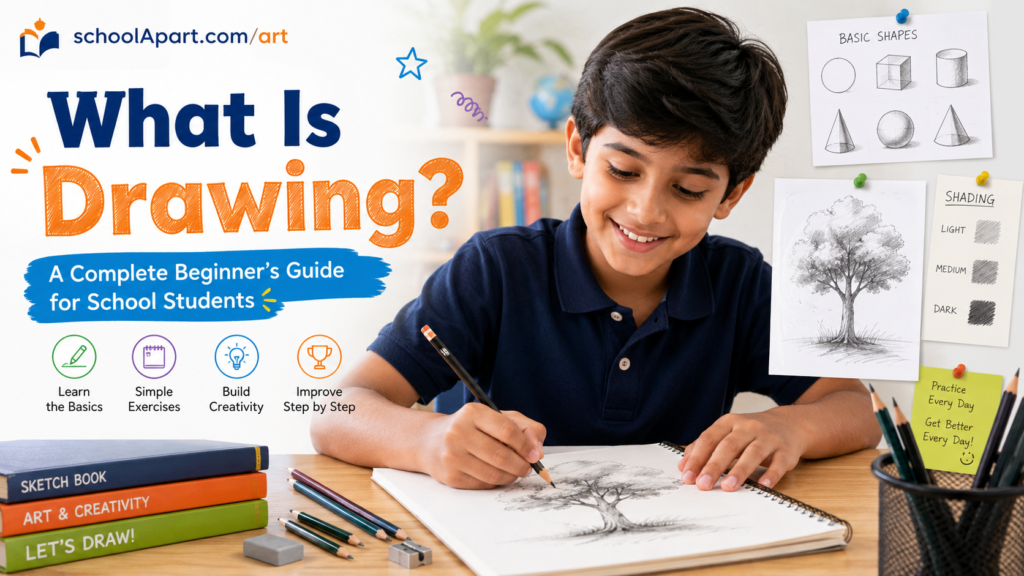
Drawing is a skill that anyone can learn with practice. You do not need special talent to begin. Start with simple shapes, practice regularly, and enjoy the process. Over time, your lines will become more confident, your shading will improve, and your drawings will become more detailed and creative.
Pick up a pencil today and start drawing—your artistic journey begins with a single line.
FAQ
1. What is drawing in simple words?
Drawing is making pictures using lines, shapes, and shading with tools such as pencils or pens.
2. Can beginners learn drawing?
Yes. Anyone can learn drawing through regular practice and simple exercises.
3. Which pencil is best for beginners?
An HB pencil is the best starting choice because it is easy to control and suitable for most practice work.
4. How much time should I practice daily?
Practicing 15–30 minutes a day is enough for beginners to make steady progress.
5. Is drawing useful for school students?
Yes. Drawing improves creativity, concentration, observation, and visual learning skills.

Leave a Reply