
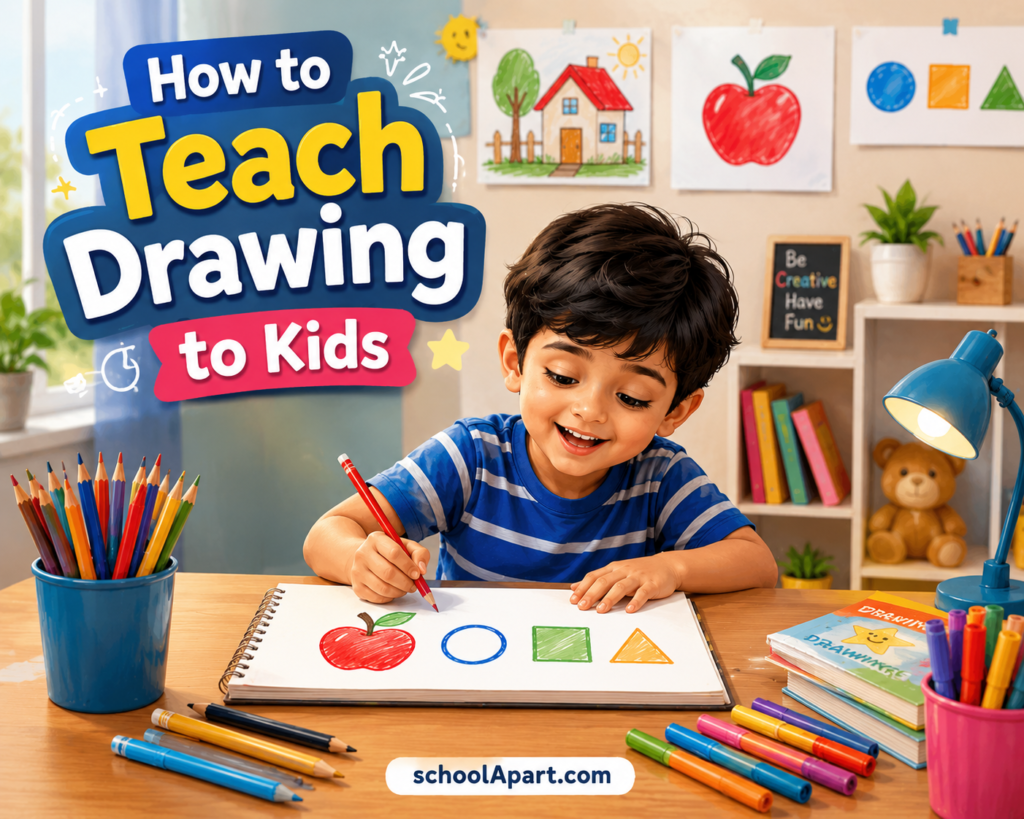
Learn how to teach drawing to kids with this step-by-step guide for parents. Simple techniques, fun activities, and easy practice plans for beginners.
🎨 How to Teach Drawing to Kids: A Complete Beginner’s Guide for Parents
Helping your child learn drawing at an early age is one of the best ways to boost creativity, confidence, and cognitive development. But many parents wonder:
👉 “Where do I start?”
👉 “What if I don’t know how to draw myself?”
The good news—you don’t need to be an artist to teach your child drawing. With the right step-by-step approach, you can guide your child from simple lines to creative artwork right at home.
🧠 Why Drawing is Important for Kids
Drawing is not just about making pictures—it’s a powerful learning tool.
✨ Key Benefits:
- 🧩 Enhances Creativity – Encourages imagination and original thinking
- 👀 Improves Observation Skills – Kids learn to notice details
- ✋ Develops Motor Skills – Better hand control and coordination
- 💬 Boosts Emotional Expression – Kids express thoughts through art
👉 In simple terms, drawing helps in overall brain development.
🚀 Before You Start: 5 Golden Rules for Parents
- 🎯 Focus on progress, not perfection
- 🎨 Keep it fun and pressure-free
- 👏 Appreciate every small effort
- 🕒 Keep sessions short (20–30 minutes)
- 🧒 Let your child lead (draw what they like)
✏️ Step 1: Line Practice (The Foundation of Drawing)
✏️ Step 1: Line Practice (The Foundation of Drawing)
🎯 Goal:
Develop hand control and pencil movement
🧒 What to Teach:
- Straight lines
- Curved lines
- Zigzag and wave patterns
🎮 Fun Activities:
- 🚗 “Road Drawing Game” (stay inside the line)
- 🐍 Curved line = snake
- 🌊 Wave line = ocean
👉 Pro Tip: Use large sheets of paper to allow free hand movement.
🔵 Step 2: Basic Shapes (Building Blocks of Drawing)
🎯 Goal:
Understand structure through shapes
🧒 Teach These Shapes:
- ⚪ Circle
- ⬛ Square
- 🔺 Triangle
- ⬭ Oval
🎮 Fun Activities:
- “Find the Shape” around the house
- Create cartoons using shapes
👉 Pro Tip: Every complex drawing starts with simple shapes.
🍎 Step 3: Simple Object Drawing (Confidence Building Stage)
🎯 Goal:
Draw real-world objects with confidence
🪄 Easy Method:
Break → Build → Detail
- Break the object into basic shapes
- Draw the structure lightly
- Add details slowly
🧒 Examples:
- 🍎 Apple = Circle
- 🏠 House = Square + Triangle
- 🌳 Tree = Oval + Rectangle
🎮 Fun Activities:
- “Draw Your Favorite Toy”
- “Draw What You Saw Today”
👉 Pro Tip: Avoid over-correcting mistakes—encourage creativity.
🌗 Step 4: Shading Practice (Adding Depth & Realism)
🎯 Goal:
Make drawings look more realistic
🧒 What to Teach:
- Light source (where light comes from)
- Shadow (where darkness falls)
- Light to dark shading (gradient)
🎮 Fun Activities:
- Use a torch to show shadows
- Practice shading a ball or cube
👉 Pro Tip: Start with pencils before using colors.
🏡 Weekly Practice Plan for Kids
| Day | Activity |
|---|---|
| Day 1 | Line Practice |
| Day 2 | Shapes |
| Day 3 | Shapes → Objects |
| Day 4 | Simple Drawing |
| Day 5 | Coloring |
| Day 6 | Shading |
| Day 7 | Fun Drawing Day 🎉 |
⚠️ Common Mistakes Parents Should Avoid
- ❌ Forcing “perfect” drawings
- ❌ Comparing with other kids
- ❌ Over-correcting mistakes
- ❌ Making sessions too long
👉 Better Approach: Guide, don’t control.
🎨 Extra Tips for Faster Improvement
- 🖍️ Use crayons, color pencils, sketch pens
- 📺 Show age-appropriate drawing videos
- 📸 Use real-life references
- 🧾 Provide worksheets
- 🏆 Give small rewards
📌
Teaching your child drawing is not about creating a perfect artist.
👉 It’s about helping them think, imagine, and express freely.
Always remember:
🎨 “Happy drawing matters more than perfect drawing.”


Leave a Reply