

Help kids improve English pronunciation with easy sound practice, word stress tips, common examples, and fun activities for clearer speaking.
English Pronunciation for Kids
Learning to pronounce English words clearly helps children communicate with confidence. When kids practise listening to sounds, saying words slowly, and speaking in complete sentences, they can gradually improve their pronunciation.
Spoken English for Kids: Complete Beginner’s Guide — start with the basics of spoken English.
English pronunciation can sometimes be confusing because the same letter may sound different in different words. For example, the letter a sounds different in cat, cake, and father. That is why children need to listen carefully and practise words in context instead of relying only on spelling.
- How to Learn Spoken English at Home — practise English through everyday routines.
- How to Improve English Speaking Skills for Kids — explore practical speaking activities.
In this guide, children will learn simple English pronunciation tips, common sound patterns, word stress, useful examples, and fun activities they can practise with parents or teachers.
What Is English Pronunciation?
English pronunciation is the way we say words and sounds when speaking English. It includes the sounds of individual letters and letter combinations, the way syllables are spoken, and the rhythm and stress used in words and sentences.
For example:
- Cat: The word begins with a clear /k/ sound.
- Ship: The beginning sound is different from the /s/ sound in sip.
- Banana: The middle syllable usually receives the strongest stress.
- Hello!: The voice may rise or fall naturally depending on the speaker’s meaning and tone.
Good pronunciation does not mean that every child must sound like a native speaker. The main goal is to speak clearly enough to be understood and to understand other people when they speak.
Why Is Pronunciation Important for Kids?
Practising pronunciation helps children:
- Say familiar English words more clearly.
- Recognise differences between similar sounds.
- Improve listening and speaking skills.
- Read new words aloud with greater confidence.
- Learn new vocabulary more effectively.
- Participate more comfortably in classroom conversations.
Children develop at different speeds. Short, regular practice is usually more helpful than long sessions that make them tired or frustrated.
1. Start by Listening Carefully
Children should listen to a word before trying to pronounce it. Listening helps them notice the sounds, syllables, and rhythm of spoken English.
Try this simple routine:
- Choose one familiar word.
- Listen to a clear recording or a trusted speaker.
- Say the word slowly.
- Listen again and compare the sounds.
- Repeat the word naturally in a short sentence.
For example, practise the word apple.
- Listen to the word.
- Notice the two syllables: ap-ple.
- Say it slowly, then at a natural speed.
- Use it in a sentence: “I eat an apple.”
Avoid repeating a word so many times that practice becomes tiring. A few careful repetitions are enough to begin.
2. Learn Common English Vowel Sounds
Vowels can be tricky because English spelling does not always tell children exactly how a word sounds. The letters a, e, i, o, and u can represent different vowel sounds, depending on the word.
Here are some useful examples.
| Word | Sound to notice | Practice sentence |
|---|---|---|
| Cat | Short vowel sound | The cat is sleeping. |
| Cake | Long vowel sound represented by “a_e” | I like chocolate cake. |
| Bed | Short vowel sound | The book is on the bed. |
| Tree | Long “ee” sound | The tree is tall. |
| Sit | Short vowel sound | Please sit here. |
| Bike | Long vowel sound represented by “i_e” | My bike is blue. |
| Hot | Short vowel sound | The soup is hot. |
| Home | Long vowel sound represented by “o_e” | I am going home. |
| Cup | Short vowel sound | The cup is on the table. |
| Cute | Long vowel sound represented by “u_e” | The puppy is cute. |
These are examples of common patterns, not rules that work for every English word. Listening to the complete word is important.
A Fun Vowel Activity
Choose two words with contrasting vowel sounds, such as sit and seat. Say each word clearly and ask the child to identify which word they hear.
Then practise these pairs:
- Ship — sheep
- Full — fool
- Hat — hate
- Hop — hope
Some of these pairs differ in more than one feature or follow different spelling patterns. Focus on listening to the actual spoken sounds rather than memorising a spelling rule.
3. Practise Consonant Sounds
Consonants are sounds made when airflow is partly or fully blocked by parts of the mouth. Children can improve their pronunciation by noticing how their lips, tongue, and teeth move.
The /p/ and /b/ Sounds
These sounds are made with the lips. The /p/ sound is usually voiceless, while /b/ uses the voice.
Practise:
- Pat — bat
- Pin — bin
- Pig — big
Example sentences:
- The pig is pink.
- The bat is on the table.
The /s/ and /sh/ Sounds
The /s/ sound is heard in sip, while the /sh/ sound is heard in ship. Listen to how the airflow and tongue position change.
Practise:
- Sip — ship
- See — she
- Sock — shock
Example sentences:
- I can see the ship.
- She has a red sock.
The /f/ and /v/ Sounds
For these sounds, the upper teeth gently touch the lower lip. The /f/ sound is voiceless, while /v/ uses the voice.
Practise:
- Fan — van
- Fine — vine
Place a hand gently on the throat while saying the sounds. Children may notice vibration when saying /v/ but not when saying /f/.
The /th/ Sound
The “th” spelling represents more than one English sound. In words such as think and three, it represents a voiceless sound. In words such as this and that, it represents a voiced sound.
For the common “th” sounds, place the tongue lightly between the teeth or near the front teeth, then let the air pass through.
Practise:
- Think
- Three
- Thank
- This
- That
- Mother
Do not worry if this sound feels difficult at first. Gentle practice and listening can help children improve gradually.
4. Understand Syllables in English Words
A syllable is a beat or sound unit in a word. Breaking longer words into syllables can make them easier to say.
Try clapping once for each syllable.
| Word | Syllables | Practice |
|---|---|---|
| Cat | 1 | Say it in one beat. |
| Happy | 2 | Clap for each syllable. |
| Apple | 2 | Say the word in two beats. |
| Banana | 3 | Clap three times. |
| Elephant | 3 | Break the word into three beats. |
| Computer | 3 | Say each syllable clearly. |
| Beautiful | 3 | Practise slowly, then naturally. |
| Education | 4 | Listen carefully to the syllables. |
Syllable divisions can be represented in different ways depending on the teaching method. For young learners, clapping out the spoken beats is a useful starting point.
Syllable Practice Game
Choose a familiar word and ask the child to clap its syllables.
For example:
- Dog — one clap.
- Pencil — two claps.
- Banana — three claps.
Then ask the child to use each word in a sentence.
5. Learn Word Stress
Word stress means giving one syllable more prominence than the others. A stressed syllable may sound stronger, longer, or clearer.
For example:
- TAble
- HAPpy
- baNAna
- comPUter
The capital letters here show the stressed syllable; they are not part of the spelling.
Word stress can change the natural sound of a word. Children can learn it by listening to reliable pronunciation recordings and repeating the complete word.
Try This Activity
Say each word aloud and clap more strongly on the stressed syllable.
- Teacher
- Window
- Today
- Balloon
- Potato
Encourage children to listen first rather than guessing stress from the spelling.
6. Notice Silent Letters
Some English words contain letters that are written but not pronounced. These are called silent letters.
| Word | Silent letter | Example sentence |
|---|---|---|
| Know | k | I know the answer. |
| Knee | k | My knee hurts. |
| Write | w | I write in my notebook. |
| Wrong | w | This answer is wrong. |
| Lamb | b | The lamb is in the field. |
| Climb | b | We climb the hill. |
| Listen | t | Please listen carefully. |
| Castle | t | We saw an old castle. |
Silent-letter patterns are not always predictable. Encourage children to listen to the word and learn its pronunciation together with its spelling.
7. Practise Difficult Words Slowly
Some common English words may be challenging for young learners. Break them into manageable parts and practise at a comfortable pace.
| Word | Practice tip | Example sentence |
|---|---|---|
| Vegetable | Listen to how the middle sounds are reduced in natural speech. | I eat a vegetable with lunch. |
| Comfortable | Practise the word slowly, then listen to its natural pronunciation. | This chair is comfortable. |
| February | Listen for the sounds and syllables rather than pronouncing every letter separately. | February is the second month of the year. |
| Library | Practise the word as a whole and avoid inserting an extra syllable. | I borrowed a book from the library. |
| Different | Listen to the middle consonant sounds. | We have different ideas. |
| Chocolate | Listen to how the word is spoken naturally. | I like chocolate ice cream. |
| Interesting | Practise its syllables, then say it in a sentence. | This story is interesting. |
| Breakfast | Say the word naturally without adding an extra vowel between consonants. | I eat breakfast before school. |
| Clothes | Listen carefully to the consonant sounds in natural speech. | My clothes are clean. |
| Wednesday | Learn the spoken form as well as the spelling. | Wednesday is a school day. |
Pronunciation varies slightly between English accents. Children do not need to copy every accent exactly; they should aim for clear and consistent speech.
8. Use Sentence Practice for Better Pronunciation
Pronouncing individual words is useful, but children also need to practise them in sentences. Sentence practice helps them connect words naturally.
Try these short sentences:
- The cat is on the mat.
- She sells seashells.
- I like red apples.
- This is my school bag.
- Three thin trees stand there.
- Peter has a blue pencil.
- The little rabbit runs fast.
- We went to the library.
- My teacher reads a story.
- I can speak English clearly.
First, say the sentence slowly. Next, repeat it at a comfortable speaking speed. Finally, say it naturally without forcing every word to sound separate.
9. Try Easy Tongue Twisters
Tongue twisters are short phrases that repeat similar sounds. They can help children practise pronunciation, listening, and speaking rhythm.
Start slowly and focus on accuracy before trying to speak faster.
Tongue Twister 1
She sells seashells by the seashore.
Focus on the difference between the /s/ and /sh/ sounds.
Tongue Twister 2
Peter Piper picked a peck of pickled peppers.
Focus on the repeated /p/ sound.
Tongue Twister 3
Red lorry, yellow lorry.
Focus on saying the words clearly without rushing.
Tongue Twister 4
Three free throws.
Focus on the initial “th” sound.
Tongue Twister 5
Big black bugs bleed blue blood.
Focus on the repeated /b/ sound and clear word boundaries.
Children can repeat each tongue twister two or three times. Stop if they become frustrated, and return to slower practice.
10. Use Fun Pronunciation Activities at Home
Pronunciation practice does not need to feel like a formal lesson. Parents can make it enjoyable with short, simple activities.
Activity 1: Listen and Choose
Say one word from a pair, such as ship or sheep. Ask the child to point to the matching picture.
Start with familiar words and introduce more challenging sound pairs gradually.
Activity 2: Mirror Practice
Let the child look in a mirror while saying words that use visible mouth movements, such as pet, van, and think.
The goal is to notice lip and tongue movement, not to judge how the child looks.
Activity 3: Record and Listen
With an adult’s help, record a short sentence and listen to it together. Choose one sound to practise instead of trying to correct everything at once.
Activity 4: Read Aloud
Choose a short, age-appropriate story. Read one sentence at a time and notice the sounds, syllables, and word stress.
Activity 5: Pronunciation of the Day
Choose one sound or word each day. Listen to it, practise a few examples, and use one example in a sentence.
A Simple 7-Day English Pronunciation Plan
| Day | Focus | Practice |
|---|---|---|
| Day 1 | Vowel sounds | Practise words such as cat, cake, sit, and seat. |
| Day 2 | Consonant sounds | Practise /p/, /b/, /s/, and /sh/ with example words. |
| Day 3 | Syllables | Clap the syllables in familiar words. |
| Day 4 | Word stress | Listen to and practise the stressed syllables in common words. |
| Day 5 | Silent letters | Learn words such as know, write, and listen. |
| Day 6 | Sentences and tongue twisters | Read short sentences slowly and clearly. |
| Day 7 | Revision | Record a short sentence and practise one sound that needs attention. |
Five to ten minutes of relaxed practice each day can be a useful starting point. Adjust the duration to the child’s age and attention span.
Tips for Parents and Teachers
- Model clear pronunciation and speak at a comfortable pace.
- Use trusted audio dictionaries or age-appropriate listening resources.
- Focus on one or two sounds at a time.
- Encourage children to listen before repeating.
- Avoid making fun of pronunciation mistakes or comparing children with one another.
- Recognise effort and improvement, not just accuracy.
- Remember that English has several widely used accents.
- Practise words in meaningful sentences rather than only as isolated sounds.
Related English Learning Guides
Continue building your child’s vocabulary and speaking confidence with these guides:
- 100 Basic English Words for Kids — build a foundation of common vocabulary.
- Daily Use English Words for Kids — practise everyday words and expressions.
- Action Words for Kids — learn common verbs with examples.
- School Vocabulary for Kids — learn words used in school.
- Opposite Words for Kids — explore common antonyms and their meanings.
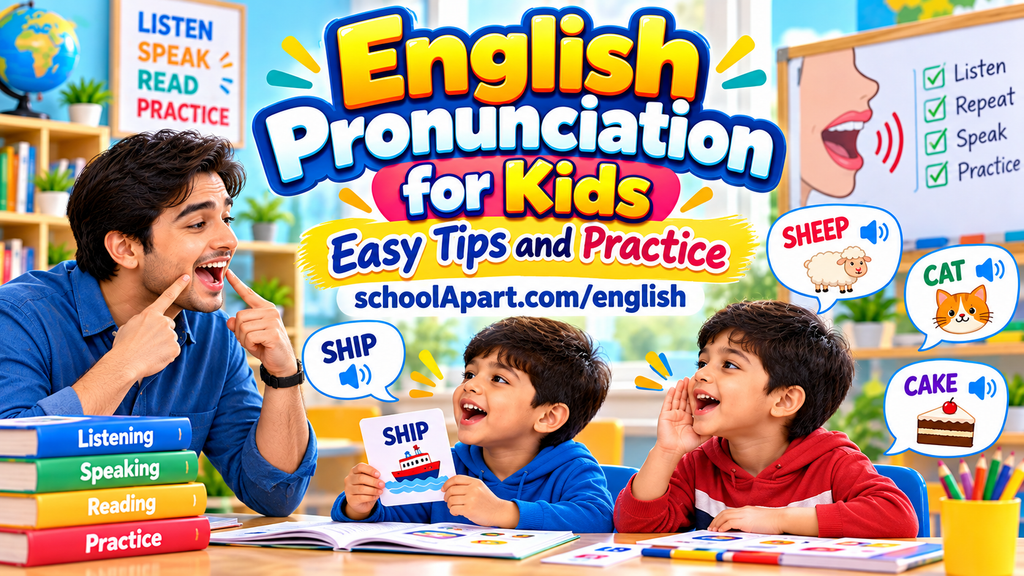
English pronunciation improves through listening, careful practice, and regular use of words in meaningful situations. By exploring vowel and consonant sounds, syllables, word stress, silent letters, and short sentences, children can gradually develop clearer and more confident speech.
Keep practice positive and enjoyable. Celebrate small improvements, allow time for mistakes, and encourage children to use English naturally in conversations at home and at school.
Frequently Asked Questions
1. How can kids improve English pronunciation?
Kids can improve pronunciation by listening to clear examples, repeating familiar words, practising common sounds, reading aloud, and using short sentences. Regular, encouraging practice is more useful than trying to learn everything at once.
2. At what age should children start learning English pronunciation?
Children can begin noticing and practising English sounds as soon as they start engaging with the language. Activities should be age-appropriate, playful, and adjusted to each child’s learning needs.
3. How long should kids practise English pronunciation each day?
Five to ten minutes can be a practical starting point for many children. Short sessions with a clear focus may be more effective than long, tiring practice sessions.
4. What is the difference between phonics and pronunciation?
Phonics teaches how letters and letter combinations relate to sounds, especially when learning to read. Pronunciation focuses on how spoken words are produced, including sounds, syllables, stress, and rhythm. The two areas support each other.
5. Why are English words sometimes pronounced differently from their spelling?
English spelling reflects words from different historical and linguistic sources, so letter-sound patterns are not always consistent. Listening to words in context helps children learn their usual pronunciations.
6. Are tongue twisters useful for children?
Yes. Tongue twisters can help children practise similar sounds, clear articulation, and speaking rhythm. Children should begin slowly and aim for accuracy before speed.
7. Should children copy a British or American accent?
Children do not need to copy one specific accent to speak English well. They can learn from clear examples in different varieties of English and focus on being understandable and consistent.
8. How can parents correct pronunciation mistakes without discouraging children?
Parents can repeat the correct word naturally, model the sound, and invite the child to try again gently. Praise effort and progress instead of interrupting every sentence.
9. What are some difficult English sounds for kids?
Some children find sounds such as /th/, /r/, /v/, or the difference between /s/ and /sh/ challenging. Difficulties vary by child and by the languages they already know. Listening and gentle practice can help.
10. Does good pronunciation mean speaking quickly?
No. Good pronunciation means producing sounds and words clearly enough to be understood. Speaking quickly is not necessary; a comfortable pace and clear speech are more important.


Leave a Reply