
Learn 100 opposite words for kids with simple meanings, example sentences, and fun activities to build English vocabulary and speaking skills.
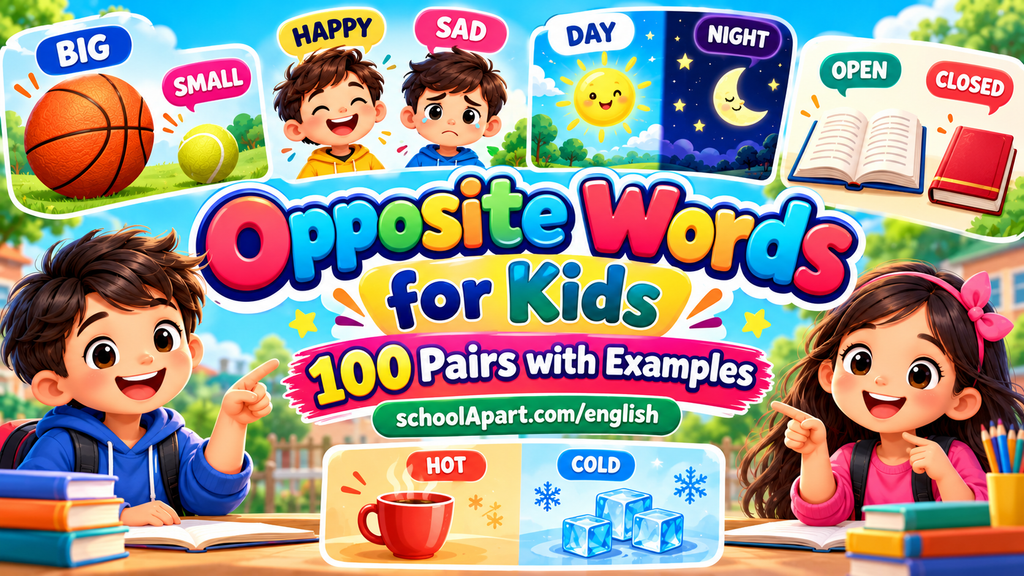
Opposite Words for Kids: 100 Pairs with Examples
Opposite words are words that have different or contrasting meanings. For example, big and small, hot and cold, and happy and sad are opposite words.
Learning opposite words helps children understand the meaning of words, describe people and objects, and express their thoughts more clearly in English. It is also a fun way to improve vocabulary, reading, writing, and spoken English.
In this guide, children will learn 100 pairs of opposite words with simple example sentences. Parents and teachers can use these word pairs for daily practice, classroom activities, and vocabulary games.
What Are Opposite Words?
Opposite words are words with contrasting meanings. They are also called antonyms.
For example:
- Big — Small: An elephant is big, but a mouse is small.
- Hot — Cold: The soup is hot, but the ice cream is cold.
- Happy — Sad: She is happy today, but he feels sad.
Opposite words help children compare things, describe differences, and communicate more effectively.
100 Opposite Words for Kids with Examples
1. Common Opposite Words
These simple word pairs are a great starting point for young learners.
| No. | Word | Opposite | Example sentence |
|---|---|---|---|
| 1 | Big | Small | The elephant is big, but the mouse is small. |
| 2 | Hot | Cold | The tea is hot, but the juice is cold. |
| 3 | Happy | Sad | I feel happy today, but my friend feels sad. |
| 4 | Up | Down | The balloon went up, and the leaf fell down. |
| 5 | In | Out | The cat is in the box, but the dog is out. |
| 6 | Open | Closed | The door is open, but the window is closed. |
| 7 | Fast | Slow | The rabbit is fast, but the turtle is slow. |
| 8 | Day | Night | We see the sun during the day and the moon at night. |
| 9 | Light | Dark | The room is light, but the cupboard is dark inside. |
| 10 | Good | Bad | That was a good choice, but this was a bad one. |
2. Opposite Words for Size and Shape
Use these pairs to describe the size, height, length, and shape of objects.
| No. | Word | Opposite | Example sentence |
|---|---|---|---|
| 11 | Tall | Short | The giraffe is tall, but the dog is short. |
| 12 | Long | Short | This rope is long, but that rope is short. |
| 13 | Wide | Narrow | This road is wide, but that path is narrow. |
| 14 | Thick | Thin | This book is thick, but that notebook is thin. |
| 15 | Heavy | Light | The suitcase is heavy, but the bag is light. |
| 16 | Large | Tiny | The pumpkin is large, but the seed is tiny. |
| 17 | Deep | Shallow | The lake is deep, but the pond near our house is shallow. |
| 18 | High | Low | The kite is high in the sky, but the ball is low on the ground. |
| 19 | Round | Square | The coin is round, but the tile is square. |
| 20 | Straight | Curved | This line is straight, but that line is curved. |
3. Opposite Words for Feelings and Personality
These words help children describe emotions, behaviour, and personal qualities.
| No. | Word | Opposite | Example sentence |
|---|---|---|---|
| 21 | Kind | Unkind | A kind child helps others, but an unkind action can hurt them. |
| 22 | Brave | Afraid | She was brave enough to speak, although her brother was afraid. |
| 23 | Polite | Rude | A polite student says “please,” while a rude student may interrupt. |
| 24 | Friendly | Unfriendly | Our new neighbour is friendly, but the dog seems unfriendly. |
| 25 | Calm | Nervous | He stayed calm during the test, but I felt nervous. |
| 26 | Quiet | Noisy | The library is quiet, but the playground is noisy. |
| 27 | Proud | Ashamed | She felt proud of her work, while he felt ashamed of his mistake. |
| 28 | Patient | Impatient | A patient person can wait, but an impatient person dislikes waiting. |
| 29 | Generous | Selfish | A generous child shares toys, but a selfish child keeps everything. |
| 30 | Cheerful | Gloomy | The cheerful room felt welcoming, but the gloomy room felt dull. |
4. Opposite Words for Temperature, Touch, and Condition
These pairs help children describe how things feel or what condition they are in.
| No. | Word | Opposite | Example sentence |
|---|---|---|---|
| 31 | Warm | Cool | The blanket feels warm, but the breeze is cool. |
| 32 | Wet | Dry | My shirt is wet, but my trousers are dry. |
| 33 | Clean | Dirty | My hands are clean, but my shoes are dirty. |
| 34 | Soft | Hard | The pillow is soft, but the table is hard. |
| 35 | Smooth | Rough | The glass is smooth, but the tree bark is rough. |
| 36 | Fresh | Stale | The bread is fresh, but the crackers are stale. |
| 37 | Sweet | Sour | The mango is sweet, but the lemon is sour. |
| 38 | Sharp | Blunt | This pencil is sharp, but that pencil is blunt. |
| 39 | Full | Empty | My water bottle is full, but his bottle is empty. |
| 40 | Healthy | Sick | She is healthy, but her brother is sick today. |
5. Opposite Words for Movement and Position
These words describe where things are and how they move.
| No. | Word | Opposite | Example sentence |
|---|---|---|---|
| 41 | Come | Go | Please come here before you go outside. |
| 42 | Enter | Exit | We enter through this door and exit through that one. |
| 43 | Arrive | Depart | The train will arrive at noon and depart later. |
| 44 | Push | Pull | Push the door to open it and pull it to close it. |
| 45 | Rise | Fall | The sun appears to rise in the morning, and leaves may fall in autumn. |
| 46 | Climb | Descend | We climb the hill and descend carefully. |
| 47 | Advance | Retreat | The team began to advance, then had to retreat. |
| 48 | Left | Right | Turn left at the shop, then turn right at the crossing. |
| 49 | Front | Back | The teacher stands at the front, and the clock is at the back. |
| 50 | Above | Below | The picture is above the desk, and the bag is below it. |
6. Opposite Words for Time and Order
These pairs help children talk about time, sequence, and change.
| No. | Word | Opposite | Example sentence |
|---|---|---|---|
| 51 | Early | Late | I arrived early, but my friend arrived late. |
| 52 | Before | After | Wash your hands before lunch and brush your teeth after dinner. |
| 53 | First | Last | I finished first, and my friend finished last. |
| 54 | Begin | End | We begin the lesson at nine and end it at ten. |
| 55 | Start | Finish | Start your drawing now and finish it before lunch. |
| 56 | Past | Future | We learn from the past and prepare for the future. |
| 57 | Always | Never | She always smiles and never forgets to greet us. |
| 58 | Often | Rarely | I often read books and rarely watch television. |
| 59 | Temporary | Permanent | This is a temporary arrangement, but the new rule is permanent. |
| 60 | Ancient | Modern | The museum has ancient tools and modern machines. |
7. Opposite Words for Actions
These pairs help children understand contrasting actions.
| No. | Word | Opposite | Example sentence |
|---|---|---|---|
| 61 | Laugh | Cry | The funny story made me laugh, but the sad film made me cry. |
| 62 | Give | Take | I give my friend a pencil, and she may take it to use. |
| 63 | Buy | Sell | We buy books from the shop, and the shopkeepers sell them. |
| 64 | Win | Lose | One team will win, and the other may lose. |
| 65 | Remember | Forget | I remember my homework and never want to forget it. |
| 66 | Accept | Refuse | You can accept an invitation or politely refuse it. |
| 67 | Build | Destroy | Workers build a house, but a storm can destroy a weak structure. |
| 68 | Connect | Disconnect | Connect the cable before you disconnect the power. |
| 69 | Increase | Decrease | We increase the volume and decrease it when it is too loud. |
| 70 | Include | Exclude | Include everyone in the game; do not exclude anyone. |
8. Opposite Words for School and Everyday Life
These useful pairs appear in lessons, conversations, and daily activities.
| No. | Word | Opposite | Example sentence |
|---|---|---|---|
| 71 | Correct | Incorrect | Your first answer is correct, but the second is incorrect. |
| 72 | Right | Wrong | It is right to tell the truth and wrong to cheat. |
| 73 | Easy | Difficult | This question is easy, but the next one is difficult. |
| 74 | Simple | Complicated | The first rule is simple, but the final puzzle is complicated. |
| 75 | Possible | Impossible | It is possible to learn a new word every day, but finishing this huge task in one second is impossible. |
| 76 | Safe | Dangerous | This playground is safe, but that broken bridge is dangerous. |
| 77 | Careful | Careless | A careful student checks the answer, while a careless student may miss a mistake. |
| 78 | Busy | Free | I am busy with homework now, but I will be free later. |
| 79 | Same | Different | We have the same book but different notebooks. |
| 80 | Public | Private | The public library is open to visitors, but my diary is private. |
9. Opposite Words for Nature and the Environment
Children can use these words when describing weather, nature, and the world around them.
| No. | Word | Opposite | Example sentence |
|---|---|---|---|
| 81 | Sunny | Cloudy | It is sunny today, but tomorrow may be cloudy. |
| 82 | Noisy | Silent | The busy street is noisy, but the room became silent. |
| 83 | Natural | Artificial | A real flower is natural, but a plastic flower is artificial. |
| 84 | Wild | Tame | A wild animal lives naturally in the wild, while a tame animal may live with people. |
| 85 | Wet | Dry | The ground is wet after the rain and dry in the sunshine. |
| 86 | Bright | Dim | The classroom is bright, but the hallway is dim. |
| 87 | Clear | Cloudy | The sky is clear today, but it was cloudy yesterday. |
| 88 | Alive | Dead | The plant is alive, but the fallen leaf is dead. |
| 89 | Fertile | Barren | Fertile soil can grow crops, but barren land may support very little plant growth. |
| 90 | Nocturnal | Diurnal | An owl is generally nocturnal, while many songbirds are diurnal. |
10. More Useful Opposite Words
These additional pairs introduce children to a wider range of English vocabulary.
| No. | Word | Opposite | Example sentence |
|---|---|---|---|
| 91 | Loud | Soft | The music is loud, but the whisper is soft. |
| 92 | Cheap | Expensive | This pencil is cheap, but that electronic device is expensive. |
| 93 | Rich | Poor | The story describes a rich merchant and a poor farmer. |
| 94 | Strong | Weak | The strong rope held the box, but the weak string broke. |
| 95 | Clever | Foolish | It was clever to ask for help and foolish to ignore the warning. |
| 96 | Beautiful | Ugly | The garden looks beautiful, but the damaged wall looks ugly. |
| 97 | Maximum | Minimum | The maximum score is 100, and the minimum passing score is 40. |
| 98 | Entrance | Exit | We waited at the entrance and left through the exit. |
| 99 | Agree | Disagree | I agree with your idea, but my friend may disagree. |
| 100 | Create | Destroy | Artists create pictures, while careless actions can destroy them. |
Note: Some opposite words depend on context. For example, “light” can mean not heavy or not dark, and its opposite changes accordingly. Some pairs above are contrasts rather than exact opposites in every situation.
How to Teach Opposite Words to Kids
Children learn best when they can see, hear, and use words in meaningful situations. Try these activities to make learning enjoyable.
1. Use Real Objects
Show children objects with contrasting qualities.
Examples:
- A big ball and a small ball.
- A full glass and an empty glass.
- A long pencil and a short pencil.
- A clean cloth and a dirty cloth.
Say each word aloud and ask the child to identify its opposite.
2. Play the Opposite Word Game
Say one word and ask the child to say its opposite.
Adult: Hot.
Child: Cold.
Adult: Tall.
Child: Short.
Adult: Happy.
Child: Sad.
Start with easy pairs and gradually introduce more challenging words.
3. Match the Opposite Words
Write words on separate cards. Ask children to match each word with its opposite.
For example:
- Big → Small
- Open → Closed
- Fast → Slow
- Clean → Dirty
- Early → Late
This activity can be done individually, in pairs, or in small groups.
4. Make Sentences with Opposite Words
Ask children to use both words in a sentence.
Examples:
- My bag is heavy, but my pencil case is light.
- The rabbit is fast, but the turtle is slow.
- The room is bright, but the cupboard is dark.
- My answer is correct, but your answer is incorrect.
This helps children learn how opposites work in real sentences.
5. Practise Through Drawing
Ask children to draw two contrasting things on one page. They could draw a big tree beside a small tree or a sunny day beside a cloudy day.
Under each drawing, ask them to write the two opposite words.
6. Revise Five Pairs Every Day
Choose five pairs and practise them for a few minutes. Ask the child to say each word, explain its meaning, and use it in a sentence. Revisit previous pairs regularly.
Opposite Words Practice for Kids
Try these exercises to check your understanding.
Exercise 1: Fill in the Blanks
Choose the correct opposite word.
- Big — ______
- Hot — ______
- Happy — ______
- Open — ______
- Fast — ______
- Clean — ______
- Early — ______
- Strong — ______
- Easy — ______
- Full — ______
Word bank: Small, Cold, Sad, Closed, Slow, Dirty, Late, Weak, Difficult, Empty
Exercise 2: Match the Opposites
Match the words in Column A with their opposites in Column B.
| Column A | Column B |
|---|---|
| 1. Tall | a. Wrong |
| 2. Correct | b. Short |
| 3. Give | c. Pull |
| 4. Push | d. Take |
| 5. Above | e. Below |
Exercise 3: Choose the Correct Word
- The ice cream is (hot / cold).
- The elephant is (big / small).
- A careful student is less likely to be (careless / helpful).
- We enter through the entrance and leave through the (exit / classroom).
- The room is bright during the day and may be (dim / strong) at night.
Exercise Answer Key
Exercise 1: 1. Small; 2. Cold; 3. Sad; 4. Closed; 5. Slow; 6. Dirty; 7. Late; 8. Weak; 9. Difficult; 10. Empty.
Exercise 2: 1–b; 2–a; 3–d; 4–c; 5–e.
Exercise 3: 1. Cold; 2. Big; 3. Careless; 4. Exit; 5. Dim.
Related English Learning Guides
Help your child explore more English vocabulary and speaking activities with these guides:
- 100 Basic English Words for Kids — build a foundation of common English vocabulary.
- Action Words for Kids — learn common action verbs with meanings and examples.
- Daily Use English Words for Kids — practice useful English words and phrases for everyday conversations.
- School Vocabulary for Kids — learn words related to classrooms, school subjects, and school activities.
Opposite words help children understand vocabulary, compare objects, describe feelings, and express ideas clearly. Learning word pairs such as big and small, hot and cold, and happy and sad gives children a useful foundation for English reading, writing, and speaking.
Start with a few pairs each day. Use real objects, simple sentences, matching games, and drawing activities to make practice enjoyable. With regular revision and encouragement, children can gradually use opposite words more confidently in everyday English.
Frequently Asked Questions
1. What are opposite words for kids?
Opposite words are words with contrasting meanings. For example, big and small, hot and cold, and happy and sad are opposite word pairs.
2. What is another name for opposite words?
Opposite words are also called antonyms. Antonyms have contrasting meanings, such as fast and slow or open and closed.
3. Why should children learn opposite words?
Learning opposite words helps children build vocabulary, compare objects, describe feelings, understand reading passages, and communicate more clearly in English.
4. How many opposite words should kids learn each day?
Children can start with three to five pairs a day. They should practise the meanings and use each pair in a sentence before learning too many new words.
5. What are some easy opposite words for beginners?
Easy examples include big–small, hot–cold, up–down, in–out, happy–sad, fast–slow, open–closed, and clean–dirty.
6. How can parents teach opposite words at home?
Parents can use real objects, picture cards, drawing activities, matching games, and short question-and-answer exercises. Everyday situations provide many opportunities to practise opposites.
7. Are opposite words useful for spoken English?
Yes. Opposite words help children describe differences, explain ideas, and make their spoken sentences more meaningful. For example, “My bag is heavy, but my pencil case is light.”
8. What is the difference between opposite words and synonyms?
Opposite words have contrasting meanings, such as hot and cold. Synonyms have similar meanings, such as happy and glad. Both help children expand their vocabulary.
9. Do all words have exact opposites?
No. Some words have clear opposites, while others have different contrasts depending on the context. For example, the opposite of “light” can be “heavy” when talking about weight or “dark” when talking about brightness.
10. How can children remember opposite words easily?
Children can remember opposite words by learning them in pairs, making example sentences, drawing contrasting pictures, playing vocabulary games, and revising regularly.
Leave a Reply