
Learn daily use English words for kids with 100 common words, polite expressions, and easy phrases for speaking confidently at home and school.
Daily Use English Words for Kids: Words and Phrases
Learning English becomes easier when children practise words they can use in everyday life. From saying “Good morning” to asking for help, simple English words and phrases help kids communicate confidently at home, at school, and with friends.
In this guide, children will learn 100 daily use English words and phrases with simple meanings and easy examples. Parents and teachers can use this list for short speaking activities, daily conversations, and vocabulary practice.
Why Should Kids Learn Daily Use English Words?
Daily-use vocabulary helps children express their needs, feelings, ideas, and questions. Instead of memorising long word lists, kids can learn a few useful expressions and practise using them in real situations.
Learning these words can help children:
- Speak more confidently in everyday situations.
- Understand common English instructions and questions.
- Ask for help and express their needs politely.
- Communicate with parents, teachers, and friends.
- Build a strong foundation for spoken English.
Greetings and Everyday Expressions
These expressions help children start conversations and respond naturally.
| No. | Word or phrase | Simple meaning | Example |
|---|---|---|---|
| 1 | Hello | A friendly greeting | Hello, how are you? |
| 2 | Hi | An informal greeting | Hi, Sam! |
| 3 | Good morning | A greeting used in the morning | Good morning, Mom! |
| 4 | Good afternoon | A greeting used after midday | Good afternoon, teacher! |
| 5 | Good evening | A greeting used in the evening | Good evening, Grandma! |
| 6 | Good night | Something we say before sleeping or leaving at night | Good night, Dad! |
| 7 | Goodbye | A word used when leaving | Goodbye, see you tomorrow! |
| 8 | See you | A friendly way to say goodbye | See you after school! |
| 9 | Welcome | A friendly greeting to someone arriving | Welcome to our home! |
| 10 | How are you? | A question about someone’s well-being | How are you today? |
Polite Words for Good Manners
Polite expressions help children speak respectfully and develop good communication habits.
| No. | Word or phrase | Simple meaning | Example |
|---|---|---|---|
| 11 | Please | Used to make a request politely | Please pass me the book. |
| 12 | Thank you | Used to show gratitude | Thank you for your help. |
| 13 | You’re welcome | A reply to “Thank you” | You’re welcome, Mia. |
| 14 | Sorry | Used to apologise | Sorry, I made a mistake. |
| 15 | Excuse me | Used to get attention or apologise politely | Excuse me, may I ask a question? |
| 16 | Pardon? | Used when you did not hear something clearly | Pardon? Could you say that again? |
| 17 | May I? | A polite way to ask permission | May I come in? |
| 18 | After you | Used to let someone go first | After you, please. |
| 19 | No, thank you | A polite way to refuse something | No, thank you. I’m full. |
| 20 | That’s okay | A friendly response when something is not a problem | That’s okay. Don’t worry. |
Useful Words for Asking for Help
Children need simple expressions to ask questions, explain problems, and understand instructions.
| No. | Word or phrase | Simple meaning | Example |
|---|---|---|---|
| 21 | Help | Support when something is difficult | Please help me with this question. |
| 22 | Can you? | Used to ask someone to do something | Can you open the door? |
| 23 | Could you? | A polite way to make a request | Could you help me, please? |
| 24 | I need | Used to say what is necessary | I need a pencil. |
| 25 | I want | Used to express a wish | I want some water. |
| 26 | I don’t know | Used when you do not have an answer | I don’t know the answer. |
| 27 | I understand | Used when something is clear | I understand the lesson. |
| 28 | I don’t understand | Used when something is unclear | I don’t understand this word. |
| 29 | Please repeat | A request to say something again | Please repeat the question. |
| 30 | What does it mean? | A question about meaning | What does this word mean? |
Common Words for Everyday Conversation
These short words and expressions help children respond during conversations.
| No. | Word or phrase | Simple meaning | Example |
|---|---|---|---|
| 31 | Yes | Used to agree or answer positively | Yes, I am ready. |
| 32 | No | Used to disagree or answer negatively | No, I am not tired. |
| 33 | Okay | Used to show agreement or acceptance | Okay, let’s start. |
| 34 | Maybe | Something that is possible but not certain | Maybe we can play later. |
| 35 | Sure | Used to show agreement or willingness | Sure, I can help. |
| 36 | Really? | Used to show surprise or interest | Really? That’s amazing! |
| 37 | Of course | Used to show agreement or permission | Of course, you can join us. |
| 38 | I think | Used to share an opinion | I think this answer is correct. |
| 39 | I agree | Used to show that you have the same opinion | I agree with you. |
| 40 | Not yet | Used when something has not happened so far | I haven’t finished yet. |
Words for Home and Family Conversations
Children can use these everyday expressions when talking with family members.
| No. | Word or phrase | Simple meaning | Example |
|---|---|---|---|
| 41 | Come here | A request to move closer | Come here, please. |
| 42 | Wait a minute | A request to wait briefly | Wait a minute, Mom. |
| 43 | I’m ready | Used when you are prepared | I’m ready for school. |
| 44 | I’m hungry | Used when you want food | I’m hungry. Can I have a snack? |
| 45 | I’m thirsty | Used when you want a drink | I’m thirsty. May I have some water? |
| 46 | I’m tired | Used when you need rest | I’m tired after playing. |
| 47 | Where is it? | A question about location | Where is my school bag? |
| 48 | Here it is | Used when you find or present something | Here it is! I found my book. |
| 49 | It’s mine | Used to say something belongs to you | This pencil is mine. |
| 50 | Let’s go | A suggestion to leave or start moving | Let’s go to the park. |
Useful Expressions for School
These phrases help children communicate with teachers and classmates.
| No. | Word or phrase | Simple meaning | Example |
|---|---|---|---|
| 51 | May I come in? | A polite request to enter | May I come in, teacher? |
| 52 | May I go out? | A request for permission to leave | May I go out for a moment? |
| 53 | I have a question | Used before asking something | I have a question about this lesson. |
| 54 | I have finished | Used when a task is complete | I have finished my homework. |
| 55 | I am trying | Used when you are making an effort | I am trying to solve the problem. |
| 56 | Please explain | A request for an explanation | Please explain this answer. |
| 57 | Which page? | A question about a page number | Which page should we read? |
| 58 | I forgot | Used when you cannot remember something | I forgot my notebook. |
| 59 | Can I borrow this? | A request to use something temporarily | Can I borrow your ruler? |
| 60 | Here you are | Said when handing something to someone | Here you are. This is your book. |
Words for Feelings and Emotions
Children should learn to describe their feelings clearly and appropriately.
| No. | Word or phrase | Simple meaning | Example |
|---|---|---|---|
| 61 | Happy | Feeling pleased | I am happy today. |
| 62 | Sad | Feeling unhappy | I feel sad when my friend leaves. |
| 63 | Excited | Feeling very happy about something coming | I’m excited about the school trip. |
| 64 | Worried | Feeling concerned about something | I’m worried about the test. |
| 65 | Scared | Feeling afraid | I am scared of the loud noise. |
| 66 | Angry | Feeling upset or annoyed | I feel angry when someone breaks my toy. |
| 67 | Proud | Feeling pleased about an achievement | I’m proud of my drawing. |
| 68 | Bored | Feeling that something is not interesting | I’m bored. Can we play a game? |
| 69 | Surprised | Feeling unexpected excitement or wonder | I’m surprised to see you here! |
| 70 | Calm | Feeling peaceful and relaxed | I feel calm after taking a deep breath. |
Words for Time and Daily Routines
These expressions help children talk about when things happen and what comes next.
| No. | Word or phrase | Simple meaning | Example |
|---|---|---|---|
| 71 | Today | This day | Today is Monday. |
| 72 | Tomorrow | The day after today | We have a test tomorrow. |
| 73 | Yesterday | The day before today | Yesterday, I visited my cousin. |
| 74 | Now | At this moment | I am doing my homework now. |
| 75 | Later | At a time after the present | I’ll call you later. |
| 76 | Soon | In a short time | The bus will arrive soon. |
| 77 | Early | Before the expected time | I woke up early today. |
| 78 | Late | After the expected time | Don’t be late for school. |
| 79 | First | Before everything else | First, wash your hands. |
| 80 | Next | Coming after something | Next, open your book. |
Words for Playing and Spending Time with Friends
Children can use these phrases to invite others, share ideas, and enjoy games together.
| No. | Word or phrase | Simple meaning | Example |
|---|---|---|---|
| 81 | Let’s play | A suggestion to play together | Let’s play a board game. |
| 82 | Your turn | It is your time to do something | Your turn to roll the dice. |
| 83 | My turn | It is your time to do something | It’s my turn now. |
| 84 | Join us | An invitation to take part | Join us in the game. |
| 85 | Good idea | Used to praise a suggestion | That’s a good idea! |
| 86 | Well done | Used to praise someone’s effort or success | Well done! You solved it. |
| 87 | Be careful | A warning to act safely | Be careful near the stairs. |
| 88 | Watch out | A quick warning about possible danger | Watch out! The ball is coming. |
| 89 | Let’s share | A suggestion to use or divide something together | Let’s share the crayons. |
| 90 | I can do it | Used to express confidence | I can do it myself. |
Short Phrases for Natural Speaking
These expressions help children connect ideas and keep conversations going.
| No. | Word or phrase | Simple meaning | Example |
|---|---|---|---|
| 91 | That’s great | Used to show happiness or approval | You won the prize? That’s great! |
| 92 | That’s funny | Used when something makes you laugh | That’s a funny story! |
| 93 | I see | Used to show understanding | I see. Now I understand. |
| 94 | Me too | Used to say you feel or think the same | I like apples. Me too! |
| 95 | Me neither | Used to agree with a negative statement | I don’t like loud noises. Me neither. |
| 96 | Why not? | Used to ask why something should not happen or to show willingness | Let’s read together. Why not? |
| 97 | It depends | Used when an answer changes with the situation | Can we play outside? It depends on the weather. |
| 98 | Never mind | Used to say something is not important or no longer needs attention | Never mind. I found it. |
| 99 | Take your time | A friendly way to tell someone not to hurry | Take your time while answering. |
| 100 | See you soon | A friendly goodbye when you expect to meet again | See you soon, my friend! |
How to Practise Daily Use English Words at Home
Children learn more effectively when they use new expressions in real situations. Try these simple activities for 5–10 minutes each day.
1. Learn Five Expressions a Day
Choose five words or phrases from this list. Read them aloud, understand their meanings, and make one new sentence with each expression.
2. Use English During Daily Routines
Parents can encourage children to use short English phrases during familiar activities.
For example:
- Before school: “I’m ready.”
- At mealtime: “May I have some water, please?”
- During homework: “I need help.”
- While playing: “It’s your turn.”
- Before sleeping: “Good night!”
3. Practise Question-and-Answer Conversations
Ask a simple question and let your child respond in English.
Parent: How are you today?
Child: I’m happy.
Parent: Are you ready for school?
Child: Yes, I’m ready.
Parent: What do you need?
Child: I need my school bag.
Keep the conversation short and friendly. Help your child when necessary, but give them time to answer independently.
4. Play the Everyday Expression Game
Write five expressions on separate cards. Ask your child to choose a card and use that expression in a real or pretend situation.
For example, if the card says “Excuse me,” the child can practise using it to get a teacher’s attention politely.
5. Practise Without Fear of Mistakes
Children may make grammar or pronunciation mistakes while learning. Encourage them to keep speaking. Repeat the correct expression naturally instead of interrupting every sentence.
A Simple 7-Day English Speaking Plan
| Day | Practice focus | Activity |
|---|---|---|
| Day 1 | Greetings | Practise saying hello, good morning, and goodbye. |
| Day 2 | Polite expressions | Use please, thank you, and excuse me. |
| Day 3 | Asking for help | Practise asking questions and requesting help. |
| Day 4 | Home conversations | Use everyday phrases with family members. |
| Day 5 | School conversations | Role-play asking a teacher a question. |
| Day 6 | Feelings and opinions | Describe feelings and share simple opinions. |
| Day 7 | Revision | Choose 10 phrases and use them in a short conversation. |
Parents and teachers can repeat this plan every week, introducing different expressions as children become more confident.
Tips for Parents and Teachers
- Teach expressions in context rather than asking children to memorise long lists.
- Use clear pronunciation and short sentences.
- Encourage children to answer in English when they feel comfortable.
- Praise effort, not just perfect grammar.
- Revisit familiar words regularly before introducing too many new ones.
- Let children practise through games, storytelling, role-play, and daily conversations.
For more vocabulary practice, read our guide to 100 Basic English Words for Kids. Children can also explore Action Words for Kids to learn common verbs and use them in sentences.
If your child is just starting to learn spoken English, begin with our Spoken English for Kids: Complete Beginner’s Guide. For practical home routines, read How to Learn Spoken English at Home. You can also explore How to Improve English Speaking Skills for Kids for more speaking practice ideas.
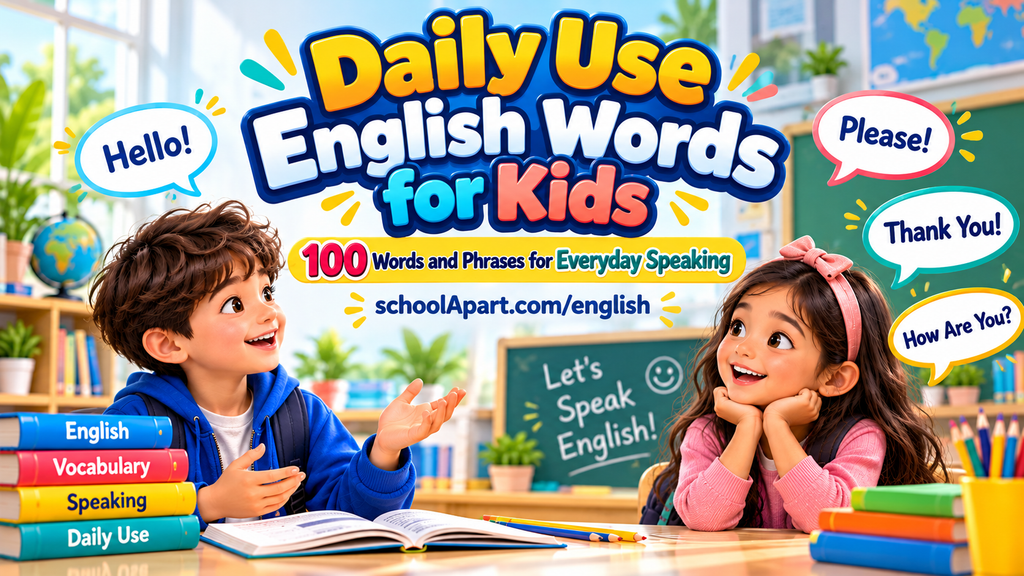
Daily use English words and phrases help children communicate naturally in familiar situations. From greetings and polite expressions to school questions and friendly replies, each phrase gives children another way to express themselves.
Start with a few expressions each day and encourage your child to use them at home, at school, and while playing with friends. With regular practice, patience, and encouragement, children can gradually become more confident English speakers.
Frequently Asked Questions
1. What are daily use English words for kids?
Daily use English words are common words and phrases children use in everyday situations, such as “please,” “thank you,” “I’m ready,” and “Can you help me?”
2. How can kids learn daily use English words easily?
Kids can learn easily by practising a few words each day, listening to simple English conversations, reading examples aloud, and using new expressions at home and school.
3. How many English words should a child learn each day?
There is no fixed number for every child. Start with three to five useful words or phrases each day and focus on understanding and using them correctly.
4. How can parents help children practise spoken English at home?
Parents can ask simple questions, have short English conversations during daily routines, read aloud with their children, and use games or role-play to practise common expressions.
5. What is the difference between basic English words and daily use English phrases?
Basic English words include common vocabulary that helps children name things, people, actions, and ideas. Daily use English phrases focus more on communicating in real situations, such as asking for help, greeting someone, or responding politely.
6. At what age can children start learning daily use English words?
Children can begin learning simple English words and expressions when they are ready to engage with language. Parents and teachers should choose age-appropriate examples and keep practice short, enjoyable, and encouraging.
7. How can children remember daily use English phrases?
Children can remember phrases by repeating them in meaningful situations, using them in short conversations, revising them regularly, and practising through games and role-play.
8. Should children worry about making mistakes while speaking English?
No. Mistakes are a normal part of learning. Children should be encouraged to express themselves, practise regularly, and learn from gentle corrections without feeling embarrassed.

Leave a Reply