

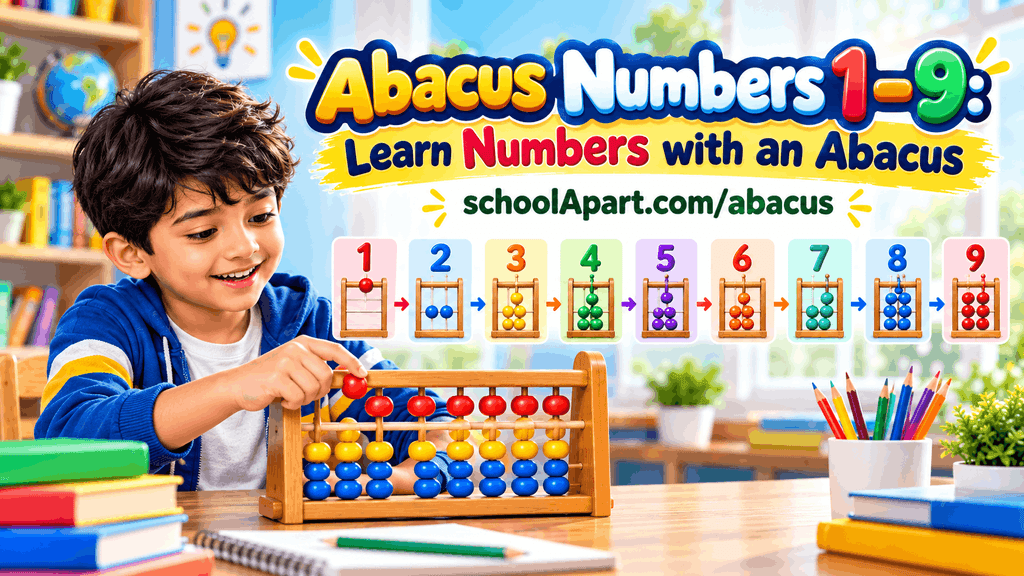
Learn abacus numbers 1–9 step by step. Understand how to represent each number on an abacus and practice reading numbers for beginners and kids.
Abacus Numbers 1–9: Learn Numbers with an Abacus
Learning how to represent numbers is one of the first important steps in learning abacus.
Before a student starts addition, subtraction or more advanced abacus calculations, they need to understand how numbers are represented using beads.
In this beginner-friendly guide, you will learn how to represent numbers 1 to 9 on an abacus, how to read them, and how to practice number recognition.
What Are Abacus Numbers?
Abacus numbers are numbers represented by moving beads on an abacus.
Instead of writing a number on paper, you use the beads to show its numerical value.
For example, a learner can represent:
1 → 2 → 3 → 4 → 5 → 6 → 7 → 8 → 9
by moving the appropriate beads on the abacus.
Learning these basic numbers creates the foundation for later skills such as:
- Place value
- Addition
- Subtraction
- Multiplication
- Division
- Mental abacus
Understanding the Abacus Before Learning Numbers
Before practicing numbers 1–9, you should understand the basic parts of your abacus.
A typical school abacus contains:
- A frame
- Vertical rods or columns
- Beads
- A central bar or divider
The beads are used to represent numerical values.
Each column can represent a different place value when you move beyond single-digit numbers.
For beginners, however, the first goal is simply to learn how to represent 1 through 9 correctly.
If you are completely new to abacus learning, first read:
What Is Abacus? A Complete Beginner’s Guide for Kids
How to Represent Numbers 1–9 on an Abacus
The exact bead arrangement can depend on the type of abacus being used.
For a common school abacus with a central bar, beginners generally learn the single-digit values by understanding the beads’ values and moving the appropriate beads toward the working position.
The important thing is not just memorizing the visual appearance of a number.
You should understand why the bead arrangement represents that number.
Number 1
To represent 1, move the appropriate unit-value bead into the active position.
The resulting arrangement represents:
1
Practice showing 1 several times until you can create it confidently without hesitation.
Number 2
To represent 2, add another unit value.
The arrangement now represents:
2
Practice moving between 1 and 2:
1 → 2 → 1 → 2
This helps you become familiar with bead movement.
Number 3
Number 3 is represented by three units.
3 = 1 + 1 + 1
Practice:
1 → 2 → 3
Then return:
3 → 2 → 1
Number 4
Number 4 represents four units.
4 = 1 + 1 + 1 + 1
Practice moving from 3 to 4 and then back to 3.
3 → 4 → 3
Number 5
Five is an important number to understand because many abacus systems use a higher-value bead to represent five.
So:
5 = 5
Instead of thinking only about five individual units, learn the value of the appropriate five-value bead.
Practice moving between:
4 → 5 → 4
This is an important transition for beginners.
Number 6
Number 6 can be represented as:
6 = 5 + 1
This means the five-value bead is combined with one unit value.
Practice:
5 → 6 → 5
Number 7
Number 7 can be represented as:
7 = 5 + 2
Practice:
6 → 7 → 6
As you practice, pay attention to how the bead positions change.
Number 8
Number 8 can be represented as:
8 = 5 + 3
Practice:
7 → 8 → 7
Try to recognize the number without counting every bead individually.
Number 9
Number 9 can be represented as:
9 = 5 + 4
Practice:
8 → 9 → 8
Number 9 completes the basic single-digit sequence.
Abacus Numbers 1–9 at a Glance
| Number | Simple Representation |
|---|---|
| 1 | 1 |
| 2 | 2 |
| 3 | 3 |
| 4 | 4 |
| 5 | 5 |
| 6 | 5 + 1 |
| 7 | 5 + 2 |
| 8 | 5 + 3 |
| 9 | 5 + 4 |
The important idea is to understand the relationship between the unit values and the five-value bead rather than simply memorizing pictures.
Learn Abacus Numbers 1–9 in Order
Start by learning the numbers sequentially:
1 → 2 → 3 → 4 → 5 → 6 → 7 → 8 → 9
Repeat the sequence several times.
Then practice backwards:
9 → 8 → 7 → 6 → 5 → 4 → 3 → 2 → 1
This helps you become familiar with moving the beads in both directions.
Practice Random Abacus Numbers
After learning the sequence, stop practicing only in order.
Try random numbers:
3 → 8 → 1 → 6 → 9 → 4 → 7 → 2 → 5
Ask yourself:
Can I represent this number without counting from 1?
This is an important step toward faster number recognition.
How to Read Numbers on an Abacus
Learning to represent numbers is only half of the skill.
You should also learn to read numbers from the bead arrangement.
For example, if you see an arrangement representing:
7
you should be able to recognize it as 7 without counting each bead repeatedly.
Start with simple numbers and gradually increase the speed of recognition.
A good practice sequence is:
Look → Recognize → Say the Number
Do not immediately start calculating.
First build strong number recognition.
Abacus Number Recognition Practice
Try these exercises with a physical abacus.
Exercise 1: Sequential Practice
Represent:
1, 2, 3, 4, 5, 6, 7, 8, 9
Then return from:
9, 8, 7, 6, 5, 4, 3, 2, 1
Exercise 2: Random Numbers
Represent:
4, 8, 2, 7, 5, 9, 1, 6, 3
Exercise 3: Quick Recognition
Ask someone to show you a number on the abacus.
Try to identify it without counting the beads one by one.
Exercise 4: Number Changes
Start with one number and change it to another.
For example:
2 → 5
5 → 8
8 → 3
3 → 9
Focus on the bead movement required for each change.
How Children Can Practice Abacus Numbers
Children can make number practice more engaging by turning it into a short activity.
For example:
Parent: Show me 4.
Child: Represents 4 on the abacus.
Parent: Now show me 8.
Child: Changes the abacus to 8.
The goal is to gradually make number recognition faster and more natural.
You can also call out random numbers and ask the child to represent them.
Common Mistakes When Learning Abacus Numbers
Counting Every Bead Every Time
Counting from the beginning for every number can slow down number recognition.
Try to recognize common bead patterns instead.
Memorizing Without Understanding
Do not simply memorize how a number looks.
Understand how the bead values create the number.
Ignoring Number Transitions
Practice moving from one number to another.
For example:
4 → 5
and
5 → 6
are useful transitions for beginners.
Trying to Calculate Too Soon
Make sure single-digit numbers are comfortable before moving into more difficult calculations.
Practicing Only in Sequence
Random-number practice is important because real calculation does not always follow 1, 2, 3, 4…
How Long Should You Practice Abacus Numbers?
Beginners do not need extremely long practice sessions.
A short, regular routine can be effective.
For example:
5 minutes: Learn or review numbers
5 minutes: Represent random numbers
5 minutes: Read numbers from the abacus
5 minutes: Practice number transitions
The exact duration can be adjusted according to the learner’s age and level.
The main goal is consistent practice.
What Should You Learn After Abacus Numbers 1–9?
Once you can confidently represent and recognize numbers 1–9, the next step is to understand place value.
You can then learn:
Ones → Tens → Hundreds → Thousands
This allows you to represent larger numbers such as:
12
35
126
548
Understanding place value is essential before moving into more advanced abacus calculations.
Abacus Learning Path for Beginners
The beginner learning sequence can be:
What Is an Abacus?
↓
Learn Abacus Step by Step
↓
Abacus Numbers 1–9
↓
Abacus Place Value
↓
How to Read Numbers on an Abacus
↓
Abacus Addition
↓
Abacus Subtraction
↓
Multiplication and Division
↓
Mental Abacus
↓
Practice and Speed
This sequence helps learners build each skill on top of the previous one.
Learn Abacus Numbers with SchoolApart
SchoolApart’s Abacus Learning Hub is designed to help beginners move through abacus learning step by step.
If you are starting from the beginning, you can first read:
Then use this guide to practice numbers 1–9.
Once you are comfortable with single-digit numbers, continue to Abacus Place Value: Ones, Tens and Hundreds.
For practical demonstrations, you can also follow the SchoolApart Abacus Course on YouTube.
Frequently Asked Questions
What are abacus numbers?
Abacus numbers are numerical values represented using the beads of an abacus.
How do you learn numbers 1–9 on an abacus?
Start by learning the bead values and then practice representing 1 through 9. After that, practice random numbers and number recognition.
Why is 5 important when learning abacus numbers?
In many common school abacus systems, a higher-value bead represents five. Understanding this makes it easier to represent numbers 5–9.
How is 6 represented on an abacus?
In a common five-based bead arrangement, 6 can be understood as 5 + 1.
How is 9 represented on an abacus?
In a common five-based bead arrangement, 9 can be understood as 5 + 4.
Should children memorize abacus numbers?
Children should understand the bead values and practice number patterns rather than relying only on memorization.
What should I learn after numbers 1–9?
The next important topic is place value, starting with ones, tens and hundreds.
Can I learn abacus numbers at home?
Yes. Beginners can practice representing and reading numbers at home using a suitable abacus and regular practice.
Learning numbers 1–9 is one of the first practical steps in abacus learning.
Start with the basic numbers, understand the bead values, and practice both representing and reading numbers.
Once you can recognize and represent 1–9 confidently, you will have a stronger foundation for learning place value and performing calculations.
The learning sequence is simple:
Understand → Represent → Read → Practice → Improve
Start with the numbers, build accuracy, and then move on to the next stage of abacus learning.








Leave a Reply