
Confused about drawing and painting? Learn the key differences between drawing and painting, their tools, techniques, benefits, and which one is better for beginners in this complete guide.
Drawing vs Painting: What’s the Difference? A Complete Comparison for Beginners
If you’re new to art, one of the first questions you might ask is:
“What’s the difference between drawing and painting?”
Although both are forms of visual art, they use different materials, techniques, and creative approaches. Some artists love the simplicity of drawing with a pencil, while others enjoy expressing themselves through colorful paintings.
The good news is that neither drawing nor painting is better than the other. Each has its own strengths, and learning both can help you become a more skilled and confident artist.
In this guide, you’ll discover the major differences between drawing and painting, their advantages, required materials, learning difficulty, and which one is the best choice for beginners.
Whether you’re a school student, a hobby artist, or someone starting an artistic journey, this comparison will help you make the right choice.
What Is Drawing?
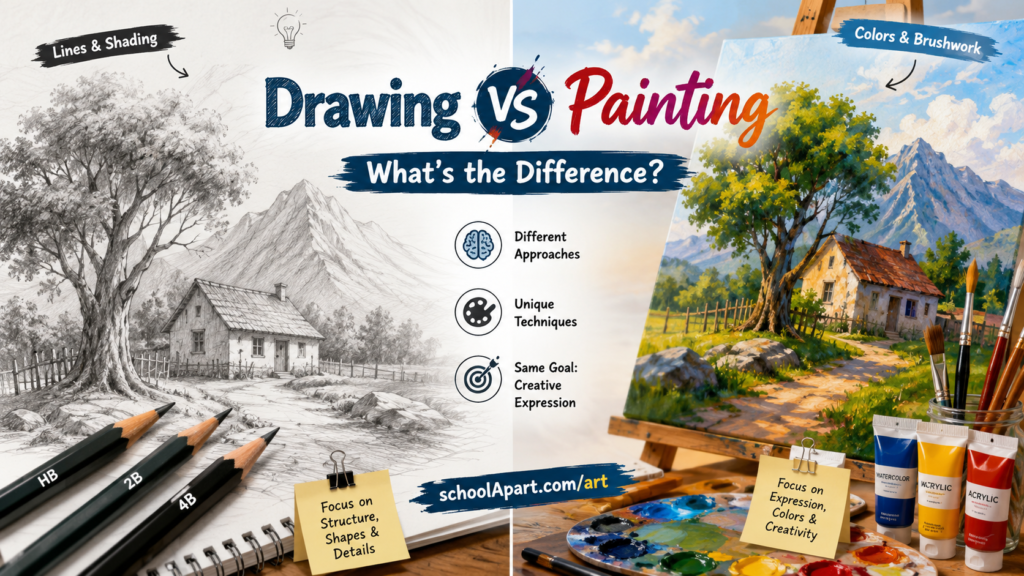
Drawing is the process of creating images using lines, shapes, shading, and textures. It is usually done with dry tools such as pencils, charcoal, graphite sticks, pens, or colored pencils.
Drawing focuses more on:
- Lines
- Structure
- Shapes
- Proportion
- Perspective
- Light and shadow
Artists often begin with a drawing before adding color through painting.
Common Drawing Tools
- Graphite pencils
- Mechanical pencils
- Charcoal
- Colored pencils
- Pens
- Markers
- Erasers
- Sketchbooks
Popular Types of Drawing
- Pencil Drawing
- Sketching
- Cartoon Drawing
- Portrait Drawing
- Nature Drawing
- Technical Drawing
- Architectural Drawing
- Digital Line Art
What Is Painting?
Painting is the process of creating artwork by applying colors to a surface using brushes, palette knives, sponges, or other painting tools.
Unlike drawing, painting emphasizes:
- Colors
- Brush strokes
- Textures
- Color blending
- Depth
- Visual expression
Painting allows artists to create vibrant and expressive artwork using different kinds of paints.
Common Painting Tools
- Paint brushes
- Watercolor paints
- Acrylic paints
- Oil paints
- Poster colors
- Canvas
- Painting paper
- Palette
- Water container
- Easel
Popular Types of Painting
- Watercolor Painting
- Acrylic Painting
- Oil Painting
- Gouache Painting
- Poster Color Painting
- Finger Painting
- Canvas Painting
- Digital Painting
Drawing vs Painting: Quick Overview
Although both belong to the world of visual art, they differ in several important ways.
| Feature | Drawing | Painting |
|---|---|---|
| Primary Focus | Lines, shapes, shading | Colors and brushwork |
| Main Medium | Graphite, charcoal, ink | Watercolor, acrylic, oil, gouache |
| Main Tool | Pencil or pen | Brush or palette knife |
| Skill Focus | Observation and precision | Color blending and creativity |
| Typical Surface | Paper | Paper, canvas, wood, fabric |
| Cleanup | Very easy | Requires cleaning brushes and palettes |
| Beginner Cost | Low | Moderate |
| Learning Curve | Easier to start | Slightly more complex |
| Portability | Highly portable | Less portable |
| Common Use | Sketches, illustrations, designs | Fine art, landscapes, colorful artwork |
Key Differences Between Drawing and Painting
Let’s explore each difference in detail.
1. Materials Used
One of the biggest differences is the materials required.
Drawing Materials
Drawing usually requires only a few basic supplies.
Examples:
- Pencil
- Eraser
- Sharpener
- Sketchbook
- Drawing paper
Many beginners can start drawing with materials they already have at home.
Painting Materials
Painting generally requires more equipment.
Examples:
- Paints
- Brushes
- Canvas or painting paper
- Palette
- Water container
- Cleaning cloth
- Easel (optional)
Because of the extra materials, painting often costs more than drawing.
2. Lines vs Colors
Drawing mainly depends on lines and shading.
Artists create form by controlling:
- Line thickness
- Pencil pressure
- Shadows
- Highlights
- Texture
Painting, however, relies heavily on colors.
Painters use:
- Color mixing
- Brush strokes
- Layering
- Transparency
- Texture
- Color harmony
This makes painting visually richer, while drawing often appears simpler and more structured.
3. Techniques
Drawing techniques include:
- Sketching
- Cross-hatching
- Hatching
- Blending
- Stippling
- Contour drawing
- Shading
Painting techniques include:
- Wet-on-wet
- Wet-on-dry
- Dry brushing
- Glazing
- Layering
- Scumbling
- Color washing
Each art form has unique methods that artists learn through practice.
4. Learning Curve
Most beginners find drawing easier to learn.
Why?
Because drawing usually focuses on one tool—a pencil—and fewer materials.
Painting introduces additional skills such as:
- Color theory
- Mixing paints
- Brush control
- Layering colors
- Drying time
- Surface preparation
Although painting may seem more challenging at first, both skills become easier with regular practice.
5. Cost of Getting Started
Drawing is one of the most affordable art hobbies.
A beginner can start with:
- HB pencil
- Eraser
- Sharpener
- Sketchbook
Painting usually requires purchasing several additional items.
For example:
- Paint set
- Brushes
- Palette
- Canvas
- Water container
- Painting paper
This makes painting slightly more expensive for beginners.
6. Time Required
Drawing projects often take less time.
Simple sketches can be completed in just a few minutes.
Paintings usually require:
- Multiple layers
- Drying time
- Color adjustments
- Brush cleaning
As a result, painting projects often take longer to finish.
7. Portability
Drawing is extremely portable.
You can carry:
- A sketchbook
- Two pencils
- An eraser
And begin drawing almost anywhere.
Painting is less portable because artists often need:
- Paints
- Brushes
- Water
- Palette
- Cleaning materials
Outdoor painting is possible, but it requires more preparation than drawing.
8. Mistakes and Corrections
Mistakes happen in every artwork.
With drawing:
- Pencil marks can often be erased.
- Light sketches are easy to adjust.
- Beginners can quickly fix proportions.
With painting:
- Corrections may require painting over mistakes.
- Some paints dry permanently.
- Color matching can be difficult.
For this reason, many artists create a pencil sketch before they begin painting.
Similarities Between Drawing and Painting
Despite their differences, drawing and painting share many important characteristics.
Both:
- Develop creativity
- Improve observation skills
- Strengthen concentration
- Encourage patience
- Help express emotions
- Build confidence
- Improve hand-eye coordination
- Require regular practice
- Can become professional careers
- Are enjoyable lifelong hobbies
Learning one art form often makes it easier to learn the other.
Which Skill Should You Learn First?
This is one of the most common questions among beginners.
For most people, drawing is the best place to start.
Drawing teaches the fundamental skills that every artist needs, including:
- Shapes
- Proportions
- Perspective
- Light and shadow
- Observation
- Hand control
Once you are comfortable with these basics, transitioning to painting becomes much easier because you already understand how to build objects and compositions before adding color.
Drawing vs Painting: A Detailed Comparison
Now that you understand the basic differences, let’s compare drawing and painting in greater detail. This section will help beginners decide which art form best matches their interests, goals, and learning style.
Drawing vs Painting: Skill Comparison
Different artistic skills are developed through drawing and painting. Although both improve creativity, each emphasizes different techniques.
| Skill | Drawing | Painting |
|---|---|---|
| Observation | ⭐⭐⭐⭐⭐ | ⭐⭐⭐⭐☆ |
| Line Control | ⭐⭐⭐⭐⭐ | ⭐⭐⭐☆☆ |
| Shading | ⭐⭐⭐⭐⭐ | ⭐⭐⭐⭐☆ |
| Color Mixing | ⭐☆☆☆☆ | ⭐⭐⭐⭐⭐ |
| Brush Control | ⭐☆☆☆☆ | ⭐⭐⭐⭐⭐ |
| Creativity | ⭐⭐⭐⭐☆ | ⭐⭐⭐⭐⭐ |
| Precision | ⭐⭐⭐⭐⭐ | ⭐⭐⭐⭐☆ |
| Experimentation | ⭐⭐⭐☆☆ | ⭐⭐⭐⭐⭐ |
Key takeaway: Drawing strengthens technical fundamentals, while painting develops color awareness and creative expression.
Advantages of Drawing
Drawing is often the first art skill students learn because it is simple, affordable, and highly effective for developing artistic fundamentals.
Benefits of Drawing
- Requires very few materials.
- Easy to practice anywhere.
- Builds strong observation skills.
- Improves hand-eye coordination.
- Helps you understand proportions and perspective.
- Mistakes can usually be erased easily.
- Provides an excellent foundation for painting and digital art.
- Suitable for students of all ages.
Because drawing focuses on shapes and structure, it helps beginners learn how objects are built before adding color.
Advantages of Painting
Painting introduces students to the exciting world of color and visual expression.
Benefits of Painting
- Encourages creativity and imagination.
- Teaches color theory naturally.
- Produces vibrant, eye-catching artwork.
- Offers many styles and techniques to explore.
- Helps develop patience through layering and blending.
- Improves brush control and color mixing skills.
- Allows artists to create expressive and emotional artwork.
Painting is ideal for students who enjoy experimenting with colors and textures.
Challenges of Drawing
Although drawing is easier to begin, beginners may face several challenges.
Common difficulties include:
- Understanding perspective.
- Drawing accurate proportions.
- Creating realistic shading.
- Making smooth, confident lines.
- Avoiding flat-looking drawings.
These skills improve with regular practice.
Challenges of Painting
Painting introduces additional concepts that beginners must learn.
Common challenges include:
- Mixing colors correctly.
- Choosing suitable brushes.
- Controlling paint consistency.
- Preventing muddy colors.
- Waiting for paint layers to dry.
- Maintaining clean brushes and palettes.
These challenges become easier as experience grows.
Which Is Easier for Beginners?
For most beginners, drawing is easier to start with.
Reasons include:
- Fewer materials are required.
- Lower cost.
- Less preparation.
- Easier cleanup.
- Simple corrections using an eraser.
Painting becomes easier after students understand basic drawing skills.
Which Is Better for School Students?
For school students, learning both drawing and painting provides the best artistic foundation.
A recommended learning path is:
Step 1
Learn drawing basics:
- Lines
- Shapes
- Perspective
- Shading
Step 2
Practice simple pencil sketches.
Step 3
Learn basic color theory.
Step 4
Start watercolor or poster color painting.
Step 5
Try acrylic or digital painting as your skills improve.
This gradual approach helps students build confidence without feeling overwhelmed.
Which Costs Less?
Budget is an important factor for many beginners.
Drawing
Basic supplies:
- HB Pencil
- 2B Pencil
- Eraser
- Sharpener
- Sketchbook
Estimated cost: Low
Painting
Basic supplies:
- Paints
- Brushes
- Palette
- Painting paper or canvas
- Water container
Estimated cost: Moderate
Drawing is generally the more affordable choice for beginners.
Which Takes More Time?
The time needed depends on the artwork, but in general:
Drawing
- Faster setup.
- No drying time.
- Easy to pause and continue later.
Painting
- Longer preparation.
- Multiple layers may be required.
- Paint often needs drying time.
- Brushes and palettes must be cleaned after use.
Can You Learn Drawing and Painting Together?
Yes.
In fact, many professional artists recommend learning both simultaneously.
A balanced weekly routine might look like this:
| Day | Activity |
|---|---|
| Monday | Pencil sketching |
| Tuesday | Shading practice |
| Wednesday | Watercolor exercises |
| Thursday | Object drawing |
| Friday | Color mixing practice |
| Saturday | Complete a simple painting |
| Sunday | Review and experiment with new ideas |
This routine helps students develop both technical drawing skills and color confidence.
Common Myths About Drawing and Painting
Many beginners have misconceptions about learning art.
Myth 1: You Must Be Born Talented
Reality: Artistic skill improves through consistent practice, observation, and patience.
Myth 2: Painting Is Always Harder
Reality: Painting introduces different challenges, but many beginners find it enjoyable once they understand basic drawing.
Myth 3: Expensive Materials Make Better Artists
Reality: Quality tools help, but regular practice matters much more than expensive supplies.
Myth 4: You Must Master Drawing Before Painting
Reality: A basic understanding of drawing is helpful, but beginners can explore simple painting projects while continuing to improve their drawing skills.
Myth 5: Mistakes Mean You’re Not Good at Art
Reality: Every artist makes mistakes. Each sketch and painting is part of the learning process.
Expert Tips for Beginners
If you’re just starting your artistic journey, these tips can help you improve more quickly:
- Practice a little every day instead of drawing once a week.
- Observe real objects rather than relying only on memory.
- Start with simple subjects before attempting complex scenes.
- Experiment with different pencil grades and paint types.
- Keep an art journal or sketchbook.
- Study the work of experienced artists for inspiration.
- Don’t compare your progress with others.
- Focus on enjoying the learning process.
Small, consistent improvements lead to significant artistic growth over time.
Which One Should You Choose?
The answer depends on your interests and goals.
Choose Drawing If You:
- Enjoy sketching ideas.
- Prefer simple materials.
- Like precise lines and details.
- Want to improve observation skills.
- Have a limited budget.
Choose Painting If You:
- Love working with colors.
- Enjoy experimenting with creative effects.
- Want to create vibrant artwork.
- Like blending and layering techniques.
- Don’t mind spending more time on each project.
Final Recommendation
For most beginners and school students, the ideal path is:
- Learn drawing fundamentals.
- Practice sketching regularly.
- Understand light and shadow.
- Learn basic color theory.
- Begin watercolor painting.
- Explore acrylic, oil, or digital painting as your skills develop.
This progression builds a strong artistic foundation while making learning enjoyable and manageable.
Quick Comparison Cheat Sheet
Need a quick answer? Here’s a side-by-side comparison of drawing and painting.
| Feature | Drawing | Painting |
|---|---|---|
| Main Focus | Lines, shapes, shading | Colors, textures, brushwork |
| Primary Tools | Pencils, charcoal, pens | Brushes, paints, palette |
| Main Skill | Observation & precision | Color mixing & creativity |
| Beginner Friendly | ⭐⭐⭐⭐⭐ | ⭐⭐⭐⭐☆ |
| Cost | Low | Moderate |
| Cleanup | Easy | Moderate |
| Portability | Excellent | Good |
| Learning Curve | Easier | Slightly more challenging |
| Best For | Sketches, outlines, illustrations | Landscapes, portraits, colorful artwork |
| Suitable for School Students | Excellent | Excellent |
Final Verdict: Drawing or Painting?
There is no single “winner” because drawing and painting complement each other rather than compete.
If you’re just starting your artistic journey, drawing is the ideal first step. It teaches the essential fundamentals of art, including:
- Line control
- Shapes
- Perspective
- Proportion
- Shading
- Observation
Once you’ve built confidence with these basics, you’ll find painting much easier because you’ll already understand how to create accurate forms and compositions.
Painting then allows you to bring those drawings to life with color, texture, and expressive brushwork.
The strongest artists don’t choose one over the other—they learn and practice both.
Learning Path for Beginners
If you’re wondering where to start, follow this simple roadmap.
Stage 1 – Drawing Basics
Learn:
- Lines
- Shapes
- Pencil control
- Basic shading
Stage 2 – Sketching
Practice drawing:
- Fruits
- Flowers
- Trees
- Houses
- Cartoon characters
Stage 3 – Color Basics
Understand:
- Primary colors
- Secondary colors
- Warm and cool colors
- Color harmony
Stage 4 – Painting
Start with:
- Watercolor
- Poster colors
Later move to:
- Acrylic painting
- Oil painting
- Digital painting
This step-by-step approach builds strong artistic skills without overwhelming beginners.
Key Takeaways
- Drawing focuses on lines, structure, and shading.
- Painting focuses on color, texture, and visual expression.
- Drawing requires fewer materials and costs less.
- Painting offers greater opportunities for color exploration.
- Drawing is generally easier for beginners.
- Painting becomes easier after learning drawing fundamentals.
- Both art forms improve creativity, concentration, and observation skills.
- Learning both provides the strongest artistic foundation.
Frequently Asked Questions (FAQ)
1. What is the main difference between drawing and painting?
Drawing uses lines, shapes, and shading to create images, while painting uses colors and brushes to create artwork.
2. Which is easier to learn: drawing or painting?
For most beginners, drawing is easier because it requires fewer materials and focuses on fundamental skills.
3. Should I learn drawing before painting?
Yes. Learning drawing first helps you understand shapes, proportions, perspective, and shading, making painting easier later.
4. Can I learn drawing and painting at the same time?
Yes. Many students practice drawing several days a week while spending one or two days learning basic painting techniques.
5. Is painting more expensive than drawing?
Generally, yes. Painting requires additional supplies such as paints, brushes, palettes, and canvas or painting paper.
6. Which is better for school students?
Both are valuable. Drawing develops technical skills, while painting encourages creativity and color awareness.
7. Do professional artists both draw and paint?
Yes. Most professional artists use drawing for planning and painting to complete their artwork.
8. Can I become good at painting without drawing?
You can learn painting without mastering drawing first, but basic drawing skills make painting significantly easier.
9. Which art form improves creativity more?
Both improve creativity in different ways. Drawing emphasizes observation and design, while painting focuses on color and visual expression.
10. What supplies do I need to start drawing?
A beginner can start with an HB pencil, a 2B pencil, an eraser, a sharpener, and a sketchbook.
11. What supplies do I need to start painting?
Basic supplies include watercolor or poster colors, brushes, painting paper, a palette, and a water container.
12. Which art form takes less time?
Simple drawings are usually faster to complete because they don’t require paint preparation or drying time.
13. Is drawing useful for digital art?
Yes. Most digital artists begin by learning traditional drawing because it teaches composition, anatomy, perspective, and line control.
14. Can children learn both drawing and painting?
Absolutely. Children can start with simple pencil drawings and gradually explore watercolor, poster colors, and other beginner-friendly painting techniques.
15. Which should I choose if I have a limited budget?
Drawing is the better option because it requires fewer materials and has a lower starting cost.
Drawing and painting are two of the most rewarding creative skills anyone can learn. While drawing focuses on structure, precision, and observation, painting brings artwork to life through color, texture, and emotion.
Instead of thinking about drawing vs painting, think of them as drawing and painting. Drawing provides the foundation, while painting expands your creative possibilities.
For beginners, the best approach is to start with simple pencil drawings, build confidence through regular practice, and then gradually introduce color through watercolor or poster painting. Over time, you can explore acrylics, oils, and even digital painting.
Whether your goal is to create realistic portraits, colorful landscapes, fun cartoons, or digital illustrations, mastering both drawing and painting will help you become a more skilled and versatile artist.
Remember: every masterpiece begins with a single line and grows with practice, patience, and creativity.

Leave a Reply