

Learn how to build confidence in students with 12 practical tips, daily habits, and activities that help children believe in themselves and grow.
How to Build Confidence in Students: 12 Simple Ways
Confidence is an important part of a student’s growth. It can help students try new things, share their ideas, ask questions, learn from mistakes, and take part in school activities.
However, not every student feels confident in every situation. Some students hesitate to answer questions in class, worry about making mistakes, or compare themselves with their classmates. Others may feel comfortable with familiar tasks but become nervous when facing something new.
The good news is that confidence is not something students must have from the beginning. It can grow gradually through practice, encouragement, positive experiences, and learning to handle challenges.
In this guide, you will discover 12 practical ways to build confidence in students, along with simple activities, daily habits, and useful tips for parents and teachers.
What Is Confidence in Students?
Confidence means having a reasonable belief in yourself and your ability to try, learn, and improve.
A confident student does not necessarily know every answer or perform every task perfectly. Instead, the student is willing to make an effort, ask for help when needed, and learn from experience.
For example, a student who is learning to solve a difficult maths problem may not know the answer immediately. However, the student can still feel confident enough to try different methods, ask questions, and keep learning.
Confidence can appear in many areas of school life, including:
- Answering questions in class.
- Trying a new activity or subject.
- Expressing ideas and opinions.
- Working with classmates.
- Accepting mistakes and learning from them.
- Taking responsibility for small tasks.
- Asking for help when something is difficult.
- Setting goals and working towards them.
Every student is different. The aim is not to make every child behave in the same way but to help each student develop a healthy belief in their own ability to grow.
Why Is Confidence Important for Students?
Healthy self-confidence can help students approach learning and everyday challenges with a more positive attitude.
Here are some important benefits.
1. Encourages Classroom Participation
Students who feel more confident may be more willing to ask questions, share ideas, and participate in discussions.
They can gradually learn that the classroom is a place to explore ideas, not a place where every answer must be perfect.
2. Helps Students Try New Things
A new subject, school activity, or group project can feel challenging.
Confidence can encourage students to give unfamiliar tasks a try instead of avoiding them simply because they are not sure they will succeed.
3. Supports Independent Learning
Students who believe they can improve may become more willing to solve problems independently before asking for assistance.
They can also learn when to seek help rather than feeling that asking questions is a sign of weakness.
4. Helps Students Handle Mistakes
Mistakes are a normal part of learning.
Healthy confidence can help students see a mistake as an opportunity to understand what went wrong and what they can do differently next time.
5. Supports Positive Relationships
Students can gradually become more comfortable expressing their needs, sharing opinions, working with classmates, and participating in group activities.
Confidence does not mean dominating conversations. Listening, respecting others, and cooperating are equally important.
12 Simple Ways to Build Confidence in Students
Parents, teachers, and students can use the following practical strategies to encourage confidence over time.
1. Set Small and Achievable Goals
One of the simplest ways to build confidence is to begin with small goals that students can realistically work towards.
A large task may feel overwhelming, but breaking it into smaller steps can make it easier to begin.
For example, a student who feels uncomfortable participating in class could start by:
- Preparing one answer before a lesson.
- Asking one question when something is unclear.
- Sharing an idea with a partner.
- Participating in a small-group discussion.
- Volunteering to answer a question when ready.
Each completed step provides an opportunity to recognise progress.
Practical tip: Encourage students to choose one small goal each week. Once it becomes manageable, they can choose a new challenge.
2. Encourage Effort, Not Just Results
Students often receive praise for getting high marks, winning competitions, or completing tasks successfully.
Although celebrating achievements is valuable, confidence can also grow when adults recognise preparation, persistence, creativity, and improvement.
Instead of saying only, “You are so clever,” try comments such as:
- “You kept trying even when the question was difficult.”
- “You prepared carefully for your presentation.”
- “You improved because you practised.”
- “You asked a thoughtful question today.”
- “You tried a different way to solve the problem.”
This approach helps students understand that progress comes from learning and effort, not just from being naturally good at something.
3. Help Students Learn from Mistakes
Some students avoid challenges because they are afraid of giving a wrong answer or disappointing others.
Parents and teachers can help by treating mistakes as a normal part of the learning process.
When a student makes a mistake:
- Stay calm and avoid embarrassing the student.
- Discuss what happened without blaming or labelling them.
- Identify what the student can learn from the experience.
- Decide on one practical step to try next time.
For example, if a student makes an error in a classroom presentation, discuss what went well and what could be improved before the next presentation.
The message should be simple: Making a mistake does not mean you cannot improve.
4. Help Students Recognise Their Strengths
Every student has different interests, abilities, and areas of potential growth.
One student may enjoy drawing, another may be good at organising group activities, and another may show patience when helping classmates.
Encourage students to recognise their strengths without comparing them with others.
Ask questions such as:
- What do you enjoy doing?
- Which activity makes you feel proud of your effort?
- What do your friends appreciate about you?
- What is something you have improved recently?
- Which skill would you like to develop further?
Students can write or draw their answers in a notebook.
Recognising strengths can help students build a more balanced view of themselves while understanding that everyone has skills they can continue developing.
5. Give Students Opportunities to Make Choices
Making simple choices can help students practise independence and develop trust in their own judgement.
For example, allow students to choose:
- Which book they want to read.
- Which topic they want to use for a project.
- Which role they would like in a group activity.
- How they want to organise their study materials.
- Which personal learning goal they want to work on.
Offer choices that are appropriate for their age and abilities.
When a decision does not work as expected, help the student review the result and consider other options rather than making them feel ashamed.
This teaches students that decision-making is a skill that develops with experience.
6. Encourage Students to Try New Activities
Trying something unfamiliar can help students discover interests and abilities they did not know they had.
Encourage them to explore suitable activities such as drawing, storytelling, sports, music, coding, gardening, science projects, or teamwork challenges.
Start with a manageable level of difficulty. Students do not need to become experts or win competitions to benefit from participating.
For example, a student who has never taken part in a group project could begin with a small responsibility, such as collecting materials or sharing one idea.
The purpose is to create opportunities for learning, exploration, and gradual progress.
7. Teach Positive and Realistic Self-Talk
The way students speak to themselves can influence how they approach challenges.
A student who repeatedly thinks, “I cannot do this,” may become reluctant to try. Learning to use more balanced language can make it easier to take the next step.
Encourage students to replace discouraging thoughts with realistic alternatives.
| Negative self-talk | More helpful self-talk |
|---|---|
| I cannot do this. | I can try one step at a time. |
| I always make mistakes. | Mistakes help me learn. |
| Everyone is better than me. | Everyone has different strengths. |
| I am not good at this. | I am still learning this skill. |
| I will never improve. | I can improve with practice and support. |
Positive self-talk does not mean pretending that every task is easy. It means recognising difficulties while remembering that effort, guidance, and practice can help.
8. Develop Skills Through Regular Practice
Confidence often grows when students become more familiar with a task.
For example, a student who practises solving maths problems may gradually feel more prepared to attempt similar questions independently.
Likewise, practising conversations, presentations, reading, or group activities can help students become more comfortable with those situations.
Encourage regular, manageable practice rather than expecting immediate results.
Students who want to develop speaking confidence can also read our guide: How to Speak Confidently: Simple Tips for Students.
Remember that confidence and skill development can support each other, but students may still feel nervous when facing unfamiliar challenges.
9. Teach Students to Ask for Help
Confidence does not mean doing everything alone.
Knowing when to ask for help is an important learning skill.
Students may need assistance when they do not understand a lesson, cannot complete a task, feel confused about instructions, or face a problem they cannot solve independently.
Parents and teachers can encourage students to ask specific questions, such as:
- “Could you explain this step again?”
- “Can you show me an example?”
- “I understand the first part, but I am stuck on the next step.”
- “Could you help me understand what I did wrong?”
When students learn that asking for help is acceptable, they can approach difficult situations with greater confidence.
10. Avoid Comparing Students with Others
Comparisons can make students feel that their worth depends on being better than someone else.
Statements such as “Why can’t you be like your classmate?” may discourage students and make them focus on competition instead of personal growth.
Instead, help students compare their current progress with their own previous efforts.
For example:
- Can you solve more of these problems than last week?
- Have you become more comfortable asking questions?
- What have you learned from your recent project?
- Which skill would you like to practise next?
Every student develops at a different pace. Personal progress is a more useful focus than constant comparison.
11. Create a Supportive Learning Environment
Students are more likely to participate when they feel respected and safe to make mistakes.
Parents and teachers can support confidence by:
- Listening carefully when students share their concerns.
- Correcting mistakes respectfully.
- Avoiding humiliation or hurtful labels.
- Giving students time to think before answering.
- Recognising different ways of participating.
- Encouraging cooperation instead of unhealthy competition.
- Providing guidance when a task feels too difficult.
A supportive environment does not mean removing every challenge. It means helping students face appropriate challenges without unnecessary fear or embarrassment.
12. Celebrate Progress and Encourage Reflection
Students may overlook their own improvement when they focus only on their final results.
Regular reflection helps them recognise what they have learned and identify their next steps.
At the end of each week, ask students to answer three simple questions:
- What did I try this week?
- What did I learn or improve?
- What would I like to practise next week?
Younger students can draw pictures or answer verbally. Older students can write a few sentences in a journal.
Celebrate meaningful progress, including small steps such as asking a question, completing a difficult task, or trying an unfamiliar activity.
Over time, this practice can help students recognise that development happens gradually.
7 Confidence-Building Activities for Students
In addition to everyday habits, students can practise confidence through simple activities at school or home.
Activity 1: My Small Goal
Ask students to choose one achievable goal for the week.
Examples:
- Ask one question during a lesson.
- Complete a task independently.
- Share one idea during group work.
- Try an unfamiliar activity.
At the end of the week, discuss what they learned.
Activity 2: Three Things I Do Well
Ask students to write or draw three things they enjoy doing or skills they are developing.
These could include helping others, solving puzzles, drawing, reading, organising materials, or learning a sport.
Remind them that strengths do not have to be extraordinary to be valuable.
Activity 3: The Try-Again Challenge
Choose an age-appropriate task that requires practice, such as completing a puzzle, learning a new drawing technique, or solving a challenging question.
Encourage students to try, review what happened, and attempt it again using a different approach if necessary.
Focus on what they learned rather than whether they completed the task perfectly.
Activity 4: One-Minute Achievement Talk
Invite students to speak for one minute about something they learned, completed, or improved.
They can practise with a parent, friend, or small group before speaking to a larger audience.
This activity combines reflection with an opportunity to practise communication.
Activity 5: Problem-Solving Together
Present a simple problem, such as organising materials for a class project with limited resources.
Ask students to suggest solutions, discuss the options, and choose a plan.
Allow them to explain their reasoning and review the outcome afterwards.
Activity 6: My Progress Journal
Ask students to record one thing they tried, one difficulty they faced, and one thing they learned.
They can use drawings, short sentences, or checklists depending on their age.
Reviewing earlier entries can help them notice progress that might otherwise go unnoticed.
Activity 7: Kind and Helpful Feedback
In pairs, ask students to share one thing their partner did well during a suitable classroom task.
For example, “You explained your idea clearly” or “You listened carefully to the group.”
Encourage specific, sincere feedback rather than comparisons or comments about appearance.
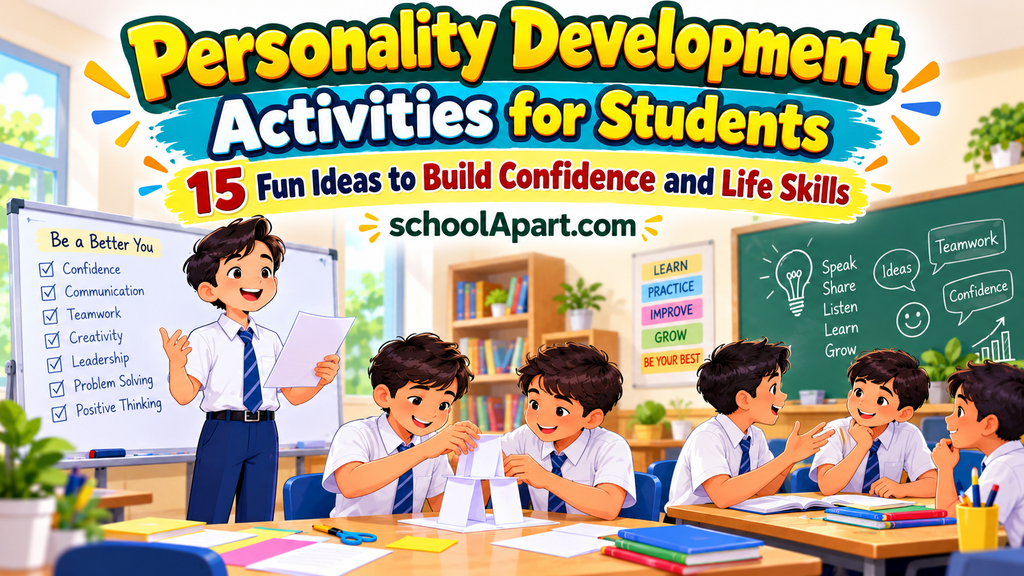
For more activity ideas covering confidence, communication, teamwork, and leadership, visit Personality Development Activities for Students: 15 Fun Ideas.
A Simple 7-Day Confidence-Building Plan
Students can use this flexible plan to begin practising confidence in everyday situations.
| Day | Activity | Goal |
|---|---|---|
| Day 1 | Write down three strengths | Recognise personal strengths |
| Day 2 | Set one small goal | Practise goal-setting |
| Day 3 | Try a task that feels slightly challenging | Build willingness to try |
| Day 4 | Ask a question or request help when needed | Practise self-expression |
| Day 5 | Complete a task with less assistance | Develop independence |
| Day 6 | Reflect on a mistake and what it taught you | Learn from experience |
| Day 7 | Review the week’s progress | Recognise improvement |
This plan is a starting point, not a test. Students can repeat activities, change goals, or take more time when needed.
The aim is to practise useful skills without adding unnecessary pressure.
How Parents Can Help Build Confidence in Students
Parents can support confidence through everyday interactions at home.
Listen Without Immediately Judging
When children share a worry or describe a difficult experience, listen first. Ask questions to understand what happened before offering advice.
Give Age-Appropriate Responsibilities
Let children complete suitable tasks such as organising school materials, preparing items for the next day, or helping with simple household routines.
Offer guidance when needed and gradually allow greater independence as their skills develop.
Encourage Honest Effort
Recognise preparation, persistence, thoughtful choices, and improvement. Avoid making praise depend entirely on marks, awards, or winning.
Respect Individual Differences
Some children enjoy social activities, while others prefer quieter tasks. Confidence can develop in different ways, and every child does not need to become outgoing to grow.
Avoid Excessive Pressure
Encourage children to try new things, but do not expect them to overcome every fear immediately.
Small, manageable steps can be more helpful than forcing a child into a situation that feels overwhelming.
How Teachers Can Build Student Confidence in the Classroom
Teachers can create opportunities for confidence-building through regular classroom practices.
- Use supportive feedback: Explain what a student did well and what they can improve next.
- Encourage questions: Make it acceptable to ask for clarification.
- Provide different participation options: Use individual thinking time, pair discussions, small groups, and whole-class activities.
- Assign meaningful responsibilities: Give students opportunities to organise materials, explain a task, or support group work.
- Recognise different strengths: Value careful listening, creativity, cooperation, preparation, and thoughtful problem-solving.
- Make expectations clear: Students can feel more prepared when they understand what a task involves.
- Allow time for improvement: Give students opportunities to practise a skill again after receiving feedback.
Teachers should also avoid publicly comparing students or treating hesitation as proof that a student lacks ability.
Common Mistakes to Avoid When Building Confidence
Even well-intentioned support can sometimes create unnecessary pressure. Keep these points in mind.
Expecting Immediate Results
Confidence develops at different rates. A student may need several opportunities to become comfortable with a new task.
Praising Only Success
If students receive recognition only when they win or get the highest marks, they may become afraid of trying something difficult.
Recognise effort and improvement as well.
Forcing Students to Perform
Public speaking, competitions, and group activities can be useful opportunities, but students should be supported with preparation and manageable steps.
Avoid using embarrassment or punishment to force participation.
Solving Every Problem for the Student
Helping too quickly can prevent students from practising independent thinking.
Offer hints, ask guiding questions, and allow students to try suitable tasks themselves.
Treating Quietness as a Lack of Confidence
Quiet students can be thoughtful, capable, and confident. They do not need to become the loudest person in the room.
Focus on whether students can express their needs, attempt challenges, and develop skills in ways that suit them.
How Long Does It Take to Build Confidence?
There is no fixed timeline for building confidence.
Some students may become more comfortable with a particular activity after a few practice sessions. Other students may need more time, encouragement, and opportunities.
Progress can also vary by situation. A student might feel confident with friends but nervous when answering a question in class.
Rather than expecting a complete change in personality, focus on specific improvements, such as:
- Being more willing to try.
- Asking for help when needed.
- Recovering more easily after a mistake.
- Participating more comfortably in familiar activities.
- Recognising personal strengths.
- Setting realistic goals and working towards them.
If a student’s fear, distress, or avoidance is persistent and significantly affects everyday life, parents can consider discussing their concerns with an appropriate school professional or qualified child-development professional.
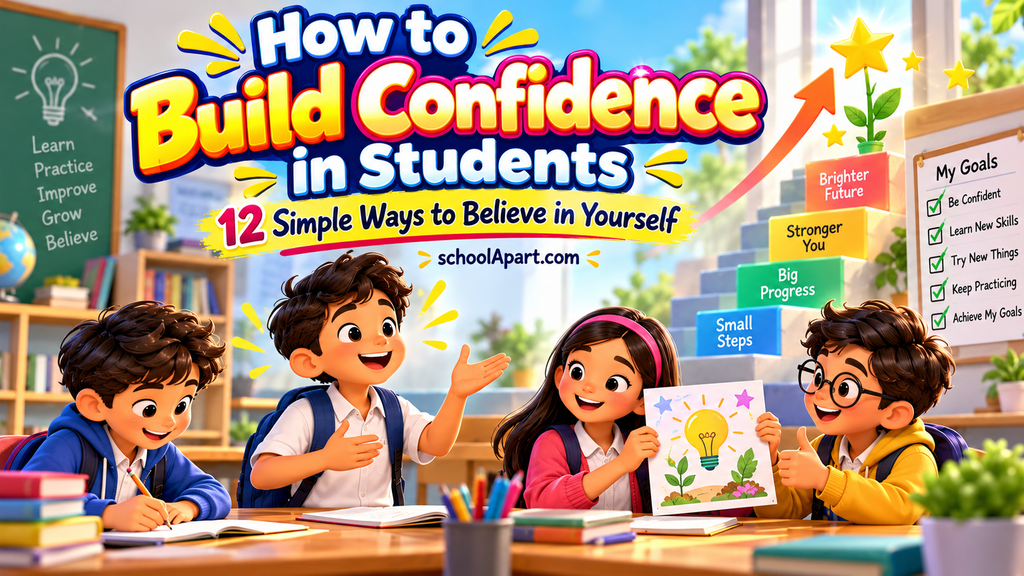
Learning how to build confidence in students is about helping them develop a healthy belief in their ability to learn, try, and improve.
Small goals, supportive feedback, opportunities to make choices, regular practice, and learning from mistakes can all contribute to this process.
Parents and teachers do not need to change a student’s personality. Instead, they can provide encouragement, practical opportunities, and a supportive environment in which different students can develop at their own pace.
Start with one simple step today. Help a student recognise a strength, try a manageable challenge, or reflect on something they have learned.
Over time, these everyday experiences can help students become more comfortable with challenges and better prepared to learn new skills.
For more guidance, explore the Personality Development & Confidence Building for Students Hub.
You can also continue learning through our guides:
- Personality Development for Students: A Complete Guide
- Personality Development Activities for Students: 15 Fun Ideas
- How to Speak Confidently: Simple Tips for Students
Remember: confidence does not mean being perfect. It means being willing to learn, try again, and keep growing.
3. Frequently Asked Questions (FAQ)
1. How can you build confidence in students?
You can help students build confidence by setting small goals, encouraging effort, teaching them to learn from mistakes, recognising their strengths, and providing regular opportunities to practise new skills.
2. Why is confidence important for students?
Confidence can help students participate in learning, try unfamiliar tasks, express their ideas, ask for help, and handle challenges. It can also support independence and positive social interactions.
3. What are the best confidence-building activities for students?
Useful activities include setting small goals, recognising personal strengths, keeping a progress journal, practising problem-solving, giving short talks, and reflecting on lessons learned from mistakes.
4. How can parents build confidence in their children?
Parents can listen supportively, encourage age-appropriate independence, recognise effort, avoid constant comparisons, and help children approach new challenges one step at a time.
5. How can teachers improve students’ confidence?
Teachers can provide respectful feedback, encourage questions, create supportive classroom environments, assign meaningful responsibilities, and offer different ways for students to participate.
6. How can shy students become more confident?
Shy students can begin with manageable activities, such as sharing an idea with a trusted person, participating in pair discussions, or trying a familiar task. Gradually increasing challenges can help them practise at a comfortable pace.
7. Does confidence improve academic performance?
Confidence may help students participate more actively, seek help, and persist with challenging tasks. However, academic performance also depends on factors such as learning opportunities, teaching, practice, and individual circumstances.
8. How long does it take to build self-confidence?
There is no fixed timeline. Some students become more comfortable with particular tasks relatively quickly, while others need more practice and support. Progress should be judged by individual improvement rather than comparison with other students.
9. What is the difference between confidence and overconfidence?
Healthy confidence involves recognising your abilities while remaining open to learning and feedback. Overconfidence can involve overestimating your abilities or ignoring important limitations.
10. Can confidence be learned?
Yes. Students can develop confidence through practice, supportive experiences, realistic goal-setting, feedback, and learning how to handle challenges and mistakes.




Leave a Reply