
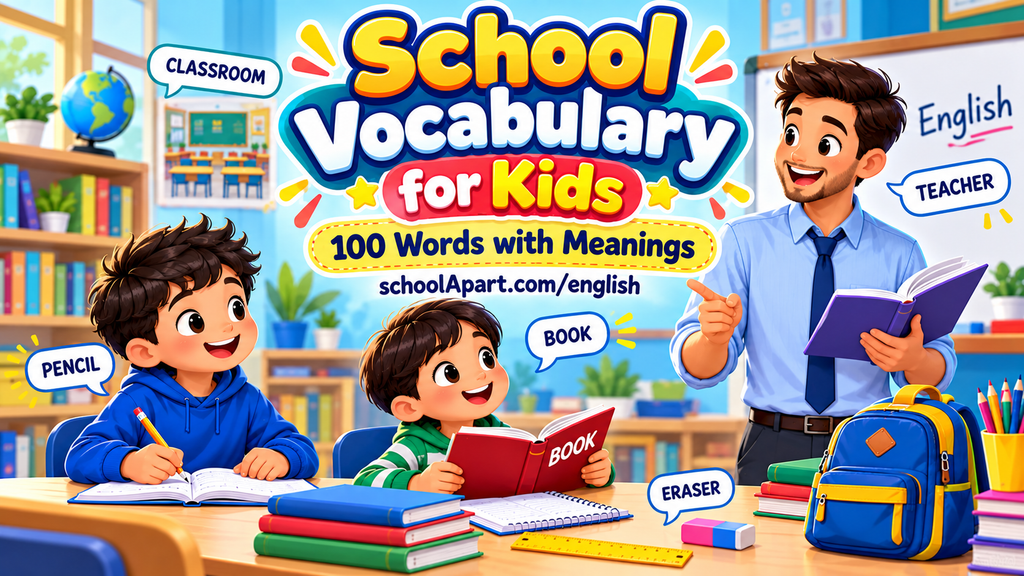
Learn 100 school vocabulary words for kids with simple meanings and example sentences about classroom objects, subjects, school places, and people.
School Vocabulary for Kids
School is a place where children learn new things, make friends, and develop important skills. Knowing common school vocabulary helps kids understand classroom instructions, talk about their lessons, and communicate with teachers and classmates.
In this guide, children will learn 100 school vocabulary words with simple meanings and example sentences. The words are grouped into useful categories, including classroom objects, school subjects, people at school, school places, and everyday school activities.
Parents and teachers can use this list to help children build their vocabulary and practise speaking English with confidence.
Why Is School Vocabulary Important for Kids?
School vocabulary helps children understand the words they hear and use throughout the school day. When children know the names of classroom objects, subjects, school staff, and common activities, they can express themselves more clearly.
Learning school words can help children:
- Understand classroom instructions.
- Name objects they use at school.
- Talk about their subjects and lessons.
- Ask teachers and classmates questions.
- Describe their school and daily activities.
- Build confidence in spoken English.
1. Classroom Objects
These are common objects children see and use in their classrooms.
| No. | Word | Simple meaning | Example sentence |
|---|---|---|---|
| 1 | Book | Something we read to learn or enjoy | I read a book every day. |
| 2 | Notebook | A book used for writing notes | I write my homework in my notebook. |
| 3 | Pencil | A tool used for writing or drawing | I have a sharp pencil. |
| 4 | Pen | A tool used for writing with ink | I write with a blue pen. |
| 5 | Eraser | Something used to remove pencil marks | I use an eraser to correct a mistake. |
| 6 | Ruler | A tool used to measure or draw straight lines | I use a ruler to draw a straight line. |
| 7 | Sharpener | A tool used to sharpen pencils | My pencil needs a sharpener. |
| 8 | School bag | A bag used to carry school items | My school bag is on the chair. |
| 9 | Desk | A piece of furniture used for working | My notebook is on the desk. |
| 10 | Chair | A seat for one person | Please sit on your chair. |
| 11 | Blackboard | A dark board used for writing with chalk | The teacher writes on the blackboard. |
| 12 | Whiteboard | A board used for writing with special markers | We solve sums on the whiteboard. |
| 13 | Chalk | A soft material used to write on a blackboard | The teacher writes with chalk. |
| 14 | Marker | A pen with a thick writing tip | I use a marker to write on the whiteboard. |
| 15 | Crayon | A coloured stick used for drawing | I colour the picture with a crayon. |
| 16 | Colour pencil | A pencil used to draw or colour in different colours | I use a colour pencil to draw a flower. |
| 17 | Scissors | A tool used for cutting paper or other materials | I use scissors carefully in art class. |
| 18 | Glue | A substance used to stick things together | I use glue to attach the paper. |
| 19 | Paper | A material used for writing, drawing, or printing | Please give me a sheet of paper. |
| 20 | Pencil case | A small case used to keep writing tools | My pens are inside my pencil case. |
2. School Subjects
Children study different subjects to develop knowledge and skills.
| No. | Word | Simple meaning | Example sentence |
|---|---|---|---|
| 21 | English | A subject that teaches the English language | I read a story in English class. |
| 22 | Mathematics | A subject about numbers and calculations | I enjoy solving problems in mathematics. |
| 23 | Science | A subject that explores nature and how things work | We learn about plants in science. |
| 24 | History | A subject about past events and people | We learned about an ancient king in history. |
| 25 | Geography | A subject about places, Earth, and the environment | We studied mountains in geography. |
| 26 | Art | A subject that involves drawing, painting, and creating | I made a colourful picture in art class. |
| 27 | Music | A subject that involves singing, instruments, and sounds | We sang a song in music class. |
| 28 | Physical Education | A subject involving exercise, movement, and sports | We play games during physical education. |
| 29 | Computer Studies | A subject about computers and how to use them | We learned about the keyboard in computer studies. |
| 30 | Language | A system of words used for communication | We learn another language at school. |
3. People at School
These words help children identify the people who teach, support, and learn with them.
| No. | Word | Simple meaning | Example sentence |
|---|---|---|---|
| 31 | Student | A person who studies | Every student should bring a notebook. |
| 32 | Teacher | A person who helps students learn | My teacher explains the lesson clearly. |
| 33 | Principal | The head of a school | The principal welcomed the new students. |
| 34 | Headteacher | The person who leads a school, especially in British English usage | The headteacher spoke at assembly. |
| 35 | Classmate | A student in the same class | My classmate sits beside me. |
| 36 | Friend | A person you like and enjoy spending time with | My friend and I study together. |
| 37 | Librarian | A person who manages a library | The librarian helped me find a book. |
| 38 | Coach | A person who trains students in a sport or activity | Our coach teaches us how to play football. |
| 39 | School nurse | A healthcare professional who helps with students’ health at school | The school nurse helped a student who felt unwell. |
| 40 | Caretaker | A person who looks after a school building and its facilities | The caretaker opened the school gate. |
4. Places Around the School
A school has different places where children learn, play, eat, and take part in activities.
| No. | Word | Simple meaning | Example sentence |
|---|---|---|---|
| 41 | Classroom | A room where students have lessons | Our classroom is bright and clean. |
| 42 | Library | A place where people read and borrow books | I borrow storybooks from the library. |
| 43 | Playground | An outdoor area where children play | We play with our friends in the playground. |
| 44 | Laboratory | A room where students do scientific activities and experiments | We observed a plant in the science laboratory. |
| 45 | Computer lab | A room where students use computers | We practise typing in the computer lab. |
| 46 | Staff room | A room where teachers can work or relax | The teacher went to the staff room. |
| 47 | Office | A place where school administration is managed | My parent visited the school office. |
| 48 | Hall | A large room used for gatherings or events | We watched a performance in the school hall. |
| 49 | Canteen | A place where students can buy or eat food | I bought a sandwich at the canteen. |
| 50 | School gate | The entrance to the school grounds | We waited near the school gate. |
| 51 | Corridor | A passage connecting rooms or areas | We walked quietly along the corridor. |
| 52 | Playground field | An open area used for outdoor games and sports | The children played football on the field. |
| 53 | School garden | An area where plants and flowers grow | We planted seeds in the school garden. |
| 54 | Washroom | A room with toilets and washing facilities | I washed my hands in the washroom. |
| 55 | Auditorium | A large room or building used for performances and gatherings | Our school concert took place in the auditorium. |
5. Schoolwork and Learning
These words describe the tasks and activities children do to learn at school.
| No. | Word | Simple meaning | Example sentence |
|---|---|---|---|
| 56 | Lesson | A period of teaching or learning | Today’s lesson is about animals. |
| 57 | Homework | Schoolwork that students complete outside class | I finish my homework after school. |
| 58 | Classwork | Work students do during a lesson | We completed our classwork before lunch. |
| 59 | Exercise | A task used to practise a skill | I completed the grammar exercise. |
| 60 | Assignment | A piece of work given to a student | Our teacher gave us a writing assignment. |
| 61 | Project | A planned piece of work about a topic | We made a project about the solar system. |
| 62 | Question | Something asked to get information | I have a question about the story. |
| 63 | Answer | A response to a question | I know the answer to this question. |
| 64 | Example | Something that shows how a rule or idea works | The teacher gave an example on the board. |
| 65 | Test | An activity used to check knowledge or skills | We have a spelling test today. |
| 66 | Examination | A formal assessment of what students have learned | I am preparing for my examination. |
| 67 | Mark | A score given for schoolwork or a test | I received a good mark in English. |
| 68 | Grade | A result or level showing performance; it can also mean a school year level | She earned a high grade on her test. |
| 69 | Timetable | A schedule showing when lessons or activities happen | I checked my timetable for tomorrow. |
| 70 | Report card | A document showing a student’s school progress and results | My parents read my report card. |
6. School Activities and Events
These words describe things students do together during the school day.
| No. | Word | Simple meaning | Example sentence |
|---|---|---|---|
| 71 | Assembly | A gathering of students and staff, often for announcements | We sang the school song at assembly. |
| 72 | Break | A short period when students rest between lessons | I talk to my friends during the break. |
| 73 | Lunch | A meal eaten in the middle of the day | I eat lunch with my classmates. |
| 74 | Recess | A break from lessons, especially in American English usage | We play outside during recess. |
| 75 | Sports day | A school event featuring sports and games | I took part in the race on sports day. |
| 76 | Competition | An event in which people try to do better than others | I joined the drawing competition. |
| 77 | Celebration | An event marking a special occasion | Our school held a celebration for its anniversary. |
| 78 | Field trip | A visit outside school for learning | We went on a field trip to a museum. |
| 79 | Performance | An activity in which people sing, dance, act, or present something | Our class prepared a dance performance. |
| 80 | Ceremony | A formal event held for a special purpose | We attended the prize-giving ceremony. |
7. School Uniform and Personal Items
These words help children talk about what they wear and carry to school.
| No. | Word | Simple meaning | Example sentence |
|---|---|---|---|
| 81 | Uniform | Special clothes worn by members of a school or group | I wear my school uniform on weekdays. |
| 82 | Shirt | A piece of clothing worn on the upper body | My school shirt is clean. |
| 83 | Trousers | Clothing that covers both legs | I wear dark trousers with my uniform. |
| 84 | Skirt | Clothing that hangs from the waist | Her school skirt is blue. |
| 85 | Tie | A strip of cloth worn around the neck | He wears a tie with his school uniform. |
| 86 | Shoes | Items worn on the feet for protection | I clean my school shoes every weekend. |
| 87 | Socks | Clothing worn on the feet inside shoes | I put on my socks before my shoes. |
| 88 | Water bottle | A container used for carrying drinking water | I keep my water bottle in my school bag. |
| 89 | Lunch box | A container used to carry food | My lunch box contains a sandwich and fruit. |
| 90 | ID card | A card used to identify a person | I wear my school ID card. |
8. Common Classroom Instructions
These words and phrases are often used by teachers. Understanding them helps children follow classroom activities.
| No. | Word or phrase | Simple meaning | Example sentence |
|---|---|---|---|
| 91 | Listen | Pay attention to what you hear | Listen carefully to the teacher. |
| 92 | Repeat | Say or do something again | Repeat the sentence after me. |
| 93 | Read | Look at and understand written words | Read the first paragraph aloud. |
| 94 | Write | Use words, letters, or symbols to record information | Write your name at the top. |
| 95 | Underline | Draw a line beneath a word or phrase | Underline the correct answer. |
| 96 | Circle | Draw a round line around something | Circle the correct option. |
| 97 | Open your book | Turn to the inside of a book so you can use it | Open your book to page ten. |
| 98 | Close your book | Shut a book | Close your book when the lesson ends. |
| 99 | Raise your hand | Lift your hand to ask or answer a question | Raise your hand before speaking. |
| 100 | Work in pairs | Complete an activity with one other student | Work in pairs to answer the questions. |
How to Learn School Vocabulary Easily
Children do not need to memorise all 100 words at once. They can learn a small group of words and practise using them in meaningful situations.
1. Learn Five Words a Day
Choose five words from one category. Read each word aloud, understand its meaning, and make a sentence with it.
For example:
- Notebook: My notebook is in my bag.
- Classroom: Our classroom is clean.
- Teacher: My teacher helps me learn.
- Library: I read books in the library.
- Homework: I do my homework every evening.
2. Label Classroom Objects
Parents and teachers can place simple English labels on suitable objects, such as a desk, chair, book, and pencil case. Children can read the labels and use each word in a sentence.
3. Play a Guessing Game
Describe an object and ask the child to guess its name.
Example:
- Adult: “You use it to remove pencil marks. What is it?”
- Child: “An eraser!”
This game makes vocabulary practice enjoyable and encourages children to think in English.
4. Practise School Conversations
Use short conversations based on familiar school situations.
Student: Excuse me, teacher. May I ask a question?
Teacher: Of course. What is your question?
Student: Where should I write the answer?
Teacher: Write it in your notebook.
Student: Thank you, teacher.
5. Revise Words Every Week
At the end of each week, ask children to name school objects, describe places, identify subjects, and explain classroom instructions. Regular revision helps them remember and use the words more confidently.
Tips for Parents and Teachers
- Introduce words in small groups instead of teaching all 100 at once.
- Use real classroom objects, pictures, and simple demonstrations.
- Encourage children to make their own example sentences.
- Practise speaking as well as reading and writing.
- Accept mistakes as part of the learning process.
- Adapt examples to the child’s age, school environment, and curriculum.
Related English Learning Guides
Children can expand their vocabulary and speaking skills with these guides:
- 100 Basic English Words for Kids — learn common everyday vocabulary.
- Daily Use English Words for Kids — practise useful expressions for everyday conversations.
- Action Words for Kids — learn common verbs with meanings and examples.
School vocabulary helps children describe their learning environment and communicate more effectively at school. By learning words for classroom objects, subjects, people, places, schoolwork, and instructions, children can gradually build a useful English vocabulary.
Start with a few words each day, practise them in simple sentences, and revisit them regularly. With encouragement and consistent practice, children can become more confident using English in their school lives.
Frequently Asked Questions
1. What is school vocabulary for kids?
School vocabulary includes words children use to talk about school objects, subjects, people, places, lessons, activities, and classroom instructions.
2. What are some common school vocabulary words?
Common examples include book, pencil, notebook, classroom, teacher, student, library, homework, mathematics, and timetable.
3. How many school vocabulary words should kids learn at a time?
Start with around five words a day, or fewer if the child needs more time. Focus on understanding and using each word rather than memorising a large list quickly.
4. How can children remember school vocabulary?
Children can remember words by using real objects, picture cards, guessing games, example sentences, short conversations, and regular revision.
5. How can teachers teach school vocabulary in the classroom?
Teachers can introduce words by category, demonstrate their meanings, label classroom objects, use simple questions, and ask students to create sentences or role-play school situations.
6. Is school vocabulary useful for spoken English?
Yes. School vocabulary helps children understand classroom instructions, ask questions, talk about lessons, and communicate with teachers and classmates.
7. What is the difference between school vocabulary and daily-use English vocabulary?
School vocabulary focuses on school-related words, including classroom objects, subjects, school places, and learning activities. Daily-use English vocabulary focuses more broadly on expressions children use in different everyday situations.

Leave a Reply