
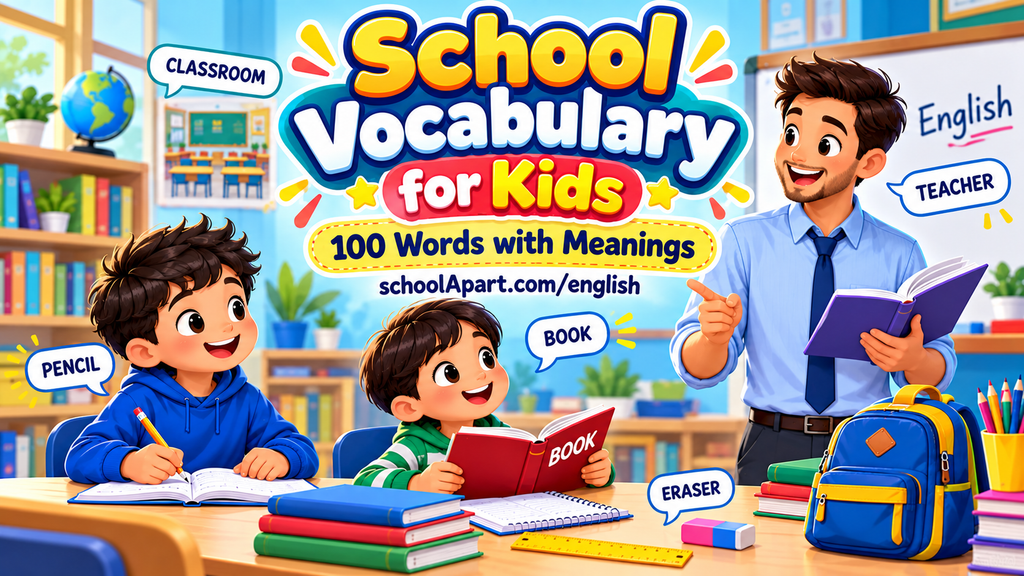
Learn 100 basic English words for kids with simple meanings, easy example sentences, and fun vocabulary activities to build confidence in English.
100 Basic English Words for Kids
Learning English becomes easier when children start with simple, familiar words. Words such as book, water, happy, school, and friend help children understand everyday conversations and begin expressing their thoughts in English.
In this guide, children will learn 100 basic English words with simple meanings and easy example sentences. The words are organised into ten categories to make learning easier for young beginners.
Spoken English for Kids: Complete Beginner’s Guide to Learn English Speaking
This vocabulary guide is suitable for Nursery, Kindergarten and primary school children, as well as parents and teachers who want to build a strong foundation in English.
Why Should Kids Learn Basic English Words?
Vocabulary is an important part of learning a language. Children need words to understand instructions, describe objects, ask questions, read simple sentences and communicate with others.
Learning basic English words can help children:
- Understand everyday English.
- Name familiar objects, people and animals.
- Describe colours, feelings and things around them.
- Build simple English sentences.
- Improve reading and listening skills.
- Become more confident when speaking English.
Children do not need to memorise all 100 words in one day. Start with a few words, practise them regularly and gradually introduce more.
100 Basic English Words for Kids with Simple Meanings
1. Common Objects
These words help children identify everyday objects at home and in the classroom.
| No. | Word | Simple Meaning | Example Sentence |
|---|---|---|---|
| 1 | Book | Something we read | I have a book. |
| 2 | Pen | A tool used for writing | This is my pen. |
| 3 | Bag | Something used to carry things | My bag is blue. |
| 4 | Ball | A round object used in games | I can kick the ball. |
| 5 | Chair | Something we sit on | Sit on the chair. |
| 6 | Table | A piece of furniture with a flat top | The book is on the table. |
| 7 | Door | Something we open to enter or leave a room | Please close the door. |
| 8 | Window | An opening in a wall that lets in light and air | Open the window. |
| 9 | Clock | Something that shows the time | Look at the clock. |
| 10 | Toy | Something children play with | This is my favourite toy. |
Try this: Ask your child to find five objects around the house and say their names in English.
2. Family and People
These words help children talk about family members and people they know.
| No. | Word | Simple Meaning | Example Sentence |
|---|---|---|---|
| 11 | Mother | A female parent | My mother is kind. |
| 12 | Father | A male parent | My father is at home. |
| 13 | Brother | A male sibling | My brother is playing. |
| 14 | Sister | A female sibling | My sister can read. |
| 15 | Baby | A very young child | The baby is sleeping. |
| 16 | Child | A young person | The child is happy. |
| 17 | Friend | Someone you like and enjoy spending time with | He is my friend. |
| 18 | Teacher | A person who helps others learn | My teacher is helpful. |
| 19 | Student | A person who learns at a school or other place of education | I am a student. |
| 20 | Family | A group of related people | I love my family. |
Try this: Look at a family photograph and help your child name the people in it using English.
3. Animals and Birds
Children can learn these words through pictures, toys, storybooks and animal sounds.
| No. | Word | Simple Meaning | Example Sentence |
|---|---|---|---|
| 21 | Cat | A small animal often kept as a pet | The cat is sleeping. |
| 22 | Dog | An animal often kept as a pet | The dog can run. |
| 23 | Cow | A farm animal that gives milk | The cow eats grass. |
| 24 | Goat | A farm animal with horns | The goat is eating. |
| 25 | Horse | A large animal that people can ride | The horse can run fast. |
| 26 | Lion | A large wild cat | The lion is strong. |
| 27 | Tiger | A large wild cat with dark stripes | The tiger is powerful. |
| 28 | Elephant | A very large animal with a long trunk | The elephant has a trunk. |
| 29 | Bird | An animal with feathers and a beak | The bird can fly. |
| 30 | Duck | A water bird with a broad bill | The duck is swimming. |
Try this: Show an animal picture and ask, “What is this?” Encourage your child to answer in a complete sentence.
4. Food and Drinks
These words help children talk about meals, snacks and familiar foods.
| No. | Word | Simple Meaning | Example Sentence |
|---|---|---|---|
| 31 | Rice | A grain commonly eaten as food | I eat rice. |
| 32 | Bread | Food made from baked dough | I like bread. |
| 33 | Milk | A drink produced by mammals, including cows | I drink milk. |
| 34 | Water | The clear liquid we drink | Please give me water. |
| 35 | Apple | A round fruit that can be red, green or yellow | I eat an apple. |
| 36 | Banana | A long, curved fruit with a peel | The banana is yellow. |
| 37 | Mango | A sweet tropical fruit | The mango is sweet. |
| 38 | Egg | Food with a shell laid by birds | I eat an egg. |
| 39 | Fish | An animal that lives in water and is often eaten as food | I like fish. |
| 40 | Fruit | The part of a plant that often contains seeds and can be eaten | I eat fruit every day. |
Try this: Ask your child to name the foods they see during breakfast, lunch or dinner.
5. Colours
Colour words help children describe toys, clothes, pictures and objects around them.
| No. | Word | Simple Meaning | Example Sentence |
|---|---|---|---|
| 41 | Red | The colour of many ripe tomatoes | The ball is red. |
| 42 | Blue | The colour of a clear daytime sky | The sky is blue. |
| 43 | Green | The colour of fresh grass | The leaf is green. |
| 44 | Yellow | The colour of a ripe banana | The banana is yellow. |
| 45 | Black | The darkest common colour | My shoes are black. |
| 46 | White | The colour of fresh snow | The paper is white. |
| 47 | Pink | A colour often described as a light red | The flower is pink. |
| 48 | Orange | A colour between red and yellow | The ball is orange. |
| 49 | Brown | The colour of many tree trunks | The table is brown. |
| 50 | Purple | A colour made by combining red and blue light or pigments in common colour mixing | The bag is purple. |
Try this: Choose three objects in a room and describe each one using a colour word.
6. Body Parts
These words help children describe themselves and follow simple instructions.
| No. | Word | Simple Meaning | Example Sentence |
|---|---|---|---|
| 51 | Head | The part of the body that contains the brain | Touch your head. |
| 52 | Eye | The body part used for seeing | I have two eyes. |
| 53 | Ear | The body part used for hearing | I have two ears. |
| 54 | Nose | The part of the face used for smelling and breathing | This is my nose. |
| 55 | Mouth | The opening used for eating and speaking | Open your mouth. |
| 56 | Hand | The body part at the end of an arm | Raise your hand. |
| 57 | Leg | The body part used for standing and walking | My leg is strong. |
| 58 | Foot | The part of the body at the end of a leg | My foot is clean. |
| 59 | Finger | One of the digits on a hand | I have five fingers on one hand. |
| 60 | Hair | The strands that grow on the head and body | My hair is short. |
Try this: Play a “Touch and Say” game. Give an instruction such as “Touch your nose” and ask your child to repeat the word.
7. Nature and Weather
These words help children describe the natural world.
| No. | Word | Simple Meaning | Example Sentence |
|---|---|---|---|
| 61 | Sun | The star that gives Earth light and heat | The sun is bright. |
| 62 | Moon | The natural object that orbits Earth | I can see the moon. |
| 63 | Star | A bright object in the night sky | I see a star. |
| 64 | Sky | The space we see above the Earth | The sky is blue. |
| 65 | Tree | A tall plant with a trunk and branches | The tree is tall. |
| 66 | Flower | The colourful part of many plants | This flower is pretty. |
| 67 | Rain | Water that falls from clouds | The rain is falling. |
| 68 | Cloud | A mass of tiny water droplets or ice crystals in the sky | The cloud is white. |
| 69 | Wind | Moving air | The wind is cool. |
| 70 | River | A natural stream of flowing water | The river is long. |
Try this: Look outside and ask your child to name things they can see, such as the sky, a tree, a cloud or a flower.
8. Action Words
Action words, also called verbs, tell us what someone or something does.
| No. | Word | Simple Meaning | Example Sentence |
|---|---|---|---|
| 71 | Eat | To take food into the body | I eat rice. |
| 72 | Drink | To swallow a liquid | I drink water. |
| 73 | Read | To look at and understand written words | I read a book. |
| 74 | Write | To form letters or words | I write my name. |
| 75 | Walk | To move using your feet at a regular pace | I walk to school. |
| 76 | Run | To move quickly on foot | I can run fast. |
| 77 | Sit | To rest with your body supported by a seat | Please sit down. |
| 78 | Stand | To be upright on your feet | Please stand up. |
| 79 | Play | To do something for fun | I play with my friends. |
| 80 | Sleep | To rest in a natural state of sleep | I sleep at night. |
Try this: Say an action word and ask your child to perform it. Then ask them to make a sentence using the word.
9. Feelings and Describing Words
These words help children express feelings and describe people, objects and situations.
| No. | Word | Simple Meaning | Example Sentence |
|---|---|---|---|
| 81 | Happy | Feeling pleased or joyful | I am happy. |
| 82 | Sad | Feeling unhappy | The boy is sad. |
| 83 | Good | Having positive qualities | This is a good book. |
| 84 | Bad | Not good or suitable | That is a bad idea. |
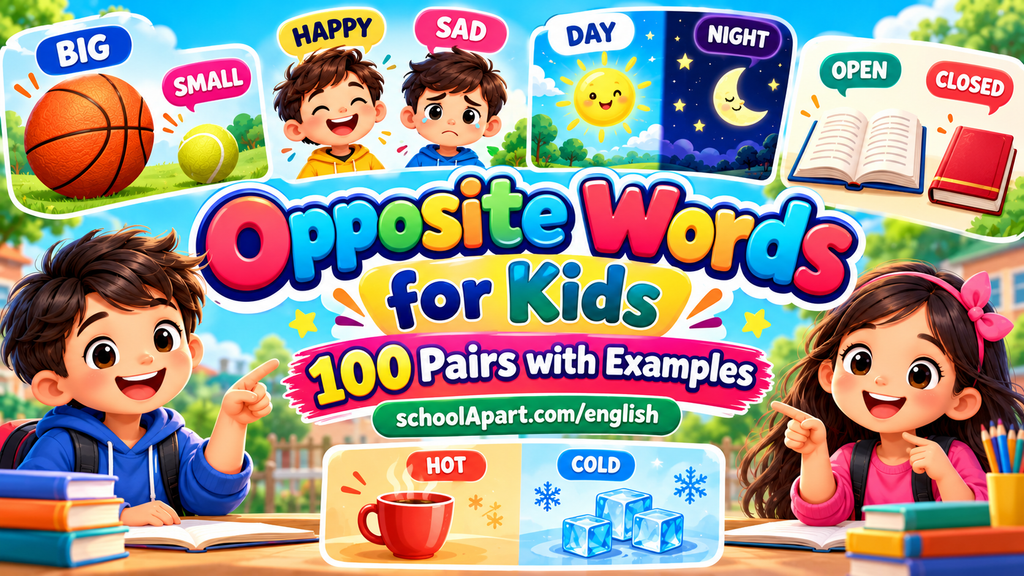
| 85 | Big | Large in size | The elephant is big. |
| 86 | Small | Little in size | The ant is small. |
| 87 | Hot | Having a high temperature | The tea is hot. |
| 88 | Cold | Having a low temperature | The ice is cold. |
| 89 | Fast | Moving quickly | The horse is fast. |
| 90 | Slow | Moving without much speed | The turtle is slow. |
Try this: Ask your child to compare two objects. For example, “The elephant is big” and “The ant is small.”
10. Useful Everyday Words
These words help children greet others, ask for help and respond politely.
| No. | Word | Simple Meaning | Example Sentence |
|---|---|---|---|
| 91 | Hello | A word used to greet someone | Hello, my friend! |
| 92 | Please | A polite word used when asking for something | Please help me. |
| 93 | Thanks | A word used to show gratitude | Thanks for your help. |
| 94 | Sorry | A word used to apologise | Sorry, I am late. |
| 95 | Yes | A word used to agree or answer positively | Yes, I can. |
| 96 | No | A word used to give a negative answer | No, thank you. |
| 97 | Come | To move towards someone or somewhere | Come here, please. |
| 98 | Go | To move away or travel somewhere | Go to your room. |
| 99 | Help | To make something easier for someone | Please help me. |
| 100 | Love | To care for someone or something deeply | I love my family. |
Try this: Use these words in everyday conversations. Encourage your child to say “Please,” “Thanks” and “Sorry” in appropriate situations.
How Can Kids Remember These 100 English Words?
Learning words is more useful when children understand and use them rather than simply memorising a list.
1. Learn Five to Ten Words at a Time
Start with a small group of words. Say each word aloud, explain its meaning in simple English and use it in a sentence. Review earlier words before introducing new ones.
2. Use Pictures and Real Objects
Show a book while teaching book, an apple while teaching apple, or a leaf while teaching green. Connecting words with familiar objects makes their meanings easier to understand.
3. Make Simple Sentences
Encourage children to use each word in a short sentence.
Examples:
- I have a book.
- My bag is blue.
- I drink water.
- I am happy.
- I love my family.
4. Ask Simple Questions
Use questions to help children recall and use vocabulary.
- What is this?
- What colour is it?
- Who is this?
- What do you like to eat?
- How do you feel?
Give children time to answer. Start with short responses and gradually encourage complete sentences.
5. Practise Through Games
Try picture matching, word cards, object hunts, drawing activities and “What is missing?” games. Keep activities short, friendly and suitable for the child’s age.
6. Encourage Speaking Without Fear
Children may make mistakes while learning English. Correct them gently by repeating the word or sentence in the correct form. Praise their effort and encourage them to try again.
A Simple Seven-Day Vocabulary Practice Plan
This plan introduces the 100 words in manageable groups. Children can take longer whenever they need more practice.
| Day | Words | Suggested Activity |
|---|---|---|
| Day 1 | 1–15 | Name common objects and family members. |
| Day 2 | 16–30 | Identify people, animals and birds. |
| Day 3 | 31–45 | Name foods and practise colours. |
| Day 4 | 46–60 | Find coloured objects and name body parts. |
| Day 5 | 61–75 | Describe nature and practise action words. |
| Day 6 | 76–90 | Perform actions and describe feelings. |
| Day 7 | 91–100 and revision | Practise everyday words and review earlier groups. |
The goal is to build familiarity, not to force children to memorise every word within seven days. Repeat difficult words during later practice sessions.
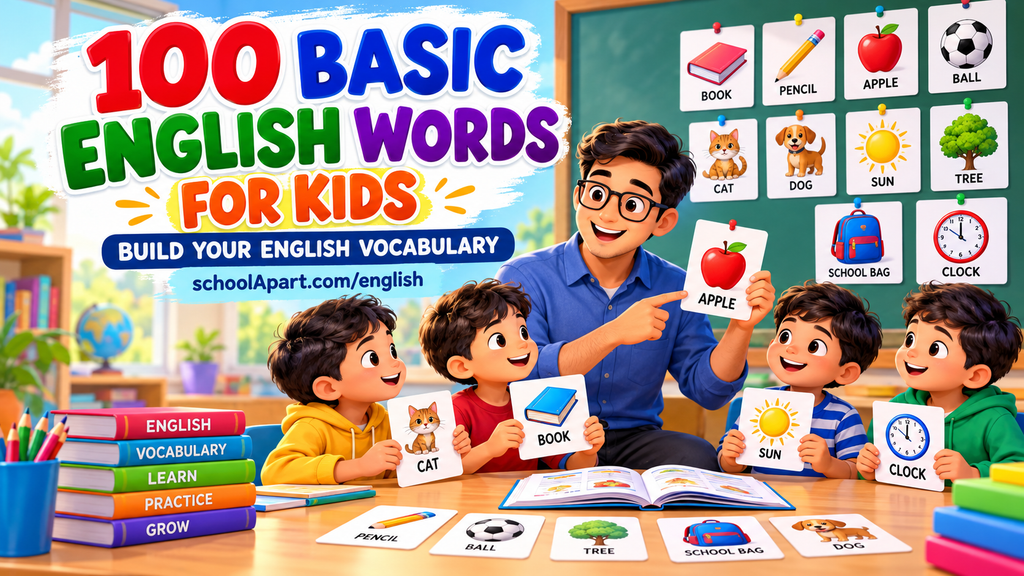
Learning 100 basic English words is a useful starting point for children who are developing their vocabulary. From common objects and family members to action words, colours and everyday expressions, each category offers opportunities to practise English in real situations.
Parents and teachers can make learning easier with pictures, games, simple sentences and short revision sessions. The goal is not only to remember words but also to understand and use them confidently.
Start with a few words, practise them regularly and gradually help your child use English in everyday life.
Frequently Asked Questions
1. What are basic English words for kids?
Basic English words are simple, commonly used words such as book, pen, water, mother, school, happy and friend. They help children name objects, describe people and understand everyday communication.
2. How many English words should a child learn each day?
There is no fixed number for every child. Five to ten new words a day can be a manageable starting point, depending on the child’s age, interest and current vocabulary. Regular revision is just as important as learning new words.
3. How can I teach English vocabulary to my child at home?
Use familiar objects, picture books, short stories and everyday conversations. Explain a word in simple English, say it aloud and encourage your child to use it in a short sentence.
4. How can children remember new English words?
Children can practise with pictures, flashcards, matching games, simple sentences and regular revision. Using words in real situations helps them connect vocabulary with meaning.
5. How can children use basic English words while speaking?
Ask children to describe objects, answer simple questions and talk about their daily activities. Begin with short sentences and gradually introduce longer conversations.
6. What should children learn after basic English vocabulary?
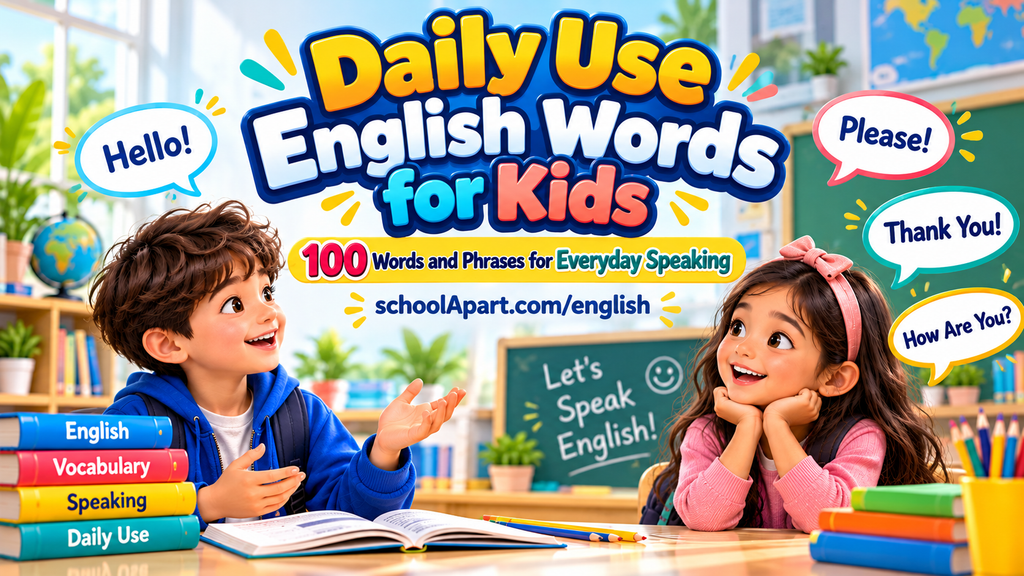
Children can progress to daily-use English words, action words, school vocabulary, common English sentences and simple conversations. Choose activities that match their age and current ability.
Leave a Reply