

Learn how to improve English speaking skills for kids with simple speaking practice, vocabulary, listening, pronunciation, sentence-building, conversation, and confidence-building activities.
How to Improve English Speaking Skills for Kids
Many children can understand English but feel nervous or uncomfortable when they have to speak it. They may know several English words but struggle to put those words together into sentences.
The good news is that English speaking skills can improve with regular, simple practice.
Children do not need to speak perfect English from the beginning. They need opportunities to listen, learn useful words, make sentences, answer questions, and communicate without being afraid of mistakes.
Spoken English for Kids: Complete Beginner’s Guide to Learn English Speaking
This guide explains how to improve English speaking skills for kids through practical activities that parents and teachers can use at home or in the classroom.
Why Do Some Kids Struggle to Speak English?
A child may have studied English for years but still hesitate to speak.
There can be several reasons.
1. Not Enough Speaking Practice
Children may spend more time reading and writing English than actually speaking it.
2. Limited Vocabulary
A child may understand a sentence but not know enough words to create a response.
3. Fear of Making Mistakes
Some children worry that others will laugh at their pronunciation or grammar.
4. Lack of Confidence
Children may know the answer but hesitate to say it aloud.
5. Too Much Focus on Grammar
Grammar is important, but knowing grammar rules does not automatically make someone a good speaker.
6. Limited English Exposure
If children rarely hear English outside school, they may have fewer opportunities to practice natural communication.
How to Learn Spoken English at Home: A Simple Guide for Kids
The solution is not to put more pressure on the child. Instead, give them more meaningful opportunities to use English.
10 Effective Ways to Improve English Speaking Skills for Kids
1. Encourage Daily Listening
Speaking begins with listening.
Children should hear simple English regularly through:
- Stories
- Conversations
- Rhymes
- Songs
- Classroom instructions
- Age-appropriate audio and videos
- Parents’ simple English sentences
Listening helps children become familiar with English sounds, words, sentence patterns, and pronunciation.
For example, hearing:
“What are you doing?”
repeatedly helps a child eventually use the same question naturally.
2. Build a Useful Vocabulary
Children cannot speak comfortably without enough vocabulary.
But vocabulary learning should focus on useful words, not huge word lists.
Start with familiar topics:
Family
- Mother
- Father
- Brother
- Sister
- Grandmother
School
- Book
- Pencil
- Teacher
- Classroom
- Homework
Daily Activities
- Eat
- Drink
- Read
- Write
- Play
- Sleep
Feelings
- Happy
- Sad
- Angry
- Excited
- Tired
Then encourage children to use the words in sentences.
Instead of only learning:
Hungry
practice:
I am hungry.
This turns vocabulary into speaking ability.
3. Teach Children to Speak in Complete Sentences
Many beginners answer questions with one word.
For example:
Parent: What do you like?
Child: Football.
Instead, gradually encourage:
I like football.
Then:
I like playing football.
Later:
I like playing football with my friends.
This gradual sentence-building method helps children become better speakers without overwhelming them.
4. Ask Questions Every Day
Questions give children a reason to speak.
Start with simple questions.
About Yourself
- What is your name?
- How old are you?
- Where do you live?
- What do you like?
- What is your favourite colour?
About School
- What did you learn today?
- Who is your teacher?
- What did you play?
- What was your favourite activity?
About Everyday Life
- What are you doing?
- Where are you going?
- What are you eating?
- What do you want?
Give children enough time to answer.
Do not immediately answer the question for them.
5. Practice English Conversations
Short conversations can be more useful than isolated vocabulary practice.
Example: At Home
Parent: What are you doing?
Child: I am reading.
Parent: What are you reading?
Child: I am reading a storybook.
Example: After School
Parent: How was your day?
Child: It was good.
Parent: What did you learn?
Child: I learned about animals.
As the child becomes more confident, conversations can gradually become longer.
6. Use Picture Description
Pictures give children ideas about what to say.
Show a picture and ask:
- What can you see?
- Who is in the picture?
- What are they doing?
- What colour is it?
- Where are they?
- What do you think is happening?
For example:
I can see a boy.
He is playing football.
He is wearing a blue shirt.
There are trees behind him.
This activity develops vocabulary, sentence formation, observation, and speaking confidence together.
7. Encourage Storytelling
Storytelling is an excellent way to develop longer speaking skills.
Start with a simple picture or familiar story.
Ask the child:
Who is the main character?
Where did the story happen?
What happened first?
What happened next?
How did the story end?
Young children can tell a story using three or four sentences.
Older children can gradually tell longer stories in their own words.
Do not insist that the story must be grammatically perfect.
The first goal is communication.
8. Use Role Play
Role play gives children a safe way to practice real-life conversations.
Try situations such as:
At a Shop
Customer: Can I have a pencil, please?
Shopkeeper: Sure.
Customer: How much is it?
At School
Student: May I come in?
Teacher: Yes, come in.
Student: Thank you.
At a Restaurant
Customer: Can I have some juice, please?
Waiter: Sure.
Role play helps children practice useful expressions repeatedly.
9. Practice Pronunciation Without Pressure
Clear pronunciation helps children communicate effectively.
Encourage children to:
- Listen carefully.
- Repeat words.
- Speak slowly.
- Notice difficult sounds.
- Practice short sentences.
- Listen to correct pronunciation.
Do not interrupt every sentence to correct pronunciation.
Let the child finish speaking first.
Then model the correct pronunciation naturally.
This keeps speaking practice positive.
10. Build Confidence Before Perfection
Confidence is one of the most important parts of speaking.
A child who is constantly worried about making mistakes may avoid speaking.
Parents and teachers can use encouraging expressions such as:
Good try!
Well done!
Keep going!
That’s a good answer.
Try saying it again.
The goal is not to make every sentence perfect.
The goal is to help children feel:
“I can speak English.”
Vocabulary Alone Is Not Enough
A child may know hundreds of English words and still struggle to speak.
Why?
Because speaking requires more than vocabulary.
Children need to learn how to:
Choose words → Build sentences → Express ideas → Respond to questions → Continue a conversation
For example, knowing:
school, friend, play, football
is different from being able to say:
I played football with my friends at school.
Therefore, vocabulary should always be connected to sentence practice.
Teach Useful Sentence Patterns
Sentence patterns help beginners speak more easily.
“I like…”
I like apples.
I like drawing.
I like football.
“I have…”
I have a book.
I have a pencil.
I have a pet.
“I am…”
I am happy.
I am tired.
I am ready.
“I can…”
I can swim.
I can draw.
I can read.
Once children understand these patterns, they can replace individual words and create many new sentences.
Use the “One Word → One Sentence” Method
When a child learns a new word, ask them to create a sentence.
For example:
Word: School
Sentence: I go to school.
Word: Friend
Sentence: My friend is kind.
Word: Play
Sentence: I play football.
This simple technique turns vocabulary learning into active speaking practice.
Use the “Three Sentence” Challenge
Choose a familiar topic.
For example:
My School
Ask the child to say three sentences:
My school is big.
I have many friends.
I like my school.
Once this becomes easy, increase it to five sentences.
Later, ask the child to speak for one minute.
This creates a natural path from short answers to longer speech.
Practice Speaking About Everyday Topics
Children should practice topics they already understand.
Good beginner topics include:
- My Family
- My School
- My Best Friend
- My Favourite Food
- My Favourite Game
- My Favourite Book
- My Pet
- My Hobby
- My Daily Routine
- My Weekend
Familiar topics reduce the mental effort needed to decide what to say.
Use English During Everyday Activities
Speaking practice does not always need a dedicated lesson.
While Eating
What would you like?
Do you want some fruit?
While Playing
Whose turn is it?
What are you playing?
While Drawing
What are you drawing?
What colour are you using?
While Getting Ready
Where is your bag?
Are you ready?
These short exchanges provide natural speaking practice.
Try a Daily Speaking Challenge
Give your child one small speaking task each day.
Monday
Talk about your family.
Tuesday
Describe your school.
Wednesday
Talk about your favourite food.
Thursday
Describe your favourite game.
Friday
Talk about your best friend.
Saturday
Tell a short story.
Sunday
Talk about your week.
The activity can take only a few minutes.
How Parents Can Correct Mistakes
Correction should help—not discourage.
Suppose a child says:
“He go to school.”
Instead of saying:
“Wrong!”
you can respond:
“Yes, he goes to school.”
This gives the child the correct model without making them afraid of speaking.
A useful rule:
Correct important mistakes, but don’t interrupt every sentence.
Fluent communication should develop alongside accuracy.
What Parents Should Avoid
Don’t Compare Children
Avoid:
“Your friend speaks better than you.”
Every child learns at a different pace.
Don’t Laugh at Mistakes
Even a small laugh can make a child afraid to speak.
Don’t Force Long Speeches
Start small.
Don’t Focus Only on Grammar
Children need opportunities to communicate.
Don’t Turn Every Activity Into a Test
English should also be enjoyable.
What Teachers Can Do to Improve Speaking Skills
Teachers can create short speaking opportunities throughout the school day.
Useful activities include:
- Pair conversations
- Question-and-answer sessions
- Show and tell
- Picture description
- Storytelling
- Role play
- Speaking games
- Short presentations
- Classroom discussions
Even two or three minutes of speaking practice can give children valuable opportunities to use English.
A Simple Speaking Practice Formula
A useful formula for children is:
Listen
Hear English every day.
↓
Learn
Learn useful vocabulary and expressions.
↓
Build
Create simple sentences.
↓
Speak
Use those sentences in conversations.
↓
Practice
Repeat them in different situations.
↓
Improve
Gradually increase vocabulary, sentence length, pronunciation, and confidence.
How Long Does It Take to Improve English Speaking?
There is no fixed timeline.
Every child learns at a different pace.
Progress depends on:
- Age
- Previous English exposure
- Vocabulary
- Listening practice
- Speaking opportunities
- Confidence
- Learning environment
- Regularity of practice
Instead of asking:
“How quickly will my child become fluent?”
focus on:
“Is my child speaking a little more comfortably than before?”
Small improvements matter.
Signs That Your Child’s Speaking Skills Are Improving
You may notice that your child:
- Answers questions more quickly.
- Uses longer sentences.
- Knows more everyday vocabulary.
- Starts conversations.
- Asks questions in English.
- Speaks with less hesitation.
- Participates more in classroom activities.
- Can describe pictures.
- Can tell short stories.
- Is less afraid of making mistakes.
These are useful signs of progress.
Final Tips to Improve English Speaking Skills for Kids
Remember these simple principles:
- Give children regular listening practice.
- Teach useful vocabulary.
- Encourage complete sentences.
- Ask questions every day.
- Practice short conversations.
- Use pictures.
- Encourage storytelling.
- Use role play.
- Practice pronunciation naturally.
- Let children speak without fear.
- Correct mistakes gently.
- Use familiar topics.
- Keep speaking activities enjoyable.
- Praise effort.
- Be patient.
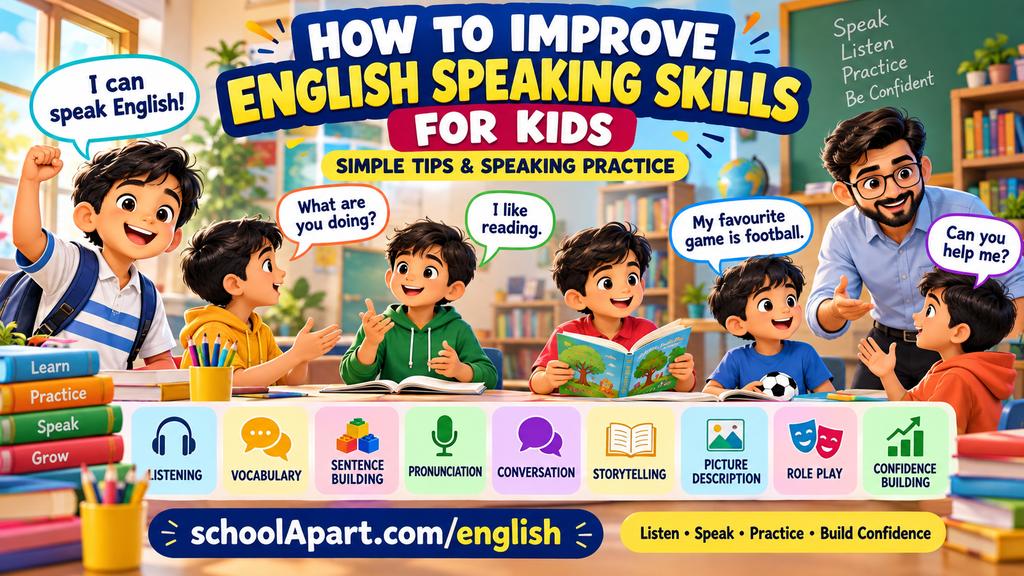
Improving English speaking skills does not happen through memorizing vocabulary or grammar rules alone.
Children become better speakers when they listen, understand, speak, make mistakes, practice, and try again.
Start with simple sentences and familiar topics. Gradually introduce conversations, storytelling, picture descriptions, role play, and longer speaking activities.
Most importantly, create an environment where children feel comfortable trying to speak English.
Confidence first. Practice every day. Improvement will follow.
FAQ
How can I improve my child’s English speaking skills?
Give your child regular opportunities to listen and speak English. Use simple conversations, vocabulary practice, picture descriptions, storytelling, role play, and everyday activities.
Why can my child understand English but not speak it?
Understanding and speaking are different skills. A child may have good listening or reading skills but need more opportunities to actively use English.
How can I make my child speak English confidently?
Avoid making the child afraid of mistakes. Start with simple questions and sentences, praise their effort, and gradually increase speaking activities.
How can I improve English speaking at home?
Use short English conversations during meals, playtime, homework, reading, and other daily activities. Regular practice is more important than long lessons.
Should I correct every English mistake?
No. Constant correction can reduce confidence. Let the child finish speaking and gently model the correct form when needed.
What activities improve English speaking skills for kids?
Picture description, storytelling, role play, question-and-answer games, show and tell, speaking games, and everyday conversations are useful activities.
How can vocabulary improve speaking?
Vocabulary gives children the words they need to communicate. However, children should also practice using those words in sentences and conversations.
How long should kids practice speaking English every day?
There is no fixed amount of time. Short, regular practice sessions can be effective, especially for younger children.



Leave a Reply