
Learn how Artificial Intelligence works in this simple guide for school students. Explore AI data, algorithms, models, training, chatbots and AI-generated answers.
⚙️ How Does Artificial Intelligence Work?
Artificial Intelligence, or AI, is becoming an important part of our everyday lives. From answering questions to recognizing pictures and recommending videos, AI can perform many tasks that seem intelligent.
But have you ever wondered how Artificial Intelligence actually works?
How can a computer answer a question? How can an AI system recognize a cat in a picture? How can it generate a story from a simple instruction?
The answer lies in a combination of data, algorithms, AI models and computing power.
AI for School Students: Learn, Use, Create & Think Critically
In this guide, we will explore how AI works through simple explanations and everyday examples that school students can understand.
💡 The main idea: AI systems process information using patterns learned during training or other computational methods to produce an output. Different AI systems work in different ways.
🧠 What Does It Mean When AI Works?
Artificial Intelligence is a technology that enables computer systems to perform tasks such as recognizing patterns, processing language, making predictions and generating content.
AI does not work exactly like the human brain. Instead, AI systems use computer programs, algorithms and models designed for particular tasks.
For example, an AI system may be designed to:
- 🐱 Recognize animals in pictures
- 💬 Respond to questions
- 🌐 Translate one language into another
- 🎬 Recommend videos
- ✍️ Generate text
- 🔍 Identify patterns in information
The way an AI system works depends on the task it is designed to perform.
If you want to learn the basic meaning of AI first, read our guide: What Is Artificial Intelligence (AI)? A Simple Guide for School Students.
⚙️ How Does Artificial Intelligence Work?
Many AI systems can be understood through a simple process:
📥 Input → ⚙️ Processing → 📤 Output
Some AI systems also require a training stage before they can perform their tasks.
Let’s understand the process step by step.
1️⃣ Step 1: AI Receives Information
The first step is receiving information, also called an input.
Input can take different forms, such as:
- 📝 Text or questions
- 🖼️ Pictures
- 🎤 Spoken words or audio
- 📊 Numbers and other data
- 🎥 Video
For example, when a student asks an AI chatbot, “Why do plants need sunlight?”, the question becomes the input.
The AI system then processes that input to produce a response.
2️⃣ Step 2: AI Processes the Information
After receiving the input, the AI system processes it using its underlying technology.
Depending on the system, this may involve algorithms, rules, trained models or a combination of methods.
An algorithm is a set of steps or instructions used to solve a problem or perform a task.
For example, an image-recognition system processes information from a picture to identify patterns that may help it recognize an object.
A language-based AI system processes the words in a question to generate a suitable response.
3️⃣ Step 3: AI Uses Patterns or Learned Information
Many modern AI systems use models that have been trained on data.
During training, a model learns patterns from examples. These patterns help it perform tasks on new inputs.
For example, an image-recognition model may learn patterns associated with cats, such as shapes, textures and other visual features.
When it receives a new picture, it can use the learned patterns to estimate whether the picture contains a cat.
💡 Remember: AI does not always follow the same process. Some systems rely on fixed rules, while machine-learning systems learn patterns from data.
4️⃣ Step 4: AI Produces an Output
After processing the input, the AI system produces an output.
The output depends on the task.
| Input | Possible AI output |
|---|---|
| A picture of an animal | A prediction about the animal |
| A question in English | A generated answer |
| Text in one language | A translation |
| A request for a story | A generated story |
| Viewing activity on a platform | A content recommendation |
The output may be useful, but it is not guaranteed to be correct.
⚠️ Important: AI-generated answers and predictions can contain errors. Always check important information.
🐱 A Simple Example: How AI Recognizes a Cat
Imagine an AI system designed to recognize cats in photographs.
How might it work?
📚 Stage 1: Training
The model is trained using many example images. The training process helps it learn visual patterns associated with cats.
🧠 Stage 2: Learning Patterns
The model adjusts its internal parameters during training to improve its ability to recognize relevant patterns.
🖼️ Stage 3: New Picture
Someone provides a new photograph that the model has not seen before.
🔍 Stage 4: Processing
The trained model analyzes the picture and uses the patterns it learned.
✅ Stage 5: Prediction
The system produces a prediction about whether the picture contains a cat.
This is a simplified example. Real image-recognition systems can use complex mathematical methods and neural networks.
💡 Try thinking about it: If the new photograph is blurry or shows only part of the animal, could the AI make a mistake? Yes! That is why AI predictions are not always reliable.
📚 What Is Data, and Why Is It Important for AI?
Data means information that a computer system can process.
Data can include text, numbers, images, audio, video and many other types of information.
Data is important because many AI systems use it during training or processing.
For example:
- 🖼️ Image data can help train image-recognition models.
- 📝 Text data can help train language models.
- 🔊 Audio data can help train speech-recognition systems.
- 📊 Numerical data can help models identify patterns and make predictions.
However, more data does not automatically mean better AI.
The quality, relevance and suitability of the data also matter. Problems in training data can affect a model’s performance.
🧩 What Is an AI Model?
An AI model is a computational system that has been trained or configured to perform a particular task.
In machine learning, a model learns patterns from data during training. Once trained, it can use those patterns to process new inputs.
For example, an image-recognition model may identify objects, while a language model may process and generate text.
Think of an AI model as the part of an AI system that applies what it has learned or been designed to do.
📌 Simple distinction:
- Data: Information used by a system.
- Algorithm: A method or set of steps for solving a problem.
- AI model: A computational model that performs a task, often using patterns learned during training.
- AI system: The broader system that uses models and other components to complete a task.
These terms are related, but they do not mean the same thing.
🎓 How Does an AI Chatbot Answer Questions?
AI chatbots can answer questions, explain topics and generate text. Many modern chatbots use large language models.
Let’s imagine a student asks:
“What is the water cycle?”
A language-based AI system may work through a process like this:
💬 1. The student asks a question.
The chatbot receives the text.
🔎 2. The system processes the input.
It represents and analyzes the text using its underlying language-processing methods.
🧠 3. The model uses learned patterns.
The model uses patterns learned during training to determine an appropriate response.
✍️ 4. The chatbot generates an answer.
The system produces text explaining the water cycle.
The exact process varies by model and application. Some systems may also use external information sources or tools.
⚠️ Remember: A chatbot can generate a fluent answer that contains incorrect information. Students should verify important facts with textbooks, teachers and reliable sources.
✨ How Does Generative AI Work?
Generative AI is a type of AI that creates content, such as text, images, audio or video.
Many generative AI systems use models trained on large collections of data.
For example, a text-generating model can learn statistical patterns in language during training. When a user provides a prompt, the model generates text based on the input and its learned patterns.
An image-generating model may use a different approach to create an image from a text description.
📝 Example: Generating a Story
Suppose a student enters this prompt:
“Write a short adventure story about a young explorer discovering a hidden forest.”
A text-generating AI system processes the instruction and generates a story that fits the request.
The result depends on the model, its training, the prompt and other settings.
AI-generated stories can be useful starting points for creativity. Students should still use their own imagination, review the output and improve the story themselves.
🔄 Does AI Learn Every Time We Ask a Question?
No, not necessarily.
This is an important point to understand.
AI training and AI use are two different processes.
📚 Training
During training, a model learns patterns from data by adjusting its internal parameters or by using other training methods.
⚙️ Using a Trained Model
After training, the model can process new inputs and produce outputs. This is often called inference.
For example, when a student asks a question, a trained chatbot generally generates a response using its existing model rather than retraining itself from scratch for that question.
Some AI systems can adapt using conversation context, external memory, feedback or additional tools. Some systems may also be updated or retrained later.
But you should not assume that every conversation automatically changes an AI model’s underlying knowledge.
⚠️ Why Can AI Give Wrong Answers?
AI can make mistakes for several reasons.
1. Incorrect or Limited Information
A model may not have the information needed to answer a question accurately.
2. Misunderstanding the Question
A vague or confusing question can lead to an irrelevant answer.
3. Limitations of the Model
An AI model may struggle with a particular task or situation.
4. Problems in Training Data
Incomplete, inaccurate or biased training data can affect the results.
5. Generating Plausible but Incorrect Content
Some generative AI systems can produce answers that sound convincing even when they are factually wrong.
🔍 What Should Students Do?
- ✅ Check important facts.
- 📚 Compare answers with reliable sources.
- ❓ Ask follow-up questions when something is unclear.
- 👩🏫 Ask a teacher or trusted adult when needed.
- 🧠 Use your own judgement instead of accepting every answer.
An AI answer is a starting point for learning, not automatic proof that something is true.
🧠 Does AI Think Like a Human?
No. AI can perform tasks that appear intelligent, but it does not experience the world in the same way humans do.
People can use personal experiences, emotions, social understanding and judgement in many different situations.
AI systems operate through computational processes, learned patterns and their available inputs.
A system can generate an explanation of a topic without understanding or experiencing it in the same way a person does.
💡 The important lesson: AI can support human thinking, but students still need to question, understand and evaluate information themselves.
🚀 How Can Students Use This Knowledge?
Understanding how AI works can help students use it more effectively.
Here are some useful habits:
- 🎯 Give clear instructions when asking questions.
- 📚 Use AI to explore concepts rather than simply copy answers.
- ❓ Ask for step-by-step explanations when appropriate.
- 🔍 Check important information before relying on it.
- ✏️ Practise solving problems independently.
- 🛡️ Protect personal information when using AI tools.
- 📋 Follow school and teacher rules about AI use.
For example, instead of asking an AI chatbot to complete an entire assignment, a student could ask it to explain a difficult concept and then attempt the assignment independently.
That way, AI supports learning without replacing the student’s effort.
🌟 The SchoolApart AI Learning Journey
SchoolApart helps students develop AI literacy through five connected stages:
🧠 Understand AI → 🛠️ Use AI → 🎨 Create with AI → 🔍 Think Critically About AI → 🛡️ Use AI Responsibly
You have now explored the basic process behind AI systems.
To learn the fundamentals first, revisit our guide: What Is Artificial Intelligence (AI)? A Simple Guide for School Students.
You can also explore the complete AI for School Students learning hub for more beginner-friendly AI learning resources.
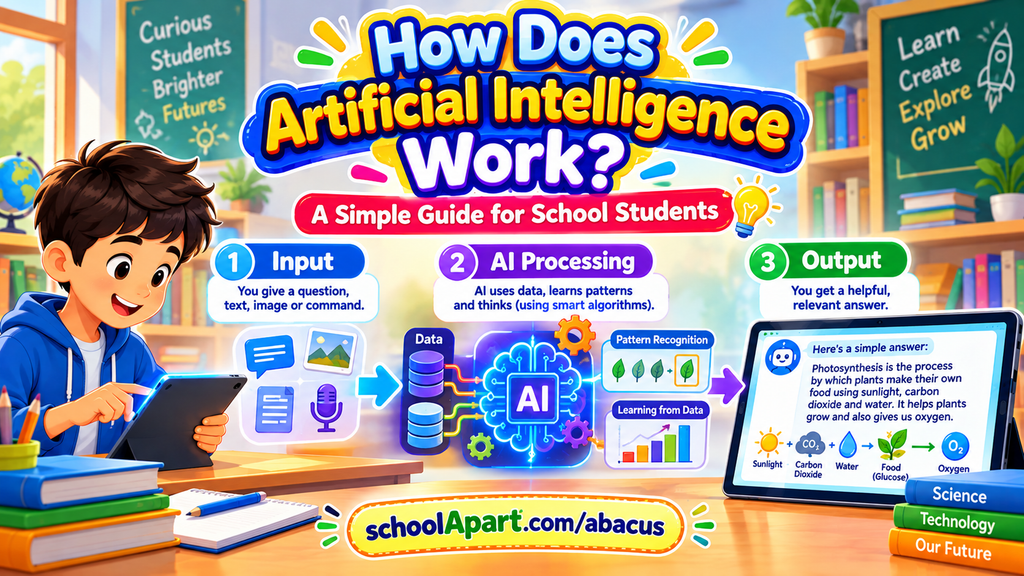
Artificial Intelligence works by processing information through computational methods. Depending on the system, it may use algorithms, data, trained models and pattern recognition to produce an output.
Some AI systems identify images. Others process language, make predictions or generate new content.
Although AI can perform many useful tasks, it is not perfect. Its outputs may be incorrect, incomplete or misleading.
For school students, understanding how AI works is the first step towards using it wisely.
🌟 Learn how AI works. Ask better questions. Check the answers. Keep thinking for yourself.
That is how students can make AI a useful learning partner rather than a replacement for their own thinking.
❓ Frequently Asked Questions
1. How does Artificial Intelligence work in simple words?
AI works by processing information using computer algorithms, models and other computational methods. Depending on the system, it may recognize patterns, make predictions, answer questions or generate content.
2. What are the main steps involved in how AI works?
Many AI applications follow a simple process: receive input, process the information and produce output. Machine-learning systems may also require a separate training stage before they can perform their tasks.
3. What is the role of data in AI?
Data provides information that AI systems can process. Many machine-learning models use training data to learn patterns that help them perform tasks on new inputs.
4. What is an AI algorithm?
An algorithm is a set of steps or a computational method used to solve a problem or perform a task. AI systems can use algorithms for processing information, training models and generating outputs.
5. What is an AI model?
An AI model is a computational system trained or configured to perform a task. Machine-learning models can learn patterns from data and use them to process new inputs.
6. How does AI recognize pictures?
An image-recognition model processes visual information and uses learned patterns to predict what objects or features may be present in a picture.
7. How does an AI chatbot answer questions?
Many AI chatbots use language models that process a user’s input and generate text based on patterns learned during training. Some chatbots also use external sources or tools.
8. Does AI learn from every question?
Not necessarily. Many AI models generate responses using an already-trained model. Some systems can use conversation context or memory, but that does not mean the underlying model is automatically retrained after every question.
9. Can Artificial Intelligence make mistakes?
Yes. AI can produce inaccurate, incomplete or misleading outputs. Students should check important information using reliable sources.
10. Does AI think like a human?
AI can perform some tasks that appear intelligent, but it does not think or experience the world exactly like humans. Students should continue using independent judgement and critical thinking.
11. What is the difference between AI and Generative AI?
Artificial Intelligence is the broader field of technology. Generative AI is a category of AI designed to generate content such as text, images, audio or video.
12. Why should school students understand how AI works?
Understanding AI helps students develop AI literacy, ask better questions, evaluate AI-generated information and use AI more thoughtfully for learning and creativity.


Leave a Reply