
Learn what composition in drawing means and how beginners can use balance, placement, focal points, negative space, and simple composition techniques to create better drawings.
✏️ What Is Composition in Drawing?
Composition in drawing means how the different elements of a drawing are arranged within the page or artwork.
It includes decisions about:
- Where the main subject is placed
- How large or small it appears
- How objects relate to each other
- How much empty space surrounds them
- Where the viewer’s attention goes
- How the overall drawing feels balanced
For example, imagine drawing a tree on a sheet of paper.
You could place the tree:
- Directly in the center
- Near one side
- Very close to the edge
- Small with lots of empty space around it
- Large and filling most of the page
The tree itself has not changed, but the composition has.
Good composition helps the different parts of a drawing work together as one complete picture.
🎨 Why Is Composition Important in Drawing?
A drawing can contain well-drawn objects and still feel unbalanced if those objects are poorly arranged.
Composition helps you decide where things should go before and during the drawing process.
1. 🖼️ Creates Balance
Composition helps distribute visual elements across the page.
2. 👀 Guides Attention
Good placement can help direct the viewer toward the most important part of the drawing.
3. 📐 Improves Organization
It prevents the drawing from feeling randomly arranged.
4. 🧩 Connects Different Elements
Composition helps objects, shapes, spaces, and details work together.
5. ✏️ Makes Drawings More Intentional
Instead of simply filling an empty page, you make decisions about what belongs where.
🔍 Main Elements of Composition in Drawing
Beginners do not need to learn complicated art theory to understand composition.
Start with these basic ideas.
1. Subject Placement
The position of your main subject can change the entire appearance of the drawing.
A subject placed in the center can feel very different from one placed toward the left or right.
Before drawing, ask:
Where should my main subject go?
2. Balance
Balance means how visual elements are distributed across the page.
For example, imagine a large tree on the left side of a drawing.
If the entire right side is completely empty, the composition may feel uneven.
You could balance it with:
- A smaller object
- Background elements
- Another shape
- More visual detail
Balance does not always mean making both sides identical.
It means creating a comfortable visual relationship between different elements.
3. Focal Point
The focal point is the part of the drawing that attracts the viewer’s attention most strongly.
For example, in a landscape drawing, the focal point could be:
- A large tree
- A building
- A mountain
- A person
- A particularly detailed object
You can create a focal point through:
- Placement
- Size
- Detail
- Contrast
- Shape
- Surrounding space
4. Negative Space
Negative space is the empty area around, between, or inside objects.
It plays an important role in composition.
Too little negative space can make a drawing feel crowded.
Too much may make the subject feel disconnected from the rest of the composition.
Learning to observe negative space can therefore help you make better decisions about placement and balance.
5. Size and Scale
The size of an object compared with other objects affects the composition.
For example:
A large tree + small house
creates a different visual effect from:
A small tree + large house.
Think about the relative size of objects before adding details.
6. Direction and Movement
Lines and shapes can guide the viewer’s eyes through a drawing.
For example:
- A road can lead toward a building.
- Branches can point toward a subject.
- Diagonal lines can create movement.
- Curved lines can guide the eye.
You can use these visual directions to make a drawing more interesting.
📐 Simple Composition Techniques for Beginners
You do not need advanced design knowledge to start practicing composition.
Try these simple techniques.
Technique 1: Use the Rule of Thirds
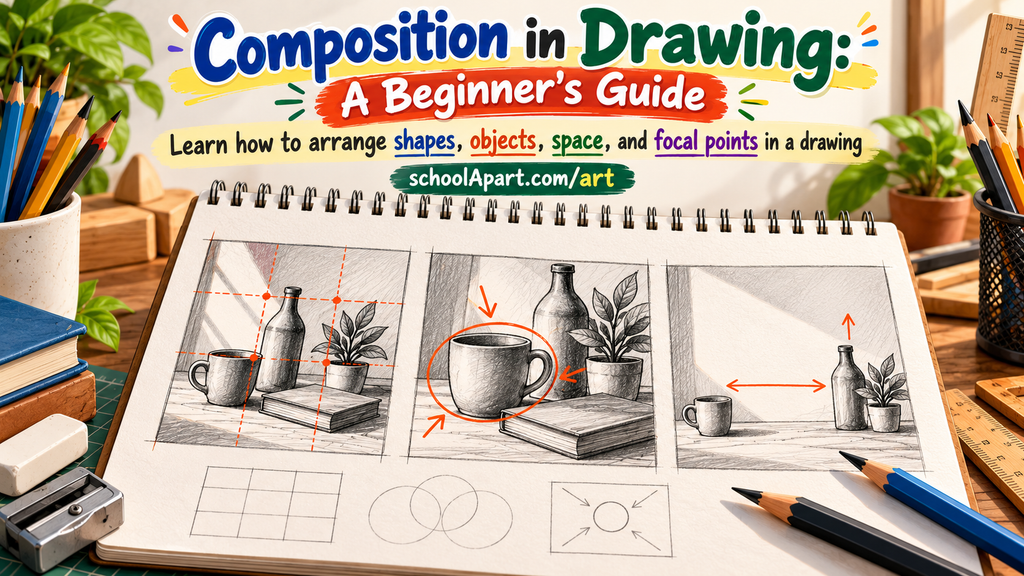
The rule of thirds is a common composition technique.
Imagine dividing your page into:
3 equal vertical sections + 3 equal horizontal sections
This creates four important intersection areas.
Placing a main subject near one of these areas can create a more dynamic composition than always placing it directly in the center.
You do not need to draw the grid permanently. It can simply be a planning guide.
Technique 2: Avoid Always Centering the Subject
Beginners often place everything in the middle of the page.
Center placement is not wrong, but using different positions can make your drawings more interesting.
Try placing your subject:
- Left of center
- Right of center
- Slightly above center
- Slightly below center
Then compare the results.
Technique 3: Leave Enough Negative Space
Do not feel that every part of the page needs to be filled.
Empty space can:
- Separate objects
- Highlight the main subject
- Create balance
- Make the drawing easier to read
Think of empty space as an active part of your composition.
Technique 4: Create a Clear Focal Point
Decide what you want viewers to notice first.
You can make that area more important by giving it:
- More detail
- Greater contrast
- Larger size
- Stronger lines
- More surrounding space
Technique 5: Use Different Sizes
If every object has exactly the same size, a drawing can feel repetitive.
Try combining:
- Large objects
- Medium objects
- Small objects
This creates visual variety.
📝 How to Plan a Drawing Composition Step by Step
Before starting a detailed drawing, spend a few minutes planning.
Step 1: Decide the Main Subject
Ask:
What is the most important thing in this drawing?
Choose one main subject.
Step 2: Choose the Page Orientation
Think about whether the drawing works better as:
- Portrait
- Landscape
- Square
The shape of the page can affect how your subjects fit together.
Step 3: Make a Small Thumbnail Sketch
A thumbnail is a tiny, simple version of your planned drawing.
You do not need details.
Use basic shapes to show:
- Main subject
- Other objects
- Empty space
- General placement
Make two or three quick versions and compare them.
Step 4: Check the Balance
Look at your thumbnail and ask:
- Is one side too heavy?
- Is the main subject easy to find?
- Is there enough empty space?
- Are the objects too close together?
- Does the composition feel crowded?
Step 5: Start With Simple Shapes
Once you are happy with the arrangement, lightly sketch the main objects using simple shapes.
Do not add details yet.
Step 6: Check Proportion and Placement
Make sure the objects have reasonable:
- Size
- Height
- Width
- Distance
- Position
Correct these before adding details.
Step 7: Add Details
Once the overall composition works, refine the objects and add important details.
This approach is usually easier than starting with details immediately.
🎯 Simple Composition Exercises for Beginners
Practice is the easiest way to understand composition.
Exercise 1: One Object, Three Positions
Choose one simple object, such as a cup.
Draw three small versions:
- Cup in the center
- Cup toward the left
- Cup toward the right
Compare how each composition feels.
Exercise 2: Two Objects
Draw a bottle and a cup.
Try:
- Objects close together
- Objects far apart
- One object larger
- Both objects similar in size
Notice how the relationship between the objects changes.
Exercise 3: Three Objects
Choose:
- A cup
- A book
- A bottle
Create three different arrangements.
Do not add details.
Focus only on:
Size + Position + Space
Exercise 4: Negative Space Practice
Draw two or three objects and pay attention to the empty spaces between them.
Ask:
- What shape is the space?
- Is it too large?
- Is it too narrow?
- Does it help separate the objects?
This connects composition practice with negative-space observation.
Exercise 5: Thumbnail Planning
Before creating a larger drawing, make three tiny thumbnail sketches.
Try a different composition in each.
Choose the strongest one before starting the final drawing.
🖼️ Composition in Different Types of Drawing
Composition is useful across many forms of art.
🌳 Nature Drawing
Use placement and negative space to organize trees, plants, sky, and landscape elements.
🪑 Still Life Drawing
Arrange objects carefully before drawing them.
✏️ Object Sketching
Think about how much of the page the object should occupy.
🧑 Character Drawing
Consider where the character is positioned and how much surrounding space is available.
🖼️ Illustration
Composition helps organize characters, objects, backgrounds, and important visual information.
💻 Digital Art
The same composition principles can be applied when arranging elements on a digital canvas.
🚫 Common Composition Mistakes Beginners Make
1. Putting Everything in the Center
Centering every subject can make compositions repetitive.
Try: Experiment with different placements.
2. Filling Every Empty Area
Beginners sometimes think an empty area means something is missing.
Remember: Negative space can be an important part of the composition.
3. Adding Details Too Early
A drawing can have beautiful details but still have poor composition.
Better approach: Solve placement and balance first.
4. Making Everything the Same Size
Equal-sized objects can make a drawing feel flat.
Try: Use different sizes to create visual variety.
5. Ignoring the Page Edges
Objects placed too close to the edge can feel cramped.
Try: Check the space between the subject and the edge of the page.
6. Having No Clear Focal Point
If every part of the drawing has equal visual importance, the viewer may not know where to look first.
Try: Give one area more importance through placement, size, detail, or contrast.
🧠 A Simple Composition Checklist
Before finishing a drawing, ask:
Subject
- What is the main subject?
Placement
- Where is it positioned?
Balance
- Does the page feel balanced?
Negative Space
- Is there enough empty space?
Size
- Are the objects appropriately sized?
Focal Point
- Is the most important area clear?
Edges
- Are objects too close to the page edges?
Details
- Did I add details only after solving the overall arrangement?
This quick checklist can help beginners review their drawings before considering them finished.
⏱️ A 15-Minute Composition Practice Routine
You can practice composition without creating a detailed artwork.
5 Minutes — Observe
Choose two or three simple objects.
5 Minutes — Thumbnail Sketches
Create three small arrangements.
5 Minutes — Compare
Choose the composition that feels most balanced and interesting.
This short exercise can gradually improve your ability to plan drawings.
🌟 Tips for Better Composition
✏️ Plan Before Detailing
A few minutes of planning can save a lot of correction later.
👀 Step Back
Look at your drawing from a little distance. The overall arrangement becomes easier to see.
🖼️ Think About the Whole Page
Do not focus on one object while ignoring the rest of the composition.
🔄 Try Multiple Arrangements
There is rarely only one correct composition.
📐 Use Simple Shapes First
Basic shapes make it easier to move and resize objects before adding details.
🧩 Treat Empty Space as Part of the Drawing
Negative space is not wasted space.
📝 Make Thumbnail Sketches
Small planning drawings are quick and useful.
Composition is an important part of drawing because it determines how the elements of an artwork work together.
You do not need advanced art skills to start learning composition.
Begin with simple objects and practice:
- Placement
- Balance
- Negative space
- Size
- Focal points
- Visual direction
Before creating a detailed drawing, make a few small thumbnail sketches and experiment with different arrangements.
Over time, composition will become a natural part of your drawing process.
Good drawing is not only about how well you draw an object—it is also about where and how you place it.
❓ FAQ
1. What is composition in drawing?
Composition in drawing is the way different elements are arranged within the artwork or page.
2. Why is composition important in drawing?
Good composition helps create balance, organize objects, guide attention, and make a drawing easier to understand.
3. What are the basic elements of composition?
Important elements include subject placement, balance, negative space, size, focal point, and visual direction.
4. What is the rule of thirds in drawing?
The rule of thirds divides the page into three horizontal and three vertical sections. Important subjects can be placed near the resulting intersections.
5. Should the main subject always be in the center?
No. Center placement can work, but placing the subject elsewhere can create more variety and visual interest.
6. What is a focal point in drawing?
A focal point is the area of an artwork that attracts the viewer’s attention first.
7. How does negative space affect composition?
Negative space can create balance, separate objects, highlight a subject, and prevent a drawing from feeling crowded.
8. What is a thumbnail sketch?
A thumbnail sketch is a small, simple planning drawing used to test composition before creating a larger artwork.
9. How can beginners practice composition?
Beginners can practice by arranging simple objects in different positions and creating quick thumbnail sketches.
10. Does composition apply to still life drawing?
Yes. Composition is especially useful when deciding how to arrange objects in a still life drawing.
11. Can composition improve a simple drawing?
Yes. Even simple objects can look more effective when they are arranged thoughtfully.
12. Should I add details before deciding the composition?
Usually no. It is better to solve placement, size, and balance before spending time on details.
13. What is balance in drawing composition?
Balance refers to how visual weight is distributed across the artwork.
14. Does composition matter in digital art?
Yes. The same principles of placement, balance, focal point, and negative space can be used in digital art.
15. How can I improve my drawing composition?
Practice thumbnail sketches, experiment with object placement, study negative space, and review the overall balance of your drawings.
Leave a Reply