
Learn what negative space in drawing is, how it works, and how beginners can use simple negative space exercises to improve proportion, accuracy, and composition.
✏️ What Is Negative Space in Drawing?
When we look at a drawing, we usually focus on the object or subject being drawn. However, the empty areas around and between those objects are also important.
These empty areas are called negative space.
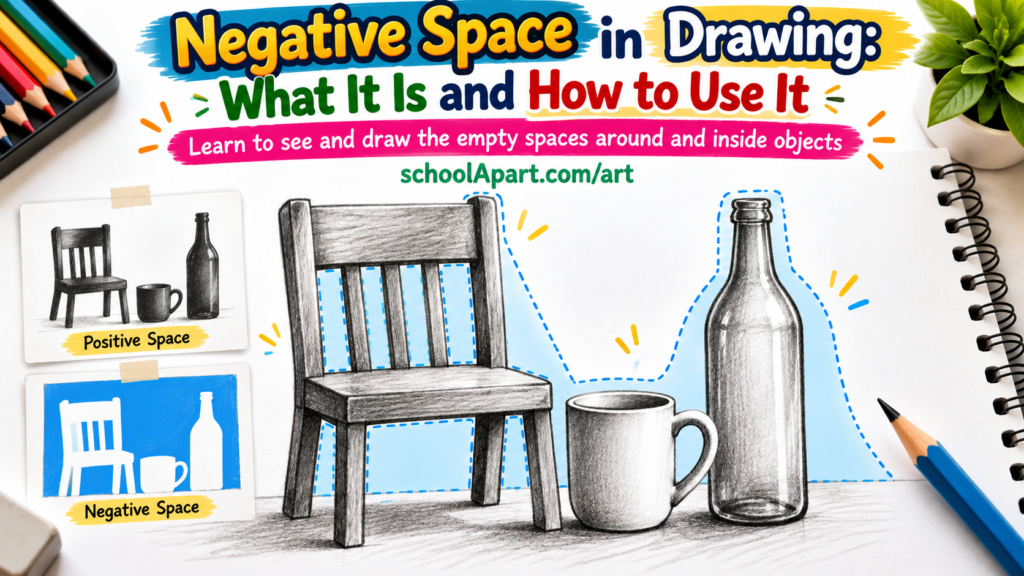
The actual object or subject is called positive space, while the area surrounding or separating it is called negative space.
For example, if you draw a cup on a table, the cup is the positive space. The areas around the cup, including the space between the handle and the cup, are negative spaces.
Learning to see and use negative space can help beginners create drawings that look more accurate and balanced.
🎨 Positive Space vs Negative Space
Understanding the difference is simple:
🟢 Positive Space
The area occupied by the subject or object.
Examples:
- A person
- A tree
- A cup
- A house
- An animal
🔵 Negative Space
The empty area around, between, or inside the subject.
Examples:
- The background around a tree
- The space between two objects
- The opening inside a handle
- The space between someone’s arm and body
Simple Example
Imagine drawing a chair.
🪑 Chair = Positive Space
⬜ Spaces between and around the chair = Negative Space
Both areas work together to create the complete drawing.
🔍 Why Is Negative Space Important in Drawing?
Negative space is more than just empty background. It can help you understand the shape and position of objects.
1. 🎯 Improves Drawing Accuracy
Instead of concentrating only on the object, you can also observe the shapes around it.
This can make it easier to notice when a line or proportion is incorrect.
2. 📏 Helps With Proportion
Negative spaces can act like visual measuring guides.
If the empty space around one part of an object looks too large or too small, your drawing may need adjustment.
3. 🧩 Makes Complex Objects Easier
Some objects can be difficult to draw directly.
Looking at the shapes of the empty spaces around them can make the overall structure easier to understand.
4. 🖼️ Improves Composition
Good use of negative space can prevent a drawing from feeling too crowded.
It helps create visual balance between the subject and its surroundings.
5. 👀 Trains Observation Skills
Negative-space drawing teaches you to look carefully instead of drawing what you think an object looks like.
This is especially useful for beginners.
✏️ How to See Negative Space
Beginners often ask:
“How do I find negative space in a drawing?”
Try this simple method.
Step 1: Choose an Object
Start with something simple such as:
- A cup
- A chair
- A pair of scissors
- A plant
- A bottle
Step 2: Ignore the Object for a Moment
Instead of asking:
“What shape is the object?”
Ask:
“What shapes do I see around the object?”
Step 3: Look for Empty Shapes
Look for:
- Triangles
- Squares
- Curved shapes
- Narrow spaces
- Open spaces
- Spaces between objects
Step 4: Draw the Empty Shapes
Try drawing the negative spaces first.
You may be surprised at how accurately the main object appears when those spaces are correct.
📝 Negative Space Drawing Exercise for Beginners
Here is a simple exercise you can practice at home.
Exercise 1: Draw Around a Simple Object
Choose a bottle, cup, or small box.
Place it in front of you.
Now focus on the empty space around it.
Practice:
- Observe the object carefully.
- Identify the empty spaces around it.
- Lightly sketch those spaces.
- Compare your drawing with the real object.
- Adjust the shapes if necessary.
- Add the object outline afterward.
This exercise helps you understand shapes without depending only on the object’s outline.
🪑 Exercise 2: Try a Chair
A chair is a great subject for practicing negative space.
Look at:
- The space between the legs
- The space below the seat
- The space between the backrest and seat
- The space around the chair
Instead of thinking:
“I need to draw a chair.”
Think:
“I need to draw these empty shapes correctly.”
This change in thinking can make drawing easier.
✋ Exercise 3: Negative Space Around a Hand
Hands can be challenging for beginners.
Instead of immediately drawing the fingers, observe the spaces:
- Between the fingers
- Around the thumb
- Between the hand and arm
- Around the outer edges of the hand
How to Draw Hands for Beginners: A Complete Step-by-Step Guide
Drawing these spaces can help you understand the position and proportions of the fingers.
🧩 Negative Space Inside Objects
Negative space does not always exist outside an object.
Some objects contain important empty areas inside their structure.
For example:
☕ Cup Handle
The opening inside a cup handle is negative space.
🔑 Scissors
The spaces between the handles and blades create interesting negative shapes.
🪑 Chair
The openings between the legs and frame are negative spaces.
🌳 Tree Branches
The spaces between branches and leaves can also form negative shapes.
These internal spaces are useful when drawing objects accurately.
🎨 Using Negative Space in Composition
Negative space is also important when creating a complete artwork.
Imagine drawing a large tree in the middle of a page.
If there is almost no empty space around it, the composition may feel crowded.
If the tree has enough surrounding space, the drawing may feel more balanced.
Negative space can help you decide:
- Where to place your subject
- How large the subject should be
- How much background to leave
- How objects relate to each other
- Where the viewer’s attention should go
📐 Negative Space and Proportion
Negative space and proportion are closely connected.
Suppose you are drawing two objects next to each other.
You may correctly draw the objects individually but still make the overall drawing look wrong because the space between them is incorrect.
For example:
Object A → Too much space → Object B
may look very different from:
Object A → Small space → Object B
Therefore, when checking your drawing, look at both:
Objects + Spaces Between Objects
This is one reason negative-space observation is useful for improving proportion.
✏️ Negative Space vs Outline Drawing
Negative-space drawing does not mean that you should stop using outlines.
Both approaches can work together.
Outline Drawing
You focus mainly on the edges of the object.
Negative Space Drawing
You focus on the shapes created around and between the object.
A beginner can use both methods:
Observe → Identify negative spaces → Draw basic shapes → Check proportions → Refine the outline
This creates a more reliable drawing process.
🚫 Common Negative Space Drawing Mistakes
❌ 1. Ignoring the Background
Beginners often focus only on the object.
Solution: Look at the spaces around it too.
❌ 2. Drawing What You Think You See
Your brain may recognize an object quickly and fill in details automatically.
Solution: Observe actual shapes instead of relying on memory.
❌ 3. Making Empty Spaces Too Large
Incorrect negative spaces can change the proportions of the entire drawing.
Solution: Compare the size and shape of each space.
❌ 4. Adding Details Too Early
Details cannot fix incorrect basic proportions.
Solution: Start with simple shapes and spaces.
❌ 5. Using Dark Lines Immediately
Heavy outlines can make corrections difficult.
Solution: Begin with light pencil lines.
🧠 A Simple Negative Space Practice Routine
You do not need complicated materials.
Use:
✏️ Pencil
📄 Drawing paper
👀 A simple everyday object
⏱️ 10–15 minutes
Daily Practice
5 minutes: Observe the object and identify negative spaces.
5 minutes: Draw the main negative shapes.
5 minutes: Compare your drawing with the real object and correct the proportions.
With regular practice, you can gradually become better at seeing relationships between objects and spaces.
🎯 Easy Negative Space Ideas for Beginners
Try these subjects:
- 🥤 A cup and bottle
- 🪑 A chair
- ✂️ A pair of scissors
- 🌿 A small plant
- 🧴 A bottle
- 👟 A shoe
- ✋ A hand
- 📚 Two books
- 🧸 A simple toy
- 🪟 A window
Start with simple objects before moving to more complicated subjects.
🌟 Tips to Improve Your Negative Space Drawing
👀 Look Before You Draw
Spend a few seconds observing the subject.
✏️ Start Light
Use light pencil marks so you can make corrections easily.
🔄 Compare Constantly
Look back and forth between the subject and your drawing.
📐 Check Relationships
Compare the width, height, distance, and angles of negative spaces.
🧩 Simplify
Break complicated spaces into simpler shapes.
🏃 Practice Regularly
Short, consistent practice is more useful than occasional long sessions.
🎨 Negative Space Drawing: A Simple Way to Think
A useful beginner mindset is:
Don’t just draw the object. Draw the shapes that make the object possible.
When you learn to see both positive and negative space, you begin to understand drawing as a relationship between shapes rather than simply copying outlines.
This can improve your observation, proportion, composition, and overall drawing accuracy.
🏁 Final Thoughts
Negative space is one of the most useful concepts beginners can learn in drawing.
It teaches you to pay attention not only to the subject but also to the empty areas around and inside it.
By practicing negative-space exercises with simple everyday objects, you can gradually improve:
- ✏️ Drawing accuracy
- 📏 Proportion
- 👀 Observation
- 🧩 Shape recognition
- 🖼️ Composition
You do not need expensive art supplies to practice. A pencil, some paper, and a simple object are enough to get started.
Start with one object today and try drawing its empty spaces before drawing the object itself.
❓ FAQ
1. What is negative space in drawing?
Negative space is the empty area around, between, or inside the subject of a drawing.
2. What is the difference between positive and negative space?
Positive space contains the main subject, while negative space is the empty area surrounding or separating the subject.
3. Why is negative space important in drawing?
It can help improve observation, proportion, accuracy, and composition.
4. Is negative space only the background?
No. Negative space can appear around objects, between objects, and even inside objects.
5. How do beginners practice negative space drawing?
Choose a simple object and focus on drawing the empty shapes around and inside it.
6. Can negative space help with proportion?
Yes. Comparing the size and shape of negative spaces can help you identify proportion problems.
7. Can I practice negative space with a pencil?
Yes. A pencil and paper are enough for basic negative-space exercises.
8. What objects are good for negative space practice?
Chairs, cups, bottles, scissors, shoes, plants, and simple household objects are good choices.
9. Is negative space used in composition?
Yes. Negative space can help create balance and improve the placement of subjects in a composition.
10. Can negative space help with drawing hands?
Yes. Observing the spaces between fingers and around the hand can make hand drawing easier.
11. Is negative space the same as background?
Not always. Background is a broader concept, while negative space specifically describes empty areas that interact with the subject.
12. Does negative space improve observation skills?
Yes. It encourages artists to study shapes and relationships instead of relying only on object recognition.
13. Should beginners draw negative space before the object?
It can be a useful exercise. Drawing the negative shapes first can help beginners understand proportions and structure.
14. Can negative space be inside an object?
Yes. The opening in a cup handle or the spaces between chair parts are examples of internal negative space.
15. Is negative space important for beginners?
Yes. It is a useful fundamental concept that can improve drawing accuracy and visual observation.

Leave a Reply