

Learn sketching for beginners with this complete guide. Discover what sketching is, the tools you need, basic techniques, practice exercises, common mistakes, and how to improve.
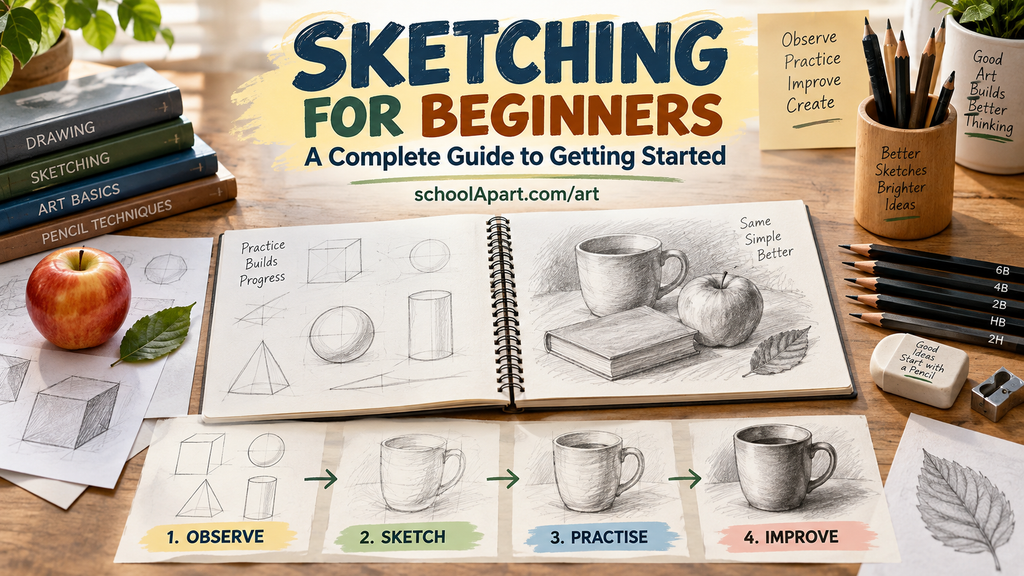
Sketching for Beginners: A Complete Guide to Getting Started
Sketching is one of the simplest and most enjoyable ways to begin learning art.
You do not need expensive materials, complicated techniques, or years of experience to start. A pencil, some paper, and a little time are enough to begin exploring lines, shapes, forms, and ideas.
A sketch does not have to be perfect.
In fact, sketching is often about exploring an idea, studying an object, understanding form, and practising observation rather than creating a finished artwork.
For beginners, sketching can also become a foundation for many other art skills. It can help you become more comfortable with pencil control, proportions, shapes, perspective, shading, and observation.
In this complete guide to sketching for beginners, you will learn what sketching is, how it differs from drawing, what supplies you need, how to start your first sketch, useful techniques, beginner exercises, common mistakes, and practical ways to improve your sketching skills.
What Is Sketching?
Sketching is the process of making a quick or exploratory visual representation of a subject, idea, object, person, place, or scene.
A sketch may be:
- Quick
- Loose
- Simple
- Detailed
- Rough
- Observational
- Creative
- Preparatory
There is no single style that every sketch must follow.
A sketch can take a few minutes or much longer depending on its purpose.
An artist may create a quick sketch to capture an idea, while another artist may spend hours developing a detailed pencil sketch.
The important difference is that sketching often emphasizes exploration and observation rather than perfection.
Sketching vs Drawing: Are They the Same?
Sketching and drawing are closely related, but they are not always used to mean exactly the same thing.
Drawing is a broad term for creating visual images using lines, shapes, values, marks, and other techniques.
Sketching often refers to a more exploratory, loose, or preliminary approach to drawing.
For example:
- A quick study of a tree can be a sketch.
- A rough character idea can be a sketch.
- A detailed pencil portrait can be called a drawing.
- A rough composition created before a painting can be called a sketch.
There is no strict boundary between the two.
For a more detailed comparison, see Sketching vs Drawing on SchoolApart.
Why Should Beginners Learn Sketching?
Sketching offers several benefits for people learning art.
1. It Improves Observation
When you sketch from real life, you learn to look carefully.
You begin noticing:
- Shape
- Size
- Direction
- Proportion
- Texture
- Light
- Shadow
- Position
This observation skill becomes useful across many forms of art.
2. It Improves Pencil Control
Regular sketching gives your hand more experience with different types of marks.
You can practise:
- Short lines
- Long lines
- Curved lines
- Light strokes
- Dark strokes
- Repeated strokes
- Crosshatching
Over time, your pencil movements can become more controlled.
3. It Helps You Understand Form
Sketching teaches you to think about the structure behind an object.
A mug may look like a simple object, but a sketch can help you understand:
- Opening
- Body
- Handle
- Thickness
- Perspective
- Shadow
This type of thinking is useful for more advanced drawing.
4. It Builds Confidence
Beginners often worry about making mistakes.
Sketching can reduce that pressure because a sketch does not have to be perfect.
You can experiment.
You can erase.
You can redraw.
You can try again.
5. It Helps You Develop Ideas
Artists often sketch ideas before creating a final artwork.
A sketch can help plan:
- Characters
- Landscapes
- Objects
- Compositions
- Illustrations
- Paintings
What Do You Need for Sketching?
You can start with very basic supplies.
Pencil
A regular graphite pencil is enough for your first sketches.
As you become more comfortable, you can explore different pencil grades.
For example:
- H pencils → harder and lighter
- HB → general-purpose
- B pencils → softer and darker
For a deeper explanation, see Pencil Grades Explained.
Paper
Almost any clean paper can work for practice.
For beginners, a sketchbook is convenient because it keeps your practice together.
You can use:
- Drawing paper
- Sketch paper
- Sketchbook paper
- Mixed-media paper
Choose paper based on the type of pencil work you want to do.
Eraser
An eraser is useful for:
- Correcting mistakes
- Cleaning construction lines
- Creating highlights
- Refining edges
But try not to depend on it for every small mistake.
Sharpener
A sharp pencil gives you better control for:
- Fine details
- Thin lines
- Small textures
A slightly duller point can be useful for softer shading.
Optional Tools
As you progress, you may also experiment with:
- Mechanical pencils
- Kneaded erasers
- Blending tools
- Pencil extenders
- Different sketchbooks
You do not need all of these when starting.
How to Start Sketching Step by Step
If you are completely new to sketching, follow this simple process.
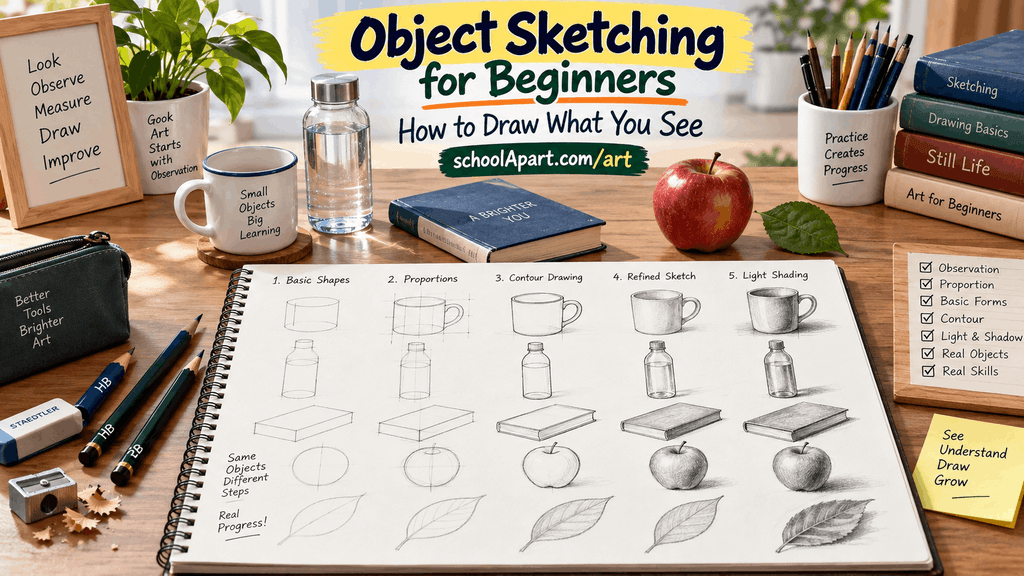
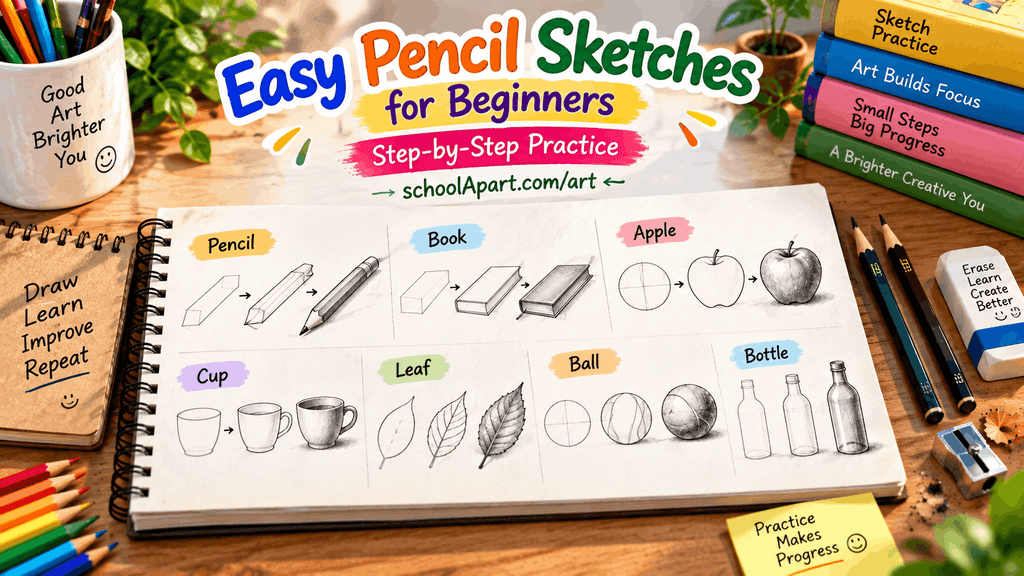
Step 1: Choose a Simple Subject
Start with something easy.
Good beginner subjects include:
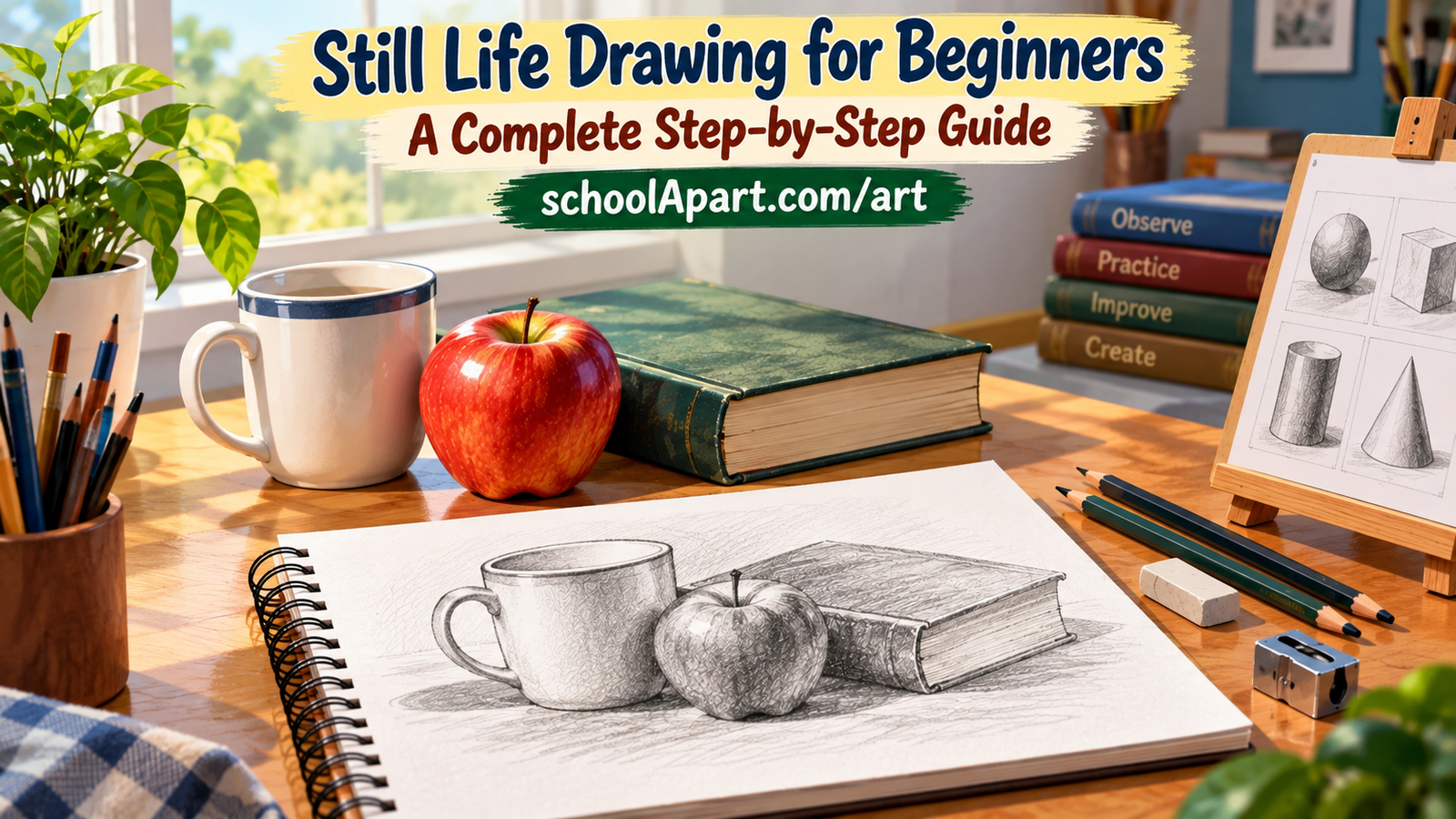
- Apple
- Cup
- Book
- Leaf
- Bottle
- Ball
- Shoe
- Simple plant
Avoid starting with a complicated scene.
Step 2: Observe Before Drawing
Look at the subject for a moment.
Ask:
- What is its overall shape?
- How tall is it?
- How wide is it?
- Where are the major parts?
- Which side is brighter?
- Where is the shadow?
Observation should happen before the first mark.
Step 3: Lightly Establish the Main Form
Begin with very light lines.
Think about:
- Basic shapes
- Overall height
- Overall width
- Position
- Angle
For example, a cup may begin with an oval and a simple cylindrical body.
Step 4: Add the Important Forms
Once the main structure is established, add smaller parts.
Do not worry about texture or tiny details yet.
Step 5: Check Proportion
Compare different parts of your sketch.
Ask:
- Is one part too large?
- Is the object too narrow?
- Is the top too high?
- Is the handle correctly positioned?
Correct major problems before adding detail.
Step 6: Develop the Outline
Now strengthen the important contours.
Not every line needs to be equally dark.
Some areas can remain lighter.
Step 7: Add Shading
Observe where the light comes from.
Then gradually build:
- Light areas
- Midtones
- Dark areas
- Cast shadows
For more practice, see Shading Techniques for Beginners and Light and Shadow in Drawing.
Step 8: Add Small Details
Only after the main structure and values are working should you add details.
Step 9: Step Back and Review
Look at the entire sketch.
Do not focus only on one small section.
Ask:
Does the whole drawing look balanced?
This is an important habit for improving.
Basic Sketching Techniques for Beginners
You do not need to master every technique immediately.
Start with a few simple ones.
1. Hatching
Hatching uses a series of parallel lines to create value.
Lines closer together usually create a darker appearance.
2. Cross-Hatching
Cross-hatching adds another set of lines crossing the first set.
This can create darker areas and richer textures.
3. Contour Lines
Contour lines follow the shape or direction of an object.
They can help communicate form.
4. Loose Sketching
Loose sketching uses relaxed, exploratory marks.
This is useful when you are trying to understand the overall structure before committing to a final line.
5. Gesture Lines
Gesture lines quickly describe movement, direction, or action.
They are especially useful when sketching people, animals, or moving subjects.
6. Construction Lines
Construction lines help establish:
- Shapes
- Proportion
- Perspective
- Position
They are usually light and may be erased later.
How to Sketch From Real Objects
One of the best ways to learn sketching is to draw things around you.
Choose a simple object.
For example:
A cup
Observe it.
Identify the main forms.
Draw them lightly.
Check the proportions.
Then add the handle, rim, shadow, and details.
You can repeat the same process with:
- Bottle
- Shoe
- Book
- Chair
- Plant
- Bag
- Spoon
- Phone
The more you practise observing real objects, the easier it becomes to sketch unfamiliar subjects.
How to Sketch From a Reference Image
Reference images can also be useful for beginners.
Choose a clear image with a simple subject.
Before drawing, identify:
- Main shapes
- Direction of lines
- Proportions
- Light source
- Darkest areas
- Important details
Do not try to copy every tiny detail immediately.
First understand the structure.
Sketching With Basic Shapes
Basic shapes are excellent construction tools for sketching.
You can begin with:
- Circles
- Ovals
- Squares
- Rectangles
- Triangles
Then gradually refine them.
For example:
Circle → head
Oval → body
Rectangle → book
Cylinder-like form → cup
Box → building
This makes sketching more approachable for beginners.
For a practical lesson, see How to Draw Using Basic Shapes.
Beginner Sketching Exercises
Exercise 1: Line Practice
Fill a page with:
- Straight lines
- Curved lines
- Short lines
- Long lines
- Light lines
- Dark lines
Try to keep your strokes controlled.
Exercise 2: Shape Practice
Draw:
- Circles
- Ovals
- Squares
- Rectangles
- Triangles
Then combine them into simple objects.
Exercise 3: Simple Object Sketching
Choose one object.
Sketch it in five minutes.
Do not focus on perfection.
Focus on:
- Shape
- Position
- Proportion
Exercise 4: Contour Practice
Choose a simple object and try to follow its outer contour slowly.
Pay attention to changes in direction.
Exercise 5: Light and Shadow
Choose a simple object such as a ball or cup.
Identify:
- Light side
- Shadow side
- Cast shadow
Try to reproduce those value differences.
Exercise 6: Timed Sketches
Set a timer.
Try:
- 2-minute sketch
- 5-minute sketch
- 10-minute sketch
The goal is to learn how much information you can capture in different amounts of time.
A 7-Day Sketching Practice Plan
Day 1 — Lines
Practise straight, curved, light, and dark lines.
Day 2 — Shapes
Practise circles, ovals, squares, rectangles, and triangles.
Day 3 — Simple Objects
Sketch a cup, book, fruit, and bottle.
Day 4 — Nature
Sketch a leaf, flower, tree, or simple landscape.
You can also practise with Step-by-Step Nature Drawing.
Day 5 — Animals or Cartoon Subjects
Create simple sketches using basic construction shapes.
Day 6 — Light and Shadow
Choose one object and focus mainly on value and shading.
Day 7 — Observation Sketch
Choose an object you have not sketched before.
Observe it carefully and create a complete sketch.
Common Sketching Mistakes Beginners Make
Trying to Make the First Line Perfect
The first line does not need to be perfect.
Sketching is exploratory.
Drawing Too Dark Too Early
Dark construction marks are difficult to correct.
Use lighter strokes at the beginning.
Focusing on Details Before Structure
A beautifully drawn eye cannot fix an incorrectly proportioned face.
Build the structure first.
Ignoring Negative Space
Pay attention not only to the object but also to the empty space around it.
This can help you judge proportions and placement.
Using Only One Pencil
You can learn with one pencil, but experimenting with different grades can help you understand value and line quality.
Drawing Without Looking at the Subject
If you are drawing from observation, spend more time looking at the subject.
Do not rely entirely on what you think an object should look like.
Erasing Too Much
Constantly erasing can interrupt the drawing process.
Try to understand why something looks wrong before correcting it.
How to Improve Your Sketching Skills
Practise Observation
Look carefully at the subject before and during the sketch.
Draw Regularly
Short, consistent practice can be more useful than occasional long sessions.
A daily routine of 10–20 minutes can be a good starting point.
See Daily Art Practice Routine for a structured approach.
Draw Different Subjects
Do not sketch only one type of object.
Try:
- Objects
- Plants
- Animals
- Buildings
- Landscapes
- People
- Everyday scenes
This develops adaptability.
Study Light and Shadow
Understanding light makes sketches more convincing.
Practise From Life
Drawing real objects helps develop observation skills.
Review Your Old Sketches
Keep your sketches.
After several weeks or months, compare older drawings with newer ones.
You may notice improvements that are difficult to see day by day.
How Long Does It Take to Learn Sketching?
There is no fixed amount of time required to learn sketching.
Your progress depends on:
- Practice frequency
- Observation
- Subject difficulty
- Drawing habits
- Feedback
- Patience
You can begin making simple sketches immediately.
Developing strong sketching skills takes longer.
The goal should not be to become perfect quickly.
The goal should be to improve gradually.
Should Beginners Copy Other Artists’ Sketches?
Studying other artists can help you understand:
- Line quality
- Composition
- Shading
- Technique
- Simplification
However, do not depend entirely on copying.
Also practise:
- Drawing from real objects
- Drawing from observation
- Creating your own subjects
This helps you develop independent skills.
Sketching and Other Art Skills
Sketching connects naturally with many areas of drawing.
Sketching + Basic Shapes
Helps with construction.
Sketching + Perspective
Helps with objects and environments.
Sketching + Shading
Helps create depth and form.
Sketching + Light and Shadow
Helps you understand value.
Sketching + Portrait Drawing
Helps with facial structure and proportion.
Sketching + Nature Drawing
Helps with observation of organic forms.
This makes sketching an important foundational skill within a broader art-learning journey.
A Simple Beginner Sketching Routine
If you have only 15 minutes a day, try this:
3 minutes
Line and shape warm-up.
5 minutes
Sketch one simple object.
5 minutes
Add basic shading or details.
2 minutes
Review your sketch.
Ask yourself:
What worked?
What should I improve next time?
This simple routine can become a sustainable daily habit.
Beginner Sketching Checklist
Before starting:
☐ Choose a simple subject
☐ Observe carefully
☐ Identify the main forms
☐ Establish proportions
☐ Draw lightly
During the sketch:
☐ Check proportions
☐ Refine major forms
☐ Observe light and shadow
☐ Add details gradually
After the sketch:
☐ Review the whole drawing
☐ Clean unnecessary lines
☐ Identify one thing to improve
☐ Keep the sketch for future comparison
Key Takeaways
Sketching is an accessible way to begin developing drawing skills.
Remember:
- Sketching does not have to be perfect.
- Observation is one of the most important skills.
- Start with simple subjects.
- Use basic shapes and construction lines.
- Establish proportion before details.
- Practise different line and shading techniques.
- Draw from real objects whenever possible.
- Keep your sketches and review your progress.
- Practise consistently rather than worrying about perfection.
The most important thing is to start sketching.
Your early sketches may not look the way you imagine.
That is completely normal.
Every sketch gives you another opportunity to observe, experiment, and improve.
Frequently Asked Questions
1. What is sketching?
Sketching is the process of creating a quick, loose, exploratory, or preparatory visual representation of a subject or idea.
2. Is sketching good for beginners?
Yes. Sketching is an excellent starting point because it helps beginners practise observation, pencil control, proportion, form, and shading.
3. What do I need to start sketching?
A pencil, paper or sketchbook, eraser, and sharpener are enough to begin.
4. Which pencil is best for beginner sketching?
An HB pencil is a practical starting point. Beginners can later experiment with harder and softer graphite grades.
5. Is sketching the same as drawing?
Sketching and drawing overlap, but sketching often has a looser, exploratory, or preliminary purpose.
6. How do I start sketching?
Choose a simple subject, observe it carefully, identify its main forms, sketch lightly, check proportions, and gradually add details and shading.
7. Can I learn sketching without artistic talent?
Yes. Sketching is a skill that can be developed through observation, practice, and experimentation.
8. How long should beginners practise sketching?
Even 10–20 minutes of regular practice can be a useful starting routine.
9. What should I sketch as a beginner?
Start with simple objects such as cups, books, fruits, bottles, leaves, plants, and other everyday objects.
10. How can I improve my sketching?
Practise regularly, draw from observation, study proportions and forms, experiment with shading, and review your previous sketches.
11. Should I sketch from real life or photographs?
Both can be useful. Drawing real objects helps develop observation skills, while reference images provide convenient practice subjects.
12. Should beginners use an eraser?
Yes, but an eraser should be used as a correction and drawing tool rather than relying on it to fix every mark.
13. What sketching techniques should beginners learn?
Beginners can start with hatching, cross-hatching, contour lines, construction lines, loose sketching, and basic gesture lines.
14. Can basic shapes help with sketching?
Yes. Circles, ovals, squares, rectangles, and other simple forms can help establish structure and proportion.
15. How long does it take to learn sketching?
There is no fixed timeline. Beginners can create simple sketches quickly, while developing strong sketching skills requires continued practice.
Learning sketching as a beginner does not require complicated equipment or advanced artistic talent.
A pencil, paper, observation, and regular practice are enough to get started.
Begin with simple subjects. Look carefully. Identify the main shapes. Build the structure with light lines. Check proportions. Gradually add form, shadow, and detail.
Over time, sketching can become much more than a beginner exercise. It can become a foundation for object drawing, perspective, portraiture, painting, illustration, and many other creative skills.
So take your pencil, choose something near you, and make your first sketch.
Do not wait for the perfect drawing. Start with a simple line.
Leave a Reply