
Learn how to ask AI questions for better answers. Discover simple prompting tips, examples, and techniques to get clearer explanations and improve learning.
How to Ask AI Questions for Better Answers: A Guide for Students
Have you ever asked an AI tool a question and received an answer that was too complicated, too short, or not quite what you wanted?
This can happen when your question is unclear or does not include enough information.
Artificial Intelligence (AI) tools can help students understand difficult topics, practise new skills, explore ideas, and organize their studies. But getting a useful answer often starts with asking a good question.
The instructions or questions you give an AI tool are commonly called prompts. A clear prompt helps the tool understand what you need and how you want the information explained.
In this guide, you will learn how to ask AI questions for better answers, explore practical examples, and discover simple techniques to improve your learning.
Why Is It Important to Ask Clear Questions?
Imagine asking your teacher:
“Tell me about plants.”
You may receive a very general explanation because the question does not explain what you want to know.
Now imagine asking:
“Explain how plants make their food through photosynthesis. Use simple English for a Class 6 student and give one everyday example.”
The second question is more specific. It tells the teacher what topic to explain, what level of language to use, and what kind of example you need.
The same idea applies when asking AI questions.
Clear questions can help you get:
- More relevant explanations
- Simpler answers for your class level
- Useful examples
- Step-by-step instructions
- Better practice questions
- Answers in a format that is easier to understand
However, a well-written question does not guarantee a correct answer. You should still check important information before using it.
8 Tips for Asking AI Better Questions
1. Ask a Clear and Specific Question
Avoid asking questions that are too broad or confusing.
For example:
Unclear question:
“Tell me about science.”
Better question:
“Explain the difference between living and non-living things in simple English for a Class 5 student. Give three examples of each.”
The second question clearly explains what you want to learn.
Try this: Before sending a question, ask yourself whether someone who has never seen your textbook would understand exactly what you need.
2. Mention Your Class or Learning Level
Different students need different explanations.
A topic explained to a Class 4 student may be very different from an explanation for a Class 10 student.
Tell AI your class, age-appropriate learning level, or how much you already know about the topic.
Example:
“Explain gravity for a Class 6 student. Use easy English and examples from everyday life.”
You can also write:
“Assume I am a beginner and explain this topic from the basics.”
This helps AI choose a more suitable level of explanation.
3. Explain Exactly What You Want to Know
Sometimes a topic has many parts. Instead of asking about everything at once, identify the specific part you want to understand.
General question:
“Explain electricity.”
More specific question:
“Explain the difference between conductors and insulators. Give five examples of each and explain why they are different.”
You can also ask separate questions about definitions, causes, functions, advantages, disadvantages, or examples.
Specific questions help keep the answer focused.
4. Tell AI How You Want the Answer
You can ask AI to present information in a particular format.
For example, you can request:
- A short paragraph
- A numbered list
- A comparison table
- Step-by-step instructions
- Simple definitions with examples
- Multiple-choice questions
- A short summary
Example prompt:
“Explain the three states of matter in a comparison table. Include their properties and two examples of each. Use simple English for a Class 6 student.”
When you choose a suitable format, the answer may become easier to read, compare, and remember.
5. Ask for Simple Examples
Examples connect new ideas with things you already know.
If an explanation seems difficult, ask AI to give an everyday example.
Example prompt:
“Explain evaporation in simple words and give three examples from everyday life.”
You can also request an analogy:
“Explain how the human heart works using a simple comparison with a water pump.”
Remember that an analogy is only a way to understand an idea. It may not describe every scientific detail exactly.
6. Ask for Step-by-Step Explanations
Some subjects are easier to understand when they are explained in smaller steps.
This is especially useful for mathematics, science, grammar, and problem-solving.
Example prompt:
“Explain how to calculate the area of a rectangle step by step. Show the formula, explain each step, and solve one simple example.”
For a maths problem, you can also say:
“Give me the first hint and let me try. Do not reveal the final answer immediately.”
This encourages you to think and solve problems independently instead of simply copying the result.
7. Ask Follow-Up Questions
You do not need to understand everything from one AI response.
If an explanation is confusing, ask another question to clarify it.
For example:
- “Can you explain that in simpler words?”
- “Can you give another example?”
- “Why does this happen?”
- “What is the difference between these two ideas?”
- “Can you explain the second step again?”
- “Can you give me a short practice quiz?”
Follow-up questions help you explore a topic more deeply.
Learning tip: Do not just keep asking AI to repeat the same answer. Explain which part you do not understand so it can focus on your difficulty.
8. Tell AI What You Already Know
If you already understand part of a topic, tell AI what you know and where you need help.
Example prompt:
“I understand that plants need sunlight, water, and carbon dioxide. But I do not understand how they make food. Explain only this part in simple English.”
This can make the conversation more focused and reduce unnecessary explanations.
A Simple Formula for Asking Better AI Questions
You can use this easy structure when writing a question for AI:
Topic + Learning Level + Specific Request + Answer Format
Let’s understand each part.
- Topic: What do you want to learn?
- Learning Level: Which class or level should the explanation suit?
- Specific Request: What exactly should AI explain or do?
- Answer Format: Do you want a paragraph, list, table, example, or step-by-step explanation?
Example
Instead of writing:
“Explain fractions.”
Use this:
“Explain fractions for a Class 5 student using simple English. Show how fractions work with three everyday examples and give me five practice questions in a numbered list.”
This structure is a useful starting point. You do not need to include all four parts in every question. Add the details that help AI understand your actual need.
10 Ready-to-Use AI Question Examples for Students
Here are some practical examples you can try with an AI tool.
1. For Understanding Science
“Explain the water cycle for a Class 6 student. Use simple English and describe the main stages with an everyday example.”
2. For Learning Mathematics
“Teach me how to solve simple fractions step by step. Start with an easy example and give me three practice questions.”
3. For Improving English
“Explain the difference between a noun and a verb in simple English. Give five examples of each and then test me with a short quiz.”
4. For Learning Vocabulary
“Teach me five useful English words for everyday conversation. Give their meanings, pronunciation guidance, and one example sentence for each.”
5. For Understanding History
“Explain the main causes of the French Revolution in simple English for a school student. Organize the explanation into short points.”
6. For Geography
“Explain why earthquakes happen. Use simple language and describe how tectonic plates are involved.”
7. For Preparing a Quiz
“Create 10 multiple-choice questions about the Solar System for a Class 5 student. Show the questions first and provide the answers separately.”
8. For Solving a Difficult Problem
“Help me understand this maths problem step by step. Give me one hint at a time and wait for me to try before showing the next step.”
9. For Writing Practice
“Give me five ideas for a school paragraph about keeping the environment clean. Do not write the paragraph for me. Help me organize my own ideas.”
10. For Revising a Lesson
“Help me revise the topic of photosynthesis. Ask me one question at a time, check my answer, and explain any mistakes in simple English.”
You can change the class level, subject, topic, and format to suit your learning needs.
What Should You Do If AI Gives an Unhelpful Answer?
Even after asking a clear question, you may not always receive the answer you want.
Instead of starting again immediately, try these steps:
Step 1: Identify the problem. Is the answer too long, too difficult, too general, or incomplete?
Step 2: Give clearer instructions. Tell AI what you want changed.
Step 3: Ask a follow-up question. Request a simpler explanation, another example, or a different format.
Step 4: Check the information. Compare important facts with your textbook or reliable educational sources.
For example, if AI gives you a difficult explanation, try:
“Your explanation is too complicated for me. Please explain the same idea using shorter sentences and one everyday example.”
If you receive an incorrect or confusing answer, do not assume that asking the question again will automatically fix it.
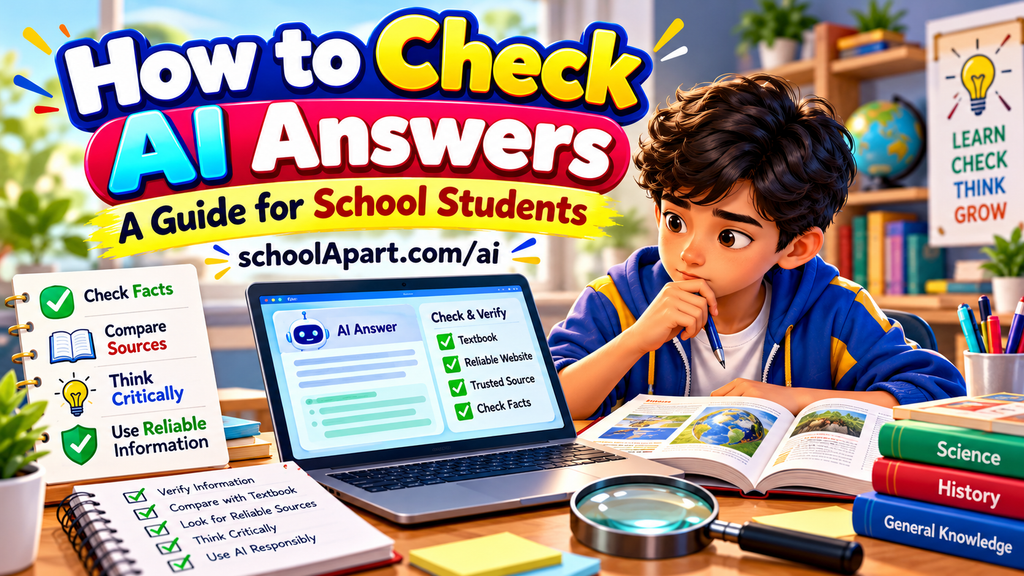
Read our guide on How to Check AI Answers to learn how to verify AI-generated information.
Common Mistakes to Avoid When Asking AI Questions
Students can get less useful answers when they make these common mistakes.
Asking Questions That Are Too Broad
A question such as “Tell me everything about history” does not identify what you actually want to learn.
Better approach: Ask about one topic or question at a time.
Giving Too Little Information
If you do not mention your learning level or the type of explanation you need, AI may provide an answer that is too advanced or too general.
Better approach: Add your class level and explain what you need.
Asking Several Unrelated Questions at Once
Combining many unrelated subjects in one prompt can make the response difficult to follow.
Better approach: Separate unrelated questions into smaller conversations or clearly numbered requests.
Copying AI Answers Without Understanding Them
A good answer is not useful if you cannot explain what it means.
Better approach: Read the answer, ask follow-up questions, and explain the idea in your own words.
Assuming a Clear Prompt Guarantees a Correct Answer
Even a well-written prompt can produce incorrect or misleading information.
Better approach: Verify important facts and calculations using reliable sources.
How Asking Better Questions Helps You Become a Better Learner
Learning how to ask good questions is useful beyond AI.
It helps you:
- Think more clearly about what you want to learn
- Identify gaps in your understanding
- Break difficult topics into smaller questions
- Communicate ideas more effectively
- Develop curiosity and problem-solving skills
- Become a more independent learner
The real goal is not to ask AI hundreds of questions. It is to ask meaningful questions that help you understand something better.
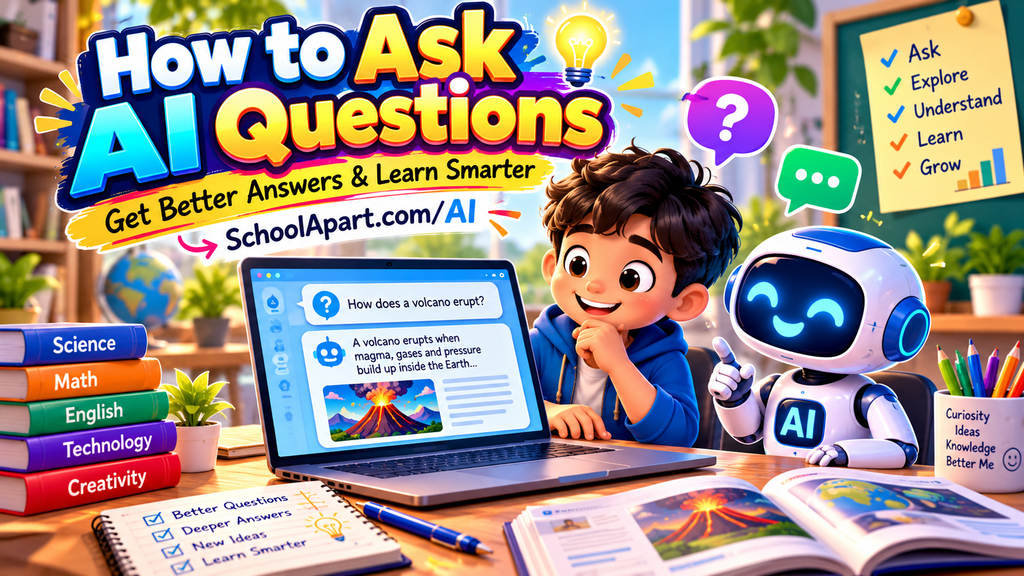
Asking clear and specific questions is one of the most useful skills students can develop when working with AI.
Mention your topic and learning level, explain what you need, choose a suitable answer format, and ask follow-up questions when necessary.
Most importantly, use AI responses as learning support. Think independently, practise what you learn, and check important information before trusting it.
Remember: Better questions can lead to better learning—but your own thinking makes the learning meaningful.
Explore our AI Learning Hub for more student-friendly guides on understanding AI, using it for learning, developing AI skills, and using AI responsibly.
Frequently Asked Questions (FAQ)
1. How can students ask AI better questions?
Students can ask better questions by clearly explaining the topic, mentioning their class or learning level, specifying what they want to know, and choosing a suitable answer format.
2. What is the best way to ask AI a question?
A useful approach is to mention the topic, learning level, specific request, and preferred answer format. For example, ask AI to explain a science topic for a particular class using simple English and everyday examples.
3. Why do AI tools sometimes give confusing answers?
AI may give confusing answers when a question is too broad, unclear, or missing important details. Sometimes the tool may also misunderstand the request or provide an explanation that is too advanced.
4. Should students mention their class level when asking AI questions?
Yes. Mentioning a class or learning level helps AI choose more suitable language, examples, and explanations. Students should still check that the information is accurate.
5. Can students ask AI to explain something in simple words?
Yes. Students can request simple language, shorter sentences, everyday examples, or step-by-step explanations to make difficult topics easier to understand.
6. What should students do if AI does not understand their question?
They should rewrite the question with clearer instructions, add relevant details, explain what they actually need, or ask a follow-up question.
7. Are clear AI questions always answered correctly?
No. A clear question can help produce a more relevant response, but it does not guarantee accuracy. Students should verify important facts, calculations, and explanations with reliable sources.
8. What is the difference between asking AI questions and writing AI prompts?
Asking AI questions is the broader activity of communicating what you want to know or do. An AI prompt is the instruction or input given to an AI tool, which can be a question, a task, or a set of detailed instructions.
9. Can asking better AI questions improve learning?
Yes. Clear questions can help students understand topics, explore examples, practise skills, and identify gaps in their knowledge. However, students should actively think, practise, and apply what they learn.
10. Should students copy AI answers into their homework?
Students should follow their school’s rules and use AI to support their understanding. They should not present AI-generated work as their own when this is not allowed. Learning and explaining ideas in their own words are more important than simply copying answers.


Leave a Reply