
Learn pattern drawing for beginners with easy shapes, lines, repeated designs, simple examples, and step-by-step practice ideas for students.
Pattern Drawing for Beginners: Easy Step-by-Step Guide
Pattern drawing is a fun and creative way to make art by repeating lines, shapes, dots, and other simple elements. You do not need advanced drawing skills to get started. With a pencil, paper, ruler, and a little practice, you can create attractive patterns for school art activities, notebook decoration, and personal art projects.
In this beginner-friendly guide, you will learn what pattern drawing is, explore different types of patterns, and follow simple steps to create your own designs.
What Is Pattern Drawing?
Pattern drawing is an art technique in which lines, shapes, dots, symbols, or other visual elements are repeated in an organised way to create a design.
For example, drawing a row of circles followed by another row of circles creates a simple repeated pattern. Alternating triangles and squares can produce a geometric pattern. Repeating curved lines or small leaves can create a decorative pattern.
Patterns can be regular and symmetrical, or they can be more free-flowing and creative. The main idea is to repeat or arrange visual elements to make a design.
Why Is Pattern Drawing Useful for Students?
Pattern drawing is a useful activity for school students because it encourages creativity and careful observation.
Some benefits include:
- Improves observation: Students learn to notice shapes, spacing, repetition, and visual details.
- Develops hand control: Repeating lines and shapes helps practise pencil control.
- Encourages creativity: Simple elements can be arranged in many different ways.
- Builds concentration: Completing a pattern requires attention and patience.
- Supports school art projects: Patterns can be used in borders, greeting cards, posters, bookmarks, and decorative artwork.
You do not have to make every line perfect. Regular practice and experimentation are more important than perfection.
Materials Needed for Pattern Drawing
You can start with a few basic materials:
- Drawing paper or a notebook
- Pencil
- Eraser
- Ruler
- Black pen or fine-tip marker
- Colour pencils, crayons, or markers, if you want to add colour
Beginners should start with a pencil so that mistakes can be corrected easily. Once you are happy with a design, you can outline it with a pen or colour it.
Different Types of Pattern Drawing
There are many ways to create patterns. Start with simple designs before trying more detailed ones.
1. Geometric Patterns
Geometric patterns use shapes such as circles, squares, triangles, rectangles, and diamonds.
For example, you can repeat squares in rows or alternate circles and triangles. A ruler helps when you want straight edges and evenly spaced shapes.
Beginner activity: Draw five squares in a row. Add a small circle inside each square. Then change the position of the circle in every second square to create variation.
2. Line Patterns
Line patterns are made by repeating straight, curved, wavy, diagonal, or zigzag lines.
You can draw parallel lines, alternate thick and thin lines, or combine curves with straight lines.
Beginner activity: Draw a rectangle and fill it with evenly spaced diagonal lines. In the next rectangle, draw diagonal lines in the opposite direction to make a criss-cross pattern.
3. Dot Patterns
Dot patterns use dots arranged in rows, circles, grids, or other shapes.
The dots can be the same size or different sizes. You can also connect selected dots with lines to create more complex designs.
Beginner activity: Make a grid of dots. Draw a small circle around every second dot, or connect the dots in alternating directions.
4. Repeating Shape Patterns
A repeating pattern uses a sequence of elements that appears again and again.
For example:
- Circle, square, circle, square
- Triangle, triangle, circle, triangle, triangle, circle
- Small leaf, large leaf, small leaf, large leaf
The sequence can be simple or complex. Once you understand the sequence, you can repeat it across the page.
Beginner activity: Create a border using a repeating sequence of three shapes. Keep the order the same throughout the border.
5. Organic and Nature-Inspired Patterns
Organic patterns are inspired by natural forms such as leaves, flowers, waves, shells, branches, and stones.
Unlike geometric patterns, these designs often use irregular or curved shapes.
Beginner activity: Draw a simple leaf shape several times. Rotate each leaf slightly and arrange the leaves in a circle or along a curved line.
6. Symmetrical Patterns
A symmetrical pattern has two or more parts that correspond to each other in a balanced arrangement.
One easy method is to draw a vertical line down the centre of the paper and create similar shapes on both sides.
Beginner activity: Draw half of a simple design on one side of a centre line. Try to repeat the same shapes and positions on the other side.
Symmetry does not have to be perfect when you are practising. Focus on making both sides look balanced.
How to Make a Pattern Drawing Step by Step
Follow these steps to create your first pattern drawing.
Step 1: Choose a Simple Element
Start with one basic element, such as a circle, triangle, leaf, dot, wave, or straight line.
Using one simple element makes the first exercise easier.
Step 2: Decide How to Repeat It
Choose whether you want to repeat the element in a row, grid, circle, border, or free-flowing arrangement.
For example, you could repeat circles horizontally or arrange triangles around a central point.
Step 3: Make Light Guidelines
Use a pencil and ruler to draw light guidelines if you need help keeping the shapes evenly spaced.
Guidelines are especially useful for geometric patterns and symmetrical designs. You can erase them later.
Step 4: Draw the First Sequence
Draw your chosen element several times. Keep the size and spacing reasonably consistent if you want a regular pattern.
For an alternating pattern, decide on the sequence before you start. This helps prevent accidental changes.
Step 5: Repeat the Sequence
Continue the same sequence across the paper. Check that you have not missed an element or changed the order unintentionally.
You can repeat the pattern in a straight line, around a border, or across the whole page.
Step 6: Add Variation
Once you understand the basic sequence, introduce small changes. You might alternate large and small shapes, use different line directions, or add dots inside selected shapes.
Avoid adding too many details at once. A clear pattern can be more effective than an overcrowded one.
Step 7: Outline and Colour
When you are satisfied with your drawing, outline the important shapes with a black pen or fine-tip marker.
Add colour if you want. You can use alternating colours, a single colour family, or a simple light-and-dark combination.
Colour is optional. A black-and-white pattern can also look attractive.
Easy Pattern Drawing Ideas for Beginners
If you are unsure what to draw, try one of these beginner-friendly ideas.
1. Simple Geometric Grid
Draw a grid of squares and fill each square with a different combination of lines, dots, or small circles.
2. Repeating Circle Pattern
Draw circles in rows. Add dots, smaller circles, or short lines inside them to create variations.
3. Zigzag Border
Draw a long rectangular border and fill it with a continuous zigzag line. Add small dots or triangles in the empty spaces.
4. Leaf Pattern
Draw simple leaves along a curved stem. Repeat the design to create a decorative border.
5. Alternating Triangle Pattern
Draw a row of triangles pointing upward, followed by another row pointing downward. Use alternating colours if you want.
6. Wavy Line Pattern
Draw several parallel wavy lines. Add small dots or short strokes between them without making the design too crowded.
7. Mandala-Inspired Circular Pattern
Draw a small circle in the centre of the page. Add rings around it and repeat simple shapes, dots, and lines in each ring.
Keep the design simple at first. You do not need to create a detailed or perfectly symmetrical mandala.
8. Checkerboard Pattern
Draw a grid of equal squares. Shade alternate squares or fill them with different simple designs.
9. Nature-Inspired Border
Repeat small flowers, leaves, or curved stems along the edge of the page. This works well for handmade cards and school project borders.
10. Mixed-Shape Pattern
Combine circles, triangles, squares, and short lines in a repeating sequence. Try to make the sequence easy to recognise.
Common Pattern Drawing Mistakes to Avoid
Beginners sometimes make a few common mistakes when creating patterns.
Changing the Sequence Accidentally
If you are making a repeating pattern, changing the order halfway through can make the design look inconsistent.
How to improve: Write or sketch the sequence first, then repeat it carefully.
Leaving Uneven Spacing
Large gaps in one area and crowded shapes in another can make a regular pattern look unbalanced.
How to improve: Use light guidelines or count the spaces between elements.
Adding Too Many Details
Too many lines, dots, shapes, and colours can make a design difficult to follow.
How to improve: Start with one or two elements. Add more only when the main pattern is clear.
Pressing Too Hard with the Pencil
Dark pencil marks are difficult to erase if you need to change the design.
How to improve: Draw lightly at first and darken the final lines later.
Trying to Make Every Element Perfect
Small differences in hand-drawn shapes are normal. Spending too much time correcting every detail can make practice frustrating.
How to improve: Aim for a clear and balanced design rather than absolute perfection.
Using Colour Before Planning the Design
Colouring too early can distract you from the arrangement and repetition of the shapes.
How to improve: Complete the pencil drawing first, check the sequence, and then add colour if needed.
How to Practise Pattern Drawing
You can improve your pattern drawing skills with a short, regular practice routine.
Try this simple 15-minute activity:
- Minutes 1–3: Draw basic lines, circles, triangles, and squares.
- Minutes 4–7: Create one repeating pattern using a single element.
- Minutes 8–11: Try an alternating pattern using two or three elements.
- Minutes 12–15: Create your own small design and add colour if you wish.
Keep your practice drawings in a notebook. After several days, compare your work and notice how your spacing, control, and creativity improve.
You can also challenge yourself by creating a new pattern every day. Start with simple lines and shapes, then gradually try more detailed designs.
Pattern Drawing for School Projects
Pattern drawing can be used in many school activities. For example, students can create decorative borders for project files, design bookmarks, decorate greeting cards, or fill a poster background with geometric shapes.
Before starting a school project, check the instructions and choose a pattern that suits the topic. Keep important text and diagrams clear if the pattern is used as a background.
For a neat result, use a limited number of shapes and colours. A simple, well-planned pattern often works better than a design with too many competing details.
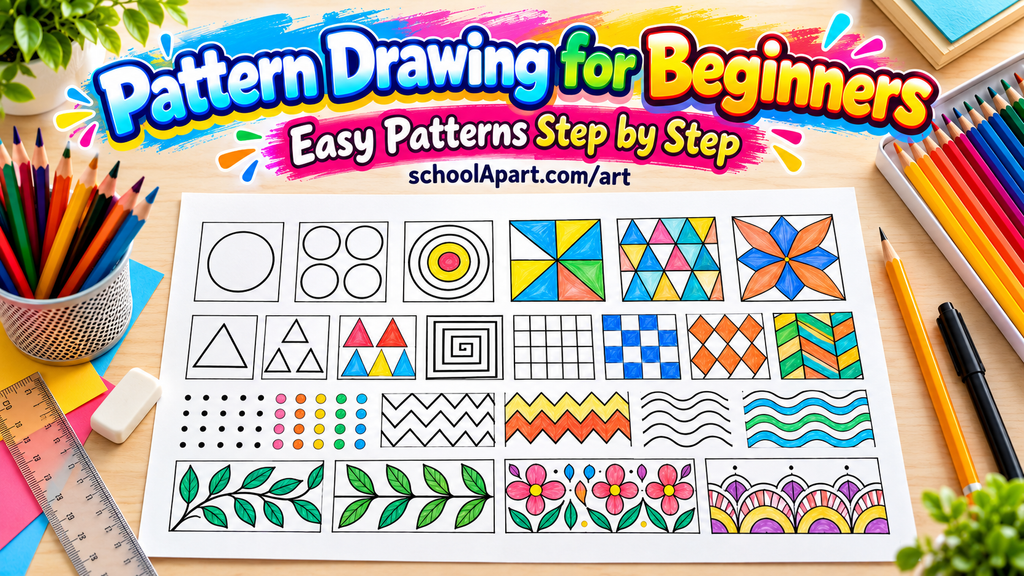
Pattern drawing is an easy way for beginners to explore creativity through repeated lines, shapes, and designs. You can begin with circles, dots, geometric shapes, or simple waves and gradually experiment with more complex arrangements.
Practise a little every day, keep your designs simple at first, and try different combinations of elements. With time, you will discover your own patterns and develop a more confident approach to drawing.
Frequently Asked Questions About Pattern Drawing
What is pattern drawing?
Pattern drawing is the process of creating designs by repeating or arranging lines, shapes, dots, symbols, or other visual elements.
How do beginners start pattern drawing?
Start with simple elements such as circles, straight lines, triangles, or dots. Repeat one element in a row or grid, then experiment with alternating shapes and different arrangements.
What materials are needed for pattern drawing?
You usually need paper, a pencil, an eraser, and optionally a ruler, black pen, and colouring materials.
What are the easiest patterns to draw?
Simple line patterns, dot patterns, repeated circles, geometric grids, zigzag borders, and alternating triangles are good choices for beginners.
Is pattern drawing useful for school students?
Yes. It provides practice in observation, hand control, concentration, repetition, and creative design. Students can also use patterns in school art projects and decorative work.
Can I make pattern drawings without a ruler?
Yes. Many organic, wavy, and free-flowing patterns can be drawn without a ruler. A ruler is helpful when you want straight lines, grids, or evenly spaced geometric shapes.
Do pattern drawings need colour?
No. Pattern drawings can look effective in pencil or black ink alone. Colour is optional and can be added to highlight repetition or create contrast.
How can I make my pattern drawing look neat?
Plan the sequence, use light guidelines when needed, keep spacing reasonably consistent, and avoid adding too many details. Outline the design after checking the overall arrangement.
Leave a Reply